

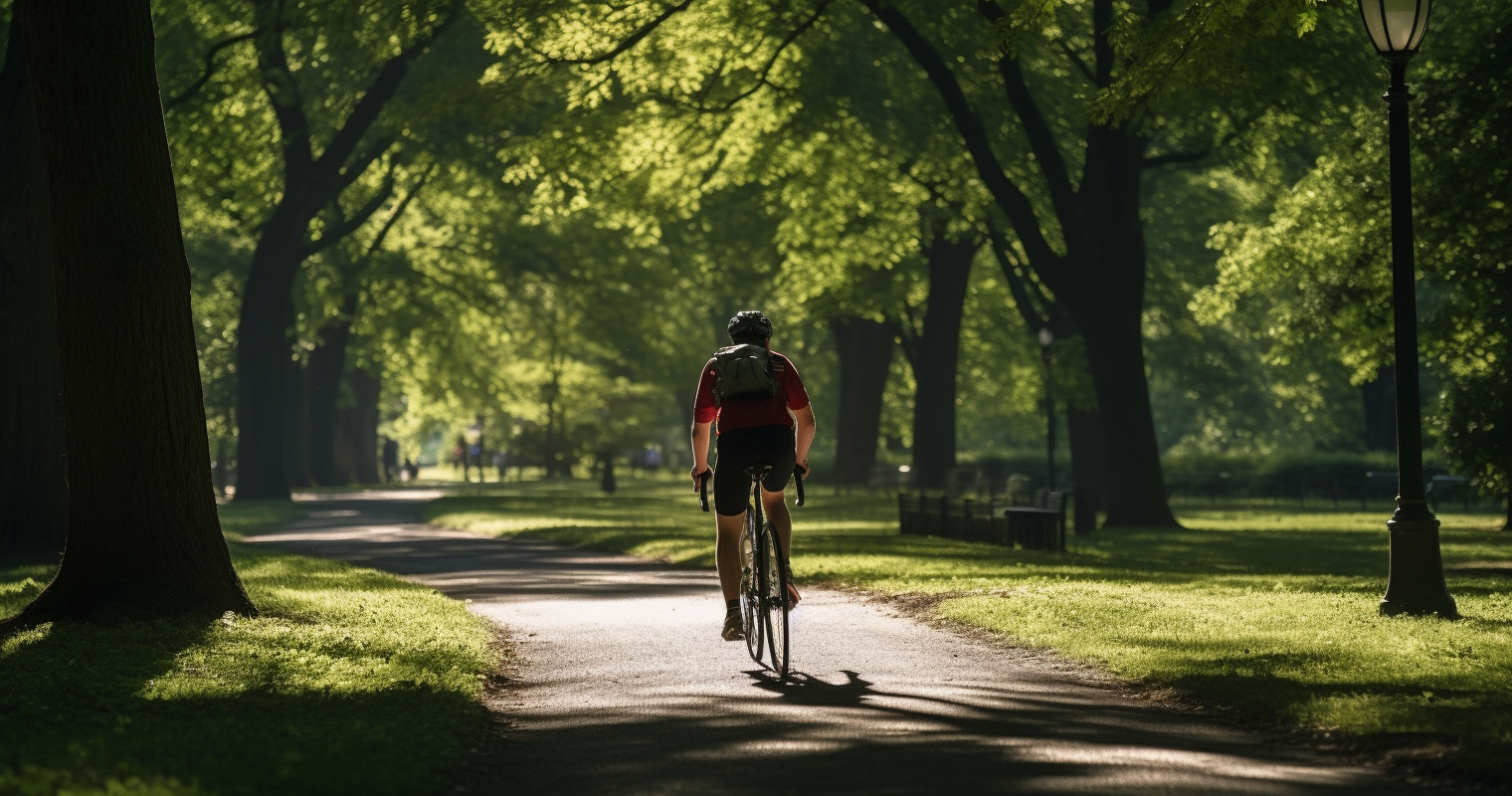
No country on earth embraces cycling quite like the Netherlands. The bicycle is not merely a form of transport here — it is a cornerstone of daily existence, used for getting to work, taking children to school, running errands, and unwinding on weekends. With more than 35,000 km of dedicated cycle paths physically separated from motor traffic, robust legal protections in place for those on two wheels, and a deep-rooted cultural expectation that cycling is simply how people move around, newcomers will find that the bicycle becomes a genuinely useful tool from the very first day they arrive.
| Item | Details |
|---|---|
| Dedicated cycle path network | Over 35,000 km of segregated cycle tracks; total cycling network 153,000 km (as of 2023) |
| Cycling modal share | 27% of all trips nationwide; up to 46% in cities like Zwolle |
| Helmet law | No legal requirement for standard bicycles (as of 2025); mandatory for under-18s from 2027 |
| Alcohol limit for cyclists | Blood alcohol content must not exceed 0.5 promille |
| OV-fiets rental cost | €4.55 per 24 hours (as of November 2024) |
| Bike registration | Not mandatory; voluntary registration recommended to deter theft |
How popular is cycling in the Netherlands — is it a common way to get around?
The bicycle ranks as the second most common means of transport in the Netherlands, with 36% of Dutch residents identifying it as their primary mode of travel on a typical day — behind the car at 45% but well ahead of public transport at 11%. This is no recreational niche or weekend hobby; it is interwoven into the texture of ordinary life at a level that few other nations come close to matching.
Cycling accounts for 27% of all journeys taken across the country, urban and rural combined. In cities the proportion climbs higher still — Amsterdam records a cycling share of 38%, while Zwolle reaches an remarkable 46%. For context, cycling rarely exceeds 15% of daily trips in most European cities, and in many parts of the world it remains primarily a sporting or leisure activity rather than a default travel choice.
Dutch residents completed an extraordinary 4.8 billion bike journeys in a single recent year, collectively covering 18.2 billion kilometres — roughly 3 kilometres per person per day. One quarter of all journeys made in the country are by bicycle. The scale of this cycling culture genuinely catches most newcomers off guard.
There are an estimated 22.8 million bicycles in the Netherlands — more than the entire population. Riding a bike to work, to school, or on the nursery run is entirely unremarkable. The trend is also strengthening: commuting by bicycle grew by 57% between March 2024 and March 2025, driven by infrastructure improvements, increased e-bike adoption, and rising numbers of people returning to office-based work.
Beyond practical travel, cycling for pleasure is also deeply popular: 76% of Dutch people ride their bikes purely for enjoyment, generating almost 700 million leisure trips annually, and 35% of the population cycles recreationally at least once a week. Unlike many countries where bikes are associated with sport or weekend outings, here the bicycle is simply the most natural way to travel — for people of every age, in every season.
For shorter journeys, particularly those under five kilometres, the bicycle is increasingly supplanting public transport. Longer trips are being enabled by the growing popularity of e-bikes, which now account for 42% of all new bicycle sales in the Netherlands — firmly established as a mainstream product rather than a novelty.
What is the cycling infrastructure like in the Netherlands?
Approximately 35,000 km of cycle track has been physically separated from motor traffic — a figure equivalent to a quarter of the country’s entire 140,000 km road network. This level of investment in dedicated cycling infrastructure is virtually unparalleled anywhere in the world. To appreciate the scale, consider that Copenhagen — frequently held up as a European cycling benchmark — has around 385 km of dedicated cycle lanes.
The total cycling network, encompassing all paths and roads where cyclists are accommodated, stretches to 153,000 kilometres. The largest segment (43,000 km) runs through built-up areas between homes and buildings. According to the Fietsersbond (the Dutch Cyclists’ Union), the vast majority of cycle paths and roads are in excellent condition, with few obstacles to impede progress. The surface is most commonly asphalt concrete (58%) or paving stones (25%).
On many roads, one or two dedicated cycleways run alongside the main carriageway, either physically separated or marked as on-road lanes. Where such facilities exist, using them is a legal requirement — cyclists are not permitted to ride on the main road instead. This differs meaningfully from countries where cycle lanes are merely advisory and sharing space with motor traffic is routine.
Beyond dedicated infrastructure, a number of roads operate as shared spaces where bicycles hold priority over cars. These streets are often marked with signs reading “fietsstraat auto te gast” — signalling that motor vehicles are visitors and cyclists are the primary users. Dutch roundabout design is another telling example of cyclist-first thinking: around 60% of roundabouts in Dutch cities incorporate a physically separated circular cycle track, and in most urban areas cyclists have right of way, with drivers required to yield.
The Dutch Ministry of Infrastructure has set aside €18 million over three years specifically for cycling highway development, with ambitions to grow the cycling highway network from 750 km to 2,150 km by 2030. These are wide, comfortable, high-quality routes connecting both urban centres and rural areas.
Bicycle parking provision is equally impressive, particularly at city centres and railway stations. Every rail station in the country offers cycle parking, and most provide guarded facilities for a small charge. In 2019, Utrecht opened what was at the time the world’s largest multi-storey bicycle park, capable of housing 12,500 bikes. For current route maps and planned infrastructure updates, visit the Dutch Ministry of Infrastructure and Water Management (IenW) and the Fietsersbond.
Is cycling safe in the Netherlands?
The sheer volume of cycling in the Netherlands is made possible by infrastructure that keeps cyclists away from fast-moving motor traffic: dedicated cycle tracks, protected junctions, generous bicycle parking, and route design that makes cycling more direct than driving. Rather than placing cyclists alongside cars on busy roads, the system is designed so that the two rarely come into meaningful conflict.
Dutch motorists are generally highly alert to cyclists sharing the road environment — in part because the majority of drivers are also frequent cyclists themselves. The attitudes of drivers towards those on bicycles are markedly more considerate than in many other countries, where cyclists must fight hard even for basic road space.
Dutch law also provides strong civil protections for cyclists involved in collisions with motor vehicles. If a cyclist is at fault in an unintentional accident, the motorist’s insurer must still cover half the cyclist’s damages. Where the injured cyclist is under 14, the motorist’s insurer must pay full damages regardless of who caused the collision. This legal framework is considerably more protective of cyclists than the fault-based liability systems common in many other countries.
Helmets are not compulsory for cyclists in the Netherlands and are not a normal part of everyday cycling attire. They tend to be worn by young children and the relatively small community of road or mountain cyclists. The Fietsersbond reviewed the available evidence and concluded that, for ordinary low-speed urban cycling, a mandatory helmet law would actually harm overall public health — primarily by discouraging people from cycling at all. This stands in sharp contrast to countries such as Australia, where helmet laws apply universally.
From 2027, the Netherlands will require all cyclists under 18 to wear a helmet, regardless of bicycle type — a policy announced in late 2024 intended to reduce head injuries among younger riders. For the most current safety data and road injury statistics, the authoritative source is SWOV (Institute for Road Safety Research), the Netherlands’ leading road safety body.
What are the rules of the road for cyclists in the Netherlands?
Cycling in the Netherlands is governed by a clear and actively enforced set of rules. Anyone new to the country should take the time to understand these requirements before getting on a bike. The complete regulations are available from the Dutch Road Traffic Authority.
- Use the cycle path where one exists. On roads where adjacent bike paths or cycle tracks exist, the use of these facilities is compulsory — cycling on the main carriageway is not permitted.
- Lighting. You need a white or yellow light at the front and a red light at the back, both shining straight ahead or back and non-flashing. A red reflector at the back, white or yellow reflectors on the wheels or tyres, and yellow reflectors on your pedals are also required. Riding without working lights carries a fine of €75 (as of 2025).
- No helmet requirement (for adults). Wearing a helmet while cycling is not required under Dutch law when riding a traditional bicycle. From 2027, helmets will be mandatory for under-18s.
- Alcohol limit. It is not permitted to cycle in the Netherlands with a blood alcohol content higher than 0.5 promille, or when under the influence of drugs. If caught, fines start at €200.
- Mobile phones. Since 1 July 2019, it is illegal to use a mobile phone while cycling. The fine for holding a phone while cycling is €170 (as of 2025).
- No cycling on pavements. You are not allowed to cycle on sidewalks.
- Cycling two abreast is permitted. You are allowed to cycle two abreast but are expected to move to the side to make room for other traffic when necessary.
- Hand signals are required when turning. Before turning left or right, extend your arm horizontally to signal your direction. Failing to signal a turn carries a fine of €45.
- Speed pedelecs (fast e-bikes) are treated differently. When riding a speed pedelec — an electric bike with a maximum speed of 45 km/h — the rider must follow the road rules that apply to mopeds, not bicycles.
The fines listed above apply from 1 February 2025 and exclude a €9 administrative charge. Some local authorities impose additional restrictions — for example, limiting certain e-bike types on particular park paths or canal-side routes. Always check guidance from local authorities when moving to a new city.
Do I need to register my bike or have insurance to cycle in the Netherlands?
There is no compulsory registration system for standard bicycles in the Netherlands. That said, voluntary registration is strongly recommended and widely practised, serving as a meaningful deterrent against theft — which is a well-known and persistent problem, particularly in larger cities such as Amsterdam.
You can register your bicycle voluntarily through schemes such as Het Fietsdiefstalregister (the national bicycle theft register), which links a bicycle’s frame number to its registered owner. Keeping photographs of your bike along with a note of its serial number is equally advisable.
Neither e-bike riders nor regular cyclists are legally obliged to carry insurance in the Netherlands. However, taking out liability cover to protect both yourself and others in the event of an accident is widely recommended. Most residents either add cycling cover to their household contents insurance (inboedelverzekering) or purchase a separate fietsverzekering (bicycle insurance) policy. The ANWB — the Dutch motoring and touring association — offers members bicycle insurance alongside roadside assistance and a range of other benefits.
A typical bicycle insurance policy covers theft, accidental damage, and third-party liability. Premiums vary depending on the provider and the level of cover chosen; you can compare current options through the ANWB or an independent price comparison website. Given how frequently bikes are stolen across the Netherlands, comprehensive cover represents a sensible investment for anyone spending a significant sum on a bicycle.
Are there public bike-sharing or rental schemes in the Netherlands?
OV-fiets — literally “Public Transport bicycle” — is a nationwide bicycle hire scheme operated by Nederlandse Spoorwegen (NS, Dutch Railways). Close to 15,000 bikes are available for hire at more than 300 locations throughout the country, including train stations, bus and tram stops, city centres, and Park & Ride facilities. Arriving at a station by train and continuing your journey by hired bike is a smooth and well-established way to travel.
Membership of the OV-fiets scheme is free and comes automatically with any NS season ticket subscription. Bikes are accessed using a standard OV-Chipkaart, and a 24-hour hire period costs €4.55 as of November 2024. The scheme is tightly integrated with the broader public transport network, meaning someone who cycles to their local station can collect an OV-fiets at their destination station and carry on seamlessly. This level of integration surpasses comparable initiatives in most other European countries.
Swapfiets is a subscription-based bicycle service operating across several European countries. For a fixed monthly fee, subscribers receive a bike and have all maintenance and repairs taken care of. The service is especially popular among expats and students who want a dependable bicycle without the upfront purchase cost or the inconvenience of finding repair services. Visit the Swapfiets website for current monthly pricing.
Visitors and short-term residents will find traditional bike rental shops in every city and most towns. Hourly and daily hire is readily available in popular destinations including Amsterdam, Utrecht, Delft, and Haarlem. For current OV-fiets availability and pricing information, see the NS OV-fiets page.
Where can I buy or service a bike in the Netherlands?
The Dutch bicycle retail market is among the most developed in the world. Dedicated bike shops (fietsenwinkel or fietsenzaak) are found in virtually every town, selling everything from basic utility bikes to sophisticated e-bikes. National chains including Bike Totaal, Decathlon, and ANWB retail outlets operate across the country, complemented by a wealth of independent specialist dealers.
Reflecting the country’s long cycling heritage, the most prevalent bicycle type is the sturdy, upright utility bike — built for practicality and durability in everyday urban use rather than speed or performance. All bicycle styles are available, from road racing bikes to recumbents, but newcomers accustomed to cultures where cycling is primarily a sport may find the emphasis on comfortable, functional city bikes — including the classic omafiets, or “grandmother bike” — a pleasant change of perspective.
Second-hand bikes are abundant and represent a popular choice for students and newly arrived expats alike. The main platforms for finding them include Marktplaats (the Dutch equivalent of classified ad sites) and local Facebook groups. Exercise caution with any bike offered at a suspiciously low price — it is very likely stolen, and purchasing stolen goods carries legal consequences, including the possibility of having the bike confiscated. Always ask the seller for proof of ownership and cross-check the frame number against the theft register.
Bike repair services are widely available throughout the country, from quick puncture fixes to comprehensive overhauls. Most retail bike shops offer servicing alongside their sales operation, and independent repair workshops are plentiful in urban areas. EU consumer protection legislation applies to new bike purchases made in the Netherlands, entitling buyers to a minimum two-year statutory warranty. Retain your receipt and any purchase documentation. The Fietsersbond publishes periodic consumer guidance covering service quality standards.
Can I bring my bike when I move to the Netherlands, and are there any import rules?
Whether your bicycle can enter the Netherlands free of customs duty depends largely on where you are relocating from and your personal circumstances.
Moving from within the EU: If you are coming from another EU member state, no customs duties or import taxes apply to personal belongings, including bicycles. As a full EU member, the Netherlands falls within the single market’s free movement of goods provisions. No customs declaration is required for personal effects transferred between EU countries.
Moving from outside the EU: Those relocating from a non-EU country may be eligible to claim “transfer of residence” relief (verhuisboedelvrijstelling) on personal effects brought as part of a household move, which can include a bicycle. To qualify, you will generally need to have been resident outside the EU for at least 12 months and be establishing your primary home in the Netherlands. Qualifying personal effects are exempted from customs duties and VAT under this relief.
Specific conditions and documentation requirements apply — goods must be declared, and you will need to provide evidence of your previous residence and the nature of your move. Before shipping belongings, consult the Dutch Tax and Customs Authority (Belastingdienst) for current rules, thresholds, and how to apply. Regulations can be updated, and the official Belastingdienst website is the most reliable source of up-to-date guidance on transfer of residence relief.
Given the depth and competitiveness of the Dutch bicycle market, many expats find it more practical to sell their bike before leaving and purchase a new or second-hand replacement once they have arrived — particularly given the prevalence of the sturdy, flat-terrain-optimised city bike style that suits Dutch roads and infrastructure so well.
What are the best cycling routes or destinations in the Netherlands?
The Netherlands maintains a national network of long-distance signed cycling routes known as Langeafstand Fietsroutes (LF-routes), spanning approximately 3,300 kilometres and waymarked in both directions. Several of these routes form part of the international EuroVelo network, including EuroVelo 2, 4, 12, and 15.
Among the most celebrated long-distance routes for cycling visitors are the LF Maasroute (forming part of EuroVelo 19 – the Meuse Cycle Route) and the LF Kustroute (part of EuroVelo 12 – the North Sea Cycle Route). Both are well maintained, clearly signed, and well suited to extended cycling trips. The LF Kustroute traces the Dutch coastline from Cadzand-Bad in the far south to Bad Nieuweschans near the German border — a spectacular route for anyone wanting to discover the full sweep of the country.
The numbered-node cycle network was first introduced in the Netherlands in 1999, and by 2014 it covered the entire country. This system is progressively replacing the older LF-route signage with a more flexible node-to-node network that allows cyclists to construct custom routes of any length. Signposts at each node display the numbers of connecting nodes, making navigation straightforward even without a detailed map.
For expats settling in Dutch cities, Amsterdam offers iconic cycling along its canal-side paths; Utrecht’s busiest cycleway at Vredenburg carries around 32,000 cyclists on an average weekday, rivalling the most heavily used routes in Copenhagen; and Groningen, a vibrant student city, is consistently cited among the world’s most cycle-friendly urban environments. Beyond the cities, the polder landscapes and tulip fields of North Holland, the windmill routes around Kinderdijk, and the forested trails of the Veluwe region are all highly regarded for leisure riding.
For route planning, the ANWB cycling section, the Fietsersbond, and Netherlands Tourism (Holland.com) are excellent resources. Many expats also use the free RouteYou and Komoot platforms, both of which hold extensive Dutch cycling route databases.
Frequently asked questions about cycling in the Netherlands
Do I need to wear a helmet to cycle in the Netherlands?
No helmet is required by law for cyclists in the Netherlands. Among everyday riders, helmets are uncommon — they tend to be worn by young children and the relatively small community of road or mountain cyclists. From 2027, however, all cyclists under 18 will be required to wear a helmet, regardless of the type of bicycle. Adults are, of course, free to wear one at any time if they wish.
Is cycling a realistic option for commuting in the Netherlands?
Absolutely. Riding a bicycle to work, school, or the nursery is entirely ordinary in the Netherlands. Bicycles account for approximately 27% of all commuting trips, and the number of people cycling to work grew by 57% between March 2024 and March 2025, driven by expanding infrastructure, greater uptake of e-bikes, and increasing numbers returning to workplace-based employment. For the majority of people living in or near a city, cycling is often the fastest and most convenient way to commute.
How do I get a bike when I first arrive?
While you are finding your feet, the simplest approach is to rent through the OV-fiets scheme or subscribe to a service such as Swapfiets. Once you are ready to buy, second-hand bikes listed on Marktplaats or in local Facebook groups offer good value. New bikes are available from dedicated cycle shops throughout the country. Steer clear of any bike sold at an unusually low price on the street — these are almost certainly stolen property.
Is bike theft a serious problem in the Netherlands?
Yes — bicycle theft is a significant and well-documented issue, especially in major cities. Use a minimum of two locks (ideally a heavy D-lock or chain lock combined with a frame lock), and register your bicycle’s frame number with the national theft database at fietsdiefstalregister.nl. Taking out dedicated bicycle insurance is strongly advisable if you are spending a meaningful sum on a bike.
Can I take my bike on the train?
Full-sized bicycles may be taken on trains outside rush hours, provided you purchase a bike supplement ticket (Dagkaart Fiets), which is valid for unlimited train travel throughout the day. Folding bikes may generally be carried on trains free of charge and at any time. Check the NS website for up-to-date fares and any applicable restrictions.
Do I need insurance to ride a bicycle in the Netherlands?
There is no legal obligation for cyclists in the Netherlands to hold insurance. Nevertheless, liability cover is recommended to safeguard both yourself and others in the event of an accident. Many residents fold bicycle cover into their household contents insurance, or take out a standalone fietsverzekering. For anyone investing in a quality or expensive bicycle, comprehensive cover against theft and damage is particularly worthwhile.
Are e-bikes subject to different rules?
For a standard electric bicycle with a maximum assisted speed of 25 km/h, the ordinary rules for cyclists apply. A speed pedelec — capable of reaching 45 km/h — is treated as a moped under Dutch law, meaning its rider must observe moped regulations rather than cycling rules. Any electric bicycle that meets the applicable EU technical standards may be ridden without registration, insurance, or a helmet (outside the under-18 requirement from 2027). Exceed those standards, however, and the vehicle is reclassified as a moped.
What is the best way to learn the cycling rules before I arrive?
The Holland2Stay cycling guide, the Fietsersbond website, and the Dutch government’s road safety pages are all solid starting points. Once you are on the road, beginning on quieter residential streets and watching carefully how experienced local cyclists navigate junctions and roundabouts will accelerate your confidence considerably. Most of the rules feel natural quite quickly once you are cycling regularly.