
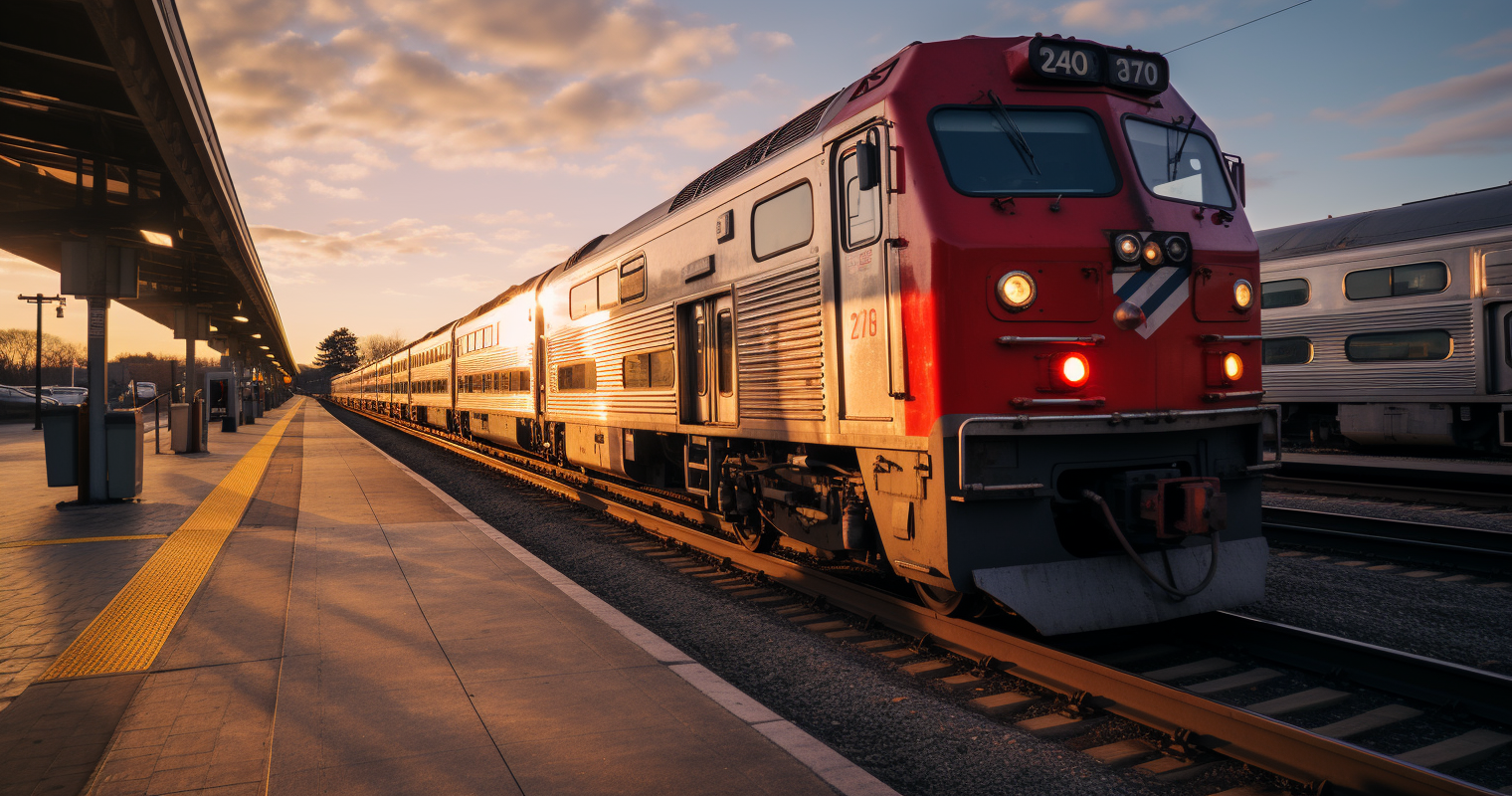
Denmark’s national rail network is extensive and well-maintained, operated chiefly by DSB (Danske Statsbaner) across roughly 2,600 km of track and handling upwards of 160 million passenger journeys annually. The system serves both everyday commuters and travellers making longer intercity trips, and is in the midst of a broad modernisation programme that includes new electric rolling stock and the expansion of urban metro and light rail infrastructure.
| Item | Details |
|---|---|
| National rail operator | DSB (Danske Statsbaner) — dsb.dk |
| Network size | Approx. 2,600 km; 162 million passenger journeys recorded in 2023 |
| Travel classes | DSB Standard (2nd class) and DSB1 (1st class) on most long-distance and regional services |
| Advance discount tickets | DSB Orange and DSB Orange Fri — available online and via the DSB app (as of 2025) |
| Travel card | Rejsekort smart card — valid across trains, metro, bus and light rail nationwide |
| S-train punctuality | Over 96% of S-train passengers arrived within 3 minutes of schedule in early 2024 |
| Disabled passenger discount | 50% off standard adult fare; disability pension holders get at least 25% off (as of 2024) |
| Journey planner | rejseplanen.dk — covers all modes of public transport |
What is the overall standard of rail travel in Denmark?
Denmark maintains a modern, largely electrified rail system operated jointly by DSB (Danish State Railways) and Banedanmark, which manages the underlying infrastructure. DSB is not only Denmark’s principal train operator but the largest rail company in Scandinavia by passenger numbers. As a state-owned enterprise, it recorded 162 million passenger journeys in 2023 across a network of 2,600 km.
Measured by passenger-kilometres per capita, Denmark ranks among the most intensively used rail nations in the European Union, with approximately 722 passenger-km per capita — considerably higher than countries such as Spain at 348 passenger-km per capita. In terms of day-to-day reliance on the network, Denmark is broadly comparable to the Netherlands or Switzerland, though it does not approach the sheer scale of Germany’s ICE high-speed services or Japan’s Shinkansen.
Punctuality performance has been notably strong: S-train services exceeded a 96% on-time rate in early 2024, based on the proportion of passengers reaching their destination within 2 minutes and 59 seconds of the scheduled arrival. Long-distance and regional services outperformed their target of 75% punctuality, reaching 81.3% in February 2024, though ongoing infrastructure programmes — covering electrification, new signalling systems, and track renewal — have at times introduced service disruptions.
While DSB dominates the national network, Arriva, Nordjyske Jernbaner, and Midtjyske Jernbaner also operate on selected routes in Jutland. Intercity services form the primary backbone of long-distance travel, linking Copenhagen via Odense to cities such as Aarhus and Aalborg on roughly hourly frequencies. The network is well adapted to both the daily commuter and the long-distance traveller seeking comfortable cross-country journeys.
Denmark is currently channelling significant investment into rail modernisation. DSB has committed to a substantial fleet replacement programme, with contracts totalling around EUR 3 billion awarded since 2020. The centrepiece of this effort is a framework agreement with Alstom for up to 150 IC5 Coradia Stream electric multiple units, valued at DKK 20 billion including 15 years of maintenance provision.
What classes of rail travel are available in Denmark, and what are the differences between them?
Danish train travel is divided into two distinct tiers: DSB1 (first class) and Standard (second class). This structure mirrors the class divisions common to many European national networks, such as those of Germany or the Netherlands, and gives passengers a meaningful choice based on budget and comfort preferences.
Among the most visible differences is seating layout: DSB1 carriages on older trains typically feature a 2+1 configuration, offering notably more personal space per passenger. Standard class provides comfortable seating in a 2+2 layout, with free Wi-Fi and power sockets fitted to nearly all trains. First class similarly provides Wi-Fi and power outlets, and depending on the train type, seating may be arranged in either a 2+2 or 2+1 configuration with more adjustable and generously sized seats.
Travelling in DSB1 often brings additional benefits such as complimentary cold drinks, coffee, tea, snacks, and newspapers. Air conditioning is standard in both classes, and while power sockets are available across the network, their prevalence can vary by train type. The main practical advantage of first class for many passengers is a noticeably less crowded environment, which makes it easier to find a seat and supports a quieter atmosphere — valuable for those working on the move or making longer journeys.
The price difference between the two classes is the most defining factor for most travellers, with first class typically costing around 50% more than the full Standard fare. For many regular passengers — particularly those commuting into Copenhagen, where trains can fill rapidly — the cost premium is considered worthwhile for the guaranteed space and calmer surroundings.
First-class carriages are identifiable by yellow stripes on the exterior and are generally located at either the front or rear of the train, though positioning can vary between services. Some local and regional trains — such as the MQ type used on the Odense–Svendborg line — offer only Standard class and do not include a first-class carriage. Copenhagen’s S-trains consist entirely of Standard-class carriages, equipped with air conditioning, Wi-Fi, step-free access, facilities for passengers with disabilities, and space for bicycles.
Where can you find rail timetables and ticket prices in Denmark?
The most thorough and reliable resource for journey planning across all forms of public transport in Denmark is Rejseplanen (rejseplanen.dk). The tool identifies the best travel option for any itinerary — including bus alternatives where these provide a faster or more practical route — and features an “Advanced options” section for filtering by specific transport modes.
For DSB timetables, fares, and ticket purchases specifically, the primary reference is DSB’s English-language website (dsb.dk/en). DSB provides downloadable timetables and an online tool for generating personalised journey schedules. Since fares and departure times can change, it is always advisable to confirm details directly on the DSB website before travelling.
Third-party booking platforms including Trainline and Omio list DSB routes and fares and can be particularly useful for comparing prices or arranging international trips. Regional services run by GoCollective (formerly Arriva) are covered at gocollective.dk. As a general rule, for national DSB routes book at dsb.dk, and for regional GoCollective routes use gocollective.dk.
Rail policy in Denmark falls under the Danish Ministry of Transport, which publishes relevant documentation at trm.dk. This site is primarily in Danish but serves as a useful source for official regulatory documents and infrastructure investment plans. Timetables and maps for the Copenhagen Metro are available at intl.m.dk.
How do you buy rail tickets in Denmark, and can you book in advance?
Rail tickets in Denmark can be purchased through several channels, from fully digital methods to physical machines and staffed counters at stations. For the majority of travellers, the DSB app or website will be the most practical choice — and these are the only channels through which discounted advance-purchase fares can be accessed.
- Via the DSB app or website: Download the DSB app or visit dsb.dk/en. With the DSB app, you can pay for transport throughout the country (except Bornholm) using a check-in function for buses, metro, train, and light rail — you need to create a user profile and activate location services, and can pay by MobilePay or card (Dankort, Visa, Mastercard). The app also allows you to buy DSB Orange discounted tickets and purchase seat reservations.
- At ticket machines at stations: Self-service ticket machines are available at all DSB stations and many local rail stations. These cover standard fares, Rejsekort top-ups, and seat reservations, and are available in multiple languages including English.
- At 7-Eleven outlets in stations: On almost every station there is a 7-Eleven, and most have a public PC and printer for train travellers — change the language to English, click “Buy Ticket”, and you can access tickets including the cheapest fares, paying by credit or debit card and printing on the spot.
- At manned ticket offices: Only a very small number of stations retain a traditional staffed ticket window. For complex bookings or assistance, DSB’s customer service can be reached by phone at +45 70 13 14 15, available every day from 7am to 8pm.
- Using a Rejsekort smart card: Use your Rejsekort for easy and convenient travel on DSB trains, with fares deducted automatically. Check in by tapping the card at a Blue Point reader at the start of your journey, and check out at the destination. This is the most cost-effective option for regular travellers.
- Via third-party platforms: Omio, Trainline, and similar services sell DSB tickets and are useful for multi-country or international journeys.
Seat reservations are optional rather than compulsory on most services, though they are well worth securing for peak-hour journeys on busier long-distance routes. DSB Orange tickets are drawn from a limited pool of discounted seats tied to a particular train and departure time — they must be bought in advance through the app or website and are unavailable at station windows or machines. Tickets may be used digitally on a smartphone or printed as a paper copy; conductors carry out on-board checks.
What types of rail tickets are available in Denmark, and are there discount schemes?
A wide variety of ticket formats is on offer in Denmark, catering to everything from occasional single trips to frequent multi-modal commuting. For long-distance journeys, two principal ticket categories are sold online: Orange (advance-purchase, discounted) tickets and Standard (fully flexible) tickets — noting that “Standard” also refers to second class on Danish trains, which can cause some initial confusion.
Orange tickets differ from Standard tickets primarily in price: the most deeply discounted Orange fares can be roughly three times cheaper than the full Standard price, though only a fixed allocation is released on each IC, Regional, and Lyn service. DSB Orange is bound to a specific train and departure time and cannot be altered after purchase. DSB Orange Fri is a newer, moderately more flexible variant that is equally tied to a specific departure but can be cancelled for a full refund up to 30 minutes before the train leaves — making it a practical middle ground for travellers seeking savings without accepting full inflexibility.
For residents commuting regularly, the Rejsekort smart card is the default choice. Rejsekort products are tailored to a broad range of passenger categories, including: adults, children (0–15), young people (16–25 or Youth Card holders), pensioners (65+ or early retirees), commuters, business users, passengers with disabilities, and accounts for dogs and bicycles. The personalised Rejsekort delivers the best bulk discounts but is restricted to a single named holder and cannot be shared, unlike the anonymous Rejsekort Flex variant.
Frequent travellers can also choose from period passes: DSB offers a 1-day pass (DSB 1′), a 7-day pass (DSB 7′), and a 30-day pass (DSB 30′), each providing unlimited journeys within a designated zone or region. Current pricing for all these products should be confirmed at dsb.dk or rejsekort.dk, as fares are revised periodically (as of 2025).
Several targeted discount arrangements are also in place for residents:
- Children: Two children under the age of 12 travel free of charge when accompanied by an adult with a valid ticket. Children aged 12–15 typically travel at around 50% of the adult fare.
- Seniors: Travellers aged 67 and over receive a variable discount depending on the length of the journey and the region. Rejsekort pensioner products (available to those aged 65+) also offer reduced fares.
- Disabled passengers and disability pension recipients: Using a Rejsekort for pensioners, recipients of disability pension can travel in all of Denmark and will always get at least 25% discount compared to a regular single-ride ticket, and at least 40% discount on travels across the Great Belt when travelling outside rush hours.
- Youth: Rejsekort Youth products (ages 16–25 or holders of a Youth Card) offer discounted fares across all modes. Check rejsekort.dk for current eligibility and pricing (as of 2025).
- Bikes: A separate bike ticket allows you to bring your bicycle on board DSB trains. Check the DSB website for the current fee, as prices change.
How accessible is the rail network in Denmark for disabled passengers?
DSB trains incorporate a range of features to support passengers with reduced mobility or additional needs. The quality of provision differs across the network, with newer rolling stock and larger stations generally offering a higher standard of accessibility than older train types or quieter rural stops.
The MF train series — deployed on InterCity Lyn and InterCity routes — provides air conditioning, low-floor boarding, wheelchair-accessible facilities, and power sockets across both first and second class. The ME double-deck series offers equivalent provisions, including air conditioning, low-floor entry points, and wheelchair-accessible spaces in both classes. Copenhagen’s S-train fleet similarly features step-free boarding areas and designated spaces for wheelchair users throughout.
Passengers with disabilities and their travelling companions can benefit from a 50% reduction on the standard adult fare. Those in receipt of a disability pension qualify for additional savings through DSB’s disability pension ID card scheme: cardholders travelling anywhere in Denmark are guaranteed at least a 25% reduction compared to a standard single-ride ticket, rising to at least 40% for travel across the Great Belt outside rush hours.
DSB operates a dedicated passenger assistance service for those requiring support at stations or during journeys. Assistance can be arranged in advance through DSB’s accessibility pages or by calling +45 70 13 14 15. Complete information about the assistance booking process, eligibility criteria, and how to apply for a disability pension ID card is available at dsb.dk/en.
The Copenhagen Metro is fully accessible at every station, with lifts to all platforms, tactile paving, audio announcements, and visual information displays throughout — a standard comparable to more recently built metro systems such as those in Amsterdam or Singapore. Passengers accustomed to older networks where accessibility can be patchy between stations — as is the case on parts of the London Underground or some continental systems — will find the Copenhagen Metro’s consistent provision notably inclusive. Accessibility-related enquiries for the Metro can be directed to intl.m.dk.
Are there metro or urban rail systems in Denmark’s cities?
Urban rail transport across Denmark currently comprises the Copenhagen Metro, two light rail networks in Aarhus and Odense, and two commuter rail systems: the Copenhagen S-Train and the Aalborg Commuter Rail.
Copenhagen Metro: The City Circle Line (M3) is a fully underground 15.5 km loop through central Copenhagen and Frederiksberg, serving 17 stations. Since 2020 the system has consisted of four lines: M1, M2, M3, and M4. Services operate around the clock every day of the week, with peak-hour frequencies of roughly 2–4 minutes — placing it among the most frequent urban rail operations in Scandinavia. Ticketing is based on a flat-fare zone system fully integrated with the national Rejsekort. Maps, timetables, and fare information are available at intl.m.dk.
Copenhagen S-Train (S-tog): The S-Train is a cornerstone of public transport in the Copenhagen area — a hybrid urban-suburban railway serving the majority of the Copenhagen conurbation, functioning much like the S-Bahn networks of Berlin, Vienna, and Hamburg. The system connects central Copenhagen with Hillerød, Klampenborg, Frederikssund, Farum, Høje-Taastrup, and Køge, covering 170 km of double track across 87 stations. S-train fares are fully integrated with both the Rejsekort system and the Metro fare zones.
Greater Copenhagen Light Rail: The new 28 km Hovedstadens Letbane (Greater Copenhagen Light Rail) is under construction, with the first section between Ishøj and Rødovre Nord expected to open in autumn 2025, and the northern section from Rødovre Nord to Lundtofte in summer 2026.
Aarhus Light Rail (Aarhus Letbane): The Aarhus Letbane is a light rail network operated by Midttrafik; the inaugural line opened in December 2017 and the system continues to expand. Both the Rejsekort and the Rejsebillet app are accepted on this network. Timetables and fares are available at midttrafik.dk.
Odense Light Rail: The Odense Letbane is a light rail system — not a conventional tram network. It opened in 2022 and links key destinations across Odense, including the central station and the university. It is integrated into the regional Rejsekort ticketing framework.
The DSB app automatically adapts to the phone’s language setting — Danish or English — making it straightforward for international residents to navigate tickets across all of these urban systems.
What should expats know about using the rail network day-to-day in Denmark?
Finding your way around stations: Major Danish stations are clearly signed in both Danish and English, with digital departure boards, well-marked platform numbers, and accessible customer service points. Copenhagen Central Station (København H) is the primary interchange hub, bringing together S-train services, long-distance DSB trains, regional connections, the Metro, and international routes. At smaller or more rural stations, signage may appear in Danish only, so downloading the Rejseplanen app ahead of your journey is strongly advisable.
Language on board and at stations: Announcements on InterCity and long-distance trains are generally delivered in Danish first and then in English. DSB staff are typically able to help in English. The DSB website, app, and ticket machines are all accessible in English, so day-to-day navigation remains manageable for new residents who are still building their Danish language skills.
Seat reservations: Reservations are not compulsory but are a sensible precaution during busy periods on longer routes. On regional trains they are generally not possible at all — these operate on a turn-up-and-board basis. If you are travelling with others or departing on a popular evening or Friday route towards Aarhus, securing a reservation alongside your ticket removes any uncertainty about finding a seat.
Luggage and bikes: There are no strict weight or size limits on luggage for most DSB services, but bulky items should go in overhead racks or designated luggage zones. Bicycles require a separate bike ticket and must be placed in the designated cycle area; spaces are finite, so arriving early on busy routes is wise. Hot food and drinks are not typically served on board, but most Danish stations have a small shop or kiosk stocking snacks and beverages.
Social norms on board: Danish train culture is generally quiet and orderly. Loud telephone conversations, music played without headphones, or otherwise disruptive behaviour are considered inconsiderate, especially in designated quiet zones or carriages — watch for relevant signage. First class provides an even more subdued environment, which many passengers find better suited to focused work or simply unwinding on longer journeys.
Getting the most out of your Rejsekort: For everyday use, the Rejsekort is both the simplest and the most economical way to travel. When leaving a train, remember to check out by holding your card against the Blue Point at the “check ud” reader — a confirming beep will signal that the fare has been deducted and show your remaining balance. The card functions across trains, buses, the Metro, and light rail, offering a scope and convenience equivalent to London’s Oyster card or the Dutch OV-chipkaart.
Frequently asked questions about rail travel in Denmark
Do I need to book train tickets in advance in Denmark?
Pre-booking is not a requirement on most routes — tickets can be purchased at the station or through the DSB app right up to departure. That said, booking ahead is strongly advisable if you want to take advantage of discounted DSB Orange or Orange Fri fares, which must be bought online or via the app and can be substantially cheaper than walk-up prices. Adding a seat reservation in advance is also a good idea on particularly busy routes during peak travel times.
What is the Rejsekort, and do I need one as a resident?
The Rejsekort is Denmark’s nationwide smart travel card, functioning much like an Oyster card in London or an OV-chipkaart in the Netherlands. It is valid on trains, buses, the Copenhagen Metro, and light rail networks across the country. For residents making regular journeys, it is the most practical and cost-effective way to travel. Simply tap in at the beginning of your trip and tap out when you arrive, and the correct fare is deducted automatically. Cards can be ordered at rejsekort.dk.
How long does it take to travel between Copenhagen and Aarhus by train?
A standard InterCity service between Copenhagen and Aarhus takes approximately three hours. The faster Intercity Lyn (ICL) trains stop less frequently and may shave a little time off the journey. For up-to-date timings, check rejseplanen.dk or dsb.dk, as ongoing infrastructure work can affect schedules.
Is the Copenhagen Metro connected to the main DSB rail network?
Yes. The Metro and the DSB S-Train network share interchange points at a number of stations, most notably Copenhagen Central (København H), Vanløse, Frederiksberg, and Kongens Nytorv. A single Rejsekort is valid across both systems and the rest of the capital region’s public transport, so moving between the Metro and S-train or regional services is entirely seamless.
Can I bring my bicycle on Danish trains?
A separate bike ticket allows you to bring your bicycle on board DSB trains. Space is limited in designated cycle areas, and on some busy services you may need to plan ahead. Bicycles are generally not permitted on the Copenhagen Metro but can be taken on S-trains outside peak hours. Check current bike ticket prices and rules at dsb.dk, as these are subject to change.
Are there discount cards or passes worth buying for regular long-distance travel?
The DSB 30-day pass delivers unlimited travel within a selected zone and can offer excellent value compared with purchasing individual Standard tickets over the same period. Buying DSB Orange tickets well ahead of travel is another effective strategy — the deepest discounts can be up to three times cheaper than the full Standard fare. Passengers aged 65 and over, young travellers between 16 and 25, and disability pension recipients are all entitled to reduced-rate Rejsekort products. Always compare the options at dsb.dk or rejseplanen.dk to find the best current fares (as of 2025).
Are train announcements and station signs available in English?
At major stations and aboard long-distance InterCity and Lyn services, announcements are typically given in Danish and then repeated in English, and station signage in larger cities tends to be bilingual. On regional and rural routes, signs and announcements may appear in Danish only. Both the DSB app and the Rejseplanen journey planner are available in English, making it straightforward to follow your journey digitally while your Danish is still developing.
Is there direct international rail travel from Denmark?
DSB has ordered 16 Talgo 230 trainsets for international services; these began testing in 2025 for planned Copenhagen–Hamburg and Aarhus–Hamburg services. An existing Øresundstog cross-border service links Copenhagen with Malmö, Lund, and Helsingborg in Sweden via the Øresund Bridge, running very frequently. For international booking, visit dsb.dk or call DSB International on +45 70 13 14 15.