Read the full transcript
The following transcript was generated by AI and may contain inaccuracies.
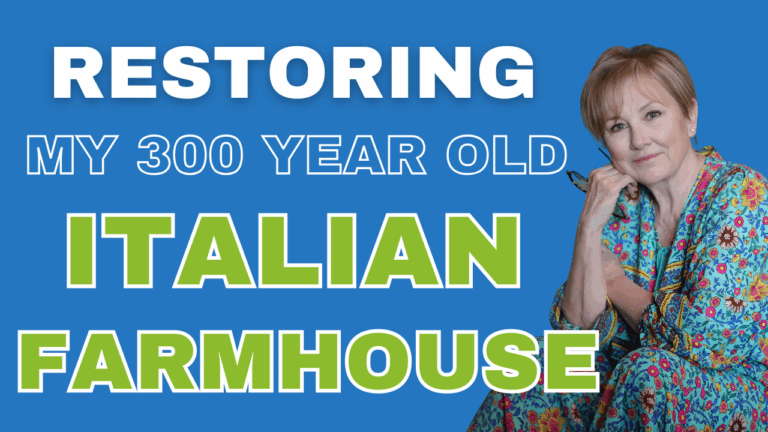
Carlie: It’s the Expat Focus Podcast, I’m your host Carlie. We talk a lot here about the dream of buying property abroad, but today’s episode is about what happens when that dream goes sideways. My guest is American Jan Savolainen, who bought a house in Italy – at age 64.
When her Italian home renovation turned into a nightmare, Jan turned everything she learned on that horror project into an app and a book series, called DolceRight.
After you’re done listening, be sure to check out our website, expatfocus.com, for comprehensive destination and moving guides, designed to help make your own move easier.
Jan, thanks for joining me.
Jan: Thanks for having me. I’m so happy to be here.
Carlie: I want to know first up, what made you and your husband Chris fall for a farmhouse in Italy?
Jan: It started with really falling for Italy. Our last trip there was in 2019. We had rented a villa in Tuscany, outside of Impruneta, with a group of friends, and I remember at one point standing at a winery overlooking the most amazing valley of vineyards and trees.
It was the most beautiful sight. I have a picture of me standing right there. And it just hit me. I said to myself, “One day I’m going to live here.” I didn’t realize at the time I was making a resolution. I went home from that trip and secretly started searching the real estate listings on Idealista.
Of course, I was looking in the area we’d stayed in, in Tuscany, and realized we would only get a little apartment there. So I started looking around other areas, and realized southern Italy was really where we’d find something affordable for our budget.
I still hadn’t said anything to my husband. I started searching on Google Earth, looking everywhere, going down to street level, and I ended up in Puglia. Being from California, where living on the coastline is cost prohibitive – you just can’t unless you’re very wealthy – it made so much sense to be able to live somewhere along a coastline.
I had already figured out our budget. It was about $250,000 all in, and we could do that there. So I started looking, and fell in love with the Ostuni area. Once I got my husband on board, we eventually found the house with the help of a consultant we had hired.
Carlie: How much did you know about Italy? How often had you been before you decided this was your place?
Jan: We had probably been there five or six times. But here’s the thing: I’d never been to Puglia. And then COVID hit, so I really began searching blindly, and we ended up finding a house sight unseen, in a region I had never been to.
In this day and age, you can practically be in an area from thousands of miles away. You can walk the streets of a city or a region using Google Earth. It’s really quite amazing, with the satellite searches available to us now.
But I knew Italy as a visitor. I did not know it as a homeowner or as a resident – and I must clarify, we’re not residents now. We don’t have visa status. I saw it from that very romantic view of Italy that you catch when you’re on vacation. When you’re visiting, you only see the historical parts.
You don’t see so much where the Italians live, where they go and where they shop. So I really did enter Italy and homeownership from a somewhat romantic view.
Carlie: Tell me a little bit about Ostuni and the Puglia region.
Jan: It’s very beautiful and very much unlike most of the rest of Italy. There was an episode of Stanley Tucci’s Searching for Italy – I don’t know if you’ve seen it – where he went to Puglia, and he described it as feeling like he was in Africa, which I thought was interesting.
Puglia is the land of the trulli homes, which are nowhere else in Italy. They’re homes with conical-shaped roofs that go back hundreds and hundreds of years. We don’t really know how far back, or their actual history. You might want to look up a picture of them sometime. They’re absolutely stunning.
Carlie: I think I saw a photo on your website earlier, and I was wondering what that interesting building was.
Jan: Yes. One cone is called a trullo, and the plural is trulli. So if there’s a home with two cones, it’s a trulli. Under each conical roof is one room, so you might see a property with eight cones, and that’s eight rooms. You go in and it’s almost like being a mouse, going through these interesting little walls from one room into another.
The Val d’Itria, the Itria Valley where we live, is absolutely stunning. Hills and valleys with trulli dotted everywhere, these conical roofs popping out of the scenery everywhere you go. There’s a town called Alberobello where the entire historical part of the town is made up of trulli.
If you head north out of the Val d’Itria, from about the central point of Puglia, you get more into agriculture: wheat fields, cherry orchards, vineyards everywhere. But down in the more southern part of Puglia, where we are, this is the land of the olive. It has the heaviest concentration of olive trees anywhere in Italy.
We have something like 90 million olive trees in Puglia. Sadly, there’s also a devastating disease going on with these trees called Xylella. Pardon me if I’m getting this wrong, but I believe it’s a bacterial infection, and the spittlebug is what carries it from tree to tree.
They think it came from Costa Rica. But it’s literally killing the trees from the southernmost region of Italy going north, and there’s no cure for it.
Carlie: Oh, that’s terrible.
Jan: So they’re rapidly trying to plant disease-resistant trees everywhere, in hopes that they’ll make up for the tree loss.
Carlie: Fingers crossed. And how far are you from the coast? I know you mentioned that was something you couldn’t achieve in California.
Jan: A 10-minute drive. If my house were sitting a little bit higher up on the hill, I would have an actual view. It’s 10 minutes because I have to go back into Ostuni and then back down. But I love driving in the area where I live, so I don’t complain about driving anywhere. It’s absolutely stunning, and it’s very close.
Carlie: Before things went wrong, I’d like to know what went right. You mentioned that you toured homes virtually through a consultant, and found your dream farmhouse.
Jan: Yes. I realized we clearly needed help to move there. I didn’t know what to do. I started searching through Facebook and other social media outlets, and ended up finding a woman who specialized in the Ostuni area of Puglia.
She had very flashy, very beautiful postings, and seemed to be quite prominent. It turned out she’d been on a couple of episodes of House Hunters International. She was not an estate agent; she had just started this consultancy.
We ended up hiring her. First we took a class she offered, with four to six modules – one a week – where a professional would teach a class. One was an estate agent. Another was a contractor, who ended up becoming our contractor. Another was a visa and immigration lawyer.
So we thought we were doing the right thing in learning all this information. Looking back, they just touched on it. And the contractor was actually an American who had moved to Italy.
Carlie: Okay.
Jan: According to him. So we felt very, very safe.
Carlie: Yeah, very familiar.
Jan: Very safe. These people were part of the consultant’s team, so we trusted them. I came from the American mindset. In the United States, we have our multiple listing service, the MLS, and we’re completely protected as homeowners buying a house. What I quickly learned is that that’s not the way it is in Italy whatsoever.
We trusted the professionals. That’s what I tell everybody not to do now. We went in thinking we were doing everything right. That’s what doing it right looked like to us: hiring a consultant with this wonderful team who promised to protect us.
Carlie: And did you get the property through the consultant?
Jan: Yes, and buying the property actually went really well. It was very straightforward. It’s actually a little house in the countryside, not a farmhouse. We were fortunate there were no problems with the house, so nothing to discover later on.
Carlie: And then you engaged the contractor to do some renovations?
Jan: Yes. This was a very typical little house, built in the ’70s. It had no historical value or interest whatsoever.
Carlie: Okay, that’s changing my mental image of this Italian house!
Jan: Yes, it was built in the ’70s, in the typical architecture of that time, which was not very attractive. It had a kitchen the size of a closet. But it was on a beautiful piece of property with 100 olive trees, in a perfect location in the Val d’Itria. I could see trulli from my doors.
I had been a home stager, preparing houses for sale here in the US and working with real estate agents. I had an eye for design. I could see a house with a lot of problems and see completely through that. This house had a perfect footprint, and it was also the perfect price. It was listed at €118,000, and we ended up paying €105,000.
Carlie: Great.
Jan: So with our $250,000 budget, we had what looked to me like a pretty healthy renovation budget.
Carlie: Yeah, definitely. So walk me through the moment you realized things were going wrong.
Jan: Everything we wanted to do, the contractor would say, “Yes, of course we can do that.”
Carlie: And this was the American contractor?
Jan: This was the American contractor who spoke Italian. He had a whole Italian team behind him. He wasn’t the one who actually did the work himself. He was working with many expats, and he had Italian contractors he would subcontract to do all the work.
Here’s one of the biggest red flags of all: when someone tells you that you can have everything, and that everything’s really great. That is your biggest red flag. This guy even promised us about 400 square feet of space in a warehouse where I could store furnishings we bought before the house was finished. It was quite an amazing list of promises, plus the wining and dining when we came over.
When things started to go wrong – this was 2021, and we were finally able to travel with COVID. I’d come over and spent the first two months of the renovation in the Ostuni area, and my husband came over for the last few weeks. We left at the same time, at the end of October.
Up to that point, we were having weekly meetings. There was a little crew of Italians who spoke English who were assigned to us. We met with them and talked about what was going on in the house, and they shared photographs of the renovation.
Mind you, from the very beginning, the photographs they had promised were few and far between. I realized later they were very strategic in what they sent us, how they sent it, and how it was spread out. It was very well planned by the contractor – not anybody else in the office. Looking back, I want to make it very clear that nobody else was involved in this. It was just the contractor.
Around February of 2022, our meetings started getting canceled. Our house was supposed to be done by May. More and more of the Thursday meetings were canceled, and there were fewer pictures. The more I started demanding, the more they started disappearing. And you have to realize you’re so dependent on these people.
Carlie: And you’re in the States at this time, aren’t you? You’re not in Italy.
Jan: We’re in the States, yes. I had just been there for two months, and you can only stay three months in any six-month period. So you’re dependent on them. You don’t want to argue with them. You’re dealing with a foreign country, and you’ve been led to believe – or led yourself to believe – that you can completely count on these people.
So it’s really easy to push down the idea that maybe something’s happening. But it started becoming more and more clear. There was another woman about my age who had bought a property there at the same time as me, using the same consultant and the same construction company, and she started having issues as well.
We started talking to each other a lot more and sharing ideas. She lived on the West Coast, so it was easier for her to travel, and she went over in March. I said, “Will you go visit my house, take pictures and send them to me?” And she said, “I absolutely will.”
Well, she didn’t know where my house was. In the countryside, there are no addresses. You have a position on Google Maps. That’s how you find out where to go.
Carlie: Like the GPS coordinates?
Jan: Yes, exactly. If you’re going to visit a friend’s house, you call up and say, “Can you send me your position?” They send you the GPS location, and Google Maps gives you directions.
So she was dependent on the people with the company to find her way to my house. And clearly the Italians who were working for him knew there were problems. But what they were being told by the contractor is a whole other story. He was running a scheme with his expats, and he was also running a scheme with his staff to keep everybody quiet.
It was quite a to-do for her to get them to take her over to my house. There was a chain on the gates. They unlocked it, she walked in, and she took pictures and a video of the house.
The next day, I got an email from her saying, “Here’s your house.” I opened it, and there was the house, almost exactly as we had left it in October. They had done a little bit of work. We had turned the garage into a master bedroom, and they had built some of the walls in that space. And they had built the septic system, which is called an Imhoff system, and buried it in the backyard. Those were the only two things they had done since we’d been gone.
Carlie: And how long were you from expected completion at this point?
Jan: When I got that video, the house was supposed to be done in about six or seven weeks.
Carlie: Oof.
Jan: We were scheduled to be there. We had friends coming. It was crazy. I opened that video and was just devastated. I cried. I didn’t understand what was going on. It was quite a moment.
Carlie: I hope you got fiery with the company.
Jan: Very fiery. I sent an email to several of the people we met with on Thursdays, and to the contractor of course. “You’re lying to us. What’s happened here? You said our house was done…” It was a very, very angry email.
What I got back was from the Italian people I had been meeting with on Thursdays. They said, “It’s not our fault. It’s the fault of the contractor. He’s been lying to everybody, and you need to talk to him.” So he sent me an email saying, “There’s a problem with your house. I’ll meet with you tomorrow on a Zoom call and explain everything.”
On the Zoom call the next day, he said there was a huge legal issue with our house. All the neighbors were complaining, and the project had been shut down by the comune, the city hall. They thought illegal work was going on in our house, that they were building without permits. Which was not true.
The contractor said he’d been dealing with this for weeks and weeks and was trying to shield me from it. So, more lies. We said, “You’ve lied to us, and we don’t believe you,” and hung up on him. Then within just a couple of days, we discovered that our money was gone too. They took our money and didn’t renovate our house.
Carlie: Wow. That’s a lot.
Jan: Yeah, that was a lot.
Carlie: Was there any action you could take from where you were sitting? Were you able to report him to someone, or get clarification?
Jan: No. What do you do? You don’t know the Italian legal system. My friend I mentioned – her house was being worked on too, and her money had been taken as well. She had a separate set of problems; what was going on with her property was a little bit different from ours, but she also had her money stolen.
It turned out there were quite a few expats going through the same thing at the same time. It’s just that she and I were the only people talking to each other. Everybody else was going through their pain separately and alone.
Carlie: So this contractor was swindling multiple people.
Jan: He was swindling everybody separately. He basically had a Ponzi scheme going on. People’s houses would eventually get finished, but probably only after the renovation budget had doubled, and instead of taking maybe a year, it would take maybe five years.
So that week, when this happened with my house and her house, the house of cards he’d been building all came tumbling down. This Ponzi scheme he’d been brewing for years was over. And I will just say this: he turned out to be a criminal, a con man who was on the run from the FBI in the US.
Carlie: What?
Jan: He had come to Italy illegally about 10 years earlier.
Carlie: Wow.
Jan: And we just happened to fall right into his hands.
Carlie: Oh my gosh. He was wanted in the States and was hiding out in Italy running a con?
Jan: Right.
Carlie: That’s crazy.
Jan: And this is where I get very angry at the consultant, because the consultant put this person forward. I had invested $3,000 in the consultant. I didn’t invest $250,000 with her – the money goes to the contractor. You’re buying the house based on what he says can be done, and on his renovation price. If you’re going to bring somebody like that onto your team, you need to vet them. You need to go out and meet all the expats whose homes he has already renovated.
Carlie: And check he’s registered with whoever he needs to be.
Jan: Had she done that, she would’ve found out there were a lot of unhappy people out there. There may have been a few people who were satisfied with him – I’ve met a couple – but they’d had little mini renos in their apartments, like new kitchen counters. He was doing full home renovations for people. How can you recommend somebody when you’re not absolutely sure?
Carlie: So what did this experience cost you and your husband in the end – not just the money, but your project, and how it set you back?
Jan: The stress was horrible. As a married couple, we probably handled it as well as or better than most people can. Maybe it’s partly our age. I’m 68. Maybe part of you realizes that life happens, stuff happens to people, and you just move forward.
It never occurred to us to just stop and walk away. I still wanted the house in Italy. I still loved Puglia. I still loved Ostuni. I loved everything about it. I just wanted it to happen. So we moved forward as best we could.
There was somebody who had worked in the office, a young architect who had actually designed the renovation for our house. At the time he was a student architect – he hadn’t had his licensing done.
Carlie: Like an intern?
Jan: Yes. Now he’s a fully licensed architect in Mola di Bari, a wonderful architect and a great friend of ours. He and his girlfriend, who also worked in the office, came forward. They realized that what had been done to us was so wrong. And he said, “I’ll get your house renovated.” He’s not a contractor, but he got us a contractor.
Carlie: An Italian this time?
Jan: Yes. This is Vito – Vito Pepe. I’ll say his name a million times. He has DUEP Studio. He’s an architect, and he and his girlfriend Francesca are the most honorable people I’ve ever met.
He found me a contractor and we agreed on a price. In order to fulfill that contract, we had to come up with another $100,000 cash, which was very, very hard. But Vito got it done for us. At the time he was living in Monopoli, which is almost an hour’s drive from my house.
He drove out to my house almost every single day and made sure that contractor kept working, showed up and got it done. He checked the work and made sure everything was done. He never said he was doing that – I didn’t find out until months later that that’s how it really got done, because Italians work differently than we do.
And he didn’t charge me anything. In the end, we found ways to compensate him, and he’s a great friend. I’ll do anything to help him. It was really quite amazing.
Carlie: That’s a beautiful turnaround.
Jan: Yes. I think it brought back our ability to believe in our dream again. But I warn people – and I think this is really important for me to say – don’t try to buy a house or move to Italy with that romanticized dream of Italy.
You need to get your feet solidly on the floor, have your eyes wide open, and learn how the Italian system works, so that you don’t just trust the professionals like we did. I set out to help Americans, because that’s the market I know. But I’m also dealing with Australians and non-EU buyers from all over.
The one thing I keep seeing too much of is a resistance to really learn and understand the system: the whole process of buying a house in Italy and how different it is from your own country. Whether you’re from the US, the UK, Australia or Denmark, it doesn’t matter. You’ve got to learn the differences.
Here in the US, we trust the real estate agent because they’re bound by law to act as our fiduciary – to operate in our financial best interest. In Italy, there’s no such thing whatsoever. There are no protections in the Italian property buying system, not even with the listings you see on Idealista or Immobiliare.
They can say anything they want. Those listings are nothing more than proof that the house exists. They’re not bound by any law to tell the truth about it. You don’t even know if the house is still for sale.
Carlie: I follow a few YouTubers who are renovating homes in Italy, and I see a lot about the one euro house schemes, for example. What would you say are the biggest misconceptions among third-country nationals – fellow Americans, Australians – who want to buy property in Italy? What’s their biggest misconception when you start talking to them about their expectations?
Jan: I think the biggest misconception is that they can get through the process without a lot of pain.
Carlie: That it’s going to go smoothly.
Jan: Yes. With the one euro houses, it can work out. Most people know you can buy a house for a euro, but number one, why is it one euro? What’s the purpose of the scheme? It’s basically to try to repopulate towns that are dying.
So where are these towns located? Many of them are on top of a hill with a road that’s almost impossible to get to. For some people, that lifestyle may be fine, and it could work out really well. But you have to commit to renovating the house within a certain period of time, to a certain degree of…
Carlie: Completion.
Jan: Thank you very much. That’s probably much more of a trial than you’d ever think. The permit process in Italy is insanely difficult to understand. You really have to have somebody good to help you through it. It’s unbelievably slow and bureaucratic.
Italians move very slowly. There are so many aspects of the renovation process that are very difficult, and it’s not for the faint of heart. To this day, we still only have part of what we set out to get, and it’s still difficult to finish what we set out to do in the beginning. Life there is beautiful, and I love it, but it’s much different when you’re trying to get some very important things done.
Carlie: The Italian pace is not the pace you might be used to in the US.
Jan: No, not at all. And there are many things people don’t take into consideration. Here in the US, if we buy a house and want to add a room or a second floor, there’s no problem, right? Not in Italy.
Expanding your space is very limited. You can only expand a home by about 20%. It might vary somewhat by region or town, but that’s about the rule – and that’s by volume, up to the roof. Also, if the house has already been expanded, you can’t do it again. These are really important things to find out before you ever purchase a house.
Carlie: I’m watching some creators who are running into issues like that. If a roof wasn’t there historically, they’re not allowed to put one on. Another can’t build within five meters of the property line with a neighbor, so that’s thrown their extension into chaos.
Jan: Yes, there are many, many restrictions, and you don’t realize it until… I’m telling you, many of the people you hire want you to buy the house. They want to help you find a house.
Carlie: They’re going to gloss over the details.
Jan: They’re not going to warn you. And I get it. I never want to stomp on anybody’s dream. But I’m in the business now of trying to teach reality. Go in, have your dream, go live. You can enjoy it, but have your eyes wide open. I can’t say it enough.
There are property purchase lawyers out there I’m good friends with now, who are so happy I’m doing what I’m doing. Oftentimes they get American expats coming to them as clients, and these lawyers – and even some estate agents – do try to tell them how the system works. And often the clients don’t believe them, or don’t take their advice. I’ve had that said to me many times.
I’ve even dealt with potential expats who follow me, who are looking to buy, and they message me: “I found this house, and I’ve got this estate agent.” And I say, “Do you have your lawyer lined up yet?” And they say, “My estate agent says I don’t need a lawyer.” I’m like, “Don’t listen to your estate agent. You need a lawyer. You need somebody to represent you.”
Your estate agent just wants to finish that sale quickly. They want to make the sale, and they don’t want any problems. That’s very common out there. They won’t do due diligence on the house because they want to close the deal, and then you’re left with a house with problems.
Carlie: Facing all of this – getting slapped in the face with reality, going through this contractor experience – what made you and your husband decide to continue, instead of maybe selling the house as far as the renovation got and walking away?
Jan: We still wanted what we set out for. We just weren’t going to accept anything less. We knew what the house was going to look like, and what the property was going to look like, and we still do. We still want to achieve that. Walking away never came into our minds. Like I said, we just kept moving forward. We never let that be entertained in our minds at all.
Carlie: Did you ever find out what happened to the contractor?
Jan: Oh, he’s still around. That business collapsed, but through Facebook and the expat groups, we’ve continued to find people in Abruzzo, Marche and up in Tuscany he was reaching out to. I think he became more brazen. People would hire him, and he would just take their money, not do anything and walk away.
We’re hearing less and less of that now. Although one of my friends in Ostuni, who’s a property lawyer, recently heard that he was trying to get a job as a project manager for a contractor in the Ostuni area.
So he’s still around. Because he came to Italy illegally, he had no paperwork. He wasn’t on any bank accounts. He had conned Italians into opening the bank accounts. His name was on nothing.
Carlie: Wow.
Jan: So in the end, I’m not going into the Italian legal system. I’m not going after him. I don’t know how it works. What I do know is it’s a huge bureaucratic nightmare. I have a friend who has tried to get some redemption through the legal system, and it’s been an absolute nightmare for her. She’s walking away from it now.
Carlie: Sounds like you decided to pick your battles.
Jan: Exactly.
Carlie: Jan, what is it that you really love about your home in Italy today?
Jan: Oh, gosh. It’s a beautiful little house. We took what was probably one of the ugliest little houses in Italy and made it the cutest. I have beautiful stone floors and beautiful multi-tile bathrooms. It’s all been renovated, it’s very modern, and I just love it.
And I love Ostuni. I have more friends in that area than I do here in the United States where I’ve been living. I have more of a social life when I’m there than I do here. My husband can’t come over as much as I can – he still has a company here that he can’t leave for as long.
It’s beautiful. It’s peaceful. It is hard; it is a challenge. I live in the countryside and I don’t have a garbage disposal, so where do you think all those little food scraps go?
Carlie: Queen of the compost!
Jan: I’m queen of the compost, yes. And there are lots of cats nearby who eat all my little meat and fish scraps. They love my house.
But we absolutely love it. It’s a whole other world. I think the main thing I gain from it is a sense of peace. That real dreaminess you get when you vacation in Italy or other foreign countries is long gone, because you’re used to it.
I enjoy speaking Italian. My Italian’s terrible, but I’m learning and I love trying. I love the language. I’m getting to know Italians better. It’s made me find a brave side of me I didn’t know existed – the part that doesn’t care anymore about making a fool of yourself by saying the wrong thing, or people not understanding you.
I think this whole process has brought out a side of me I didn’t know existed, and I very much enjoy what I’ve learned about myself. And I started this company a year ago, at age 68. I was actually quite bored, and now I’ve started a tech company, and I love it.
I never thought I would do something like this. I thought I was done. Like a lot of women my age, you think you’re put out to pasture, and you just live in your past. I’ve created a whole other future for myself, and I really get into that when I’m in Italy.
In my house, I have my computer. I don’t have my dogs around my feet – I miss them terribly – but I throw myself into work and into enjoying the area. I enjoy the food, and I really enjoy my fellow expats, my friends and that life.
A question I see a lot from single women looking to move over there is that they’re worried about finding community. I think there’s a lot of community to be found. Expats really do seek each other out. Many say, “Don’t just live within the expat world – find the Italians,” and I encourage that very much.
And I can’t say enough how important it is to learn to speak the language as best you can. A lot of people try to live there without really trying to speak the language. But I can’t encourage you enough to learn it – it’s so freeing. You need to know how to call an ambulance, call the police, or call for help in the event that something happens.
Carlie: Or call out a contractor when he’s taking all your money.
Jan: Exactly. You’ve got to learn how to stand up for yourself there as well.
Carlie: Jan, if there’s someone about to sign for their first property in Italy, what is one thing you’d want them to know and do?
Jan: Well, it’s one thing, but it’s kind of a big one thing: understand the system you’re walking into. Understand every professional you need – a lawyer, an estate agent, a geometra and a notaio. These are the most important people who will complete your purchase process.
Know the duties of each one of them, and hire each one of them separately, on your own. I can’t stress enough that you have to independently hire these professionals. If you find a house you like and the buyer has a lawyer, sometimes your estate agent might say, “You can use the same lawyer.” No. You need your own independent professionals who work solely for you.
The geometra does not come from the estate agent. The lawyer does not come from the estate agent. The estate agent does not come from the lawyer. You need to find your own people, because they need to independently represent you so that nothing happens to you. That’s probably the most important thing I can say: independently hire the professionals to understand you.
And in order to work with them properly, you need to know what their specific duties are. Everybody has their role, but none of the roles work together. They all work independently. It’s very important.
Carlie: If listeners want to benefit from your advice and your experiences, where can they find you?
Jan: My company is DolceRight. It’s a series of two apps, which you can download at dolceright.com, and I’ve written two companion books, one for each app. The first app is Find and Secure, and the second is Renovate and Settle. On your phone or device, you can see the entire Italian property buying or renovating process, step by step.
I also have a personally vetted professionals directory, so you can find the people you need. I personally seek them out. It’s not a huge directory, because it takes a long time to vet each one, but it’s slowly building. You can find me at dolceright.com.
Carlie: Jan, thank you so much for this conversation and for sharing your horror story of buying and renovating a home in Italy.
Jan: My crazy story!
Carlie: I think it’s really a case of making lemonade out of lemons, and I’m so glad you got to your dream home in Italy eventually.
Jan: Thank you. We have it, and it’s wonderful. When one door closes, I believe a window opens. This has been a nightmare, but it’s also probably been one of the best things that’s ever happened to me. Odd to say, but I look back on it now and I see it that way.
Carlie: That’s it for today. Are you currently navigating a purchase abroad? Maybe you’re having your own version of a contractor nightmare? Let us know in the comments on our YouTube channel. We are Expat Focus. Check out our podcast archives for more property stories, including running a guest house in Italy, buying property in France, and the truth about buying a home in Panama.
And sign up for our newsletter at expatfocus.com/newsletter to never miss a future episode. I’ll catch you in the next one.