
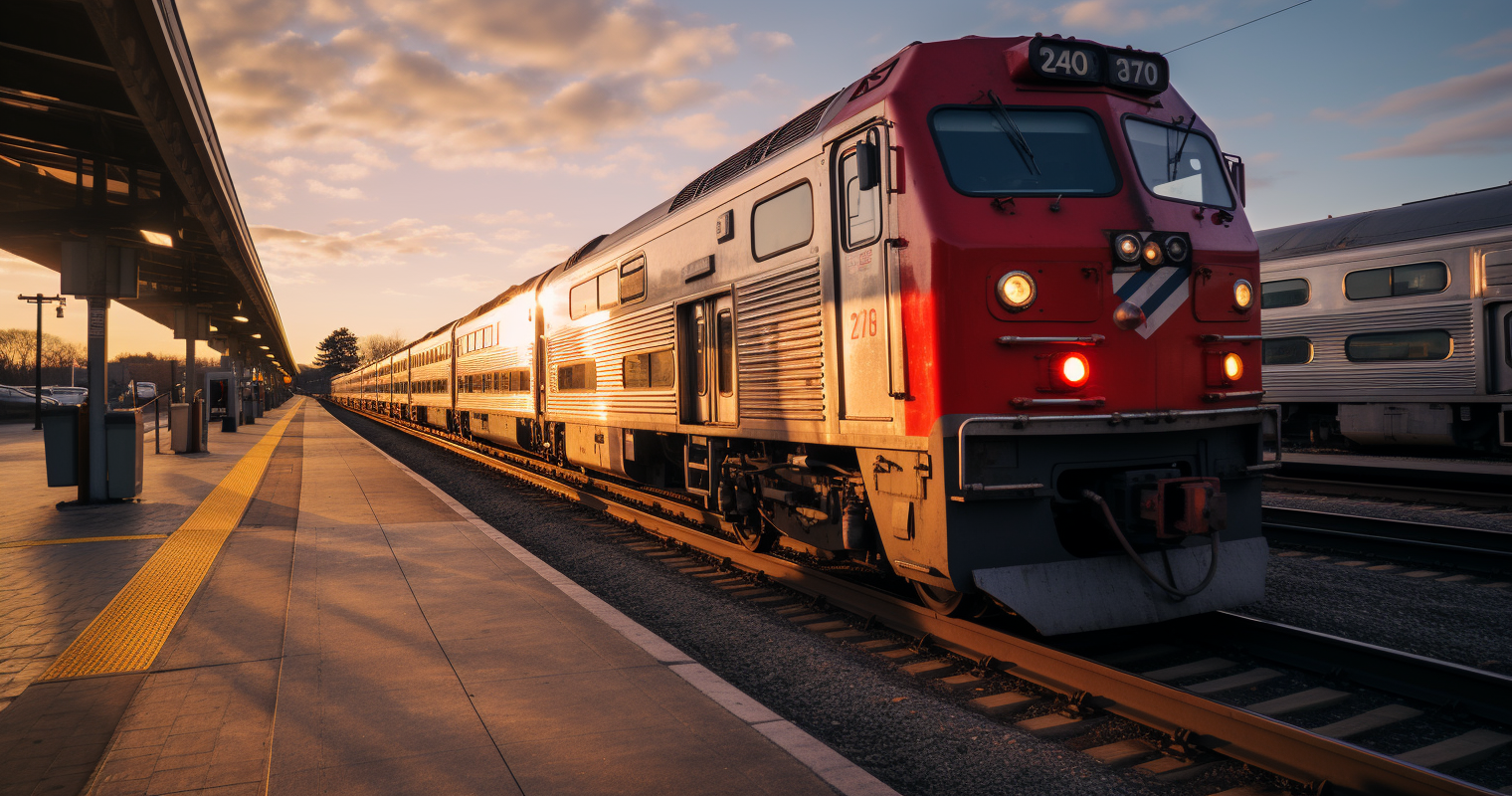
Hungary’s national rail network, run by MÁV Group, spans roughly 7,000 kilometres of track and links Budapest to every significant city as well as many smaller rural communities. Service quality varies widely across the system — intercity routes and flagship trains offer modern, comfortable travel, while older regional lines can feel considerably behind the times. By European standards, fares are modest, making rail a practical choice for residents going about their daily lives.
| Item | Details |
|---|---|
| National rail operator | MÁV Group (Magyar Államvasutak) — mavcsoport.hu |
| Network size | Approx. 6,980 km of track, of which 2,864 km electrified (as of 2025) |
| Punctuality | Over 21.5% of trains ran late in 2024; compensation introduced for delays over 20 minutes from June 2025 |
| Key day passes (as of 2024) | County24: 999 HUF; Hungary24: 4,999 HUF — verify current prices at ujtarifa.hu |
| Free travel (as of 2024) | Under-14s and over-65s travel free on domestic services; ages 14–25 eligible for 50% discount |
| Online ticketing | jegy.mav.hu and MÁV app (iOS and Android) |
| Budapest urban transit | BKK — bkk.hu — operates metro, tram, and HÉV suburban rail |
What is the overall standard of rail travel in Hungary?
Hungary’s standard-gauge rail network extends to approximately 6,980 kilometres in total, with 2,864 kilometres of electrified track. MÁV Group is the primary state-owned body responsible for managing rail operations across the country. The organisation went through substantial restructuring in 2024 and 2025, aimed at improving operational efficiency and streamlining management as part of wider transport sector reforms.
The passenger experience differs markedly depending on which route and train type you use. On the main intercity corridors — such as those linking Budapest with Debrecen, Pécs, or Győr — trains are modern, air-conditioned, and generally run to schedule. On branch lines and older regional routes, both rolling stock and infrastructure can lag considerably behind. This uneven picture is broadly typical of mid-tier Central European rail networks, and noticeably less consistent than the systems found in countries like Germany or Switzerland.
More than 21.5% of MÁV Group trains ran behind schedule in 2024, and close to 6% were delayed by more than 20 minutes. Punctuality has long been a subject of public debate in Hungary. Nevertheless, investment in new rolling stock is producing tangible improvements: Hungary’s most significant locomotive renewal programme in three decades has begun to show results on some routes, with new locomotives helping to stabilise schedules.
By 2024, MÁV had launched a €2 billion national modernisation initiative targeting 15 major rail corridors. The programme encompasses track renewal, upgraded signalling systems, and the elimination of level crossings to shorten journey times and expand capacity. Rolling stock replacement accelerated during the 2020s, with plans to introduce 280 new domestically produced InterCity passenger carriages by 2030, replacing ageing units across the fleet.
Significant spatial disparities exist in the availability and quality of public transport services. Budapest benefits from high-quality urban transit by international standards, with recent investments strengthening suburban connections. At the other end of the scale, economically disadvantaged regions suffer from poor service frequency, pushing residents toward private car use. Expats living in or near Budapest will find rail a genuinely practical everyday option; those based in smaller provincial towns should research their specific routes carefully before relying on rail travel.
A second rail operator, GYSEV (Győr-Sopron-Ebenfurth Railway), runs local services across parts of western Hungary. The Hungarian state holds a majority stake, with the Austrian state holding a minority interest. GYSEV services are generally well-regarded and connect smoothly with the wider national network.
What classes of rail travel are available in Hungary, and what are the differences between them?
Domestic rail services in Hungary are divided into two standard travel classes — first class (1. osztály) and second class (2. osztály). The difference in comfort between the two is meaningful on intercity trains, but largely insignificant on slower regional services where both classes often use identical or near-identical rolling stock.
InterCity (IC) and EuroCity (EC) trains link Hungary’s major cities and key international destinations, stopping less frequently and offering a higher standard of travel. These services are typically air-conditioned and the better-equipped ones include restaurant cars. Seat reservations are compulsory on domestic IC trains and most international services, costing approximately 940–990 HUF when purchased online or at a machine (as of 2024). Both first and second class carriages offer power outlets and variable Wi-Fi coverage.
On IC services, first class provides wider seating, additional legroom, and generally quieter carriages. For everyday commuting, second class on modern rolling stock is perfectly adequate for the overwhelming majority of journeys. The price difference between the two classes is relatively modest by European standards, making the upgrade reasonable to consider for longer intercity trips.
Modern Railjet (RJ) trains serve the corridor between Budapest and Győr, continuing onward to Vienna, Munich, and Zürich — typically in partnership with Austrian Federal Railways (ÖBB). These trains represent a notable step up in both comfort and speed. Railjets are divided into Economy, First, and Business Class, and reservations are obligatory across all classes.
On slower regional trains (személyvonat or sebesvonat), class distinctions carry little practical weight — older carriages may show minimal differences between first and second class seating. For this type of journey, the route itself matters far more than the class chosen. It is always worth checking whether a specific service actually offers both classes, as not all trains are configured the same way.
Where can you find rail timetables and ticket prices in Hungary?
The official MÁV website is your primary resource for both timetable information and ticket purchasing. The main portal at mavcsoport.hu directs visitors to jegy.mav.hu for buying tickets. The ticketing platform operates in both Hungarian and English. Schedules, route maps, and fare details are all accessible through this site, making it the best starting point for checking up-to-date travel information.
MÁV’s journey planner is now hosted at emma.mav.hu, replacing the long-established Elvira system. Note that the planner displays all transport modes by default; to see rail-only results, you will need to select the train filter manually.
Tickets for both domestic and international journeys can be purchased online at jegy.mav.hu or through the MÁV apps. Buying online is not only more convenient, but for certain fare types it also works out cheaper than purchasing from a ticket machine or at a counter.
For pass information and a clear breakdown of the revised fare structure introduced in 2024, the dedicated website ujtarifa.hu — available in English — provides straightforward explanations of available passes and day tickets. This site is the most accessible source for understanding the current ticketing landscape.
For trains operated jointly with other national railways — such as Railjet services between Budapest and Vienna — each operator sells tickets through its own independent system. If a particular service does not appear on jegy.mav.hu, you may be able to find it at oebb.at or through a platform such as Trainline. Always consult official sources for the most accurate fares, as prices change regularly and promotional offers have limited availability.
How do you buy rail tickets in Hungary, and can you book in advance?
Several purchasing methods are available, and newcomers will find the process straightforward once they are familiar with the options. Below is a step-by-step guide to the main ways of buying tickets:
- Online via jegy.mav.hu: Both domestic and international tickets can be purchased through jegy.mav.hu or within the MÁV apps. This tends to be the most practical approach and frequently offers the lowest prices for advance purchases.
- Via the MÁV app: By 2023, mobile app sales accounted for 27% of all ticket transactions, reflecting a growing preference for digital purchasing. Your ticket can be displayed directly within the app on all routes, removing any need for a printed copy.
- At station ticket machines: Self-service machines at many major stations include an English-language option. They allow you to specify a departure station other than your current location for journeys starting elsewhere.
- At ticket offices (pénztár): Staffed counters at larger stations are available for complex itineraries, international travel, or whenever you would prefer face-to-face assistance. Queues can become lengthy during busy periods.
- On board (limited): On certain regional services where no staffed ticket office was available at your departure station, purchasing from the conductor on the train may be possible, though this is not guaranteed and could involve a small surcharge.
Advance booking is possible and advisable for intercity services, especially around public holidays and busy summer weekends. Worth noting is that MÁV’s online platform only displays trains for which special discounted advance fares remain available — if a train does not appear in your search, this does not necessarily mean it is fully booked. It may simply indicate that promotional fares have sold out, and a standard flexible ticket can still be bought at the ticket office.
In 2023, online ticket sales matched ticket office sales for the first time in Hungary’s rail history, signalling a decisive shift toward digital booking habits. Setting up a MÁV account at jegy.mav.hu simplifies booking management, e-ticket access, and discount applications considerably.
What types of rail tickets are available in Hungary, and are there discount schemes?
Hungary’s rail ticketing system underwent its most far-reaching reform in decades in March 2024. The overhaul introduced free travel for under-14s and over-65s alongside a comprehensive simplification of the existing fare structure. Understanding the key ticket and pass types is essential for anyone looking to make the most of the network on a regular basis.
Single and return tickets
Standard point-to-point tickets are sold for single and return journeys, with fares calculated on a distance basis. Always check the latest prices at jegy.mav.hu, as fares are adjusted periodically.
Day tickets (Hungary24 and County24)
Introduced in March 2024, the Vármegye24 (County24) is priced at 999 HUF (as of 2024) and grants unlimited travel within a specified Hungarian county for 24 hours on MÁV trains, Volánbusz long-distance buses, and HÉV lines within Pest County. The Magyarország24 (Hungary24), priced at 4,999 HUF (as of 2024), covers unlimited nationwide travel for a single 24-hour period on MÁV trains — including InterCity services, though a mandatory seat reservation still needs to be purchased separately — as well as Volánbusz and HÉV lines. Always confirm current pricing at ujtarifa.hu.
30-day passes (Hungary Pass and County Pass)
The Hungary Pass, which is priced at the equivalent of two County Passes, is valid across the entire country on interurban buses and second class trains. Passes can begin on any chosen date and remain valid for 30 days. The most convenient way to purchase a Hungary or County Pass is through the MÁV app, allowing you to store it on your phone and travel by train, suburban rail, or intercity bus whenever needed.
Discount schemes (as of 2024)
Children under 14 and adults aged 65 or over travel free, while passengers between the ages of 14 and 25 are entitled to half-price fares. These entitlements appear to apply to all passengers regardless of nationality.
Students holding a valid Hungarian student card, or in many cases an EEA student card, are generally eligible for a 50% discount. However, only documentation issued within Hungary qualifies holders for a reduced-price pass — a student card from abroad can only be used to purchase a full-fare Hungary or County Pass. Once you have registered as a student in Hungary, check your eligibility at mavcsoport.hu.
Beyond the free and discounted fares already mentioned, half-price travel also applies to all public-sector workers, and the overall pass system has been streamlined significantly. Always verify your specific discount entitlements directly with MÁV, as eligibility rules and required documentation are subject to change.
How accessible is the rail network in Hungary for disabled passengers?
Accessibility across Hungary’s rail network is gradually improving, though it remains uneven — modern intercity services and older regional infrastructure represent two very different experiences. The situation is broadly comparable to mid-sized European networks in the process of modernisation: ahead of some, but not yet at the standard of fully upgraded systems such as those in the Netherlands or Scandinavia.
Overall, the Hungarian rail network is reasonably accessible for passengers with disabilities. The majority of trains offer wheelchair access, and stations are fitted with ramps and lifts. MÁV provides support services for passengers with disabilities, including assistance with boarding and alighting and access to an onboard wheelchair. Anyone needing this kind of support is strongly advised to contact MÁV ahead of their journey to make the necessary arrangements; full details are available at mavcsoport.hu.
In Budapest, work to improve urban transit accessibility is ongoing. BKK has deployed passenger information systems that can be activated remotely at stops as part of its FUTÁR real-time information platform. Currently, more than 90% of buses operating in Budapest are low-floor vehicles.
Budapest’s public transport network is progressively becoming more accessible, though some older infrastructure — particularly at stations on Metro M1 — may still feature steps only. Newer metro lines (M2, M3, M4) and the majority of recently introduced buses and trams are wheelchair accessible.
BKK acknowledges that significant work remains to fully achieve accessibility across its network, with progress constrained primarily by funding limitations and technical challenges rather than any absence of commitment. Accessibility information for BKK services is available at bkk.hu. For MÁV-specific accessibility queries, reach out to MÁV customer services via the contact details on mavcsoport.hu.
Are there metro or urban rail systems in Hungary’s cities?
Budapest is the only Hungarian city with a metro system, though the capital also has an extensive network of trams, suburban HÉV rail lines, and bus services, all brought together under the Budapest Transport Centre (BKK). Urban rail provision elsewhere in Hungary is limited, though an innovative new development has taken shape in the country’s south.
Budapest Metro
According to BKK, the metro carries around 450 million passengers each year, representing close to 30% of all public transit journeys in the city. The Budapest metro network comprises four lines — three currently in operation and one under construction. The historic M1 line, which opened in 1896 as the first underground railway on the European continent, is a UNESCO World Heritage-listed route. Lines M2, M3, and M4 serve the broader city, with M3 having completed a comprehensive refurbishment between 2017 and 2023.
Budapest’s metro operates within a unified fare system managed by BKK, which also covers trams, buses, and trolleybuses. Fares are time-based rather than route-based, meaning a single ticket is valid across all modes of transport. Tickets must be validated on first use using the yellow machines found at station entrances. Both the BKK app and ticket machines at all metro stations are available in English.
HÉV suburban rail
Budapest’s HÉV suburban rail network connects the capital with surrounding towns including Szentendre and Gödöllő. Standard BKK tickets and passes are valid on the HÉV within Budapest’s administrative boundaries. For travel beyond the city limits — to Szentendre or Gödöllő, for example — an extension ticket (kiegészítő jegy) must be purchased to cover the section of the journey outside Budapest.
Tram-Train in Szeged
The Szeged–Hódmezővásárhely tram-train, a 32-kilometre hybrid system combining urban tram travel with regional rail, opened to full passenger services in November 2021. It has improved connectivity across southern Hungary and is widely regarded as a model for integrated urban-rural sustainable transport. The Hungary Pass, Hungary24, and the Csongrád-Csanád County Pass and County24 are all valid for the complete tram-train route between Szeged and Hódmezővásárhely.
The official website for Budapest’s integrated public transport is bkk.hu. The BKK Futár app provides real-time journey planning, live departure boards, and mobile ticketing for the entire Budapest network and is strongly recommended for anyone making their home in the capital.
What should expats know about using the rail network day-to-day in Hungary?
Getting around by train in Hungary is manageable for new arrivals, but a handful of practical points are worth understanding before you begin commuting or travelling around the country.
Language and signage
Hungarian belongs to a language family unrelated to most Western European tongues, and even those with knowledge of several other languages may find station terminology unfamiliar. That said, many Hungarians — particularly younger generations and people in Budapest — speak English or German. Signage at major stations is largely interpretable once you recognise a few key terms (for example, “Indulás” means departures and “Érkezés” means arrivals), and ticket machines at larger stations offer English menus. At smaller rural stations, signage may be in Hungarian only.
Seat reservations
Seat reservations are compulsory on domestic IC trains and most international EC and EuroNight services, costing approximately 940–990 HUF when purchased online or at a machine (as of 2024). On regional trains, no reservation is needed and passengers may sit anywhere within the appropriate class. Always verify whether your specific service requires a reservation at the time of booking.
Luggage
MÁV generally allows passengers to travel with a reasonable amount of hand luggage, and bicycles are permitted on many services — though specific rules apply and a supplement may occasionally be required. Luggage racks are provided in carriages. There are no strictly enforced weight limits on most services in the way airlines operate, though oversized items may need separate arrangements. Refer to the current luggage policy at mavcsoport.hu for precise details.
Purchasing and validating tickets
On MÁV national rail services, paper tickets or app-based e-tickets are presented to conductors who move through the carriages. Unlike urban transit systems such as BKK in Budapest, most national rail services do not use gate barriers — but ticket checks do take place regularly. On the Budapest metro, tickets must be validated immediately upon entry using the yellow machines positioned at station entrances; failing to do so is a common oversight that can result in an on-the-spot fine.
Connecting with buses
From January 2025, Volánbusz was fully merged into MÁV, bringing the national bus and rail networks under a single operational umbrella. This simplifies integrated travel considerably, and products such as the Hungary Pass and Hungary24 are valid on both trains and interurban buses, making multi-modal day trips much easier to plan and pay for.
Cultural norms
Hungarian passengers tend to travel quietly and with a degree of reserve, particularly in first-class carriages. Mobile phone calls are generally tolerated but kept brief and low in volume. Priority seating near carriage doors is reserved for elderly passengers, those with disabilities, and pregnant women — these conventions are widely respected. Eating on trains is common and not subject to any restrictions on most services.
Frequently asked questions
Is rail travel affordable in Hungary for everyday residents?
Rail travel in Hungary is genuinely inexpensive by European standards. A County24 day pass costs 999 HUF (as of 2024) for unlimited travel within a single county over 24 hours, while the Hungary24 pass costs 4,999 HUF for unlimited national coverage. Check the most current prices at ujtarifa.hu, as fares are subject to periodic revision.
Do I need to book train tickets in advance in Hungary?
Advance booking is not a strict requirement on most regional services, but it is well worth doing for intercity (IC) trains — particularly around public holidays and busy summer periods. Seat reservations are mandatory on IC trains and must be bought separately from your base ticket or pass. Advance bookings can be made at jegy.mav.hu or through the MÁV app.
Can I use my phone to show train tickets in Hungary?
Yes — your ticket can be displayed via the MÁV app on all routes, meaning there is no need to print anything. Creating an account at jegy.mav.hu makes it easy to store and manage your bookings digitally.
Does my student ID from outside Hungary entitle me to a rail discount?
Only documents and certificates issued in Hungary qualify holders for a reduced-price Hungary or County Pass. A student card from abroad can only be used to purchase a full-fare pass. Once you have enrolled at a Hungarian educational institution and obtained a valid Hungarian student card, you will generally be entitled to a 50% discount. Verify your eligibility at mavcsoport.hu.
Is there a free travel benefit for older passengers on Hungarian trains?
Since 2024, anyone aged 65 or over — regardless of nationality — may travel free on Budapest’s entire public transport network, including buses, trams, trolleybuses, the metro, and local suburban trains. This entitlement also extends to national and regional trains and buses operated by MÁV and Volánbusz throughout Hungary. Always carry proof of age when travelling, and confirm the latest rules at mavcsoport.hu.
What is the best app for navigating public transport in Budapest?
The BKK app is a free, reliable tool offering real-time departure information for metro, tram, bus, and HÉV services across Budapest. For national rail journeys, the MÁV app or the Vonatinfó app both support journey planning and ticket purchasing. The BKK Futár app is particularly recommended for anyone living in the capital.
Are trains in Hungary wheelchair accessible?
The rail network is broadly accessible for passengers with disabilities. Most trains have wheelchair access, and stations generally provide ramps and lifts. MÁV offers support services for passengers with disabilities, covering assistance with boarding and alighting. The level of accessibility does vary between modern intercity services and older regional trains, so it is advisable to contact MÁV in advance to arrange any required assistance: see mavcsoport.hu. In Budapest, metro lines M2, M3, and M4 and the majority of newer buses and trams are wheelchair accessible.
How do the Hungary Pass and Hungary24 differ?
The Hungary Pass provides nationwide travel on interurban buses and second-class trains and is valid for 30 days from a chosen start date. The Hungary24 costs 4,999 HUF (as of 2024) and covers unlimited travel for a single 24-hour window across MÁV trains, Volánbusz, and HÉV lines throughout the country. The 30-day Hungary Pass is best suited to regular commuters, while the Hungary24 is ideal for a concentrated day of travel. Remember to add a seat reservation when using either product on an IC train. Current pricing is available at ujtarifa.hu.