
Milan isn’t just Italy’s fashion capital anymore — it’s becoming Europe’s newest expat hotspot. In the past few years, the city has seen a surge of wealthy newcomers, drawn by generous tax breaks, global business opportunities, and a lifestyle that blends high finance with la dolce vita. Removal vans are now a familiar sight in Milan’s historic streets, and international schools are filling fast with students from London, New York, and Paris. For expats weighing their next move, Milan is increasingly competing with London, Geneva, and even Dubai — but with its own distinctly Italian twist.
01The Tax Advantage
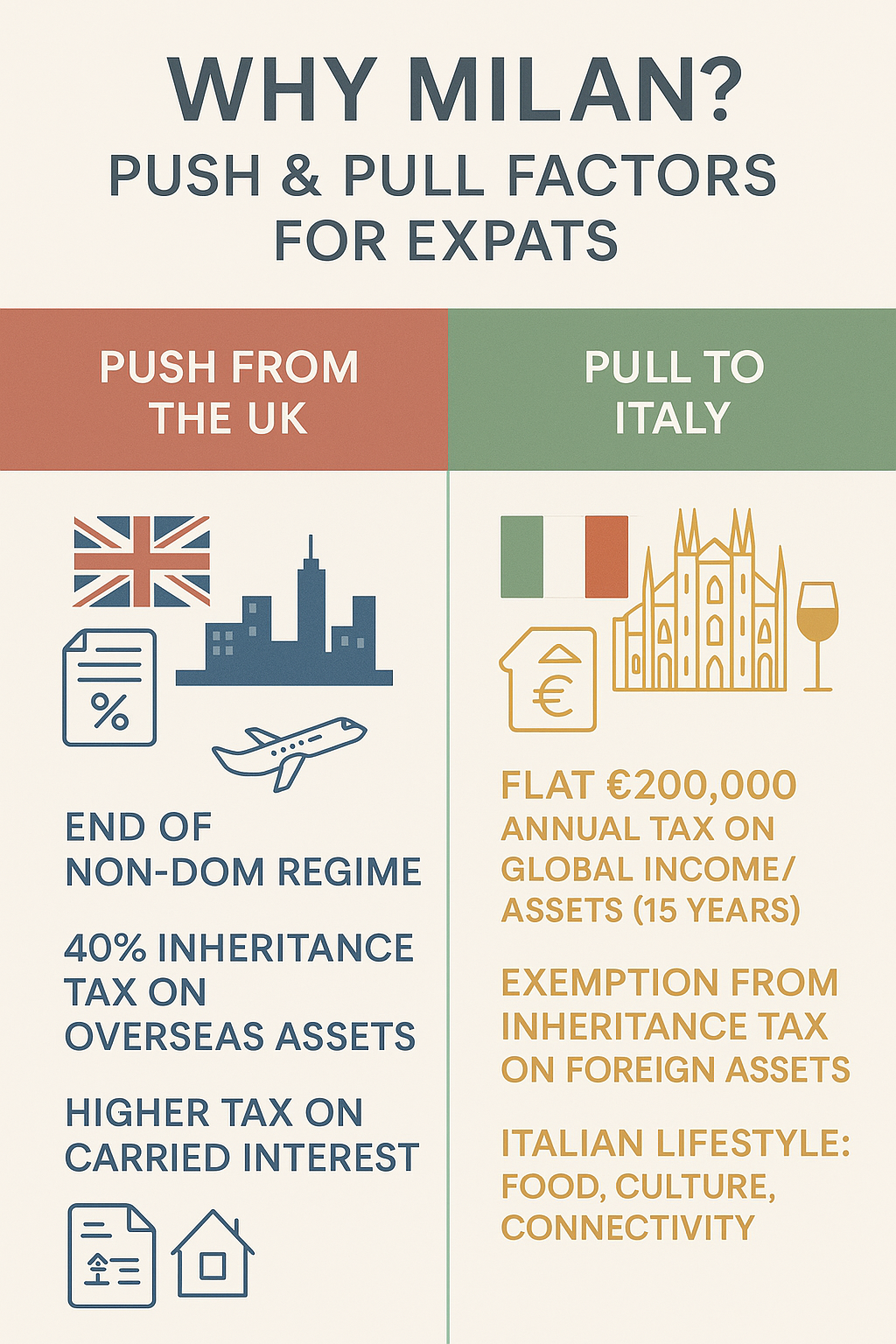
The foundation of Milan’s expat “explosion” lies in reforms introduced in 2016. Italy rolled out a flat-tax regime that allows new foreign residents — and Italians returning home after at least nine years abroad — to pay a fixed €200,000 per year on any foreign income and assets, no matter the amount. The benefit can last up to 15 years and includes exemption from inheritance tax on overseas assets.
For wealthy expats accustomed to navigating complex international tax systems, this simplicity is appealing. The scheme has already drawn several thousand individuals, and it continues to attract high-profile financiers, executives, and business owners.
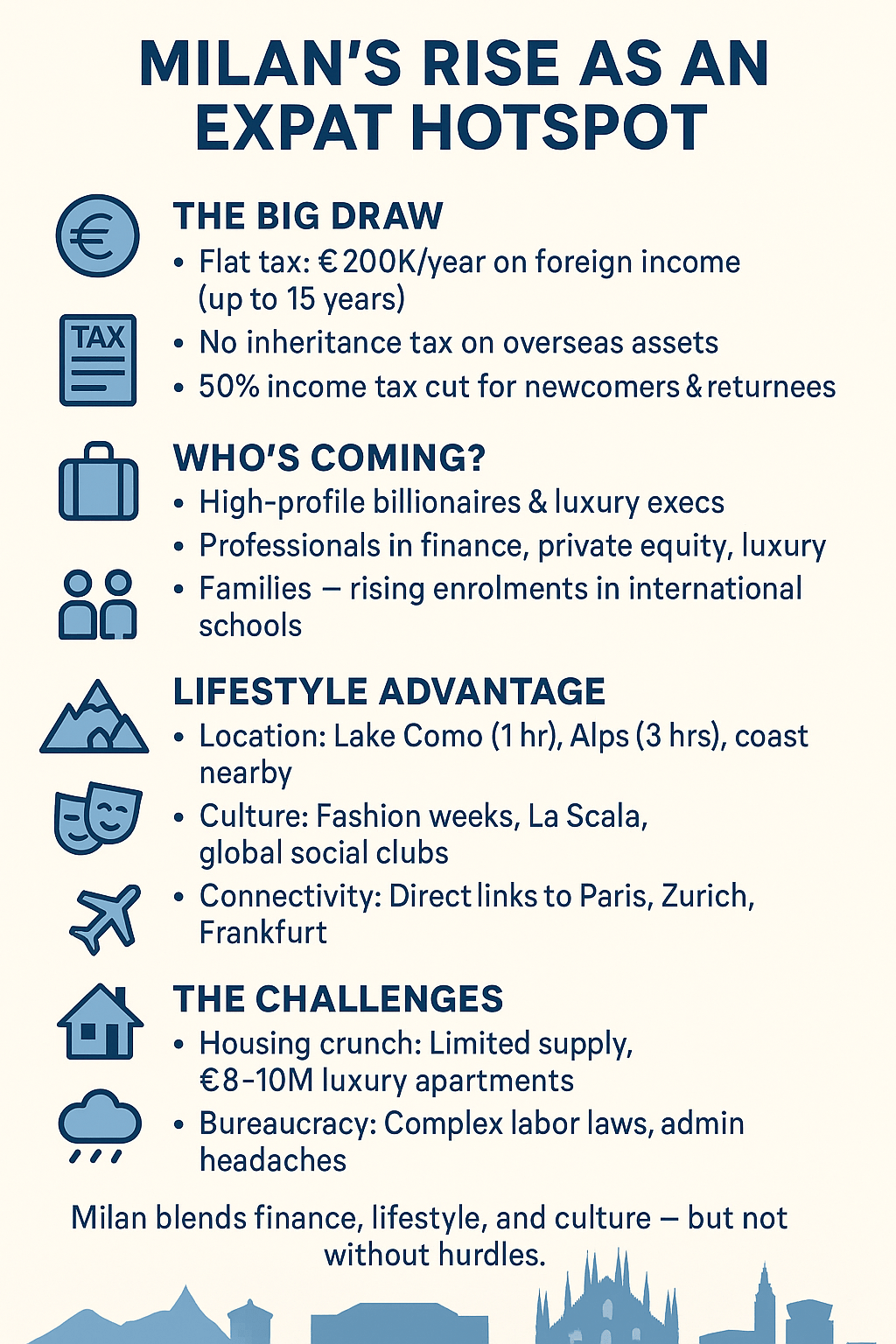
A second incentive targets returning Italians and incoming professionals with a 50% reduction on taxable Italian income for up to five years (longer in some cases). Together, these measures have turned Milan into a serious contender against traditional hubs like London and Geneva.
This shift has accelerated in the wake of the UK’s decision to abolish its long-standing non-dom regime, which previously shielded overseas assets and income. For many wealthy residents, Italy’s model now looks far more favourable.
02Who’s Moving to Milan?
The new arrivals are not only billionaires and celebrity entrepreneurs. While figures like Nassef Sawiris (Egypt’s richest man) and Frédéric Arnault (son of the LVMH CEO) have made headlines, the majority are senior professionals in sectors such as finance, private equity, and luxury goods.
Many are in their mid-40s to early-70s — a stage of life where the appeal of lifestyle, stability, and wealth preservation often outweighs the chase for aggressive career growth. Families are also part of the story. International schools in Milan report rising enrolments, with students arriving from the UK, the US, and France in particular.
A recent Financial Times report described the “explosion of arrivals” in Milan, noting that new residents now include well-known financiers, luxury executives, and globally mobile families drawn by Italy’s incentives and quality of life.
This new expat wave is adding layers of diversity to a city that, until recently, was seen as fairly insular compared to Rome or Florence.
03Milan as a Lifestyle Destination
Tax benefits might bring people to the table, but lifestyle often seals the deal. Milan is uniquely positioned to offer both urban energy and access to some of Europe’s most celebrated leisure destinations.
- Location: Lake Como is under an hour away, the Alps are within three hours, and the Mediterranean coast is easily reachable for weekend escapes.
- Connectivity: Milan’s airports and high-speed rail links make Paris, Zurich, and Frankfurt short flights or train rides away. Trenitalia’s high-speed services put much of Europe within easy reach.
- Culture: From opera at La Scala to fashion weeks and contemporary art galleries, Milan delivers cultural depth alongside its reputation for design.
- Social Scene: International members’ clubs such as Casa Cipriani and The Wilde have opened in recent years, joining Soho House, luxury hotels, and a growing roster of restaurants aimed at a global clientele.
For expats used to London or New York, Milan offers a similar cosmopolitan feel — but with aperitivo hours, slower Sundays, and a distinctly Italian sense of style.
04Expat Challenges in Milan
Relocating to Milan isn’t without complications, however:
- Housing: Demand far outstrips supply, particularly for high-end “trophy” apartments and penthouses. Prices for central properties with luxury amenities often start at €8–10 million. Prime rents have risen more than 14% in five years, and competition can be fierce.
- Authenticity: Some locals worry Milan is losing its traditional character. The arrival of London-salaried bankers and global social clubs has raised questions about affordability and identity.
- Bureaucracy: Italy’s labour laws and administrative processes can be notoriously complex. Even wealthy newcomers can find paperwork around visas, hiring, and compliance frustrating.
- Environment: Milan struggles with air quality and has fewer parks compared to other European capitals. The city also empties out during August, which can feel isolating for newcomers.
These challenges don’t negate Milan’s appeal, but they are worth factoring in for expats considering a move.
05The Real Estate Squeeze
One of the clearest signs of Milan’s changing fortunes is its real estate market. Luxury apartments in districts such as Brera, Quadrilatero della Moda, and Porta Nuova are in especially high demand.
International buyers, often accustomed to London’s Kensington or Paris’s 7th arrondissement, are willing to pay top prices. While Milan remains cheaper than London on a per-square-foot basis, the gap is closing fast. Developers have responded with new luxury projects, but supply still lags far behind demand.
High-end hotels such as the Four Seasons and Mandarin Oriental report suites occupied long-term by executives waiting for suitable properties. Some expats even choose to base themselves just over the Swiss border in Lugano, commuting into Milan for work.
06A City in Transition
Milan’s transformation is not just economic. The influx of international residents is reshaping the city’s culture and identity. New clubs and art spaces are appearing, English is more widely spoken in business circles, and the city is drawing global attention in ways not seen since the fashion booms of the 1980s and 1990s.
But the changes are uneven. While international newcomers bring investment and prestige, they also highlight Italy’s broader challenges. Economic growth lags behind other European countries, and young Italians still leave in search of opportunities abroad. For expats considering Milan, this means joining a city in flux: vibrant and glamorous, but still wrestling with structural hurdles.
07Is Milan the Right Move for You?
Milan is in the midst of a transformation—stylish, cosmopolitan, and alive with opportunity. The city is drawing global wealth and talent like never before, while still holding on to the culture, cuisine, and lifestyle that make Italy distinctive. For expats, its flat-tax regime and central location present strong incentives to relocate, though housing shortages, bureaucracy, and air quality remain real challenges. Still, if you’re looking for a European base that blends financial advantages with cultural vibrancy—and offers weekend escapes to Lake Como or the Alps—Milan could well be your next home.