
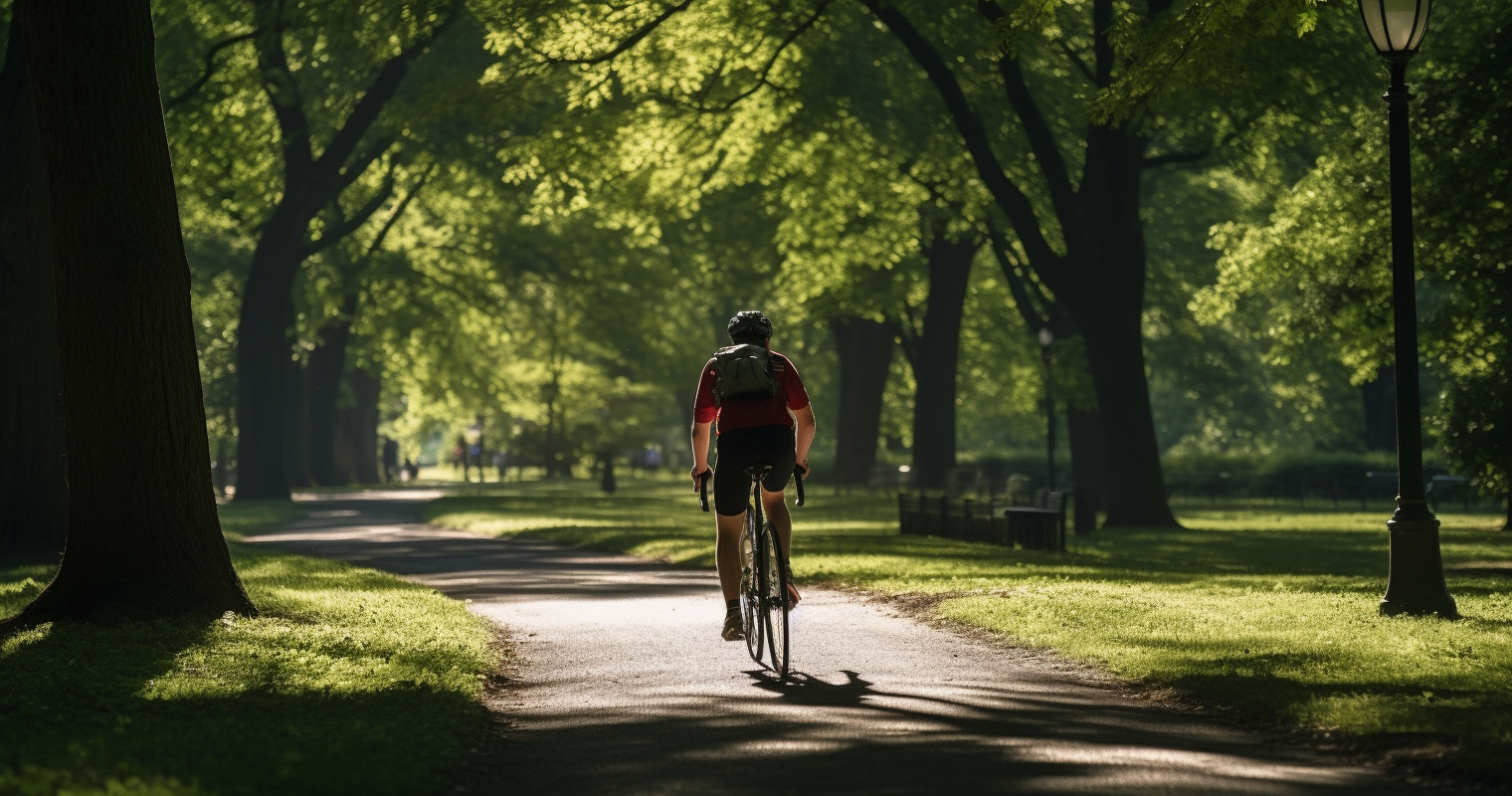
The UAE has emerged as a destination undergoing rapid transformation for those who ride bikes — cycling networks are growing at pace, especially across Dubai and Abu Dhabi, yet the activity continues to be seen primarily as a recreational or sporting pursuit rather than a routine way of getting from A to B. Scorching summer temperatures, road layouts built around the car, and a network that still has gaps mean that using a bike for everyday commuting is the exception rather than the rule, even as government-backed investment works to rewrite that story.
| Item | Details |
|---|---|
| Cycling network (Dubai) | 527+ km of cycling tracks; target of 1,000+ km by 2030 (as of 2024) |
| Cycling network (Abu Dhabi) | 621 km urban network in 2024; planned expansion to 1,270 km by 2028 |
| Helmet law | Legally required in Dubai (fine: AED 200); strongly recommended UAE-wide |
| Speed limit on cycle tracks | 30 km/h on designated tracks; 20 km/h on shared pedestrian–cycling paths |
| Careem Bike share (Dubai) | From AED 20/day, AED 75/month, AED 420/year (as of 2022–2023; verify current pricing) |
| Fine for cycling on roads ≥60 km/h | Up to AED 600 (Dubai) |
How popular is cycling in the UAE — is it a common way to get around?
For the vast majority of residents, cycling in the UAE belongs firmly in the world of sport and leisure rather than everyday transport. Whereas countries like the Netherlands and Denmark have spent decades cultivating cycling as a cornerstone of daily commuting — underpinned by the infrastructure and cultural norms to match — the UAE’s relationship with the bicycle has historically been shaped by blistering summer temperatures, sprawling cities built for cars, and a strong cultural preference for private motor vehicles. The direction of travel, however, is shifting.
The Bici UAE 2025 initiative represents a major policy commitment to cycling culture, sustainability, and active urban living across the country. Its aims include expanding cycling infrastructure, encouraging community engagement, and weaving electric bikes into the fabric of eco-conscious urban mobility. This marks a decisive move toward treating the bicycle as a genuine transport option rather than a purely weekend pursuit.
Dubai in particular is witnessing a growing appetite among residents for cycling, and considerable effort is going into adapting urban spaces for two-wheeled travel — encompassing everything from casual family rides to elite competitive racing. The UAE now caters to a broad spectrum of cyclists, and the community around the sport is vibrant. Group rides, clubs, and organised events are flourishing, and the country hosts the prestigious annual UAE Tour, a UCI WorldTour professional race that reflects just how seriously cycling is now taken in the region.
Obstacles have not disappeared, though. Climate, safety, and cultural familiarity with cyclists on roads continue to pose challenges, which authorities are tackling through shaded cycle lane design, tighter safety rules, and the promotion of e-bikes to make longer distances more manageable. In day-to-day reality, most expats ride recreationally — heading out in the early morning or evening during the cooler months — rather than swapping the car for a bike on their daily commute.
What is the cycling infrastructure like in the UAE?
Spending on cycling infrastructure has picked up considerably in recent years, though what is on offer differs markedly from one emirate to the next. Dubai and Abu Dhabi are well ahead of the field, while places like Sharjah, Ras Al Khaimah, and Fujairah offer a more modest picture.
In Abu Dhabi, the Department of Municipalities and Transport (DMT) is driving an ambitious programme under the Bike Abu Dhabi banner, channelling substantial investment into a network that ranges from scenic waterfront loops and desert trails to inner-city lanes and a world-class velodrome.
As part of the city’s broader urban mobility strategy, the DMT is working to extend the cycling network on Abu Dhabi Island to between 1,266 and 1,270 km by 2028, with the goal of stitching together every part of the island through safe, modern cycling routes. A dedicated 85 km corridor linking Abu Dhabi to Dubai is also in the pipeline, as is the Abu Dhabi Loop — a 109 km fully segregated and grade-separated cycling route threading together major urban centres across the capital.
Construction is already progressing on key arterials including Sheikh Zayed Bin Sultan Street, First Sheikh Sultan Bin Zayed Street, Sheikh Rashid Bin Saeed Street, and Saeed Bin Ahmed Al Otaiba Street, with these new connections intended to link communities and make cycling a more family-friendly option.
In Dubai, the bike-rental service gives residents and tourists access to a 527 km network of cycling tracks spread across the emirate. The Roads and Transport Authority (RTA) has set its sights on extending this to more than 1,000 km by 2030.
Newer sections of the Abu Dhabi network incorporate shaded stretches, directional signage, and supporting facilities — a pragmatic response to the UAE’s punishing heat. Dubai has similarly introduced road signs and lane markings that guide both cyclists and drivers, clarifying where two-wheeled users may travel, the applicable speed limits, and the direction of permitted movement.
For up-to-date maps and the latest developments, visit the Bike Abu Dhabi official website for Abu Dhabi and the Roads and Transport Authority (RTA) website for Dubai.
Is cycling safe in the UAE?
Road safety for cyclists in the UAE is a picture that continues to evolve. The significant growth in dedicated cycling infrastructure has meaningfully improved conditions, but venturing onto general roads outside marked cycling lanes still carries genuine risk. Driver awareness of cyclists is on an upward trend but remains patchy, and the prevalence of wide, fast roads engineered primarily for motor vehicles means that leaving a designated cycle track can be a hazardous experience.
According to The National News UAE, 109 cycling crashes were recorded over a two-year period, accounting for 4 percent of all road incidents in that time. This figure should be read as indicative rather than current — for the most recent road safety data, refer to the UAE Ministry of Interior or the police authority of the relevant emirate, and take note of the publication date of any figures you consult.
To maintain safety and orderly traffic flow, the DMT has laid out a clear framework: cyclists may use internal roads where the speed limit is 40 km/h or below, dedicated cycling and e-bike lanes, and shared pedestrian–cycling paths, but are barred from highways, pedestrian-only routes, and roads with limits above 60 km/h.
Heat is a hazard that deserves far more attention than it typically receives. Riding a bicycle in temperatures that routinely climb above 40°C carries real and serious health risks, and the majority of experienced UAE cyclists confine their outdoor sessions to the early morning or after sunset between June and September. Poor visibility during sandstorms — which can strike during the shamal season — is another condition that warrants particular caution on desert-adjacent routes.
On helmet legislation, Dubai mandates the wearing of a helmet by law, though this obligation does not extend in identical form across every emirate — nonetheless, wearing one is strongly advisable wherever you ride. Cyclists in Dubai who are caught riding without a helmet face a fine of AED 200 under Dubai Police traffic safety regulations.
What are the rules of the road for cyclists in the UAE?
Traffic law in the UAE is built on a federal framework, with each emirate also able to set its own rules. Dubai has the most fully developed regulatory environment for cyclists, codified in Executive Council Resolution No. 13 of 2022. In Abu Dhabi, cyclists are governed by regulations administered through the Department of Municipalities and Transport (DMT). As rules are updated on a regular basis, always confirm the current position directly with the relevant authority.
The principal rules applying across the UAE are as follows:
- Helmets: Regulations clearly require riders to wear a protective helmet, along with reflective clothing when cycling at night. In Dubai, riding without a helmet can attract a fine of AED 200.
- Road restrictions: Cycling is not permitted on most roads where the speed limit reaches 60 km/h or above — those found riding on such roads in Dubai may face a fine of up to AED 600.
- Lighting: Bicycles and electric bicycles must carry a white headlight at the front and a red taillight or red reflector at the rear when ridden at night, together with a handlebar-mounted sound-producing device and working brakes.
- Speed limits: The RTA has fixed the maximum speed for bicycles in Dubai at 30 km/h on dedicated cycling tracks, dropping to 20 km/h on private tracks or paths shared with pedestrians in urban areas.
- Road positioning: Cyclists must confine themselves to lanes and roads set aside for bicycle use; where no such lane exists, they must ride on side roads — typically subject to a 20 km/h limit — keeping as far to the right as possible.
- Prohibited acts: Holding onto another moving vehicle while cycling is strictly forbidden, as is riding against the direction of traffic under any circumstances.
- Riding conduct: Riding without both hands on the handlebars, or with only one hand, is prohibited. Cyclists must at all times ride in a manner that is safe for others — zigzagging and riding in ways that obstruct pedestrians are both offences.
- Mobile phones: Using a mobile phone while cycling is prohibited.
- Parking: Bikes must be parked only in designated areas; chaining them to traffic signal posts or street lighting columns is not permitted.
- Identification: Carrying identification and emergency contact information when cycling is strongly advised.
- No licence required: A driving licence is not needed to ride a bicycle in the UAE, but cyclists are still fully bound by traffic control rules and subject to penalties for violations.
Bear in mind that rules differ to some degree between emirates. For the full and current legal position in Dubai, consult the RTA website; for Abu Dhabi, refer to the DMT. The UAE Cycling Federation is also a useful point of reference for organised rides and group training requirements.
Do I need to register my bike or have insurance to cycle in the UAE?
There is no compulsory registration scheme for privately owned bicycles in the UAE. Standard pedal bikes do not require a number plate, registration document, or periodic roadworthiness check of any kind. As in most countries, ownership of a bicycle is established through a proof of purchase rather than through any official state register.
On the question of insurance, the regulations require rental operators to carry adequate insurance covering riders against road accidents — but for those who own their own bikes, insurance is not a legal requirement. That said, taking out cover is highly recommended. Most UAE insurers allow personal accident cover and third-party liability to be added to a home contents policy, protecting your bicycle against theft and damage while also providing cover should you cause injury or loss to another party in an accident.
Injuries sustained while cycling can be covered under a personal accident or health insurance policy, and combining these with home insurance can offer a more comprehensive safety net. This is especially worth thinking about in the UAE, where the healthcare system operates on a private insurance model rather than a tax-funded public one — unlike the NHS in the UK or Medicare in Australia. It is important to check your policy wording carefully, as some plans exclude injuries arising from non-motorised sports activities unless cover for those is explicitly included.
For current insurance requirements and the range of available products, consult the Central Bank of the UAE, which regulates the insurance industry, or seek guidance from a licensed UAE insurance broker.
Are there public bike-sharing or rental schemes in the UAE?
Dubai’s leading bike-share offering is Careem Bike, a joint initiative between the Roads and Transport Authority (RTA) and Careem. The scheme has expanded to encompass 950 pedal-assisted e-bikes and 95 stations, bringing the overall fleet to 1,750 bikes across 175 stations — a distinction it holds as the world’s first entirely pedal-assisted docked bike-share programme.
By January 2023, the RTA and Careem Bike had collectively celebrated 2.8 million trips since the service launched. Coverage spans a wide range of popular areas including the Marina, Jumeirah Beach, JLT, The Greens, Dubai Canal, Dubai Media City, Downtown Dubai, and Al Qudra, as well as residential neighbourhoods such as Al Karama and Al Mankhool.
Stations use solar-powered docking technology and are managed through the Careem BIKE app — users can unlock a bike by scanning a QR code or entering a five-digit access code. Membership tiers include a daily pass (AED 20), a weekly pass (AED 50), a monthly pass (AED 75), and an annual pass (AED 420, as of 2022). Always check the RTA Careem Bike page for the most up-to-date pricing, as these figures may have changed.
Riders must be at least 15 years old to use Careem Bike. For e-bikes hired from rental services, the minimum age rises to 18.
In Abu Dhabi, the Gocyc app-based bike-sharing service provides another option, enabling users to unlock and ride bikes at various points around the city. Cycling tracks span the emirate, with routes available at the Corniche, Al Hudayriyat Island, Al Wathba, and beyond. For the most current information on bike-share options in Abu Dhabi, visit the Bike Abu Dhabi official site.
Beyond Dubai and Abu Dhabi, formal public bike-share schemes are limited or absent altogether. Rental outlets do operate at popular cycling destinations — the Al Qudra cycle track, for instance, has a facility for visitors who want a single-occasion ride without bringing their own bike.
Where can I buy or service a bike in the UAE?
Cyclists looking to purchase a bike in the UAE will find a well-stocked retail market, particularly across Dubai and Abu Dhabi. Both cities host dedicated specialist cycle shops carrying major international brands such as Trek, Giant, Specialized, Merida, and Cannondale, alongside a healthy range of accessories and cycling apparel. Sports-oriented malls and leisure precincts are generally the most reliable areas to find shops that combine a wide range of stock with professional servicing.
Notable specialist retailers include The Cycle Hub, Adventure HQ, and Sun & Sand Sports, all of which run multiple branches across the UAE and provide bike servicing and repairs in addition to sales. For those on a tighter budget or looking for a basic commuter bike, large hypermarkets including Carrefour and LuLu Hypermarket stock affordable entry-level options — though the product range and after-sales support naturally fall short of what a dedicated cycle shop can provide.
The second-hand market also offers excellent value, particularly on platforms like Dubizzle — the UAE counterpart of sites such as Gumtree or Craigslist — where departing expats regularly list quality bikes at well below retail prices. This route is especially practical for newcomers who want to explore cycling in the UAE before deciding how much to invest in their setup.
Consumer protections in the UAE are governed by Ministry of Economy regulations. New bicycles bought from registered retailers carry a manufacturer warranty, and the UAE’s Consumer Protection Law offers broad safeguards against faulty products — broadly equivalent to EU-level consumer rights frameworks. Retaining receipts and warranty paperwork, as you would when buying from any reputable retailer, will help ensure you have recourse if problems arise.
Can I bring my bike when I move to the UAE, and are there any import rules?
Relocating to the UAE with your personal bicycle is generally a uncomplicated process. When a bike is brought in as part of a household goods consignment at the point of relocation, it is typically treated as a used personal effect and exempt from customs duties, provided it qualifies under the UAE’s personal effects exemption for incoming residents.
The UAE levies a standard 5% customs duty on most imported goods under the GCC Common Customs Law. However, personal effects and household goods belonging to people relocating to the UAE are generally exempt from this duty under certain conditions — the items must have been in use for a minimum period and must not be intended for commercial sale. A bicycle correctly packed within a household removal and declared as a personal effect should ordinarily pass through customs without a duty charge, though this outcome is not guaranteed and depends on accurate documentation.
Where a bicycle is shipped independently rather than as part of a household removal, it may be subject to the standard 5% import duty. On a high-value performance bike, this could amount to a notable sum, so it is worth factoring this into any decision about whether to import or purchase locally. E-bikes may attract additional requirements, given UAE regulations on electric mobility devices.
Always declare your bicycle accurately on customs documentation and keep proof of prior ownership — purchase receipts and serial number records are both useful. For authoritative and up-to-date guidance on personal effects and import duties, consult the Federal Customs Authority of the UAE or the customs department at your emirate of entry. Your removal company or freight forwarder will also have experience navigating this process and can advise on the paperwork needed.
What are the best cycling routes or destinations in the UAE?
The UAE presents a wide variety of cycling environments — purpose-built urban tracks, iconic motorsport venues, mountain trails, and open desert routes all feature in the mix. The window of ideal riding conditions falls between October and April, when temperatures are pleasant and the risk of heat-related illness is relatively low.
- Al Qudra Cycle Track, Dubai: Widely known simply as the Al Qudra Cycle Track, this 86 km loop takes riders deep into the Al Qudra desert landscape. The route is equipped with rest stations featuring benches and shade, with restrooms located at the intersection of Bab Al Shams Road and Al Qudra Road.
- Jumeirah Beach Road, Dubai: Riding along Jumeirah Beach Road combines an enjoyable glimpse of Dubai’s coastal scenery with well-maintained pathways and handy amenities, making it equally appealing to leisurely riders and more dedicated cyclists.
- Dubai Canal: The Dubai Canal winds through Sheikh Zayed Road, Safa Park, and Jumeirah — a 3.2 km scenic waterway extension that provides a lively and visually striking setting for a cycling excursion.
- Mushrif Park, Dubai: Mushrif Park features a Green trail, Blue trail, and Red trail catering to different levels of ability. One of the country’s oldest parks, it sits on Khawaneej Road in Mirdiff and stretches across 1,300 acres, including a 5 km cycling circuit.
- Yas Marina Circuit, Abu Dhabi: The Yas Marina Circuit on Yas Island — home to the Formula 1 Abu Dhabi Grand Prix — opens its 5.5 km loop to walkers, runners, and cyclists, with the interior section designated for bike use, making it a genuinely unique riding experience.
- Abu Dhabi Corniche and Al Hudayriyat Island: Cycling infrastructure runs throughout Abu Dhabi emirate, with routes at the Corniche, Al Hudayriyat Island, and Al Wathba among the most popular, all set to benefit further as the network expansion continues.
- Shawka Mountain Bike Trail, Ras Al Khaimah: Situated between the Shawka Dam and a picturesque natural pool, this mountain bike trail attracts off-road enthusiasts with a roughly 10 km round trip that blends challenging terrain with outstanding scenery.
- Jebel Hafeet, Al Ain: The climb up Jebel Hafeet is a bucket-list ascent for road cyclists, featuring an 11% average gradient over approximately 10 km of winding road that rewards riders with sweeping views across the desert — and features as a stage finish on the professional UAE Tour each year.
The UAE Cycling Federation is the national governing body for the sport and organises regular competitive and community events, including the UAE Road Cycling Championship. Their website, along with the Visit Dubai and Visit Abu Dhabi tourism portals, are excellent starting points for route planning and finding out about upcoming events.
Frequently asked questions about cycling in the UAE
Is cycling a practical way to commute to work in the UAE?
For most people, cycling does not yet function as a fully practical option for all commuting journeys — roads designed around cars, intense summer heat, and network gaps in certain areas all remain genuine obstacles. That said, for shorter trips in areas where dedicated infrastructure is well developed, such as parts of Dubai and Abu Dhabi, using a bike for the first or last leg of a journey in combination with public transport is increasingly workable, particularly outside the summer months. The RTA actively positions cycling as a complement to metro and bus travel.
Is it legal to cycle on pavements in the UAE?
Cyclists are restricted to lanes and roads set aside for bicycle use. Where no such lane exists, they must ride on side roads — usually with a 20 km/h limit — keeping to the far right, or use pavements explicitly designated for cycling. Riding on pavements intended solely for pedestrians is generally not permitted. Specific rules vary between emirates, so it is worth checking with the relevant local authority for your location.
Do I need a licence to ride a bicycle in the UAE?
No licence is needed to ride a bicycle in the UAE. It is, however, essential to understand the rules that apply to cyclists. Riders are still obliged to follow all traffic regulations, respect road signs, and observe any conditions specific to the route they are using.
Is cycling safe in summer in the UAE?
Cycling outdoors during the UAE summer — broadly June to September — poses serious risks of heat exhaustion and heatstroke, with temperatures consistently surpassing 40°C and potentially extreme humidity levels. Most seasoned UAE cyclists either stop riding outdoors altogether in the peak summer period, limit themselves to very early morning or night sessions, or switch to indoor facilities. Always carry sufficient water, plan your route around available shade, and review temperature and humidity conditions before heading out during the warmer parts of the year.
Are electric bikes (e-bikes) allowed in the UAE?
E-bikes are permitted in the UAE within areas designated by the relevant transport authority. Any electric bicycle operated on a commercial basis must be equipped with a GPS tracking device that meets approved technical specifications. For privately owned e-bikes, riders should confirm which roads and tracks are accessible with the RTA in Dubai or the DMT in Abu Dhabi, as the rules that apply to e-bikes differ in some respects from those governing standard pedal cycles.
How do I find cycling groups or clubs in the UAE?
Connecting with local riding groups is one of the best ways to improve both your safety awareness and your knowledge of the best routes. The UAE has an active and welcoming cycling community, with clubs and informal groups in Dubai, Abu Dhabi, and Sharjah. Most organise early-morning rides at weekends and are straightforward to find via social media or through local sports clubs. The UAE Cycling Federation supports amateur racing and events, and retailers such as The Cycle Hub publish regular group ride schedules.
Can I lock my bike securely in UAE cities?
Bike theft does take place in the UAE despite the country’s strict legal penalties — always use a quality lock and park in a designated area rather than leaving your bike unsecured in a public space. Dedicated cycle parking exists at tracks, parks, and near metro stations, though coverage is less extensive than in cities with long-established cycling cultures. A robust D-lock is the recommended minimum, particularly in busy or high-footfall locations.
What is the weather like for cycling in the UAE, and when is the best time to ride?
The ideal riding season stretches from October through to April, when daytime temperatures settle in the region of 18–28°C and humidity drops to more comfortable levels. Between May and September, midday heat regularly exceeds 40°C and makes outdoor exercise genuinely hazardous. Even in the cooler season, early morning starts are the preference of most serious cyclists. Sandstorms occur throughout the year but are most frequent in spring, so checking conditions before heading out to exposed desert routes like Al Qudra is always a sensible precaution.