
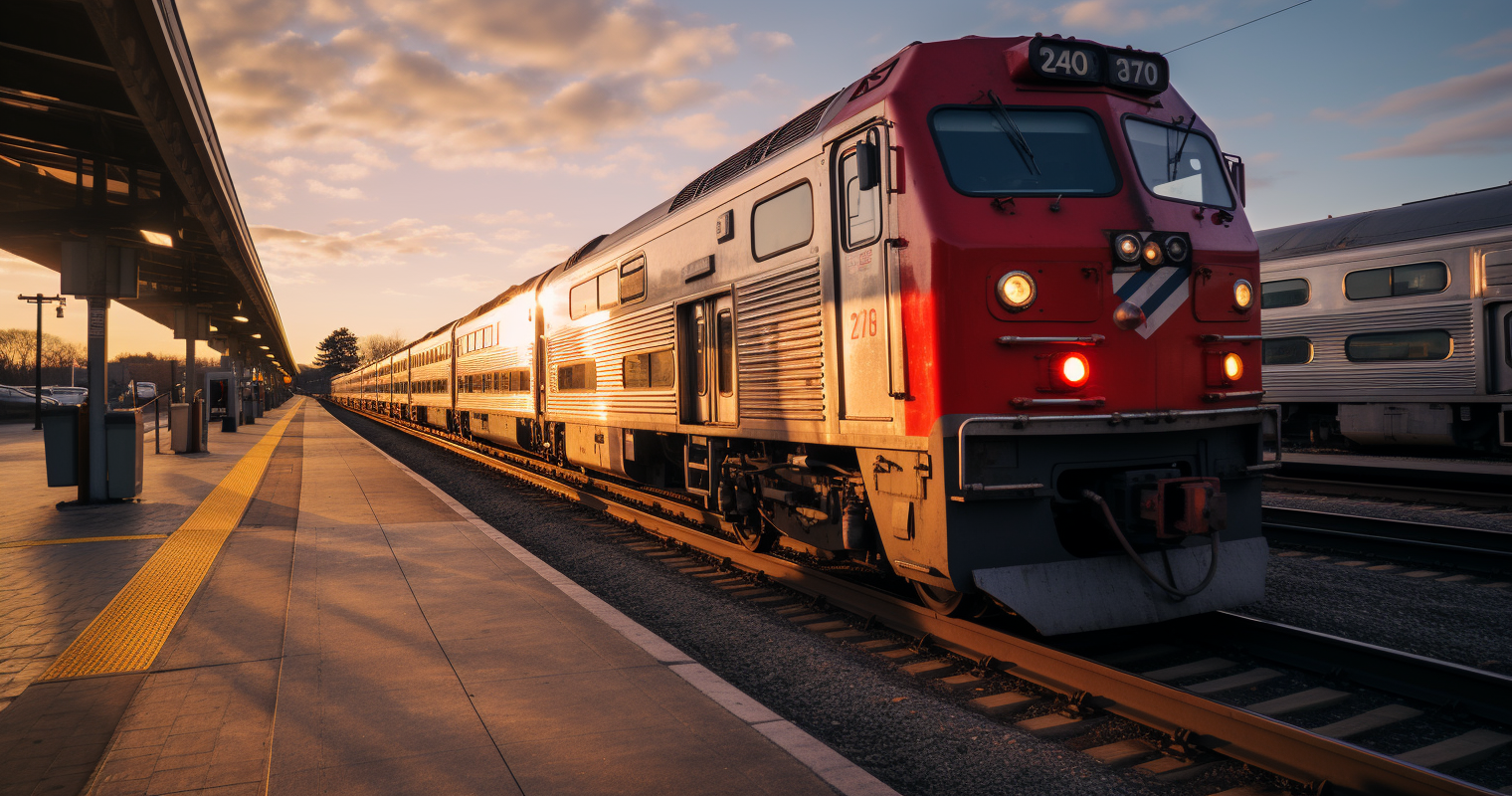
VIA Rail, Canada’s national passenger rail operator, runs a network spanning roughly 12,500 kilometres and serving more than 400 communities from the Atlantic to the Pacific. Although it provides a pleasurable and unhurried way to cover vast distances, punctuality has been an ongoing concern and the network is poorly suited to everyday commuting beyond a small number of urban corridors. Major centres such as Toronto, Montréal, and Vancouver each maintain their own independent transit systems for daily travel.
| Item | Details |
|---|---|
| National rail operator | VIA Rail Canada (Crown corporation) |
| Network size | ~12,500 km; 400+ communities served |
| Annual ridership | 4.4 million passengers (2024) |
| On-time performance | ~51% full-year average (2024); dropped to 30% in Q1 2025 |
| Ticket booking | Online at viarail.ca, mobile app, phone, or station ticket office |
| Key discount schemes (as of 2025) | CAA members (20% off), Canadian military (25% off), Indigenous communities (33% off), youth/student fares, group rates |
What is the overall standard of rail travel in Canada?
VIA Rail Canada is a federal Crown corporation tasked with delivering national passenger rail services on behalf of the Government of Canada, including intercity connections and routes serving regional and remote communities. Since it was founded in 1977, VIA Rail has run Canada’s national passenger network across routes in the Windsor–Québec City Corridor, long-haul services in both Eastern and Western Canada, and connections to isolated communities — operating around 400 trains weekly over approximately 12,500 kilometres of track.
When held up against the dense, high-frequency rail networks of countries like Germany, Japan, or the Netherlands — where intercity trains depart hourly or more often and punctuality consistently exceeds 80–90% — Canada’s rail network is considerably more constrained in both reach and reliability. The sheer geographic scale of Canada combined with its sparse population distribution makes the economics of building a comprehensive rail network fundamentally different. The system is best thought of as a long-distance and regional service rather than a high-speed commuter backbone.
Over the past decade, VIA Rail has struggled to improve its punctuality record, with on-time performance collapsing to just 30% in the first quarter of 2025. The annual average fell to 51% in 2024, down sharply from 71% in 2015. A fundamental structural problem underlies these figures: VIA Rail owns only 3% of the track it operates on, with the remainder largely controlled by Canada’s two dominant freight railways and regional transit operators. Passenger trains are therefore routinely held up by freight movements — a situation that stands in stark contrast to European or Japanese systems where dedicated passenger infrastructure is standard.
Persistent service difficulties have been particularly visible in the Québec City–Windsor corridor, where new infrastructure regulations introduced in October 2024 further undermined on-time performance. Nevertheless, 2024 marked a significant turning point, with VIA Rail completing the rollout of its new train fleet across Southwestern Ontario — a modern fleet expected to extend across the entire Québec City–Windsor corridor by summer 2025.
Looking further ahead, in February 2025 the federal government announced that the VIA HFR (High Frequency Rail) project had been rebranded as “Alto,” a planned high-speed rail network linking Toronto and Québec City. This represents considerable ambition for the future, though construction remains in the early planning phase. For expats settling in Canada today, the practical picture is that rail travel is best reserved for leisure and occasional intercity trips, while urban transit or private vehicles remain the norm for daily commuting.
What classes of rail travel are available in Canada, and what are the differences between them?
VIA Rail structures its service classes differently depending on the route. The range of available accommodation is far broader on long-distance trains such as The Canadian (Toronto to Vancouver) or The Ocean (Montréal to Halifax) than on shorter corridor services along the Windsor–Québec City route.
On corridor routes (for example Toronto–Montréal or Toronto–Ottawa), passengers choose between Economy and Business class. Economy class offers comfortable reserved seating, complimentary Wi-Fi, and use of the onboard café. Business class provides wider seats, meal service delivered to your seat, complimentary drinks, and priority boarding. The newest corridor trains bring enhanced passenger amenities, including ergonomic seating, a smoother ride, and better connectivity — catering equally to leisure and business travellers.
On long-distance trains such as The Canadian, the class hierarchy is considerably more elaborate. Economy (coach) seating is the entry-level option, suitable for budget-conscious travellers or those covering shorter segments. Sleeper Plus class grants access to private or semi-private sleeping berths, all meals in the dining car, and entry to the dome car — a glass-roofed carriage affording sweeping views of the prairies and Rocky Mountains. Prestige class, exclusive to The Canadian, is the most luxurious offering: a spacious private suite with a full en-suite bathroom, premium bedding, and dedicated personal service. VIA Rail also sells flexible fares and curated packages tailored to business trips, group travel, family holidays, and all-inclusive journeys.
The price gap between classes can be considerable, especially on long-distance routes where Sleeper Plus and Prestige fares bundle in meals and sleeping accommodation. For those riding The Canadian primarily to enjoy the scenery, Sleeper Plus is broadly considered excellent value relative to what separate hotel accommodation along the route would cost. Always consult the VIA Rail classes and services page for the latest details on your specific route, as inclusions differ.
Where can you find rail timetables and ticket prices in Canada?
The most accurate and up-to-date source for schedules, route details, and current fares is the official VIA Rail website at viarail.ca. The site lets you search by departure point, destination, and travel date to view available services and live pricing. Because fares are set dynamically and can shift frequently, always consult the official site directly rather than relying on third-party guides for precise figures.
VIA Rail’s fare comparison tool helps travellers plan journeys and evaluate fares and conditions side by side, including baggage allowances and services across different fare types. The Fares & Conditions page is especially valuable for understanding exactly what each ticket tier covers and what the rules are for refunds or exchanges before you commit to a purchase.
Urban transit systems operate separately from VIA Rail, with each city running its own authority and its own timetable and ticketing information. Key websites include TTC (Toronto), STM (Montréal), TransLink (Vancouver), OC Transpo (Ottawa), and ETS (Edmonton). Transport Canada, the federal transport authority, provides a national overview of transport policy at tc.canada.ca.
Given that fares and timetables are subject to revision — particularly in light of ongoing infrastructure upgrades and fleet renewal programmes — always confirm current information through official channels before travelling or calculating journey costs.
How do you buy rail tickets in Canada, and can you book in advance?
VIA Rail offers several purchasing channels, and booking ahead is both possible and advisable — especially for long-distance routes and during busy travel periods. Booking windows can open months in advance, and fares on popular services like The Canadian tend to climb as the departure date nears, much like airline ticket pricing.
- Online at viarail.ca: The primary booking channel. Head to viarail.ca/en/plan/book-travel, enter your route and travel dates, choose your fare class, and pay by credit or debit card. E-tickets are generated instantly and can be used on a mobile device.
- VIA Rail mobile app: Launched in 2024, VIA Rail’s mobile app lets passengers search routes, purchase tickets, manage existing bookings, and retrieve digital tickets directly from a smartphone.
- By telephone: VIA Rail’s customer service team is available to assist with phone bookings for those who prefer this method or require additional help. Contact information is listed on the VIA Rail website.
- At station ticket offices: The majority of major VIA Rail stations have staffed counters where tickets can be purchased or collected in person. Opening hours vary, so it is worth checking ahead for smaller or less frequently served stations.
- Through travel agents: Conventional travel agents and certain tour operators are able to book VIA Rail tickets, particularly for bundled rail holiday packages on long-distance routes.
E-tickets are widely accepted and can simply be displayed on a phone screen at the platform or to staff onboard, so there is generally no need to print anything. For long-distance sleeper services, booking weeks or even months ahead is strongly recommended, as popular dates and premium berths sell out rapidly. Corridor routes such as Toronto–Ottawa can often be booked a few days before travel, though purchasing in advance usually secures a better fare.
What types of rail tickets are available in Canada, and are there discount schemes?
VIA Rail applies a tiered fare structure broadly comparable to airline pricing — the earlier you book and the more restrictive your ticket, the less you pay. Refund and exchange policies differ by fare tier. Escape fares are non-exchangeable and non-refundable. Economy fares permit exchanges subject to fees and allow partial refunds; Economy Plus fares are both exchangeable and fully refundable. Business fares carry exchange fees and partial refunds; Business Plus is fully refundable.
The principal fare types on corridor routes are:
- Escape: The cheapest option, but completely non-refundable and non-exchangeable — best suited to travellers with firm, unchangeable plans.
- Economy: The standard tier, with limited exchange options and partial refund eligibility.
- Economy Plus: Fully refundable and exchangeable, making it a sensible choice for those with flexible or uncertain travel plans.
- Business / Business Plus: Premium seating with at-seat meal service; the Plus variant is fully refundable.
On long-distance trains, discounted Sleeper Plus fares carry a 10% change fee, while standard Sleeper Plus fares are fully refundable. Prestige class is fully refundable when cancelled more than 90 days before departure.
VIA Rail provides a range of discount programmes covering Indigenous communities, Canadian military personnel, groups, and corporate travellers. As of 2025, the main standing discounts are:
- CAA members: 20% reduction on fares to all destinations.
- Canadian military: 25% discount for military personnel and their families.
- Indigenous communities: 33% off fares.
- Groups: Discounted fares for parties of 10 or more; group leaders receive one complimentary ticket for every 20 Economy class tickets purchased (up to a maximum of 4 free tickets per booking).
- Youth/student fares: VIA Rail offers reduced pricing for young people and students; consult the students and youth page for current rates, which are updated periodically.
The federal government committed to launching a “Canada Strong Pass” offering free travel on VIA Rail for children and youth under 18, alongside discounted fares for those aged 18–24, available from mid-June to September 2025. Visit the Canada Strong Pass page for information on any future versions of this initiative. All fees and discount thresholds cited here reflect the position as of 2025; confirm current figures directly with VIA Rail prior to booking.
How accessible is the rail network in Canada for disabled passengers?
VIA Rail has placed accessibility among its stated priorities and is working to build a more inclusive service. Its newest trains have been designed with accessibility as a central consideration, incorporating improved boarding mechanisms, ergonomic seating, a smoother ride, brighter cabin interiors, and faster Wi-Fi. That said, as with many large national networks, the practical level of accessibility can vary significantly depending on the age of the rolling stock used on any given route and the facilities available at individual stations.
Federal funding commitments, including measures announced in Budget 2024, support VIA Rail’s accessibility ambitions — among them funding to renew VIA Rail’s pan-Canadian fleet, which will bring universally accessible modern trains to routes across the country from 2032 onwards. VIA Rail’s 2026–2029 Accessibility Plan is publicly available for consultation on its website.
In day-to-day practice, passengers who require assistance are encouraged to contact VIA Rail before travelling. The carrier provides onboard wheelchair spaces, accessible washrooms on suitably equipped trains, audio and visual announcements, and staff assistance for boarding and alighting at staffed stations. For passengers travelling with a personal attendant, VIA Rail’s policy allows the attendant to travel at a reduced fare on certain bookings — check the VIA Rail accessibility page for full details and to arrange any required support ahead of your journey.
Compared to fully modernised networks like those in the Netherlands or Japan — where step-free access is virtually universal and accessibility information is readily available through apps in real time — Canada’s provision is less uniform, particularly on older long-distance rolling stock and at smaller rural stations. The newest corridor trains represent a meaningful step forward, and the broader fleet renewal programme is expected to raise standards substantially across the network over the next decade.
Are there metro or urban rail systems in Canada’s cities?
Each of Canada’s major cities operates its own urban transit network, entirely separate from VIA Rail. These are the systems that most residents rely on for daily travel, and they differ considerably in both scale and quality.
| City | System(s) | Type | Website |
|---|---|---|---|
| Toronto | TTC Subway; GO Transit; UP Express | Metro, regional rail, airport rail | ttc.ca / gotransit.com |
| Montréal | STM Métro; REM (Réseau express métropolitain) | Metro, light metro | stm.info |
| Vancouver | SkyTrain; West Coast Express; SeaBus | Automated light metro, commuter rail, ferry | translink.ca |
| Ottawa | OC Transpo O-Train (Confederation Line) | Light rail | octranspo.com |
| Calgary | Calgary CTrain | Light rail | calgarytransit.com |
| Edmonton | Edmonton LRT (Valley Line, Capital Line) | Light rail | edmonton.ca/ets |
Toronto has the most extensive urban rail offering. The TTC runs four subway lines, while GO Transit — operated by Metrolinx — delivers regional commuter rail connecting Toronto with surrounding municipalities across the Greater Toronto Area (GTA). The UP Express provides a dedicated rail link between Union Station and Pearson International Airport. Both the TTC and GO Transit, along with many other regional services in Ontario, accept contactless payment and the PRESTO smart card.
Vancouver’s SkyTrain is widely regarded as one of North America’s finest urban rail networks: fully automated, frequent, and reaching across much of Metro Vancouver. Post-secondary students in the Metro Vancouver region can access subsidised transit through the U-Pass BC programme, which covers buses, SeaBus, and SkyTrain services as well as discounts on the West Coast Express. TransLink’s Compass Card is the standard contactless travel card for travel throughout the Vancouver region.
Montréal’s STM Métro is a long-established rubber-tyred metro system, now supplemented by the newer Réseau express métropolitain (REM), an automated light metro extending into the broader Montréal area. Urban transit systems do not integrate directly with VIA Rail ticketing, though the main VIA Rail stations in cities such as Toronto (Union Station) and Montréal (Gare Centrale) are directly connected to metro and commuter rail networks, making transfers straightforward.
What should expats know about using the rail network day-to-day in Canada?
Canada is officially bilingual at the federal level, so VIA Rail provides all information, signage, and onboard announcements in both English and French. Major station signage is bilingual, and staff at larger stations can assist in either language. French predominates in Québec, while English is more commonly used elsewhere. Urban transit systems in Montréal function primarily in French, whereas those in Toronto and Vancouver operate in English.
On VIA Rail services, seat reservations are required as a standard practice — in contrast to some European rail systems that allow open seating. When you book, you choose your seat at the time of purchase. Noting your car number before boarding will help avoid confusion, particularly on longer trains. Boarding is generally smooth, with tickets checked either at the gate or by staff onboard.
Baggage policies depend on the service and class. Corridor train passengers are typically permitted two carry-on items and two checked bags, with restrictions on size and weight. Long-distance trains with sleeping accommodation offer more generous allowances. Fees apply for excess or oversized items. Review the VIA Rail fees and optional services page for up-to-date baggage rules ahead of your journey.
Long-distance trains including The Canadian feature a dining car and a dome observation car. Dining car meals are included for Sleeper Plus and Prestige passengers, while those in Economy can buy food from the café car. The atmosphere on long-distance services is notably unhurried — passengers frequently congregate in the dome car to take in the passing landscape, giving these journeys a character closer to a voyage than a transit trip.
For urban transit, most cities now accommodate contactless bank card payments alongside transit-specific smart cards such as PRESTO in Ontario and the Compass Card in Vancouver. Downloading the relevant local transit app before you arrive is a practical first move: tools such as the TTC app, Moovit, and Google Maps all provide real-time arrivals and journey planning for Canadian urban transit. On VIA Rail intercity services, complimentary Wi-Fi is available, though connection speeds and reliability can be patchy on the more remote stretches of long-distance routes.
Frequently asked questions about rail travel in Canada
Is VIA Rail suitable for commuting to work every day?
For the vast majority of residents, VIA Rail is not a practical commuting option — it functions primarily as an intercity and long-distance service. Everyday commuting is served by urban transit systems (metro, light rail, and bus networks) or, in some cities, dedicated commuter rail such as GO Transit in the Greater Toronto Area. If you are based in a city like Toronto, Vancouver, or Montréal, your routine travel needs will be met by the local urban transit network rather than VIA Rail.
How punctual are VIA Rail trains?
Punctuality has been a persistent problem for VIA Rail, with on-time performance falling to just 30% in the first quarter of 2025. The annual average dropped to 51% in 2024, compared with 71% in 2015. Delays are most frequent along the Québec City–Windsor corridor owing to the network’s shared use of freight railway infrastructure. Expats arriving from countries with highly reliable rail systems — such as Germany, Switzerland, or Japan — should calibrate their expectations accordingly when planning Canadian rail journeys.
Can I travel by train from Toronto to Vancouver?
Yes. The Canadian is VIA Rail’s iconic transcontinental service, running between Toronto and Vancouver with stops including Winnipeg, Saskatoon, Edmonton, and Jasper. The journey spans roughly three to four days. It is fundamentally a scenic and leisure experience rather than a quick travel option, and the stretch through the Rocky Mountains draws travellers from around the world. Early booking is strongly advised, as sleeping berths — particularly in summer — sell out well in advance.
Are rail tickets cheaper if booked in advance in Canada?
Yes. VIA Rail operates a dynamic pricing model, which means fares tend to increase as the travel date draws closer. Booking early — especially for Escape-tier fares — gives you access to the lowest prices, though these fares cannot be refunded or changed. If there is any chance your plans might shift, Economy Plus or Business Plus fares are worth considering, as they allow full refunds and exchanges, albeit at a higher initial cost.
Does VIA Rail offer a rail pass for tourists or new residents exploring Canada?
VIA Rail has previously offered the Canrailpass, which provided unlimited travel across the network for a fixed number of journey days within a specified period. Pass products are revised periodically, so check the VIA Rail fares and packages page for any active pass or multi-journey deals. The government-supported Canada Strong Pass provided free or reduced-cost travel for young people during summer 2025 — visit the official site for information on any future versions of the scheme.
How do I get from the airport to the city centre by rail?
The options differ by city. In Toronto, the UP Express runs between Pearson International Airport and Union Station in around 25 minutes. In Vancouver, the Canada Line (SkyTrain) connects Vancouver International Airport directly to the city centre. In Montréal, the REM’s airport branch offers a rail link into the city. Direct rail connections are not available at every Canadian airport, so it is worth checking the relevant transit authority’s website for your destination before you travel.
What is the best way to get real-time journey updates on VIA Rail?
VIA Rail’s mobile app, launched in 2024, offers booking, ticket management, and live service updates. The VIA Rail website also posts service alerts. For urban transit, each city’s dedicated app — such as the TTC app for Toronto — along with the Transit app and Google Maps all provide real-time departure information. Monitoring VIA Rail’s official social media accounts can also be a useful way to stay informed about disruptions on long-distance routes.
Is rail travel in Canada accessible for wheelchair users?
VIA Rail offers a range of accessibility provisions, including onboard wheelchair spaces, accessible washrooms on appropriately equipped trains, and station staff assistance for boarding and alighting. Federal investment will bring fully accessible modern trains to pan-Canadian routes from 2032 onwards. Passengers requiring assistance are encouraged to contact VIA Rail ahead of their journey and to consult the VIA Rail accessibility page for comprehensive guidance. Accessibility at urban metro stations varies across cities and lines; newer systems such as Vancouver’s SkyTrain and Montréal’s REM offer high standards of step-free access, while certain older metro stations may present more limited options.