
Moving abroad for the first time is exciting, but it can also feel overwhelming. You are not just relocating physically — you are navigating new legal systems, unfamiliar healthcare, financial complexity, language barriers and cultural differences, often all at once. For first-time expats, that learning curve can be steep. AI tools cannot replace official guidance or professional advice, but they can make the process far more manageable. Used thoughtfully, AI can help expats research faster, organise their plans more effectively, and approach big decisions with greater confidence. From early destination research to settling into daily life, AI tools now form a practical support system for anyone preparing to move abroad.
01Using AI to Plan Your Move Abroad
AI tools are particularly useful during the early planning stages, when first-time expats are trying to understand their options and narrow down decisions.
General-purpose AI platforms such as ChatGPT and Claude are increasingly used as starting points for relocation research. Rather than trawling through dozens of websites, these tools can summarise complex topics such as visa options, cost-of-living differences, healthcare systems and cultural norms in plain language.
First-time expats commonly use AI at this stage to:
- create personalised relocation checklists and timelines
- compare countries or cities by cost, lifestyle, climate and safety
- identify common mistakes people make when moving abroad
- prioritise research before committing to a destination
Many expats also use AI to build a “first 30 days” checklist covering tasks such as registering with local authorities, enrolling children in school, opening a bank account or setting up utilities.
AI-driven destination-matching platforms can also help narrow the field. Tools such as WhichCountryToMoveTo use questionnaires and algorithmic matching to suggest countries based on income, lifestyle preferences and long-term goals. These tools are best used as an early filtering step rather than a final decision-maker.
If you plan to use ChatGPT as part of your research, this Expat Focus guide provides practical examples of how to ask better questions: 25 ChatGPT Prompts Every Expat Should Use Before Moving Abroad.
02Overcoming Language Barriers with AI
Language barriers are one of the most immediate challenges new expats face, particularly in the early weeks after arrival. AI-powered translation tools have become far more accurate and natural, making everyday interactions significantly easier.
Tools such as DeepL, Google Translate and Microsoft Translator are widely used to understand official letters, contracts and basic forms, especially when dealing with immigration offices, landlords or schools. On a day-to-day level, they also help expats navigate menus, signage and simple conversations, reducing stress and building confidence more quickly.
Beyond translation, many first-time expats use AI as a language-learning and confidence-building aid. Chat-based AI tools are commonly used to practise everyday conversations, ask grammar questions in plain English, or rehearse real-life situations such as registering with a doctor or opening a bank account. This low-pressure practice can make face-to-face interactions feel less intimidating, particularly in the early months abroad.
03Managing Finances and Administration with AI
Financial and administrative systems are often among the most confusing aspects of moving abroad, particularly for expats dealing with multiple currencies or ongoing obligations in their home country.
While many financial platforms do not explicitly market themselves as AI tools, artificial intelligence increasingly underpins features such as automated spending categorisation, fraud detection and budgeting insights. Multi-currency services such as Wise and Revolut use AI-driven systems to streamline cross-border transactions, flag unusual activity and provide real-time spending insights — all especially useful during the transition period of a move abroad.
AI can also help first-time expats make sense of unfamiliar administrative concepts such as tax residency, social security agreements or local insurance requirements by explaining them in straightforward language. This can provide valuable background understanding, but it should never replace professional advice, particularly for complex areas such as US expat taxation, pensions or business ownership abroad.
04AI Tools for Remote Work and Productivity
For expats who work remotely, freelance or run businesses abroad, AI-powered productivity tools can help maintain structure during what is often a disruptive period.
Platforms such as Notion and Trello now include AI features that assist with organising work tasks alongside relocation planning, summarising notes and documents, and managing projects across time zones. Many expats use these tools to keep personal admin, work deadlines and relocation tasks in one place, reducing mental overload during the move.
AI writing tools are also widely used to draft emails, proposals and CVs adapted for local markets. For first-time expats working in a second language or unfamiliar business culture, these tools can help improve clarity and tone without removing personal input.
05Practical Tips for Using AI When Moving Abroad
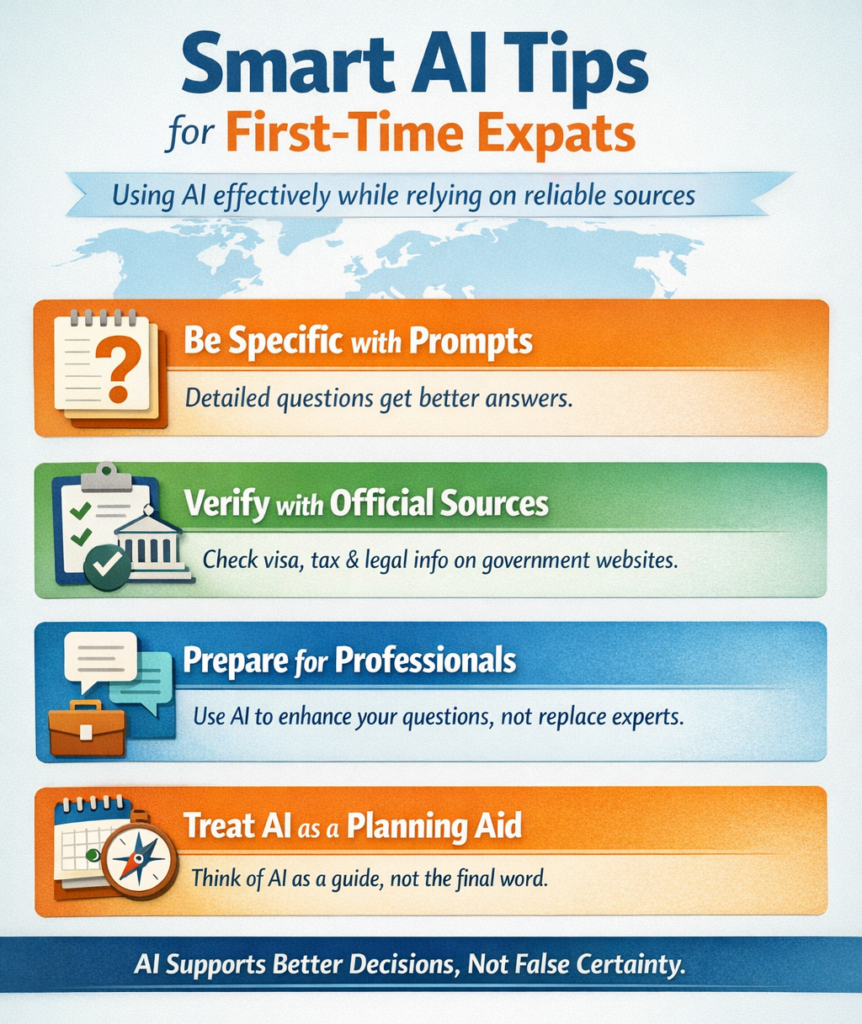
AI tools are most effective when used deliberately and alongside reliable sources. For first-time expats, a few practical principles can help ensure better results:
- be specific with prompts, as detailed questions produce more useful answers
- always verify visa, tax and legal information using official government sources
- use AI to prepare better questions for professionals, not to replace them
- treat AI as a planning aid rather than a final authority
Used this way, AI supports better decision-making without creating a false sense of certainty.
06AI as a Relocation Companion, Not a Shortcut
AI tools will not remove the complexity of moving abroad, but they can make it easier to manage. By helping first-time expats understand unfamiliar systems, organise their plans and anticipate common challenges, AI reduces uncertainty at every stage of the process. Used thoughtfully, AI becomes a practical relocation companion — supporting better decisions without replacing official guidance or professional advice. For first-time expats, that support can make the difference between feeling overwhelmed and feeling prepared, informed and confident as they begin their life abroad.