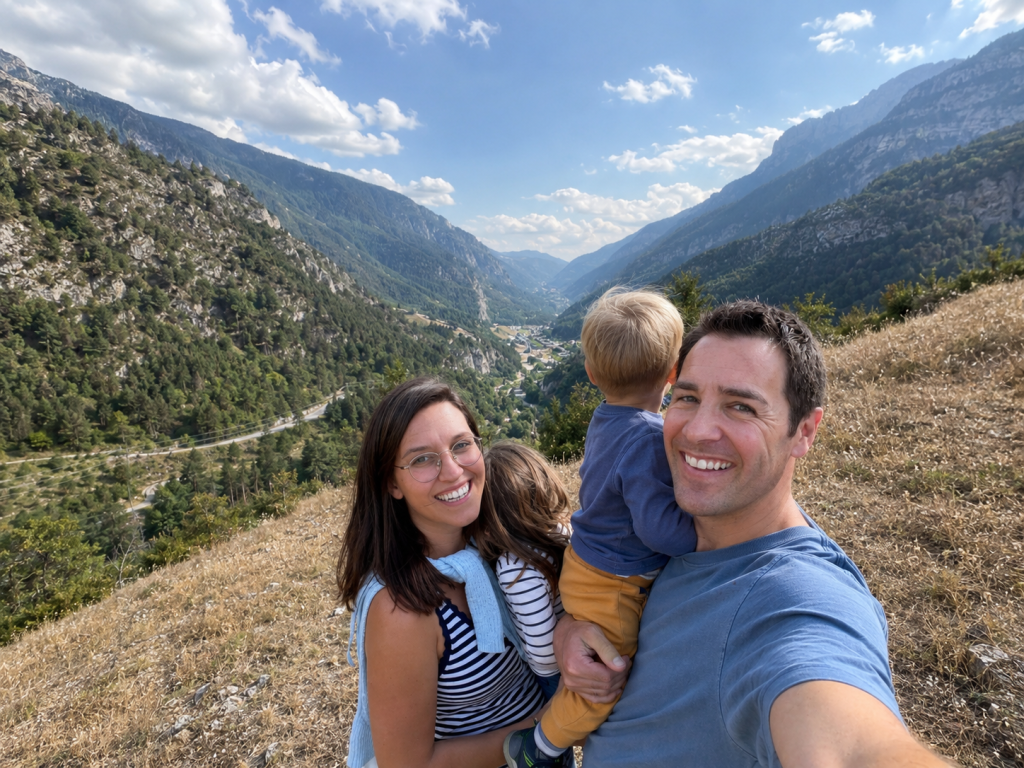
Alexandra is a German expat mum of two living in southwest France with her Scottish husband. She shares her experiences of expat family life, multilingual parenting, motherhood and creating a flexible working life abroad.
Where, when and why did you move abroad?
My expat story actually started long before I had children. I’m originally from Germany, but I’ve spent much of my adult life living abroad. One of my first big experiences was spending a year in Washington, D.C. as an au pair. Later, during my studies, I moved to Paris for Erasmus — and that move ended up changing much more than just my academic life, because it was also where I met my husband, who is Scottish.
Since then, living internationally has simply become part of our family story. Over the years I’ve lived in Malta, Copenhagen and Paris, and in 2023 we moved from Paris to Pau in southwest France because of my husband’s work. His career means that we potentially relocate every few years, so we have learned to build a family life that is quite adaptable.
Today we are a German-Scottish family raising two young children in France. Our children are growing up with three languages — German, English and French — and although moving so often certainly comes with challenges, I also feel incredibly grateful for the international childhood they are experiencing.
What challenges did you face during the move?
Before having children, moving countries felt much more spontaneous. You packed your belongings, dealt with some paperwork and started exploring. Moving internationally with children is a completely different experience!
When we moved from Paris to Pau, we suddenly had to think about childcare, schools, doctors, activities, routines and creating a completely new social network. French bureaucracy can also be challenging when you are unfamiliar with the system. Even though I speak French, there are still situations where I think, “I have absolutely no idea how this works!”
The emotional side is probably underestimated as well. Every move means leaving behind friends, routines and places that have become familiar. As adults we make the decision to move, but our children don’t necessarily choose it, so creating stability for them is very important to us.
Professionally, frequent international moves have also made me rethink what a career should look like. A traditional career tied to one company or location doesn’t always fit very well with our lifestyle, so over the past few years I have increasingly focused on freelance and flexible online work that I can take with me wherever our family goes next.
What do you enjoy most about life in your new country?
What I love most about southwest France is the quality of life. We live close to both the Pyrenees and the Atlantic coast, so within a relatively short drive we can be hiking in the mountains or spending the day by the ocean. With two small children, having so much nature around us is something I really appreciate.
Life here also feels slower than life in Paris. We spent several years in Paris and loved many things about it, but family life there could be intense. In Pau we have more space, more nature and a calmer rhythm.
I also love watching our children become part of French culture. They speak French at school and childcare, German with me and English with their dad. Sometimes our dinner table sounds slightly chaotic, but seeing how naturally they switch between languages is fascinating.
And of course, there are the very French pleasures: markets, bakeries, long lunches and the importance placed on enjoying everyday life. I definitely wouldn’t complain about having good cheese and croissants nearby either!
What is the hardest part of expat life for you / your family?
For me, the hardest part is probably the lack of a permanent support network.
When you live close to your family, you might be able to call grandparents when a child is sick, when you have an appointment or when you simply need a break. As an expat family, that support often isn’t available. My husband also travels regularly for work, so there are periods when I am managing two young children, work and everyday life largely on my own.
There is also a strange emotional contradiction to expat life. You become very good at starting again, but you also become very aware that relationships may be temporary. You meet wonderful people knowing that either they or you could move away again in a few years.
And although our international lifestyle gives our children many opportunities, we are also conscious that they don’t grow up with their grandparents and extended family just around the corner. Video calls help, but they don’t completely replace having family nearby.
What is your relationship like with locals and other expats?
I think having both local and international friendships is really important.
Other expats often understand certain parts of your life immediately. There is a shared understanding of arriving somewhere new, struggling with bureaucracy, trying to build friendships as an adult or raising children between several cultures.
At the same time, I don’t want to live in an expat bubble. Speaking French has made a big difference in building relationships locally, especially since having children. School, childcare, neighbours and children’s activities naturally create opportunities to meet French families.
Social media has also surprisingly become part of my expat community. I started sharing more about our multilingual family life, moving abroad and motherhood on Instagram, and it has connected me with women living internationally in many different countries. Some of those online connections have turned into genuine friendships and even professional collaborations.
What advice would you give to someone thinking of making a similar move?
My biggest advice would be: don’t expect your new life to feel like home immediately.
When you move somewhere new, there is often an exciting honeymoon period, but there will also be frustrating days when you don’t understand the language, the bureaucracy makes no sense, you miss your friends or something as simple as finding a doctor feels unnecessarily complicated. That doesn’t mean the move was a mistake. Building a life somewhere takes time.
I would also make an effort to learn the local language, even if you don’t speak it perfectly. You don’t need flawless grammar. Simply being willing to communicate makes everyday life easier and opens many more doors socially.
For families who know they may move internationally several times, I would also think carefully about creating things in your life that are portable — friendships you actively maintain, family traditions that move with you and, if possible, work that isn’t entirely dependent on your postcode. That has become particularly important to me. I now combine flexible freelance work with building my own small online business, which gives me something professionally that can continue even when our family’s location changes.
Finally, embrace the fact that your life may look different from the one you originally imagined. Living abroad has sometimes been uncomfortable and has definitely pushed me outside my comfort zone, but it has also given me experiences, friendships and opportunities that I would never have had otherwise.