
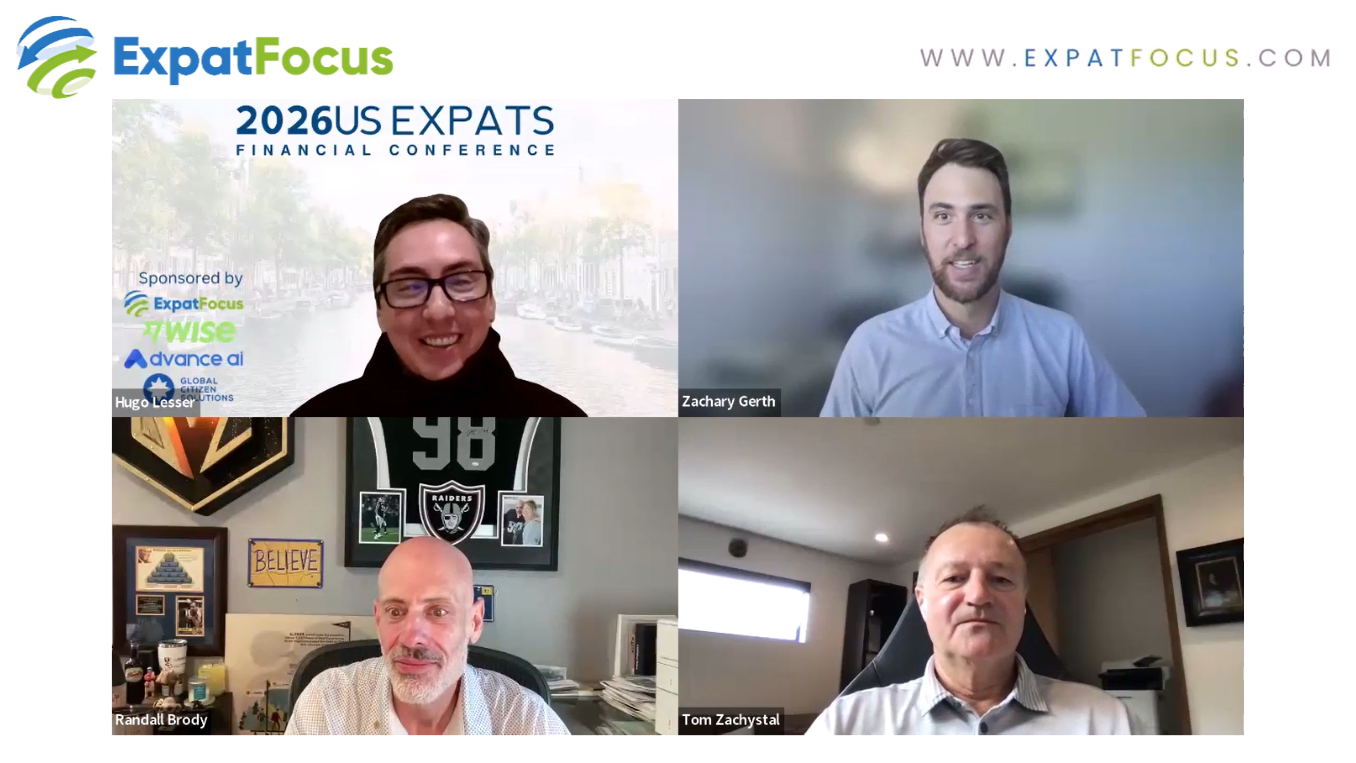
At the 2026 US Expats Financial Conference, a panel of cross-border experts — relocation specialist Zach Gerth of Start Abroad, US expat tax specialist Randall Brody of Tax Samaritan, and investment advisor Tom Zachystal of International Asset Management (IAM) — answered audience questions on moving to and living in Panama as an American. Together they covered Panama’s territorial tax system and the US filing obligations that follow Americans wherever they live, choosing between visa and residency routes, healthcare and international insurance, schools and family life, and the realities of cost of living from Panama City to Boquete and Volcán.
The following transcript was generated by AI and may contain inaccuracies.
Hugo: Welcome, everyone. We’ll just wait a couple of minutes in the hope that a few more people will join, and then it’s an opportunity for you to ask questions of our expert panellists about moving to and living in Panama. We’ll wait a couple of minutes, then do some introductions and get started.
I’ll read a little introduction and we can get things moving, and we’ll see what questions we have.
Hello and welcome to day three of the 2026 US Expats Financial Conference, sponsored by Expat Focus, Wise, Global Citizen Solutions, and Advanced AI Services. Today is the third day of the conference, and this is our fifth session of the day: a Q&A expert panel session for Americans moving to and living in Panama.
I’m delighted to be joined by Zach Gerth from Start Abroad, Randall Brody from Tax Samaritan, and Tom Zachystal from International Asset Management. Before we start, please bear in mind that the information presented is for educational purposes only and you should always seek your own personalised financial advice.
Add your questions in the Q&A popup at the foot of your screen and we’ll try to answer them all. To get things started, I’d like to ask our panellists to briefly say who you are and what your firm does, just to give our audience a little context. Tom, would you mind kicking us off?
Tom: Sure. I have a US registered investment advisor, which is a firm that provides investment management and financial planning services specifically to Americans living abroad. I started this firm in 2002. I was an expat myself for 10 years, working in the oil services industry as an engineer for Schlumberger.
What’s different about our firm is that pretty much all of our clients are Americans living abroad, in about 35 countries now. And, as I say, we’ve been around for 25 years specialising in this space. It’s pretty unusual, because most of the US banks and brokerage firms and investment advisors don’t want to deal with expats anymore. So that’s what we do.
Hugo: Many thanks. Randall, would you like to go now?
Randall: Absolutely. Greetings, everyone. My name is Randall Brody. I’m the founder of Tax Samaritan, based in Las Vegas, Nevada — which typically has the opposite weather to London, but it’s not sunny today. With over 30 years of tax and finance experience, I’ve helped over 9,500 taxpayers solve their expat tax problems and collectively eliminate more than $800 million in tax debt.
I’m passionate about travel, and a proud father and grandfather, and I understand the unique challenges of expat life. When I’m not busy saving people money on taxes, my wife and I enjoy rooting for the local Las Vegas Golden Knights hockey team and the Raiders football team, along with our giant dogs — Gracie, a Labradoodle; Scoobie, a Great Dane; and Zummie, a St. Berdoodle. I also love to snow ski, and try to get on the slopes at least once a week.
Hugo: Many thanks for that. Zach?
Zach: Hello everyone, and thank you so much for having us participate in this year’s conference. My name is Zach. I’m a co-founder of Start Abroad. We’re an international relocation company, and we support relocation services largely for US, Canadian, and UK clients moving to Panama, Costa Rica, Spain, and Portugal.
If you’re deciding between some of those countries, I offer free 15-minute consultations and I’d be happy to hop on a call and talk you through it. I’m from the US — from Florida — and I’ve lived all over the US. I’ve lived abroad for about 15 years. My partner Anna and I met when we were living in East Africa, and most recently, about five years ago, we moved down to Costa Rica when we launched Start Abroad.
We have a two-year-old baby girl. We bought a house here, and we have two street dogs that adopted us — that wasn’t really our choice. We love it, and we’re here for a while. So I know from a professional perspective the logistics of moving abroad, but I also know personally where the challenges and the real joys are.
Hugo: Many thanks. We’re all set to take some questions, so to our audience, please do drop in any questions you may have: US tax, financial planning, moving to Panama, living in Panama, visas, taxes, pet transport — anything you can think of. Throw those questions into the Q&A popup at the foot of the screen.
In the meantime, Randall, I think this is something always worth mentioning: when Americans move abroad, they’re always surprised that they have to file US taxes even if they no longer live in the US. Would you be able to say a few words on why that is and how that works?
Randall: The US is one of two countries in the world that has what’s known as a citizenship-based form of taxation. The other country is Eritrea. If I could see the audience, probably most of them are saying, “Where the heck is Eritrea?”
What that means is that regardless of your country of residency — whether you’re residing in the US or Panama, for example — you continue to be subject to annual US tax filing requirements. If you meet those filing requirements, which are the same as if you were in the US, then you need to file a US tax return to report your worldwide income, and you’re taxed on that worldwide income.
Hugo: Very nice. Tom, I was going to ask you: what would be the top three considerations, things to think about, before relocating overseas from a financial planning point of view?
Tom: On the investment management and financial planning side of things, the biggest thing is that a lot of the banks and brokerages don’t want to deal with non-US residents anymore. So we don’t hold our clients’ money — it’s held at either Charles Schwab or Interactive Brokers. Both those firms have been pretty good partners for us, and they will deal with people living in many countries.
But sometimes there are nuances. For example, in Europe with Schwab, if you open your own account you can’t buy US ETFs. Generally, if your address is outside the US, you can’t buy US mutual funds. So there are some nuances to that, but that’s probably the number one issue.
The second issue is that there are taxation issues that come up, obviously — Randall talked about those — and estate planning issues sometimes. Sometimes people are US citizens but their spouse is not. Maybe they have a US trust that’s not recognised in their country of residency. Things like that come up as well.
And then these days a lot of people are saying, “I want to get my money out of the US.” So the question is what does that mean for you? Do you actually want an account outside the US, or are you just concerned about currency risk? Maybe you want non-US investments. Depending on how you feel about that, we have a conversation around it and we can find a solution.
Hugo: Many thanks. And Zach, what are some of the first questions people ask when they’re thinking about moving to Panama?
Zach: I think the first is: is Panama the right country for me? There are pros and cons to every country. Ideally you can visit — if you have a top two or top three, ideally you can take scouting trips to each.
I’m a strong believer in cultural fit. Sometimes you go to a place and you say, “This is nice for a vacation, but I don’t want to live here.” And sometimes you go to a place and you say, “This feels like it could be home.” That’s a really important first step — to see it, get boots on the ground.
Once you’ve picked Panama as your destination, what you need to do is ascertain which visas you might qualify for. For a lot of nationalities you can go for at least 90 days as a tourist, and as a US national up to 180 days. But then you need a longer-term plan if you intend to move to Panama — or just get residency in Panama and never move there, because that’s something we can talk about as well.
Once you’ve picked the visa, then it’s really setting timelines, setting a budget, and picking where in Panama you’re going to move. So there’s a cascading order of things, and it starts with making sure Panama is for you, figuring out the visas and where, and then taking concrete next steps.
Hugo: Fantastic. We’ve got some questions here. Tom, this one’s for you, I think: what investment opportunities would be open to me once I establish permanent residency in Panama? Looking to diversify my retirement holdings.
Tom: I’m not sure whether that question’s for me or not, because maybe they’re looking for specific Panama-type investments — things like real estate, for example. We deal in portfolio investments: brokerage firms, the kinds of things that are in that space. We don’t deal in private equity or real estate and so on.
But if we’re talking about brokerage-type investments, then you can have a regular US brokerage account, and it could be diversified internationally, obviously. Panama probably isn’t a big market in terms of public equity markets, but it’s certainly possible to diversify internationally and to have a US brokerage account while you live in Panama.
Hugo: So you can diversify that way from US brokerage accounts. And am I right in saying there are US reporting advantages to taking that approach too?
Tom: That’s right. Obviously as a US citizen, you get the tax forms, the 1099s. Some people say, “Oh, I just want to get my money out of the US and I’m going to move it to a bank in Uruguay or something.” Well, Uruguay doesn’t have SIPC insurance — maybe they do, but we have $500,000 of SIPC insurance.
Obviously Panama is a financial hub in Central America, so it’s a bit different, probably a bit safer and more developed that way. Interestingly, there’s a good question for Randall: I don’t know whether there’s a tax treaty with Panama. I don’t think there is.
Randall: That is a good question. I’ll be able to answer that momentarily… No, there is no tax treaty with Panama.
Hugo: Zach, am I right in saying Panama has a territorial-based tax system, so residency is irrelevant — it’s only if you have income in Panama that you pay Panamanian taxes?
Zach: That’s right. You don’t pay tax on worldwide income; you’re only paying income tax based on income generated within Panama. So if you go there and have your own company in Panama, obviously, or if you make a Panamanian salary. You’ll also pay things like property tax, but nothing on income.
Hugo: I think that’s one of the appeals of moving to Panama. So here’s a question, and I think this one’s probably for Zach again: do you have any trusted real estate partners for purchase and renting that have been vetted and work well with expats?
Zach: Absolutely. Start Abroad offers a suite of services. We manage rental search ourselves, so we do walkthroughs of apartments, we’ll do a long list, and we’ll negotiate with the owner. If you’re interested in purchasing, we work with realtors — we don’t handle real estate purchases ourselves, but we work with a great network of realtors throughout the country.
Hugo: Many thanks. There are a few more that are fairly general, maybe for you, Zach: how do you find the cost of living in Panama compared to the States?
Zach: This is going to be a matter of perspective. We have some clients coming from San Francisco who move to Panama City, to a swanky neighbourhood, and they say, “Cost of living here is great” — even though it’s more expensive than you think. And then you’ll have people coming from a small town in the US, and it’s more expensive than they think.
In general it’s not the cheapest country. People think Central America and they think really low prices. A lot of things are much cheaper in Panama, and almost certainly your cost of living will go down, but cost of living is normally a function of where you live and how you live.
If you’re living in Volcán, up in the mountains, it’s much more local. If you’re living simply — maybe you’re renting a house for $800, you’re paying very little for medical, you have a cheap car, you’re eating locally — then it’s going to be a lot more affordable. You can live very comfortably on $1,800 to $2,000.
You might want to go higher, because some people say, “Well, can I live on $1,200?” And the answer is yes, but it might not be what you’re expecting. If you want to maintain or improve your standard of living, then it’s more of a personalised conversation, depending on where you’re looking and whether you want to be going out a lot.
What’s typically very cheap in Panama is healthcare — it’s much more affordable, even insurance — and labour. Having somebody come and clean your house a few times a week, which is a luxury many of us can’t afford in the US or Canada, is very accessible. If you have kids, having a nanny and things of that nature are extremely affordable. Typically Panama is much more affordable than these countries, but it’s a matter of expectation.
Hugo: Somebody else asked: is an international health insurance plan required for Panama?
Zach: When you submit your application, you’re going to need to show some kind of insurance, because what they want to see is that you’re not going to become a burden on the local state.
Once you are a resident, you can enrol in what’s called CSS, which is their local public system. It’s not a true public healthcare plan, but it gives you access to the public system. Or what most of our clients choose to do is get international insurance, because that gives you access to the private system, which is world-class. There’s a lot of medical tourism to Panama.
So you’re probably going to want travel insurance when you’re first coming down, and then you might consider either enrolling in CSS or, more likely, getting private insurance.
Hugo: Many thanks. Somebody asked about the educational system: I have a friend considering Panama with two young kids, one in first grade, the other two-ish years old. Any insights into life in general for a family in Panama?
Zach: People love it. It’s a great place for young families — there are really good international schools. If we’re talking about the educational system in general, homeschooling is an option. It’s actually not very well regulated in Panama, so people can do it. You’ll need to register, but it’s an option.
Once you’re a resident you can send your kids to public school, but most people choose not to, because it’s going to be almost exclusively in Spanish, and the quality of education in the public school system will really vary depending on where you are.
So most people choose international schools. There’s a really strong network, especially in the Panama City area, and we can help you think through that if that’s of interest. There are also neighbourhoods that are really popular for young families, like El Cangrejo, and a lot of other wonderful neighbourhoods — there’s one right next to the park where there are good schools. We’ve moved so many people that we know where the young expat families are settling and which schools are popular.
Hugo: Fantastic. And somebody else asks: is there a city in Panama where one can live car-free?
Zach: Honestly, to get between places in Panama you’re probably going to want a car. If you’re living in Boquete, for instance, you could be in Boquete without a car, but you’re probably going to want to drive down to David to go to PriceSmart — essentially like a Sam’s Club — or do your shopping, or go to the hospital.
The place where you really don’t need a car is Panama City itself. There’s a metro, there are buses, you can use Uber, and there are a few neighbourhoods that are walkable, like El Cangrejo, which I just mentioned. Also, if you’re living in Bocas del Toro, for instance, which is a small beach town, you might not need a car.
But when you want to go between places, you’ll likely want a car. Some clients move to the city, and part of the reason is that they don’t want to have to drive — and that’s very viable. But if you’re outside of Panama City, you’re probably going to want a vehicle.
Hugo: Thanks. Tom, this may be one for you: what are the options for transferring money from the US to Panama? What are the best ways to transfer money internationally?
Tom: Usually the worst way is through your bank, because they’ll give you a lousy exchange rate. They’ll tell you, “We don’t charge any fees,” but then the exchange rate will be abysmal.
The best way for most people is to use currency transfer services like Wise, for example, or Currencies Direct or Moneycorp. Depending on how much you’re sending, I would say Currencies Direct and Moneycorp are probably more hands-on and Wise is probably more hands-off — but pretty easy to use online and through an app.
You can just Google any of those, or go to wise.com, Currencies Direct, and Moneycorp. They’re currency transfer and conversion services, so you can send to multiple countries if you want.
Hugo: Thanks. This is a question that came up in another session earlier, and I’m not sure quite which area this is, but: can one keep beneficiaries on US accounts when living abroad? Does anyone have any insights into that?
Tom: Sorry — that’s actually a really good question. Can you keep beneficiaries when moving abroad? That’s a problem. We have to distinguish between beneficiaries and what are called transfer on death instructions.
Beneficiaries are on retirement accounts — IRA accounts, 401(k)s, Roths, that kind of thing. Yes, you can keep those beneficiaries when you move abroad and when you no longer have a US address. However, if you have an individual or a joint account and you have what are called transfer on death instructions on those, which is basically like having a beneficiary, those come under US state law.
Once you leave the country, once you no longer have a US address, you will not be able to have those anymore. In fact, in some states they don’t have TOD instructions at all. So you lose those, and then you need to think about how you’re going to manage that if it’s an individual account — what if something happens to you?
Typically, either you put on a joint account holder instead of a beneficiary, or you’ll have to manage it through a will, or possibly a trust or some kind of instrument like that.
Hugo: Many thanks. Keep those questions coming. I was going to ask Randall: perhaps you’d like to say a little about something that comes up a lot — if somebody opens a bank account in Panama, whether that creates US reporting obligations.
Randall: Potentially. There’s an information disclosure called the Foreign Bank Account Report, or FBAR for short. If the aggregate value of your foreign bank accounts — whether that’s Panama accounts, Portugal accounts, in total — reaches $10,000 or more at any point during the calendar year, it’s going to trigger the information disclosure on the FBAR.
That’s just a reporting of all the details of your foreign accounts: bank name, address, account number, and what the high balance was in the account for the year. It doesn’t trigger any taxes, it’s just an information disclosure. However, the penalties for failure to file the FBAR could be quite punitive if they’re assessed.
Hugo: Many thanks. And something you were actually talking about in the session earlier — would you like to say something about the advantages of tax planning before moving abroad?
Randall: It’s always advantageous to be proactive in your planning when moving abroad. There are a number of areas to consider. One example is state income taxes. Usually that’s not a factor that’s planned in advance, but it is one where you definitely want to be proactive, depending on which state you’re residing in.
Some states, such as California and New York, have very specific rules about when you become a non-resident for state income tax purposes. In California, for example, it could apply for a number of years following your move to the foreign country. So that’s a consideration you want to plan for.
Maybe you want to change your state residency prior to your move. It’s a very wise choice to do so if you’re in one of those states that’s going to hold on to your state residency. So changing your state residency to a state that has no income taxes, such as Nevada, is something to definitely consider.
Hugo: Many thanks. I think we’ve answered all the questions our audience has submitted. To our audience, if you’d like to get in touch and schedule consultations: Zach, again, from Start Abroad at startabroad.com — they cover every aspect of moving to Panama, along with some other countries, so have a look at that.
Randall from Tax Samaritan at taxsamaritan.com, for US tax planning and optimisation before and after your move, as well as compliance. And Tom from IAM Advisors — International Asset Management, which is IAM, at iamadvisors.com — for your financial planning and investment management as the cross-border American that you become when you move, avoiding pitfalls and getting structured.
These are all important considerations. I think it’s always important to consult with experts and assemble a team — that’s the way to make the most out of your move financially. So thank you very much for joining us, and thank you to our panellists for taking the time.
We have three more sessions tomorrow as part of the conference, starting with the legislative path to residence-based taxation. If you haven’t already, register for that at usexpatconference.com. We look forward to seeing you soon — have a great rest of your day.
Tom: Bye, thank you so much.