

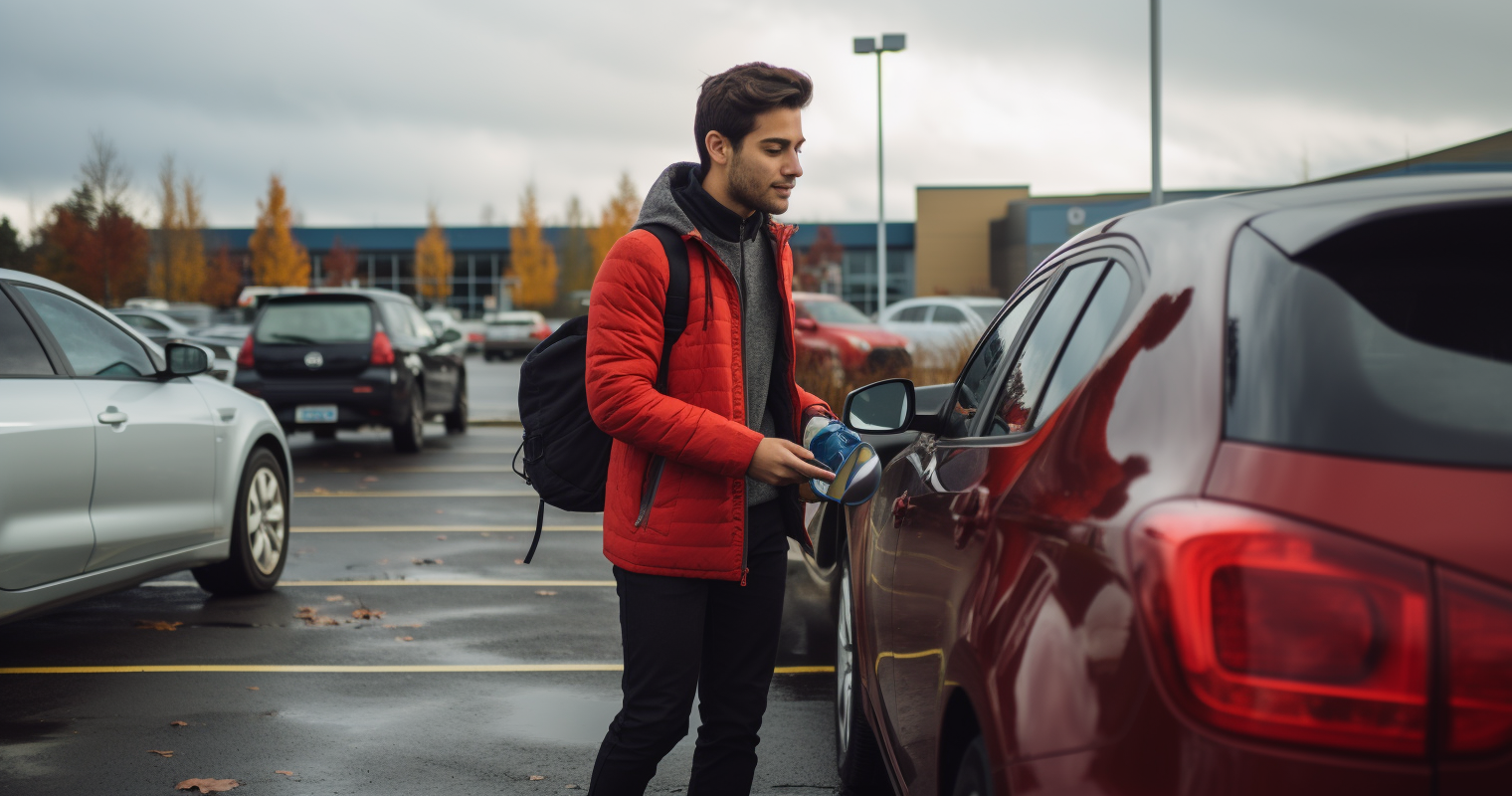
For most visitors and new arrivals, hiring a car in Switzerland is a relatively uncomplicated process. The minimum age requirement is typically between 19 and 21, depending on which company you use, and a valid national driving licence is ordinarily all you need — though drivers whose licences use non-Latin script will also need to carry an International Driving Permit (IDP). All major international rental brands maintain desks at Switzerland’s principal airports, and every rental vehicle comes with the mandatory motorway vignette already attached.
| Item | Details |
|---|---|
| Minimum rental age (as of 2025) | Generally 19–21, varies by company and vehicle category |
| Young driver surcharge | Typically applies to drivers under 25 |
| Licence held for | At least 1 year (some companies require 2 years) |
| Motorway vignette cost (as of 2025) | CHF 40 — usually pre-fitted on rental cars |
| No-vignette fine (as of 2025) | CHF 200 + mandatory CHF 40 purchase (CHF 240 total) |
| Foreign licence validity for residents | Up to 12 months from date of Swiss residence permit |
| IDP requirement | Required if licence is in non-Latin script (e.g. Arabic, Cyrillic, Chinese) |
| Blood alcohol limit (as of 2025) | 0.05% |
What are the rules and requirements for renting a car in Switzerland?
The lower age threshold for car rental in Switzerland is generally 19 or 20, though certain vehicle categories may impose additional conditions or surcharges for anyone under 25. Some providers set their minimum at 21 or even 25, depending on factors such as vehicle size and associated insurance risk — economy models may be available at a lower minimum age, whereas luxury, performance and premium vehicles frequently require the driver to be at least 25 or 30. It is always worth confirming the precise age threshold with your chosen provider at the point of booking, as policies differ considerably.
Anyone renting a car must hold a valid driving licence that has been in their possession for a minimum of one year; some companies extend this to two years. A passport must also be presented as proof of identity. Swiss rental companies will require a credit card registered in the driver’s name to cover the security deposit — debit cards are not typically accepted for this purpose.
Third-party liability insurance is a legal requirement and is included as standard in every rental agreement. This type of cover applies to damage or injuries sustained by third parties outside the rental vehicle. Switzerland’s legal blood alcohol limit stands at 0.05%, and mobile phone use at the wheel is only permitted when a fully hands-free system is in place.
Headlights must remain on at all times, regardless of conditions. On roads with multiple lanes, overtaking must be carried out on the left — passing on the right is forbidden. Children under the age of four must be secured in an appropriate child seat, while those aged four to ten who are shorter than 150 cm must use a booster seat. Children under ten may not travel in the front passenger seat unless they are in an approved rear-facing seat with the airbag deactivated.
For the most current and authoritative guidance, visit the Swiss Federal Roads Office (FEDRO) at astra.admin.ch and the official Swiss government portal at ch.ch.
Which major car rental companies operate in Switzerland, and where can I find them?
Switzerland is well covered by all of the leading international rental brands, with counters at each of its main international airports — Zurich (ZRH), Geneva (GVA) and Basel/Mulhouse (BSL) — as well as in city centres and at numerous train stations. Advance reservations are strongly encouraged, particularly during the summer months and school holiday periods.
The principal international operators active in Switzerland include:
- Hertz — hertz.com
- Avis — avis.com
- Budget — budget.com
- Europcar — europcar.com
- Sixt — sixt.com
- Enterprise — enterprise.com
- Alamo — alamo.com
Sixt, for instance, maintains branches at Basel Airport (BSL), Geneva Airport (GVA) and the Geneva Airport French Sector, alongside a broader network of locations across the country. Available vehicle types commonly include manual and automatic models, electric cars, family estate vehicles, compact city cars and robust SUVs.
Beyond the major chains, local and regional operators can deliver competitive pricing, especially for longer hire periods. Companies such as Swiss Rent Car have earned positive feedback from customers in Switzerland. Aggregator platforms including DiscoverCars and Auto Europe enable side-by-side price comparisons across multiple suppliers, which can represent a worthwhile saving — particularly for multi-day bookings.
Picking up a vehicle at the airport generally attracts a premium, so collecting from a city-centre or out-of-town branch operated by one of the major companies can reduce costs. That said, airport desks remain the most convenient option for those arriving by air who want to get on the road without delay.
How does car rental pricing work in Switzerland, and what should I watch out for?
Rental pricing in Switzerland broadly follows the same model used across Europe: a base rate per day or week, with a variety of optional extras that can push the final bill considerably higher. Most hire agreements include unlimited mileage and basic mandatory liability insurance as standard. Collision Damage Waiver (CDW) cover may be bundled into the rate with a remaining deductible, or it may be offered as a paid addition.
Manual gearbox cars are the norm in Switzerland and tend to be less expensive. If you require an automatic, book well ahead — they carry an average additional cost of around CHF 10 per day. This is worth bearing in mind if you are used to driving in North America, where automatics dominate rental fleets; across most of Europe, including Switzerland, the manual transmission remains standard.
Key additional charges to be aware of include:
- Collision Damage Waiver (CDW) excess: Even when CDW is part of the package, most policies retain an excess — the sum you would be liable to pay if the vehicle is damaged. Providers may offer a Super CDW product at the counter that reduces this deductible to zero.
- Theft Protection: CDW and theft protection are frequently combined in inclusive rates at a discounted price, though they may also be purchased separately at the desk.
- Young driver surcharge: Renters under the age of 25 can expect to be charged a supplementary daily fee.
- Additional driver fees: If someone other than the primary renter intends to drive, rental companies generally charge a daily or per-booking fee for each extra named driver.
- One-way fees: Domestic one-way rentals are available, though certain routes attract a drop-off surcharge. International one-way trips also carry additional costs, and not all vehicle categories are eligible.
- GPS rental: Hiring a GPS device typically costs CHF 10–15 per day (as of 2025), though most travellers find that a smartphone navigation app serves as a perfectly adequate and free alternative.
- Fuel policy: The prevailing arrangement in Switzerland is full-to-full — you collect the vehicle with a complete tank and return it the same way. Some companies offer a full-to-empty option where you pre-purchase fuel upfront; this is rarely advantageous unless you are confident you will use the entire tank before returning.
Before driving away, take time to walk around the vehicle and check for any pre-existing damage, confirming that all marks are recorded on the hire agreement. Capture photographic or video evidence of the car from every angle at the point of collection — this is as important in Switzerland as it is anywhere else, and it provides clear proof of the vehicle’s condition should any dispute arise on return.
For guidance on consumer rights or rental disputes, the Swiss consumer protection body Konsumentenschutz (Consumer Protection Switzerland) and MySwitzerland, the national tourism authority, both publish helpful information for travellers.
Do I need an International Driving Permit (IDP) to rent a car in Switzerland?
An International Driving Permit is only required in Switzerland when your driving licence does not display the permitted vehicle categories in Latin characters. In practical terms, this means that holders of licences printed in Arabic, Cyrillic, Chinese, Japanese or any other non-Latin script must carry an IDP alongside their original national licence at all times.
As of 2025, an IDP is not a legal requirement for drivers holding licences issued by EU or EEA member states (including Iceland, Liechtenstein and Norway), or by the United Kingdom. All licences issued within the European Union are valid for use in Switzerland.
Where no IDP is available to accompany the original national licence, the driver must instead carry a certified translation. A translation into French, German, Italian or English will generally be acceptable, provided it has been produced by an authorised body — for example, the national authority responsible for issuing driving licences in the home country, a public notary, or a qualified professional translator.
It is worth noting that even where Swiss road law does not require an IDP, individual rental companies may make it a condition of hiring a vehicle. Carrying an IDP is therefore strongly advisable as a precaution, particularly if your licence is not written in one of Switzerland’s four official languages (German, French, Italian and Romansh) or in English.
An IDP must be obtained in the country where your domestic driving licence was issued — it cannot be obtained abroad. Arrange yours before you travel. Always verify the current requirements directly with your rental company and via the official Swiss government portal on driving licences, as regulations are subject to change.
What types of roads and driving conditions should I be prepared for in Switzerland?
Switzerland’s road network is generally well maintained, but the country’s mountainous landscape and variable weather can present real challenges behind the wheel. Conditions range from smooth lakeside motorways to steep, narrow Alpine tracks, so it pays to select a vehicle suited to your planned route.
The vignette system: Any car using Switzerland’s motorway network must display a valid vignette — a sticker or e-vignette costing CHF 40 (as of 2025). Unlike some neighbouring countries, Switzerland does not offer short-term passes covering a week or ten days; the vignette is an annual permit, regardless of how briefly you are visiting. All rental cars collected within Switzerland already carry the vignette, so no additional toll payments are required as long as you remain in the country. Driving without a vignette results in a fine of CHF 200, plus the compulsory purchase of the vignette itself (CHF 40), bringing the total to CHF 240 (as of 2025).
Tunnel tolls: Certain tunnels — among them the Great St. Bernard and Munt la Schera — charge tolls over and above the vignette. These are chiefly relevant to drivers crossing into Italy.
Speed limits: The standard limits are 120 km/h on motorways, 80 km/h on other roads outside built-up areas, and 50 km/h in towns, cities and villages, unless signs indicate otherwise. Switzerland operates a dense network of unmarked speed cameras concealed in tunnels, behind foliage, within traffic light housings and in other unexpected positions — adherence to speed limits is therefore both a safety measure and a financial one. Notably, severe speeding penalties in Switzerland may be calculated as a proportion of the offender’s income, which can result in very considerable sums.
Winter conditions: Switzerland experiences four distinct seasons. Visitors travelling in winter or early spring should confirm that their rental vehicle is fitted with winter tyres — many Swiss operators equip their fleet accordingly during the colder months. Although winter tyres are not a statutory requirement in Switzerland, they are strongly recommended on safety grounds. If your route takes you over high Alpine passes, carrying snow chains is advisable, as certain roads display mandatory chain signs in severe snowfall.
Mountain roads: Expect frequent tunnels, tight roads with significant drops and the possibility of rapidly deteriorating weather — snow or dense fog can arrive with little warning. Drivers should reduce speed accordingly, use headlights inside tunnels, and equip themselves with snow chains during winter. Keeping a warning triangle in the car and wearing a high-visibility vest if you stop at the roadside are important safety practices.
Vehicle choice: Switzerland’s road network spans everything from congested city streets to high Alpine passes. A small, nimble car is ideal for urban travel, offering easier parking and better fuel economy. For mountain journeys or winter driving, a 4WD vehicle or something with greater engine output may be preferable. Bear in mind, however, that larger vehicles consume more fuel and can prove cumbersome on narrow mountain roads.
What insurance do I need when renting a car in Switzerland?
Third-party liability insurance is a legal requirement and is automatically included in every Swiss rental. It covers losses, injuries and property damage caused to parties outside the hired vehicle. Beyond this statutory minimum, rental providers typically offer a range of supplementary protection products.
To drive legally in Switzerland, all vehicles must carry an international insurance certificate — commonly referred to as a Green Card (Carte Verte). Rental cars are ordinarily supplied with this document in the glove box alongside the registration certificate and owner’s manual. There is no need for the renter to arrange this separately; rental companies include it as part of the standard package.
The principal optional or sometimes included insurance products are:
- Collision Damage Waiver (CDW): CDW and theft protection reduce the financial excess you are responsible for in the event of damage or theft, with the precise deductible amount varying by company and vehicle type.
- Super CDW / Zero Excess cover: Some providers offer a Super CDW product at the counter that can bring the deductible down to zero, substantially limiting your financial exposure in the event of an incident, though it does add to the daily hire cost.
- Personal Accident Insurance (PAI): Available at the rental desk, PAI provides cover for medical costs incurred by the driver and passengers following an accident.
Given the combination of mountain terrain and unpredictable weather that characterises much of Switzerland, taking out comprehensive cover is a sensible precaution. Speak to your rental provider to clarify exactly what is included in your agreement and consider upgrading your cover if any significant gaps remain.
Certain premium credit cards — particularly those from major international issuers — extend rental car excess insurance as a cardholder benefit, provided the hire is charged to that card. However, the scope of this cover varies considerably between cards, and exclusions for particular vehicle types, destinations or excess amounts are common. Always check the precise terms with your card issuer before relying on this benefit, and confirm with the rental company that they accept credit card cover in place of their own products.
Insurance regulations impose restrictions on certain luxury vehicle categories and on cross-border travel to specific countries. If you plan to drive a high-specification hire car or cross an international border, discuss the insurance implications with your rental company before setting off.
Are there any specific rules for expats or long-term residents renting cars in Switzerland?
The regulations governing car rental differ noticeably depending on whether you are a short-stay visitor or someone who has established residence in Switzerland. The central issue is how long you have been living in the country and whether you are still entitled to use a foreign driving licence.
Foreign nationals may drive in Switzerland on a licence issued abroad for up to 12 months. Once that period has elapsed, it becomes possible to convert your foreign licence into a Swiss one. Depending on your nationality and professional background, this process may involve passing a theory test, a practical driving examination, or both.
Citizens of European Economic Area countries (EU member states plus Iceland, Norway and Liechtenstein) are permitted to exchange their foreign licence for a Swiss equivalent without sitting a test, on condition that the exchange takes place within 12 months of taking up residence. Licence holders from countries outside the EEA will generally be required to pass a practical driving test in Switzerland before the exchange can be completed.
Those who have been resident in Switzerland for more than 12 months — without an absence of more than three consecutive months — are legally obliged to hold a Swiss driving licence. Failing to exchange your licence before the deadline renders your foreign licence invalid, and using it after that point can attract a significant fine.
The administrative fee for a licence exchange varies from canton to canton but typically falls in the range of CHF 30–60 (as of 2025). The exchange is handled by the cantonal road traffic office. As processing can take several weeks, it is advisable to begin the application well ahead of the 12-month deadline.
When renting a car, Swiss residents must present a valid Swiss driving licence that has been held for at least 12 months, together with their national identity document and a current residence permit. Once the licence has been successfully converted, the rental process for long-term residents is identical to that for any other driver in Switzerland.
For guidance tailored to your specific canton, contact your local cantonal road traffic office (Strassenverkehrsamt). The ch.ch portal provides reliable information in English, French, German and Italian and is an excellent starting point for understanding the current requirements.
How do I rent a car in Switzerland step by step?
- Check your licence eligibility: Verify that your licence is current, has been held for at least one year, and is either written in a Latin-script language or supported by a certified IDP or translation. If your licence originates from outside the EU or EEA, bring an IDP as a precautionary measure.
- Compare rental companies: Use aggregator platforms such as DiscoverCars or AutoEurope to compare rates across major international operators and local suppliers. Pay attention to any age restrictions that apply to the vehicle category you have in mind.
- Book in advance: Demand for hire cars can be substantial, especially during the summer and school holiday periods. Reserving several months ahead frequently secures a more favourable rate.
- Gather required documents: Assemble your valid national driving licence, IDP (where applicable), passport or national identity card, and a credit card registered in your name to cover the security deposit.
- Review insurance options: Determine whether you will take the rental company’s CDW excess cover, rely on credit card insurance (confirm the exact terms in advance), or take out a standalone excess policy through a travel insurer.
- Inspect the vehicle at pickup: Carefully examine the car for any pre-existing damage and ensure that every mark is recorded on the rental contract before you drive away. Photograph or film the entire vehicle as supporting evidence.
- Check the vignette: All rental cars in Switzerland should already carry the motorway vignette, but it is worth confirming this with the rental company before joining the motorway network.
- Familiarise yourself with Swiss road rules: Refresh your knowledge of the speed limits, right-of-way conventions at unsigned junctions, the ban on overtaking on the right, and the requirement to keep headlights on at all times.
- Return the car correctly: Refuel to the level specified in your agreement before returning, allow sufficient time to avoid late return penalties, and ensure the vehicle is in the same condition as when you collected it.
Frequently asked questions about renting a car in Switzerland
What is the minimum age to rent a car in Switzerland?
The lower age limit for hiring a car in Switzerland is typically 19 or 20, though certain vehicle classes impose additional conditions or surcharges for drivers under 25. Luxury, sports and high-specification vehicles often carry a minimum rental age of 25 or even 30. Always confirm the age requirement for your particular vehicle category with the hire company before completing your booking, as thresholds differ by provider and vehicle type (as of 2025).
Can I drive across the border into neighbouring countries with a Swiss rental car?
The majority of car and van categories can be driven freely throughout Western Europe, though restrictions do apply to certain luxury vehicle classes and to travel in specific countries. Some suppliers prohibit their vehicles from entering particular destinations; others will permit it for an additional fee with prior notice. Always inform the rental company of your full itinerary before departure — driving across a border without authorisation can invalidate your insurance cover.
What happens if I am involved in an accident in Switzerland?
In the event of an accident, bring the vehicle to a stop immediately, activate your hazard lights and position your warning triangle behind the car. If anyone has been injured, call the emergency services — dial 144 for an ambulance or 117 for the police. Swap details with the other party or parties involved. Report the incident to your rental company as promptly as possible using the emergency contact number in your hire agreement, complete any required accident report forms, and document the scene thoroughly with photographs before the car is returned.
Is a credit card mandatory for renting a car in Switzerland?
Yes. Swiss rental companies require a credit card in the primary driver’s name to hold the security deposit; debit cards are generally not accepted for this purpose. The card is used to place a hold equivalent to the excess amount under the CDW policy. Make sure your card carries sufficient available credit to accommodate both the hire cost and the deposit simultaneously, as both are typically reserved at the same time.
What should I do if I return the car with less fuel than when I collected it?
Under the full-to-full fuel arrangement that is standard in Switzerland, returning a vehicle with less fuel than it had at collection will result in a charge for the shortfall — usually at a per-litre rate higher than you would pay at a filling station, along with an additional refuelling service fee. To sidestep this cost, stop at a petrol station shortly before dropping the car off and retain your receipt as proof of refuelling.
Are there speed cameras on Swiss roads?
Yes, and they are plentiful. Switzerland operates a large number of unmarked speed enforcement cameras located inside tunnels, concealed behind vegetation, mounted within traffic light housings and positioned in various other unexpected spots. Penalties are issued to the registered owner of the vehicle — for a rental car, this means the hire company will forward the fine to you, frequently accompanied by an additional administrative charge. It is also worth knowing that serious speeding penalties in Switzerland may be scaled to the offender’s income, meaning they can reach very significant amounts.
Do I need snow chains when renting a car in Switzerland in winter?
Although winter tyres are not a legal requirement in Switzerland, they are strongly recommended from a safety perspective. If you are planning to traverse high mountain passes, snow chains are a sensible addition — some mountain roads display mandatory chain signs during periods of heavy snowfall. Ask your rental provider whether winter tyres are fitted to their fleet as standard during the winter season and whether snow chains can be hired or purchased. Road and pass conditions can be checked in advance via via.admin.ch.
How long can I drive on my foreign licence after moving to Switzerland?
A foreign driving licence is valid for use in Switzerland for up to 12 months, measured from the date on your Swiss residence permit, provided you are at least 18 years old. Once that period expires, you must hold a Swiss licence. EEA licence holders may exchange their licence for a Swiss one without sitting a test, provided the exchange occurs within the 12-month window. Drivers from outside the EEA generally need to pass a practical test before the exchange is finalised. Contact your cantonal road traffic office for the current requirements applicable to your licence and nationality (as of 2025).
Does a rental car in Switzerland come with a motorway vignette?
Yes. Every rental vehicle collected in Switzerland is supplied with the motorway vignette already in place, so you will not need to pay any motorway tolls within the country. If you are bringing a hire car into Switzerland from abroad, you will be required to obtain a vignette at the border. Each vignette costs CHF 40 (as of 2025) and functions as an annual pass — no short-term equivalent is available. The official e-vignette can be purchased through e-vignette.ch.