
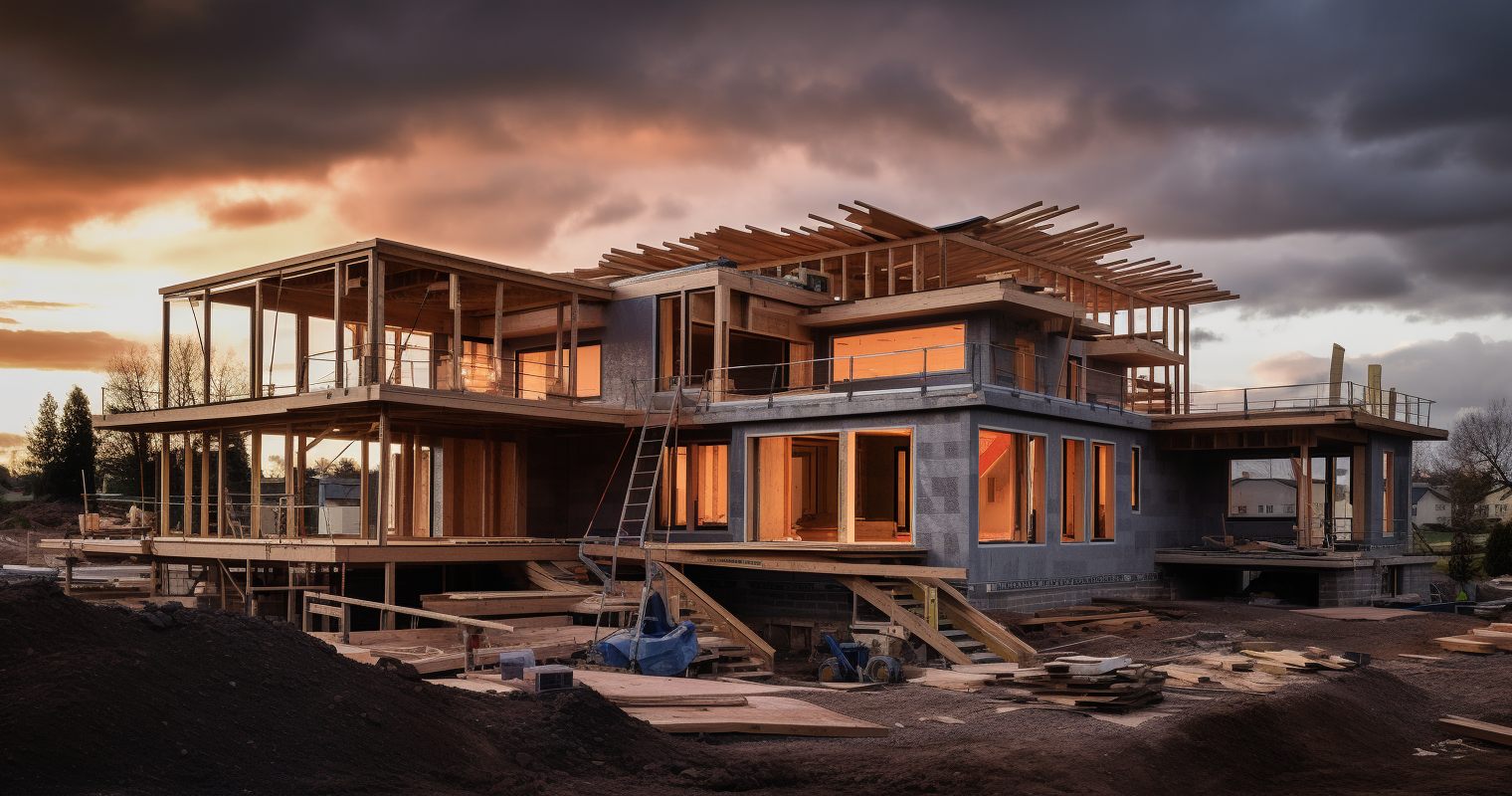
Almost all structural work on property in South Africa requires planning permission, governed by the National Building Regulations and Building Standards Act. Every set of building plans must be prepared by a professional registered with SACAP. Several statutory bodies regulate the construction sector, and while foreign nationals are generally free to own land and commission builds, particular financial and legal obligations apply to them.
| Item | Details |
|---|---|
| Planning permission required? | Yes — legally required for all new builds, extensions, and most renovations (as of 2024) |
| Plans must be drawn by | A professional registered with SACAP (South African Council for the Architectural Profession) |
| NHBRC builder registration fee | R745.61 application fee + R526.32 annual membership (as of 2024) |
| Heritage authority | South African Heritage Resources Agency (SAHRA) — sahra.org.za |
| Construction industry regulator | CIDB (Construction Industry Development Board) — cidb.org.za |
| Foreign land ownership | Generally permitted; no blanket prohibition, but financial regulations apply |
Do you need planning permission to build or renovate a property in South Africa?
Obtaining planning permission before undertaking any building, renovation, or extension work in South Africa is a legal requirement. Section 4(1) of the National Building Regulations and Buildings Standards Act is explicit: no person may erect any building for which plans and specifications must be drawn and submitted without first receiving written approval from the relevant local authority. This obligation covers new homes, substantial additions, and the majority of structural renovation work.
A building permit is issued for any permanent or large-scale construction project. Temporary structures, routine repairs, and replacing fittings that involve no structural modifications generally fall outside the permit requirement. If you are uncertain whether your particular project needs formal approval, contact your local municipality before any work begins.
Planning permission rules are broadly uniform across South Africa, though stricter controls may apply in protected environments such as natural bush estates or heritage-listed buildings, where even minor works can attract closer scrutiny and additional approval requirements.
Compared with systems in countries like the UK or Australia — where minor internal works or small outbuildings may qualify as “permitted development” requiring no formal application — South Africa’s regime is more wide-ranging in demanding formal plan submission across a broader category of works. A defining feature of the South African system is the mandatory role of a SACAP-registered professional at every stage of the process.
No building plan — whether for a new home or a significant alteration — will receive approval from any local council unless it has been prepared and submitted by a professional registered with the South African Council for the Architectural Profession (SACAP). This requirement applies even to relatively modest changes.
Sectional title schemes and estates managed by homeowners associations (HOAs) will also have their own building rules that must be observed, available from the relevant body corporate or HOA. It is essential to check both municipal and estate-level requirements before commencing any construction activity.
How to apply for planning permission: a step-by-step guide
- Appoint a SACAP-registered professional. Once you have identified a suitable professional, ask to see their SACAP registration number and evidence of indemnity insurance. Without both of these, the process cannot proceed.
- Carry out site analysis and gather documentation. The documentation package for a development will typically include site planning documents, the building plans, completed SANS 10400 forms, the Title Deed, an SG Diagram, a stormwater management plan, a zoning certificate, and a geotechnical report where applicable.
- Submit plans to the municipality’s Town Planning Department. Initial applications are lodged with the municipality’s Town Planning Department, which assesses whether the proposal aligns with the permitted zoning or use of the site. The plans then move on to the Building Inspectorate for further review.
- Pay the scrutiny fee. Town planning scrutiny is generally free unless the application involves a relaxation, consent from neighbours, or rezoning. The same applies at the Building Inspectorate stage, though this varies by area. Confirm current fees directly with your local council, as these differ between municipalities and are subject to change.
- Await council review and approval. The council will assess the application and communicate its decision within a set timeframe. Once approval is granted, construction may begin. Timescales differ from one council to another — request a current processing estimate from your local authority when submitting your application.
- Notify the building inspector before construction begins. Following plan approval and prior to breaking ground, you must formally notify the local building inspector. Certain municipalities — including Ekurhuleni and Mogale City — require this notification to be given at least two working days in advance.
- Undergo staged inspections. The inspector will attend the site at critical stages — such as after foundation laying, sewer installation, and upon final completion — to verify that the build conforms to the approved plans. Inspection protocols differ between councils, so confirm requirements directly with your local authority.
- Obtain an occupation certificate. Completing each inspection stage correctly is vital to ensuring the timely issue of an occupation certificate. Occupying a building without one is against the law.
A building inspector has the authority to enter your property and halt any unauthorised construction. The penalties for building without approval can be severe, and in some cases demolition of the unlawful structure may be ordered. Never begin any building work before your plans have been formally approved.
What are the rules around listed buildings, conservation areas, and heritage protection in South Africa?
South Africa operates a formal heritage protection framework that is broadly comparable to listed building systems in the UK or the National Register of Historic Places in the United States, but it functions through a tiered grading structure rather than a single unified national list. Understanding this framework before buying or modifying an older property is vital.
The South African Heritage Resources Agency (SAHRA) is a statutory body established under the National Heritage Resources Act (No. 25 of 1999) as the national authority responsible for safeguarding South Africa’s cultural heritage resources. SAHRA operates at the national level, while Provincial Heritage Resources Authorities handle matters of provincial and regional significance.
Heritage resources management is organised across three tiers: national-level responsibilities sit with SAHRA, provincial-level responsibilities rest with provincial heritage resources authorities, and local-level responsibilities fall to local authorities.
Heritage resources are categorised by significance. Grade 1 status is reserved for resources of outstanding universal value. Grade 2 encompasses resources with special qualities that render them significant within a provincial or regional context. Grade 3 applies to resources considered worthy of conservation that meet one or more of the criteria established under the Act, or that enhance the environmental quality or cultural significance of a local area.
Once a site has been formally proclaimed a National Heritage Site, no person may — without a permit from the appropriate authority — destroy, damage, deface, excavate, alter, remove from its original position, subdivide, or change the planning status of the site. In practical terms, this is analogous to the restrictions imposed by Grade I listed building status in the UK.
For heritage-listed buildings, more stringent planning controls generally apply. Even minor renovation work may be subject to review by both SAHRA and the relevant local authority. This is a critical distinction from standard planning rules: cosmetic work on a heritage property may require a dedicated SAHRA permit before it can proceed.
SAHRA administers the South African Heritage Resources Information System (SAHRIS), a searchable database of the National Estate. Provincial Heritage Resources Authorities maintain Heritage Registers to formally recognise resources of provincial and local significance (Grade 2 and Grade 3). The SAHRIS database can be searched at sahris.sahra.org.za before purchasing or planning any work on a property of potential heritage value.
Where contraventions of the Act are identified, SAHRA inspectors may investigate, issue contravention and prohibition notices, and impose penalties as appropriate. Penalties under the National Heritage Resources Act may include fines and orders requiring the owner to restore the heritage site at their own cost. Always consult SAHRA and your Provincial Heritage Resources Authority before undertaking any work on a structure that may carry heritage significance.
SAHRA can be contacted at: www.sahra.org.za | PO Box 4637, Cape Town, 8001 | Email: [email protected]
What permits and licences are required when building or renovating in South Africa?
Beyond the central planning approval process, construction in South Africa involves a range of additional permits, registrations, and authorisations. The precise combination required will depend on the type, scale, and location of your project.
Building regulations compliance (SANS 10400)
The Building Inspectorate will assess submitted plans to determine whether the proposed construction satisfies requirements in areas including access, energy efficiency, building codes, provision for disabled persons, foundation specifications, and fire safety. These requirements are set out in SANS 10400, South Africa’s national building regulations. Your SACAP-registered professional will ensure these are incorporated into the plans submitted to the council.
Environmental authorisation
Developments of significant scale, or those situated near a watercourse, wetland, or environmentally sensitive area, may require environmental authorisation under the National Environmental Management Act (NEMA). This process is administered by the Department of Forestry, Fisheries and the Environment (DFFE). Consult your local municipality or a qualified environmental consultant to determine whether your project triggers this requirement.
Demolition permits
Where a project involves substantial demolition, a separate demolition permit application will need to be submitted to the relevant municipality. Many municipalities require this before any structure is taken down. Depending on the scope of the demolition, a waste-management plan may also be required — your contractor can assist in preparing this.
NHBRC home enrolment
The NHBRC is a statutory body that regulates residential building in South Africa in accordance with the Housing Consumers Protection Measures Act, with the aim of upholding construction standards and protecting homeowners. Before any building begins, your builder must register the home with the NHBRC, and a fee calculated as a percentage of the home’s value must be paid. This fee provides a five-year structural warranty: should any significant structural defects emerge within that period after you move in, you can lodge a claim to have the property repaired.
An NHBRC-accredited inspector must visit the construction site on at least four occasions during the build to assess workmanship and address any concerns promptly. NHBRC enrolment is a separate requirement from municipal building plan approval and must be completed before construction starts. Further information is available at www.nhbrc.org.za.
Utility connections
Connecting a new property to municipal water, electricity, and sewerage networks requires separate applications to your local municipality or to Eskom (the national electricity utility) as applicable. These applications are typically submitted after building plan approval but before or during construction, and turnaround times vary considerably between municipalities. Confirm requirements and anticipated timescales with your local council early in the planning phase.
Rezoning and title deed restriction removal
Where a title deed restricts a property to a single dwelling and a second dwelling is proposed, a removal of restriction application must be lodged by a qualified town planner. Significant departures from permitted use may similarly require such an application where no alternative route is available. The removal or relaxation of title deed restrictions must be approved before building plans can be submitted.
How do you find a reliable, trustworthy builder in South Africa?
Two principal statutory bodies regulate South Africa’s construction sector: the Construction Industry Development Board (CIDB) for general construction, and the National Home Builders Registration Council (NHBRC) specifically for residential building. Any contractor you engage for a new home or major residential renovation should hold current NHBRC registration.
NHBRC registration
Registration with the NHBRC is a legal obligation for anyone operating in the home building industry. The NHBRC certificate represents a foundational assurance within the residential construction sector, underpinning the integrity and safety of the homes it covers. Created to safeguard housing consumers, the NHBRC enforces rigorous construction standards and provides a framework of accountability for builders.
As of 2024, the initial NHBRC application fee is R745.61 — a once-off, non-refundable charge. An annual membership fee of R526.32 is payable each year thereafter. Before signing any contract, independently verify your builder’s current NHBRC registration status on the NHBRC website.
CIDB registration
Any construction company operating legally in South Africa must be registered with the Construction Industry Development Board (CIDB). The CIDB manages a national Register of Contractors, which classifies and grades contractors according to their financial capacity and demonstrated works capability. Grades run from 1 to 9, with higher grades reflecting the ability to take on progressively larger and more complex projects.
Contact details for key industry bodies:
- NHBRC (National Home Builders Registration Council)
Website: www.nhbrc.org.za
Toll Free: 0800 200 824 | Fraud Hotline: 0800 203 698
Email: [email protected] - CIDB (Construction Industry Development Board)
Website: www.cidb.org.za
Private Bag X136, Pretoria, 0001
Vetting contractors: practical advice
- Verify NHBRC and CIDB registration. Request registration numbers and check them independently on the official registers. Do not rely solely on certificates presented to you, as these can be falsified.
- Request references and inspect completed work. Ask for a minimum of three recent client references and, where possible, visit finished projects in person before making a commitment.
- Insist on a written contract. A thorough written contract should set out the full scope of work, materials to be used, the payment schedule, start and completion dates, and a procedure for handling any variations. Never proceed on the basis of a verbal agreement alone.
- Use staged payments. Tie payment instalments to verified completion milestones rather than handing over large sums at the outset. Be wary of any contractor who insists on full payment before work commences.
- Check insurance. Confirm that your builder carries public liability insurance and that workers are covered under the Compensation for Occupational Injuries and Diseases Act (COIDA).
- Be cautious of unsolicited approaches. Foreign property owners and expats are occasionally targeted by unlicensed contractors offering suspiciously low quotes. If pricing seems unrealistically favourable, take the time to verify credentials before proceeding.
New homes presenting structural issues such as leaking roofs or cracking foundations fall short of NHBRC standards. Registered builders are bound by the Council’s code of conduct, providing a degree of accountability and reliability that unregistered contractors simply cannot offer.
How do you find a qualified local architect in South Africa?
SACAP regulates the architectural profession in South Africa and exists to protect the public in relation to services delivered by its registered members. Only professionals holding current SACAP registration may legally draw and submit building plans for municipal approval — making SACAP registration the most important credential to confirm when appointing an architect or architectural technologist.
The updated National Building Regulations and Building Standards Act (2008) makes clear that anyone preparing plans for submission must be registered under a recognised professional act — such as the Architectural Professions Act, 2000, the Engineering Profession Act, 2000, or other applicable legislation. This is a firm legal requirement, not merely best practice.
In South Africa, you are permitted to design your own home and submit the plans for council approval. However, you are still required to engage a SACAP-registered practitioner — whether an architect, a senior architectural technologist, an architectural technologist, or a draughtsperson — before the submission can be made.
SACAP maintains a publicly accessible online register that allows you to search for registered practitioners by name, registration number, or geographic location. You can consult this register, verify credentials, and locate suitable professionals at:
SACAP (South African Council for the Architectural Profession)
Website: www.sacap.org.za
Physical address: Block D, The Woodlands, Woodlands Drive, Woodmead, Sandton, 2191
PO Box 1174, Halfway House, 1685
Tel: +27 (0)11 479 5000
For expats commissioning construction in South Africa, there is no legal requirement for an architect to be fluent in any particular language or to hold qualifications issued in your home country. South Africa applies its own construction standards — SANS 10400 — and its own municipal submission procedures. An architect with direct local experience is strongly preferable to one whose background lies exclusively in another country’s planning system. If you are overseeing a project from abroad, ensure your architect has experience working with the specific municipality where construction will occur, as processes can differ considerably from one council to the next even though the national standards remain consistent.
Applications to a local authority can be rejected if required documentation is missing or incomplete. Accredited practitioners are familiar with the specific submission requirements and can help you avoid costly delays resulting from incomplete applications.
What are the common pitfalls when buying land to build on in South Africa?
Acquiring land with a view to building in South Africa demands a level of due diligence that extends well beyond settling on an agreed price. Overlooking any of the following matters before signing a sale agreement can give rise to significant and expensive complications.
Zoning and land-use restrictions
The starting point is to obtain a zoning certificate for the area where you intend to build or develop, along with a diagram of the property known as the Surveyor General (SG) diagram. A zoning certificate confirms the legally permitted use of the land. If the current zoning does not allow for residential development, you will need to pursue a rezoning application before building can proceed — a process that is not guaranteed to succeed and can take substantial time to resolve.
Title deed restrictions
South African title deeds may contain conditions that limit what can be constructed on a property, including restrictions on the number of dwellings, building height, or permitted uses. The removal or relaxation of any such restrictions must receive formal approval before building plan submission can take place. Always obtain and carefully review the full title deed — with the assistance of a qualified conveyancer — prior to purchasing.
Land boundaries and surveys
A survey diagram lodged with the office of the Surveyor General clearly defines the dimensions and boundaries of a property. Boundary disputes are a recurring issue in South Africa. Always have the exact boundaries verified by a registered land surveyor, and check that the SG diagram corresponds to the physical boundaries as they exist on the ground.
Environmental and flood-risk issues
Establish whether the land is subject to environmental restrictions, sits within a floodplain, or is affected by protected watercourses or wetlands. Your municipality’s spatial development framework and the DFFE’s environmental database are useful initial resources. An environmental consultant can conduct a formal assessment if the situation warrants it.
Utility availability
Do not assume that water, electricity, and sewerage connections are readily available simply because a property lies within a residential area. Across many parts of South Africa — particularly in newer or peri-urban developments — infrastructure capacity may be constrained. Confirm with your local municipality and Eskom whether connections are available, and clarify the anticipated cost and timeline before proceeding with a purchase.
Risks specific to foreign buyers
South Africa does not currently impose a blanket prohibition on foreign nationals owning land, but a number of specific risks apply. Foreign exchange controls administered by the South African Reserve Bank require that funds used to purchase property be properly declared on importation and formally recorded, since this directly affects your ability to repatriate proceeds from any future sale. The inheritance of South African property by foreign-based heirs can also be complicated by exchange controls and local succession law — obtain specialist estate legal advice before purchasing. Always engage a qualified South African conveyancer, who bears legal responsibility for transferring ownership through the Deeds Registry, and verify the property’s title history via the Deeds Office (deeds.gov.za) before committing to any transaction.
What are the rules around foreign ownership and financing for construction projects in South Africa?
South Africa does not currently impose any general prohibition on foreign nationals owning land or immovable property. Foreign individuals may purchase and register property in their own name in the same manner as South African citizens, provided they comply with the exchange control regulations administered by the South African Reserve Bank (SARB).
Exchange controls and fund importation
Any funds brought into South Africa for the purpose of purchasing property or financing construction must be declared and processed through a South African commercial bank. Oversight of these regulations falls to the SARB’s Financial Surveillance Department. Maintaining a clear and accurate record of all imported funds is essential, as this documentation determines how much of any future sale proceeds may be repatriated. All foreign exchange transactions in South Africa are subject to exchange control regulations administered by the South African Reserve Bank.
Accessing construction financing
Foreign nationals without permanent residency in South Africa generally face restrictions when seeking local mortgage or construction finance, though products tailored to non-residents with adequate income do exist. South African banks typically lend non-residents up to 50% of the property or construction value, though terms differ between institutions and may be influenced by your visa status and the source of funds used to service the loan. Always seek independent financial advice and compare offerings from several lenders. The South African Reserve Bank website (resbank.co.za) provides guidance on exchange control requirements.
Company-held ownership structures
Some buyers opt to hold South African property through a local company or trust for estate planning, tax, or privacy purposes. While this is permissible, it introduces additional compliance obligations, including annual company returns and potential tax consequences. Consult a qualified South African attorney or tax adviser before adopting such a structure. The Companies and Intellectual Property Commission (CIPC) at cipc.co.za is the relevant authority for company registration.
Investment promotion
The Department of Trade, Industry and Competition (DTIC) and South Africa’s investment promotion agency InvestSA (investsa.gov.za) offer guidance to foreign investors considering larger development projects in South Africa and can provide clarity on current investment incentives and ownership frameworks.
What official sources should you consult when planning to build or renovate in South Africa?
Requirements, fees, and procedures in South Africa are subject to change. The official sources listed below should always be consulted to ensure you have the most up-to-date requirements for your specific project and location.
| Body / Resource | Remit | Website |
|---|---|---|
| Local Municipality / Town Planning Department | Building plan approval, zoning certificates, occupation certificates | Varies — search your municipality’s name online |
| SACAP (South African Council for the Architectural Profession) | Architect registration and verification | sacap.org.za |
| NHBRC (National Home Builders Registration Council) | Builder registration, home enrolment, warranties | nhbrc.org.za |
| CIDB (Construction Industry Development Board) | Contractor registration and grading | cidb.org.za |
| SAHRA (South African Heritage Resources Agency) | Heritage site protection, permits for work on heritage buildings | sahra.org.za |
| SAHRIS (SA Heritage Resources Information System) | Heritage property database and search | sahris.sahra.org.za |
| Deeds Office (Chief Registrar of Deeds) | Property title and ownership history | deeds.gov.za |
| DFFE (Dept. of Forestry, Fisheries and the Environment) | Environmental authorisation for developments | dffe.gov.za |
| South African Reserve Bank | Exchange control regulations for foreign buyers | resbank.co.za |
| DTIC / InvestSA | Foreign investment guidance and incentives | investsa.gov.za |
| CIPC (Companies and Intellectual Property Commission) | Company registration for property holding structures | cipc.co.za |
Always confirm current fees, processing times, and procedural requirements directly with the relevant authority before submitting any application, as this article is based on research carried out in 2025 and details may subsequently have changed.
Frequently asked questions: building and renovating in South Africa
How long does building plan approval typically take in South Africa?
Processing timescales differ considerably between municipalities. Straightforward residential applications may be turned around within four to six weeks at some councils, while more complex submissions — or those lodged with high-demand municipalities — can take several months. Applications that also involve rezoning, heritage review, or environmental authorisation will take longer still. Request a current processing estimate from your local municipality when you submit, and build potential delays into your overall project timeline.
How much does it cost to build a house in South Africa?
Construction costs vary considerably depending on the location, specification, and contractor chosen. As a general indication, mid-range residential construction in South Africa has in recent years typically fallen somewhere in the range of R8,000 to R15,000 or more per square metre, though these figures are sensitive to shifts in material costs and the labour market. Obtain at least three independent written quotes from NHBRC-registered builders and have a quantity surveyor review the figures before committing to a budget.
Are overseas building qualifications or standards recognised in South Africa?
Qualifications obtained in other countries are not automatically recognised in South Africa. Architects and other built-environment professionals must hold registration with the relevant South African professional body — SACAP in the case of architects — in order to submit building plans for municipal approval. South Africa applies its own national building regulations, SANS 10400, rather than those of any other country. If you intend to practise as a construction professional in South Africa, contact SACAP or the relevant body to enquire about the recognition and registration pathway.
What happens if I breach planning rules or build without permission in South Africa?
Where substantial renovation or construction has been carried out without approved plans, a building inspector is entitled to enter the property and halt the work immediately. Penalties for proceeding without a building permit can be severe. In the most serious cases, authorities may order that an unauthorised structure be demolished at the owner’s expense. Retrospective regularisation of an existing unauthorised structure — sometimes referred to as an “admin penalty” process — is possible but not guaranteed, and carries additional costs and delays. Construction should never begin without plans that have received formal approval.
Can I manage my own building project in South Africa as an expat?
There is no legal bar to self-managing a construction project. However, if you are based outside South Africa or are unfamiliar with local construction practices, it is strongly advisable to engage a registered professional — such as a quantity surveyor, project manager, or principal agent — to oversee the project on your behalf. Such a person can manage contractors, monitor quality and progress, certify payment milestones, and handle all liaison with the municipality. Attempting to run a build remotely without professional representation substantially raises the likelihood of delays, budget overruns, and substandard workmanship.
What should I do if I have a dispute with a contractor in South Africa?
Where your builder holds NHBRC registration, complaints can be submitted through the NHBRC complaints portal or at a regional office. For contractual disputes that cannot be resolved directly with the contractor, South Africa’s National Consumer Commission handles certain categories of consumer complaints, and disputes may also be referred to the courts or — where agreed in the contract — to arbitration. Having a written contract that specifies a dispute resolution procedure before work begins makes any subsequent legal process considerably more straightforward.
Is there a language barrier when dealing with South African planning authorities?
South Africa has eleven official languages, but planning departments in the major cities — Cape Town, Johannesburg, Durban, Pretoria, and others — generally conduct administrative work in English, with standard forms available in English. This may be less consistent in smaller or more rural municipalities. Your SACAP-registered architect or town planner will typically manage all municipal submissions on your behalf, which largely removes any language-related challenges. Where formal legal translation of documents is required, engage a certified translator.
Do I need a visa or residency permit to commission a building project in South Africa?
Residency in South Africa is not a prerequisite for owning land or commissioning a construction project there. However, if you plan to be physically present in South Africa during construction for longer than the standard 90-day visitor visa allowance that applies to many nationalities, you will need an appropriate visa category. Consult the South African Department of Home Affairs (dha.gov.za) for current requirements applicable to your nationality. If you intend to occupy the completed property as your primary residence, investigate the appropriate long-term visa or residency permit well in advance of your intended move.