Hugo: Welcome everyone. We’ll hold off a couple of minutes while everyone joins before we get started. I’m here with Nathalie from My Expat Taxes. We’re going to be talking about tax filing requirements today for expats in 2025.
So it’s going to be an overview and I’m sure some tax saving tips as well. Nathalie’s in Austria and you’ve lived there quite a few years, haven’t you?
Nathalie: Almost 10 years coming up this May. I’m a lifer.
Hugo: Do you visit the states once a year?
Nathalie: Once or twice a year now with the kids. It used to be more – three or four times a year, like once a quarter. Now it’s about once a year.
Hugo: With the kids, it’s a different proposition traveling.
Nathalie: Tomorrow I’m flying off on an international trip, and the only thoughts my husband and I have is how do we survive the flights? They’re two and four and a half, so no, not quite ready for separate seats.
I’m always like, can I just book business class and sit in economy? They can be in business and have all the attention they need. I’d be happy to suffer in economy and watch TV in peace. That’s first class to me.
Hugo: It’s the peace that’s worth paying for. How are we doing? I think lots of people are still joining, so we’ll give it a minute or two more. It looks like a sunny day there. We’ve actually got sunshine in the UK today, which is rare.
Nathalie: It’s sunnier now. That’s also why I’m flying – over to Vietnam. I cannot wait because living in Europe up to Christmas is amazing because it’s like this winter wonderland. Then afterwards it’s terrible. It’s just so gloomy, there’s no sun.
I need sun. I’m a sunny person, and without sun I become grumpy.
Hugo: You’re from California, that’s tough coming to Northern Europe from a sunny place.
Hugo: Let’s do the intro and get started. Hello everyone and welcome to day two of the 2025 US Expats Financial Conference, sponsored by Expat Focus, the web’s favorite destination for anyone moving or living abroad, and Wise, the leading provider of fast, low-cost international money transfer services and multicurrency accounts.
We have a fantastic schedule consisting of nine sessions over three days, covering multiple aspects of financial information for Americans living abroad with perspectives from some of the world’s leading experts. Today is the second day, and for our first session, I’m delighted to be joined by Nathalie Goldstein from My Expat Taxes.
We’ll be discussing US tax filing requirements for expats in 2025. Please bear in mind that the information presented is for general educational purposes only and you should always seek your own financial advice.
Note that while the conference is free to attend, if you’d like to leave a tip for the organizers, you can do so using the PayPal link I’ll drop into the chat window. Nathalie will be answering your questions after her presentation, so please add them in the queue that will pop up at the foot of your screen. Without further ado, over to you, Nathalie.
Nathalie: Perfect. Thank you so much. Let me share my slides and jump into it.
Welcome to the first session of today. I hope it’s interesting and gets you excited about taxes. I know I’m a little overenthusiastic – probably the sun showing up today.
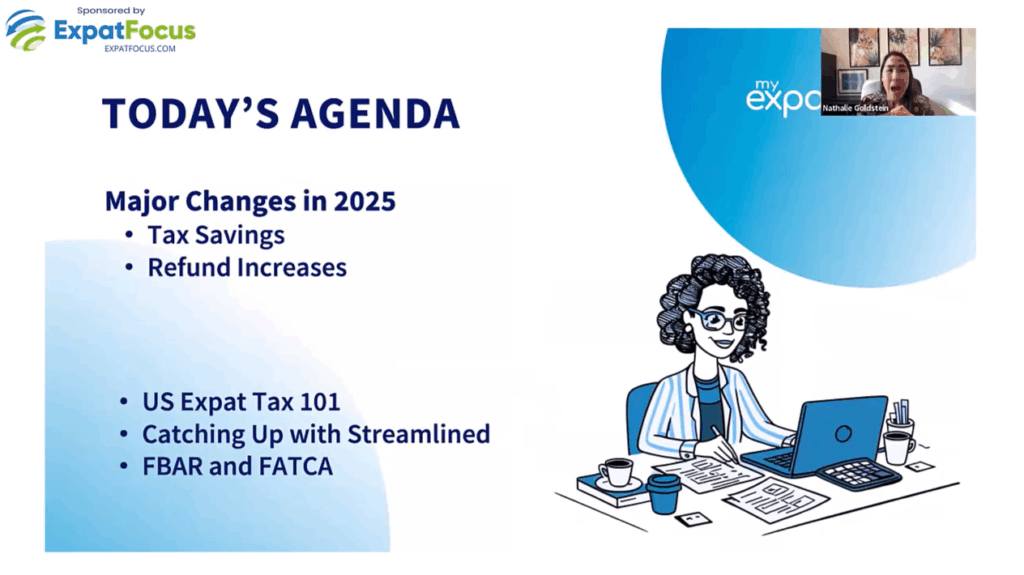
What do you need to know about filing US taxes from abroad this tax year? We’ll talk about tax savings, potential increases in refunds for US taxpayers abroad, and the basics of US tax 101, catching up through the streamline procedure and FBAR FATCA, all the information you need alongside your US tax return.
01General Deadlines
Before we get started, let’s talk about general deadlines. We are still in a citizen-based taxation regime, so we still need to generally file our US taxes as Americans living abroad. What are some key deadlines you should be aware of this year?
Deadlines can change depending on if they fall on a Sunday or holiday. April 15th – we all know this deadline. That’s the first deadline and it’s still important for expats if you owe taxes. If you owe taxes, we always recommend trying to file by April 15th.
If you don’t think you owe taxes, you can wait until the automatic two-month extension until June 16th. It’s June 16th this year because the 15th falls on a Sunday.
How do you know if you need to file? If you think you might owe taxes – maybe you owe taxes from previous years, maybe you moved abroad in the middle of the year, maybe you still have a lot of US-sourced income – there are different reasons why you may owe taxes.
If this is your situation, please look to file earlier. But if you know you won’t owe taxes, you only have foreign salary, you’re always using the foreign income exclusion or foreign tax credit, then you can wait.
If you’re unsure, you can try through My Expat Taxes. A little about me – I’m from California and I’m just like you. I moved abroad and had to file taxes. In that process was confusion about having to file by April 15th to pay, but not really having to file until June 16th.
With all that confusion about expat tax benefits, we decided to create My Expat Taxes, which is the leading tax software for US expats. What’s important for you to know based on tax deadlines is if you’re not sure if you owe taxes, you can model your tax return first on My Expat Taxes completely for free without paying.
You can see before you hit a payment screen if you might owe taxes or not. This can guide you on what deadline to follow.
Those are the general deadlines. You can always extend to October 15th with Form 8968. If you want to extend further, you can extend to December 15th. That’s more difficult because you have to submit a signed letter to the IRS requesting more time past October 15th.
So there are four general filing deadlines: April 15th, June 15th, October 15th, or December 15th if you really need it. If you need to file back taxes, please do that as soon as possible because if you owe taxes, there are penalties and interest that accrue.
02Who Needs to File
Who needs to adhere to these deadlines? The general threshold is what you see on screen. If you’re a US citizen or US green card holder – and this is the tricky part – there are folks who have a US green card, leave the US, or let their green card lapse and think they don’t have to file US taxes.
The rule is if you’re a US citizen or have a US green card and haven’t formally revoked your green card with Form I-407, you’re still considered a US tax resident even if you’re not physically resident in the US.
Depending on your filing status, you’ll have to file if you meet these filing thresholds. When we think about filing thresholds, it’s your worldwide income – all salary, interest income, investment income, rental income, before expenses, deductions, or taxes paid.
It’s your gross worldwide income. It can include Social Security benefits, pension income, all income from all sources. If you’re over these filing thresholds, you have to file a US tax return.
I want to call out that the married filing separately amount is very low – $5, and it’s been that way since tax year 2018. The IRS sees married filing separately as the least beneficial filing status. If you have interest income over $5 from any bank, you’d technically have to file.
Married filing separately is common for expats, especially if you’re married to a non-US citizen and they decide they don’t want to be on your US tax return. You might file married filing separately because you can’t file single if you’re married.
If you’re married to a non-US citizen and have a US child or dependent and qualify for keeping up more than half the home costs, you might be able to file as head of household with a higher filing threshold.
Self-employment is not a filing status, but if you’re self-employed in any sense – even freelancing or content creation on the side – if you have income you’d report on Schedule C with $400 or more net profit, you’ll have to file because you may be subject to self-employment tax.
It’s tricky sometimes to know if you have to file because there are all these “ifs, ands, or buts” about filing US tax returns. My general advice is if you’re earning enough money to live, you might have to file. Even if you’re not earning much or not working, if you’re getting investment income – even $5 of bank interest – you might still have to file.
Unfortunately, this continues to follow the majority of us living abroad.
03Annual Increases and Benefits
There are some benefits though – it’s not all bad news. There are increases every year that help us. The standard deduction will always increase. The standard deduction is in line with the filing threshold, so what I showed on the last screen is normally your standard deduction with the exception of married filing separately.
If you’re married filing separately, you’ll have the same standard deduction as single. It’s just the filing threshold for married filing separately that’s much lower.
With inflation, tax brackets will continue to increase even though rates stay the same. That means you can earn more money and it’s still taxed at a lower rate, or at least not taxed at a higher rate.
If you’re using the foreign income exclusion, because of inflation, that increases every year. Now it’s jumped up by another $6,500 to $126,500 US dollars. This is great for higher earners in low income tax countries.
For example, if you’re in Switzerland, Hong Kong, or Singapore as a salaried worker, this is a great benefit because you can exclude more foreign earned income and potentially not be subject to US taxation.
This is also important for digital nomads or remote workers. If you’re working for a US company but working abroad and you’re abroad for long enough – 330 days in a tax year – you could potentially use this benefit and make your foreign earned income potentially tax-free.
My favorite increase is the refundable part of the child tax credit. The additional child tax credit has continued to increase. For a long time, it was only $1,400 that you could get as a potential refund for every US citizen child with a US Social Security number under age 17 on your tax return, assuming you’re not using the foreign income exclusion.
Now it’s jumped from $1,400 to $1,700, and I hope it continues to jump next year. That’s something nice about filing a US tax return – there are cases where you can get a refund. Most people will not owe taxes, and a good handful will get refunds and actually get money from the US government even if they’re not paying taxes to the US government.
04Other Changes and Updates
There are always changes every tax year, and I’m sure next tax year will be no exception with the change in leadership. For this tax year, know that for IRA contributions, you have an increased limit on how much you can contribute.
If you’re still contributing to your individual retirement account in the US, you can contribute more. Remember, you can still contribute to that account up to April 15th.
If you’re older, keep in mind that you may be subject to required minimum distributions, meaning you need to pull out a certain amount from your US IRA accounts every year after a certain age. If you don’t, you could be hit with a tax. This tax has lowered from 50%, but it’s still something to consider.
Another part is refunds. I know COVID feels like another age, but there are still stimulus payments on the table. For those on this call who still haven’t filed your 2021 tax return, if you haven’t filed it, get on it because this is the last chance for you to get the final stimulus payment.
That’s $1,400 per taxpayer, plus an additional $1,400 for all dependents you can claim on your tax return, or if you’re married filing jointly, another $1,400. It’s still quite a lot of money.
Technically, you can still claim this up to June 15th, 2025. We really recommend doing this before April 15th just to make sure the IRS cannot argue with you because generally you only have three years past the deadline, plus expats have an additional two months extension.
However, with our experience on the 2020 stimulus payments, it’s easier the sooner you submit this. You will get the refund and not have to fight with the IRS about it, because fighting with the IRS is not fun.
There’s so much in the media about Direct Free File, and I really hope they make a great program to make tax filing easier. US expats are always kind of the last to get looked at, and that’s one reason we created My Expat Taxes.
We’re just not really in the supported cases. You still see the alert right now if you get on Direct Free File that you cannot use this if you don’t live in the US. If you’re an international taxpayer, check next year hopefully.
We sit in this weird pool of having to file taxes in the US but we don’t live in the US. We’re unfortunately not really supported yet by most US-based tax software.
05New Reporting Requirements
Since this webinar is about filing taxes this new year, a couple of other things not directly related to your tax return but you should have in the back of your mind: if you’re selling anything online, it could be anything.
If you’re making stuff on Etsy, selling on Amazon, really doing anything with credit card payments – it could even be Airbnb transactions – the IRS is really trying to increase compliance here. That means there’s a new tax form they’re issuing out.
If you have US investments, you’re familiar with 1099-INT, 1099-B, 1099-DIV forms. They also have another form, 1099-K, and it’s not new to this year, but it’s now going to be issued to a lot more people.
There used to be quite a high filing threshold before anyone would issue this form. Now the IRS is starting to say anyone that makes reportable income needs to have a paper trail.
If you made over $5,000 in calendar year 2024 somewhere online through credit card transactions, Amazon, Airbnb, whatever, you should expect to get this Form 1099-K next year. They’re going to lower it even more – it’s going to $2,500, and then for calendar year 2026, it’s going to be $600.
The IRS is really upping their compliance on selling anything online, and if they know you’re a US citizen, they expect a paper trail. This is important because we’ve seen it a lot already this past tax year where people will file their tax return but won’t realize that inside their Airbnb portal or other platforms, there is a 1099-K form waiting for them.
They don’t realize it and don’t report it on their tax return. Then a few months later, you get a letter from the IRS saying you didn’t report all your income because they have record of a 1099-K form.
Have that in the back of your mind. If this is you, if you’re selling anything online, it may be possible that the platforms you use have issued you a 1099-K form. This is very important that you look for it because the IRS has a record of this, and they expect you to report this on your US tax return.
06Good News: Windfall Elimination Provision
That was not-so-great news, so here’s better news. We did see that the Windfall Elimination Provision is eliminated. As our last president left office, they eliminated this elimination provision.
While we are not Social Security benefit experts, what we can tell you is basically there was this provision that if you had income not subject to Social Security tax in the US – basically people with foreign employers – it could be that later your US Social Security benefits would be reduced.
This has now been taken back. So this is great for expats. If you have eligibility to get Social Security benefits, technically you should be able to get as much as you’re entitled to without any further reduction for being an expat.
While it’s not in scope for this webinar, also something to keep in mind: if you’re an expat living abroad, there are still chances to contribute to US Social Security benefits.
If you know anything about Social Security benefits, you have to have 40 credits to be eligible to get US Social Security benefits when you retire. A lot of us expats moved maybe earlier in life. For example, I moved in my twenties, so I don’t have the full 40 credits.
But I have a good chunk of credits because I was a W-2 worker while I was in the US. What you can do is actually report self-employment income from abroad and subject that to US self-employment tax on purpose.
If there is a totalization treaty, if there’s not, then you have to pay self-employment tax anyway. But you could basically still pay self-employment tax from abroad and that will still get you credits.
If you’re very close to the 40 credits and want to get them so you do get US Social Security benefits later, it’s still possible. It’s not in scope for this webinar, but I think it’s important that as you file your US tax return, you understand what you can and can’t do.
07Bad News: Net Investment Income Tax
Back to bad news. The other bad news is Net Investment Income Tax. You’ve probably seen this in the news. There’s so much about expats in the news – we’re really creating the conversation there.
However, there is another court decision saying that yes, per the tax treaties, you should allow foreign tax credits against Net Investment Income Tax because otherwise it’s double taxation. I do believe it’s double taxation.
However, the IRS is continuing to just appeal and block these court decisions. As of now, even though you’ll see in the media that another court says yes, you do allow foreign tax credits, the IRS has not approved this.
Until they say yes, we agree and approve this, there’s actually no way to do that on your US tax return. For your 2024 taxes, if you have been paying Net Investment Income Tax, if you are a high earner with a lot of investment income, expect that you will still be subject to Net Investment Income Tax, which is 3.8% of your investment income.
08Streamlining Procedure
Let’s get to streamlining. In the event that I have potentially made you a little anxious because you haven’t been filing your taxes, I want to tell you there’s no need to be anxious if you have been filing your taxes regularly.
If you haven’t been filing your taxes, the IRS is actually very understanding. I know you don’t believe me, but they generally are quite understanding, depending on the agent.
If you haven’t been filing your taxes, what you can do is complete your three back years of taxes. So even if you haven’t been filing for 10 or 20 years, you can go through the streamlining procedure as an American abroad and file three back years of taxes only.
So it’s capped – only back to 2021. Then you file six back years of your foreign bank account reports. You only have to file six back years. This means you’ll be going through streamlining, and once you pass it, you’re seen as compliant. Your slate is wiped clean.
Even if you haven’t filed those past 30 years, the IRS will say, slate is clean, just be compliant up to now.
This is also important because if maybe you have been filing but realize you haven’t filed the right forms. For example, we have a lot of people who file with US-based tax software or firms, and then there will be things that are missed.
Maybe they have a foreign corporation with limited liability where they live and think, “Well this has nothing to do with the US so we don’t report this.” But actually you needed Form 5471, which is a very high penalty form – $10,000 if you don’t file it.
Or maybe you have some type of more complex foreign pension or private pension that you needed Form 3520 for, which is also a high penalty form. Or maybe you forgot to report all your bank accounts and you had over a certain amount, so over $200K, and you have to report it on this FATCA form, which is also a high penalty form.
It’s not that all is lost. If you have been filing but maybe forgot some very high penalty forms or made some mistakes, you can also go through the streamlining procedure and amend those returns to include those forms to get ahead of the game so you can remove those penalties before they ever come.
I do think that the IRS is generally understanding. Most expats do not actually end up owing taxes because of the expat benefits I will talk about. But a lot will get refunds, and especially if you haven’t filed your 2021 tax return.
If you haven’t filed your 2021 tax return, make sure to do it ASAP because this is the last chance for you to get that $1,400 refund, which literally will pay for your tax return and more if you go through streamlining.
09Expat Tax Benefits
Why do you end up not owing taxes? Why should this US tax filing procedure not be as scary as it might seem? That’s because there are two main expat tax benefits: the foreign income exclusion and the foreign tax credit.
Foreign income exclusion is as it sounds – it’s a chance to exclude your earned income that is foreign-sourced from US taxation, and a very high amount of it. As you see, $126,500 US dollars. On top of that, you also have the chance to exclude housing deductions, housing exclusions. So it’s a very great expat tax benefit.
Just a couple of things you need to understand about it: it is for foreign earned income. You can only use this for earned income. Earned income being salary, self-employment income, active partnership income.
Earned income is not pension income. It is not Social Security income. It is not investment income. It is not rental income. Earned income is income you earn actively for your services rendered, and it must be foreign-sourced.
When you look at earned income, the way the sourcing works is that you physically were abroad when you worked and earned that income.
Something else that can cause confusion is if you are a US taxpayer working for a foreign company, you live abroad, you live in Germany, you work for a German company, and because you don’t need a visa to go to the US, maybe your boss says, “We need you to do a business trip in the US for a month because you can just stay there and work from there.”
Not necessarily, because now that daily income you earn while working in the US for that one month is now US-sourced. Because you physically worked out of the US, it’s no longer foreign-sourced, so you cannot exclude it on the foreign income exclusion.
You can still claim tax credits. But remember, it is for foreign earned income only. Very straightforward form – Form 2555. You put it in your tax return, pretty easy to use, especially for those living abroad for more than a year.
However, if you use it, you will immediately disqualify yourself for the additional child tax credit. So it might not be the best approach to use. If you are still contributing to your US IRA, it can make it more difficult to contribute because it can basically wipe out your taxable compensation.
Foreign tax credit is another approach and it’s much more flexible. What it does is it uses the income taxes you pay abroad as a direct credit against your US tax liability.
If you’re paying 30,000 euros of income taxes in Germany, you can use the US equivalent on your US tax return. So if you owed $25,000 on your US tax return, consider that you owe nothing afterwards.
I think it’s really flexible in general because one, you can still claim the additional child tax credit. It gives you enough taxable compensation for your IRA contributions. What is also great about it is that you have the chance to carry over credits.
What I mean about that is imagine you’re a salaried worker in Germany and you’re paying really high income tax – I just picked Germany, it could be any country, France, whatever. But you pay a lot of income tax on your salary and then you don’t use all of those income tax credits because the US will normally have a lower income tax rate.
You pay 30,000 euros in income taxes, you only use $25,000 equivalent on your US tax return. So you can carry over $5,000. Now you can carry that over for 10 years, and that’s amazing because if you retire or move to a lower income tax country, you can use those carryovers against that same bucket of income.
Maybe you retire in the next few years and have pension income. This pension income is taxed at a lower tax rate. You still have all the carryovers from your salary.
It all sounds great, but the con is this form is pretty math-heavy and intense to use because what you have to do is separate out your income into the right bucket.
You can’t use income taxes paid on your salary against your investment income because salary is generally in the general bucket, whereas investment income is normally in the passive bucket, and there’s multiple buckets – like eight different buckets.
There’s general, passive, resource treaty, foreign branch, and on top of that, not only do you have to figure out what bucket the income sits in so you can apply the right foreign tax credits, you also have to do this background calculation for alternative minimum tax.
So it can be possible that you have like eight versions of Form 1116 in your tax return when you use the foreign tax credit. It’s a bit much – a lot more flexible in what it gives you, but that means it takes away your time to compute it.
10Third Option: Tax Treaties
There is a third tax benefit. In the event you’re sitting there saying, “Well I have a foreign state pension, foreign government Social Security benefits, this is not earned income. I cannot use the foreign income exclusion, but because it’s a state benefit, I pay no foreign tax credits. So are you telling me I owe US tax?”
Not necessarily. There is a third one – it’s less common, but just using the tax treaty. The US has so many tax treaties that are available.
One thing you have to realize though is you cannot take the tax treaty at face value. If you are a US citizen or US green card holder, generally 99% of that US tax treaty is not applicable to you.
What they have is called the savings clause, and that’s in every treaty. That basically says out of this entire treaty, as a US citizen, you can use one or two paragraphs. But luckily for us, those one or two paragraphs is normally around Social Security benefits.
That means if you do have foreign Social Security or even US Social Security and you’re retired abroad, you can generally look at the tax treaty to figure out which country has taxing rights, so you’re not double-taxed.
What we will do for you at My Expat Taxes is you just enter your income and we will automatically look for what’s the best tax benefit for you. We’ll model your return. No matter which plan you’re in – base plan, reviewed plan, or premium plan – you will get an optimization schedule.
You’ll see what your return would’ve looked like under the foreign income exclusion, what it would’ve looked like under the foreign tax credit. Then we’ll decide which benefit is best for you.
If there is a tax treaty application eligible for you to use, we’ll automatically include it with Form 8833. Because if you use a tax treaty position, you have to include Form 8833. Otherwise, there’s a $1,000 penalty for claiming a benefit without disclosing the benefit you claimed.
11FATCA and FBAR
That’s everything with your US tax return. Obviously not everything because there’s a lot more information than that, but I hope that was some good information for you to get general understanding of your US tax return.
Other things for you to keep in mind – FATCA and FBAR and all of that. You probably know FATCA already. You tried to open a bank account abroad, you showed your US passport, everyone freaked out. You had to sign a stack of papers.
Why? The reason is because those financial institutions now have to report that information to the US Treasury, and you as a US taxpayer also have to report that information to the IRS or US Treasury.
So there’s two versions of this form. There’s the FBAR. The FBAR is if your combined maximum balance from all your foreign financial assets… let me break that down.
Foreign financial assets is foreign bank accounts, foreign investment accounts. It is foreign pension funds with a cash value. It’s not state pension funds because there’s not really a cash value there. You don’t really have an account, you just have a right to a state benefit later on.
But if you have an employer pension account, a private pension account, those definitely count. If you have a foreign life insurance policy with a cash value, technically that is an investment vehicle that can be used as an annuity later on. That also counts.
If you have online banking accounts – if you have a Wise UK account, if you have a PayPal UK account – we also say include those in there. Because technically if you have a Wise UK account, that’s technically a UK bank account. It acts as one. It’s most likely set up in some type of UK entity.
What you have to do is calculate what was the maximum balance I had for each account? This can result in double counting because if you had $5,000 in one account and then transferred that to a second account, your maximum balance in account number one is $5,000, and your maximum balance in account number two is $5,000.
Add that together and you’re hitting the $10,000. So if you go over it, you have to file FBAR. Unfortunately, double counting does exist and it’s okay.
I know a lot of people come in and go, “But the IRS is going to think I have so much money because I’m double counting how much the maximum balances were.” But there is no tax calculated on your FBAR.
It’s important that you just report the information because technically the IRS also has it, and the FBAR is not going to the IRS, it’s actually going to the US Treasury.
If you meet over the higher threshold of $200K for your combined maximum balances on the last day of the tax year, $300K at any time during the year, if you’re filing jointly double these amounts, you also have to include this FATCA form – Form 8938 – and this does go in your US tax return.
Basically, if you have a good chunk of money sitting in your foreign financial accounts, expect to file these forms. That is why it’s really important to use an expat-specialized software or expat-specialized firm to do your taxes.
A lot of the US-based firms or US-based software won’t even think about your FBAR requirements. However, you have to do the FBAR if you meet the filing threshold. That has to be e-filed specifically to the US Treasury FinCEN.
On top of that, if you meet the threshold for 8938, you need to include basically the same information on that form in your US tax return. That form is a high penalty form. If you don’t include it, there can be potentially significant penalties that the IRS would charge against you.
That’s FATCA and FBAR in five minutes. I hope it gives you an overview of other things to think about when filing your taxes, whether you’ve been doing this for years or it’s your first time moving abroad and now you have to think about it for the very first time.
One other callout I will put there: if you have children and you’re opening up accounts for your children’s foreign financial accounts, if your children also have a combined maximum value of over $10,000 US dollars, they may have to file their own FBAR.
Just because you may report that on your FBAR as a parent, that doesn’t necessarily cover all the bases. If your child also meets the filing threshold, they will have to file their own FBAR.
You can obviously file it for them on their behalf, but they technically have to submit their own FBAR. You can submit FBARs for you, your spouse, and your children all through My Expat Taxes as you do your US tax return.
12Planning for Financial Success
I’ll close out with a little bit of planning for financial success. E-filing already opened, so the tax season is already going underway. April 15th is the first deadline to make payments if you think you owe.
Who normally owes taxes? People that move in the middle of the year. So if 2024 was your first year abroad, you moved in the middle of the year, you probably have US-sourced income.
What happens a lot is that you would’ve worked for the US and your withholding on your W-2… obviously they don’t realize that you also now have foreign income, so they didn’t withhold enough US federal tax.
Another situation is if you’re a high earner – this can be $125K for a married filing separate filer – and then you have investment income because then you have Net Investment Income Tax of 3.8%.
If you’re self-employed and you are in a country without a totalization treaty – for example, New Zealand or Singapore – and you’re self-employed, expect to pay about 15.3% self-employment tax.
That will go towards your Social Security benefits, so it’s not all loss, but that’s something you should plan for. You may owe tax, and if you wait too long, you’ll end up paying interest and penalties.
Another thing to watch out for: if you are contributing to your US IRA, you can still do so for your 2024 IRA up to April 15th. There are no further extensions – it’s just you can contribute up to April 15th.
Watch out as you contribute to US IRAs. It might be worth it to model your 2024 tax return first to see if you are eligible to contribute because there are a lot of eligibility requirements such as having enough taxable compensation.
Especially if you are contributing to a Roth IRA, if you have too much money, you might have to do a backdoor traditional to Roth IRA conversion instead. A little out of scope for this, but just keywords for you to keep in the back of your mind.
Obviously, if you don’t think that you need to file by April 15th, you can wait till June 15th. So file your tax return – it’s June 16th technically, but I’ll say June 15th because if you need to file a 2021 tax return, it is June 15th, not June 16th, because it’s only three years since the original due date of that return.
Make sure to file your 2024 tax return or if you had to file back taxes that you just finish that process by June 15th. Then of course you can still file an extension, which you can do for free in My Expat Taxes.
But you have to do that by June 15th. June 16th of this year is you file an extension to October 15th, and then this will give you additional time to file your US tax return.
This is really handy for those that maybe you have a new family member, maybe you had a child in 2024 and you’re going now through the process of how to get them a US passport, how to get them a Social Security number.
This is amazing to do because then you have until October 15th of this year to get their US Social Security number so that you can claim them on your US tax return and potentially get a refund of $1,700 for them.
As you go through this, obviously there is a lot of tax information, and My Expat Taxes is here to help you file your US taxes. But as we realize working with everyone, there’s also questions about investments and questions about tax planning in general.
So we do have My Expat Invest, which you can use, and then that will help connect you to a certified financial advisor that can help you in that journey. That also has a connection with us so that we can understand how your financial movements impact your tax return.
At the same time, if you want to do tax planning, we do have a lot of tax planning possibilities on My Expat Taxes. So as you go through your tax filing journey, if you need any support, My Expat Taxes is here for you.
We have different plans, so whether you want to be in our base plan, which is the most affordable plan, it’s a do-it-yourself plan where you get access to our calculation engine with the optimization schedule. You know you’re getting the best tax return you can get, and then you also have your FBAR and everything included.
Or you say, “I want to work with a tax professional and get a little bit more peace of mind.” We also have the reviewed plan. Or if you say, “No, I really prefer to work with a tax professional from day one, really work through that, make sure I understand my tax return, I have a lot of questions to think about how to report certain things,” we also have a premium tier for those that need more help.
If you’re streamlining, we’ll help you with streamlining. Basically whatever you need, we are here. We are trying to help you in the most affordable way possible.
I moved abroad 10 years ago, if you were here at the beginning of the call, and I just remember my first year moving abroad thinking I can’t use a US-based tax software because it doesn’t realize the fact that I live in Austria, I earn in euros.
However, if I try to go through a traditional tax firm approach, they’re asking me $2,000 to start a conversation and I just have wages. I don’t have… I can’t afford a $2,000 bill to have a conversation with a Big Four firm.
So that’s how My Expat Taxes was born. With that, we have Q&A coming up. So Hugo, I will let you take back the stage and hopefully we can get through all of your questions.
If not, there’s always ways to reach out to My Expat Taxes. You can find us on social media. We have a really lively Facebook group where we’re always answering questions. You can email us directly at [email protected].
We are always here for your questions. Whether or not you go with us, we know that the tax filing process is very stressful. So if we can help you along the way, we’re happy. It’s not a fun process, but we’re here for you.
13Q&A Session
Hugo: Thank you very much for that excellent presentation. We’ve got lots of questions. Some of them are very personal. I think if your question is about your specific circumstances and they’re a little bit complicated, maybe just get in touch with the team at My Expat Taxes.
My Expat Taxes.com. As Nathalie was saying, you can communicate by email, there’s a Facebook group, various ways to get in touch. That being said, let’s dive into some questions.
Is there an income minimum to qualify for the child tax credit?
Nathalie: Yes, there is. You do need to have $2,500 of earned income to start qualifying for the additional child tax credit refund.
Hugo: Does the My Expat software calculate the child tax credit?
Nathalie: Of course. So what you would do is you would go in, you would enter what your income is, and we’ll figure out do you have earned income? Because there’s also some special requirements where technically if you have self-employed income, but you’re using a totalization treaty, then it doesn’t count as earned income.
So we’ll make sure we understand, do you have earned income? And then depending on the tax benefit you use, for example, if you were using the foreign income exclusion in past years, we may have that discussion with you and say it might be worth it to revoke the foreign income exclusion and go for the foreign tax credit so that you get the refund this year and maybe even amend your prior tax returns to get the refunds you are missing out on.
Hugo: Somebody works abroad for a company in California, but has been paying federal and California taxes the last five years, but doesn’t have any property in California. Do they need to continue paying California taxes?
Nathalie: So California, what they will do in terms of 1099… So I assume that now it’s seen as self-employment income.
Generally for a state, you don’t pay state taxes unless the income is state-sourced, and most of the time state-sourced income means that you physically worked out of the state. California is a little crazy because they say it’s not about you working in a state, it’s also if the person that received the services… if your client is California-based, it is considered California-sourced income.
So in your situation, even if you’re living abroad, you may still be subject to California tax because the person you’re working for is based in California. So if that 1099, the payer’s name and address is California, it’s a big hint that California will try to tax that income.
Of course, if you can argue that the services rendered are not for someone physically based in California, but maybe that’s just where their headquarters is, but you’re actually working for someone else, you could always try to file and claim back California.
They might just ask a few questions and you can always get a letterhead from your employer saying, “No, this is the actual facts and circumstances.”
That’s a pretty long-winded answer, but most of the time, not for states, California is different. It is possible that you might still have to pay California state taxes.
However, in terms of federal taxes, you generally shouldn’t have to because on the federal side, it’s about where you physically are, so you should be able to claim federal taxes back.
Hugo: A couple of questions about filing status. Jeffrey says, should you do married filing jointly if you’re married for the sole income earner, or should it be head of household? And somebody else says, what kind of proof is required to file as head of household versus married filing separately?
Nathalie: If you are married… So it depends. If you’re married to a US citizen, you can never go under head of household because you’re considered married. Head of household is only for those that are considered unmarried.
However, the IRS will say that if you are married to a non-US citizen – so a non-resident alien – and they’re not electing to file a US tax return, then you will be considered unmarried.
So head of household is only for those that are actually single, so not married at all with a dependent that they can claim and they can claim the head of household filing status, or those that are married to a non-resident alien that then qualifies for head of household anyway.
I have only seen it once or twice that the IRS has asked for actual proof of head of household. But when they do ask for proof, they basically will say they have a form that you have to fill out and then it will ask you for basically statements saying that you have paid utilities, you have paid for childcare, you have paid for rent.
So normally the proof that is asked, rarely ever asked. Like I said, in the thousands and thousands and thousands of tax returns that we have filed, I have seen it twice probably.
But if they do ask, it will be a certain form that they have and then you will fill it out and then you will have to include proof. Basically receipts. So obviously the IRS operates on a “you tell the truth and you should always have the records to prove that” in the event that they ask.
Hugo: Another question about the child tax credit. Somebody says, “I had a baby last autumn. Can I request the child tax credit for 2024?”
Nathalie: Of course. I would totally recommend that you file an extension to October 15th ASAP, and you can do that on My Expat Taxes. We normally open it out towards March, but you could already file the extension.
What you want to do is you want to make sure you start that process. So you want to get the US passport, you want to get the US Social Security number because that can take three to six months.
You can claim a dependent on your tax return as long as their Social Security number is valid by the due date of your return. So if you get the extension, then you just need to get that Social Security number before October 15th, 2025.
And again, there’s other qualifications to get the refundable child tax credit, but normally if you are a salaried employee, you’re working in a high income tax country and you’re using foreign tax credit, you should expect a $1,700 refund.
Hugo: How would it affect expat taxes if the TCJA isn’t extended – Tax Cuts and Jobs Act?
Nathalie: There’s not too much… I mean, basically a lot of those… There’s a lot in there. I think a lot of that was revolving also around IRAs and stuff. There’s really not too much impact because they were not touching our foreign income exclusion. They’re not touching our foreign tax credit.
So this is not… it’s really not going to make a big difference. I mean, maybe you’ll see some changes in terms of foreign corporations, but I’m kind of diving now into a separate area, but for the general population, it’s not going to make a big difference.
Hugo: Somebody asked about the refundable additional child tax credit. Is it available for children over age 17 who are handicapped?
Nathalie: No, unfortunately not. There is a very strict 17 age limit for this. You can still claim dependents that are older, but then they’ll fall in the category… basically other dependent. And so you won’t get a refundable refund. I’m sorry.
Hugo: Somebody says, “I’ve been filing the foreign earned income exclusion the whole time I’ve lived abroad, but I’m thinking about changing to the foreign tax credit in order to be able to open a Roth IRA and receive the refundable child tax credit. Are there anything in particular I need to do or keep in mind making that change?”
Nathalie: So what I would normally say is when you use the foreign income exclusion… that’s another reason we say if you don’t need to start it, don’t. Because once you revoke it, you can’t use it for five years.
And so this is a little bit risky. So in your situation, what I would say is you can go on My Expat Taxes, you can do your return and we’ll normally suggest that you then switch because we’ll see that under the foreign tax credit, you would get a bigger refund.
With that being said, what you can then do to minimize the risk is we would normally, especially if you’re in our reviewed or premium tier, we would then say it’s probably best that you amend your prior year tax returns up to three years, so that you can try to claim the refund for those past three years.
But at the same time, this means that your revoking date for foreign income exclusion is now three years ago. And so now you don’t need to wait five years from now to use foreign income exclusion again, but then you only have to wait two years from now because technically you’ve now revoked three years in the past.
When you’re looking at Roth IRA contributions, do think again, it is important because there is income threshold. So if you are earning a lot, and it doesn’t even have to be a lot if you’re married, filing separately, if you earn anything, you basically cannot contribute because if you earn a dollar or more it gets phased out.
And then if you earn $10,000, you cannot contribute to a Roth IRA. So make sure you look at that because the way you would then go around that is you would make a traditional IRA contribution first and then you would make it then non-deductible and then roll it over to a Roth IRA.
So yes, there are a couple things to think about.
Hugo: That might be one worth talking to somebody about. Have you got a few more minutes if we go over the hour?
Nathalie: I do have as many minutes as needed.
Hugo: Perfect. So lots of questions here, so let’s keep going for a bit. How is an inheritance from a non-US citizen considered?
Nathalie: So there is no inheritance tax at the federal level, so you’re not necessarily paying an inheritance tax. Inheritance tax there is, but it’s an estate gift tax, so that means that the person that’s giving you the inheritance would then be subject to gift tax. But obviously they’re not a US citizen, so this is not too important.
What you do have to consider is if you get over $100K in gifts from non-US citizens. This can trigger a Form 3520 reporting. So Form 3520 is for pensions… or not pensions, but normally it’s foreign pension, so it’s for foreign trust and foreign gifts.
So if you have over $100K from a non-US citizen, you may have to disclose this on Form 3520. And this is really important you do this because if this form is late, you will automatically get a $10,000 penalty from the IRS.
They do not play with Form 3520. This is the one form where I see those notices coming out automatically. You can fight them, but it’s a very long fight. So if this is you, get on it, make sure you get your extensions, make sure you file 3520.
We do that for you in My Expat Taxes. There is an additional cost for the form because it’s a high penalty form, but we will help you file 3520 if needed.
Hugo: And that’s… so there’s no tax on it, it’s just a reporting… just reporting. Not taxed as income, a gift like that?
Nathalie: Nope. There’s no tax. There’s no tax. You just have to disclose it. But if you don’t disclose it, then there is a $10,000 penalty. So it is very important you disclose it.
Hugo: Somebody asked, does property count as foreign financial assets for reporting on FBAR or FATCA form 8938?
Nathalie: A property itself, like a residence, a property, it’s not a foreign financial asset. Obviously any bank account that’s related to the mortgage is, but real estate, it’s not a foreign financial asset.
Hugo: Somebody else, does your software support automated PFIC calculation?
Nathalie: So I think there’s nothing automated about PFICs, I’ll tell you that one.
But we do support PFIC reporting. So when you go in, we’ll ask you about your PFICs and we’ll ask you for the transaction history. And what we will offer is we basically have probably the lowest PFIC report preparation fee. So we charge 49 euros per PFIC, and I think the standard is more closer to like 99 plus per PFIC, if not even higher.
There is no automation there because PFICs are terrible. They’re really not… They’re fine as long as you know your transaction history. So you’ll have to follow through and enter the transaction history and then you’ll be prompted to work with a tax professional.
And then we’ll have to look at your prior PFIC declarations to make sure that everything’s aligned.
So, no, it’s not automated. Yes, we do support it and we do support it for generally the most affordable rates possible. And we do so many PFICs and it’s also for anyone that did make PFIC investments. So investments in foreign pooled funds in 2024, please file a timely tax return because you may be able to make a first time election mark-to-market election.
And this is something that requires a little bit of planning, but is generally a good way to go when it comes to PFICs. And we do that for you of course.
Hugo: Does a credit union account have to be reported on FBAR?
Nathalie: I would assume that’s a US account normally. I mean, it depends. If it’s… what I always say is look at the financial institution. If the address of the financial institution is not in the US, report it. If it’s in the US, it’s a US account.
Hugo: Somebody else, okay, a 19-year-old accidental American with no income, who will want to renounce, but I think to renounce they need five years of tax filing, but they’ve got no income. Do they start filing anyway to build up those five years?
Nathalie: Yeah, so what you’ll generally do is it’s catch-22 a little bit, but yeah, so definitely file now because at least you get the $1,400 refund for 2021, and this will offset your filing expenses later.
So I would say file now, go under streamlining. We’ll help you go through that. We’ll get you the $1,400 refund for 2021 and then you’ll have to file three years.
You could technically try to streamline and file four years. You could technically file back to 2020 to just have it on record because as Hugo said, you need five years on record. And even though you don’t get the refund for 2020, we do have some people that will try to file four years under streamlined so that they can renounce the very following year.
So then you would file your current year, three to four years of back taxes. And then next year you could renounce or you could renounce the year after.
Hugo: Does the software help you figure out what bucket your income falls onto for foreign tax credit?
Nathalie: Of course. So you just enter what you earn and then you enter your foreign taxes and you can separate them by how much tax you paid per each income stream. If you know it or you just have a part at the bottom of the screen when you get that, it says, “This is how much I paid in total to Germany, to France, to wherever.”
And then we’ll go ahead and prorate it per bucket. So we’ll prorate it between general, passive, resource treaty, foreign branch, etc.
Hugo: Thomas asks, so US citizen living in Italy, and wants some help with their expat taxes. If I use My Expat Taxes, can I be confident avoiding double taxation?
Nathalie: Yes, definitely. I would say for those that are US citizens in Italy, the one trickiest part for people that are self-employed. If you’re self-employed in Italy and you’re a US citizen and you’re not an Italian citizen, you will still be subject to US self-employment tax.
So just be aware of that. It’s not double taxation, but it can trip people up because they don’t realize that and they pay into the Italian system. But then technically you’re supposed to pay in the US system.
So yes, you can use us. We even have some preparers that are in Italy, so I need to visit there. But we have a lot of US citizens in Italy that use My Expat Taxes. We have a lot of US citizens all over the world in every different country using My Expat Taxes.
And our goal is always to make sure that you are never double taxed and that your return is optimized.
Hugo: That’s an interesting question. What advice would you give to someone who is planning to move abroad this year to make things easier in advance?
Nathalie: To make things easier in advance… So one is probably… I mean, there’s really, it depends, like if you’re a wage worker, it’s never going to be too complex.
But what you should do is, obviously if you have a W-2 and you have some type of federal tax withholding, I would generally say to see if you can make sure you get as much withholding as possible.
Because like I said, the situation is people will have a W-2 and they might try to get a lower federal withholding and then they move abroad and they have foreign income, and then their income is higher. So the federal withholding doesn’t quite match.
So that is one… you basically want to cut state ties, so if you’re deciding to move abroad permanently, you might want to make sure that you cut state ties. So cutting state ties could be anywhere from just making sure that you don’t keep having property there. You don’t keep living there. Maybe you end your driver’s license there. You don’t have to do these things, but it makes it a little bit more clear that state residency has been cut.
It’s nice if you have a US bank account still when you move abroad so that you can still work with the IRS pretty easily.
And then when you move abroad, make sure to keep monthly payslips, because especially if you move to the UK or a country that has a different tax year, so not January to December, but randomly April 4th to April 5th or whatever it is, then you’ll want to rely on monthly payslips so that you know how much income you earned and what taxes you paid locally.
So the main thing there is just really keep documentation. But there’s not really deductions you can claim. Like the moving expenses is not claimable. So this was something that happened a while back, but so there’s no real expenses to claim there.
I think I answered that question. But basically it’s key documentation. And if you have some suspicion that your federal withholding is not high enough, then try to then pay an extension payment or just make sure you file by April 15th of the next year.
Hugo: I’ve heard… as you were saying about cutting state ties, I think that particularly applies in certain states like California, some people move state before they move abroad.
Nathalie: Yeah. Some people will move states before they move abroad. You don’t have to get so extreme. I mean, what I would normally do is if you move abroad and the year you move abroad, make sure you file a part year to say that, “Hey, I moved from the state” and then the following year file a non-resident.
And then that way you have it on record that you put the documents there on record. Because there’s nothing… you can actually send to California to say, “I left.” But you can create a paper trail by saying, “Okay, I file a part year, I have a date where I moved out.”
And then the following year and maybe one or two years after I keep filing a non-resident, even if I have no CA-sourced income just to prove like I left. This is my paper trail.
Hugo: Let’s just do a couple more. Dave says, how do you indicate when reporting self-employment income that you live in a country with a totalization agreement?
Nathalie: What was the first part of the question?
Hugo: So reporting self-employment income from abroad. But if there’s a totalization agreement, which I think means you won’t…
Nathalie: Yeah, this is… I mean, so there’s quite a lot of totalization treaties. What you do, it’s a little tricky because technically the IRS wants a certificate of coverage for anyone that’s self-employed if you don’t want to pay self-employment tax.
If you are self-employed and there’s a totalization treaty, what you can do is you can claim it and then you would technically include a certification of coverage in your return.
However, you cannot easily get this from most local governments because you can go to the UK and they might be like, “I don’t know why I would give you this form.” Some people get it, but long story short, that’s the safest way.
And then you paper mail your tax return, you include your certificate of coverage and you say, “I am exempt from self-employment tax.”
But this is not really the reality and especially the whole fact that you have to paper mail the tax returns. So what is the general practice people will do… and what we do as well is that you’ll enter your self-employment income. We will include a treaty-based position that you’re claiming the totalization treaty inside your tax return.
And then we will then include a couple other statements to say that you are exempt because of totalization treaty and this can then be e-filed. So this is generally… this is pretty much always accepted by the IRS as another way to do that.
It can happen that they may follow up and say, “Can you provide us a certificate of coverage?” And if you don’t have one, you can normally provide a local tax return to say like, “Hey, I did pay my Social Security taxes, my self-employment tax locally, so don’t come looking at me for that money.”
I hope I answered that. But yeah, we do support that and we do it in a way where you can e-file. There is definitely a way where you would paper mail the return, but this is just not… it’s not very fun to paper mail return.
Hugo: Somebody else can My Expat Taxes cover amended returns for prior years?
Nathalie: Of course, yeah, we cover streamlining. We can cover amended returns at this point. I always think back a little bit fondly. So we started back in 2018 and when we first started, we always said, “Okay, we just… we’re starting out, we do a do-it-yourself tax software for salaried folks, just to make it a little bit easier for a little bit of the population.”
And because there was just so much demand. I mean, now you can do anything with My Expat Taxes. For the most part. If you have foreign corporations, 5471s, you have foreign pensions, 3520s. You’re streamlining, if you’re streamlining from abroad, if you’re streamlining domestically, if you have PFICs, you can pretty much do everything.
We are always here to try to help you and if you have dual status returns, if you’re expatriating, if you’re starting… I would always say just send us an email. Send us an email.
And if for some situation, we can’t handle a return, we will let you know, but generally we will always look to help you if we can.
Hugo: Fantastic. I think there are lots more questions. Lots of them are quite personal and I’d say to everyone, if we haven’t had time to answer your questions, sorry, and just get in touch via MyExpat Taxes.com.
Nathalie, thank you very much for taking the time to join us today. Our next session in the conference is on financial planning considerations for Americans living abroad in 2025, starting in just under an hour.
So we hope to see you there and otherwise, thank you all for joining us and thanks once again, Nathalie.
Nathalie: Bye everyone. Thank you.