
The following transcript was generated by AI and may contain inaccuracies.
At the 2026 US Expats Financial Conference, Randall Brody of Tax Samaritan joined host Hugo Lesser to discuss tax planning for Americans moving or living abroad. Drawing on over 30 years of experience, Randall made the case that filing correctly is only the starting point — covering why compliance alone is a costly default, what a year-round advisory relationship looks like, the key 2026 changes to deadlines, deductions and the foreign earned income exclusion, and audience questions on PFICs, foreign tax credits and the passport revocation rules.
Hugo: Hello, and welcome to day three of the 2026 US Expats Financial Conference, sponsored by Expat Focus, Wise, Global Citizen Solutions, and Advanced AI Services.
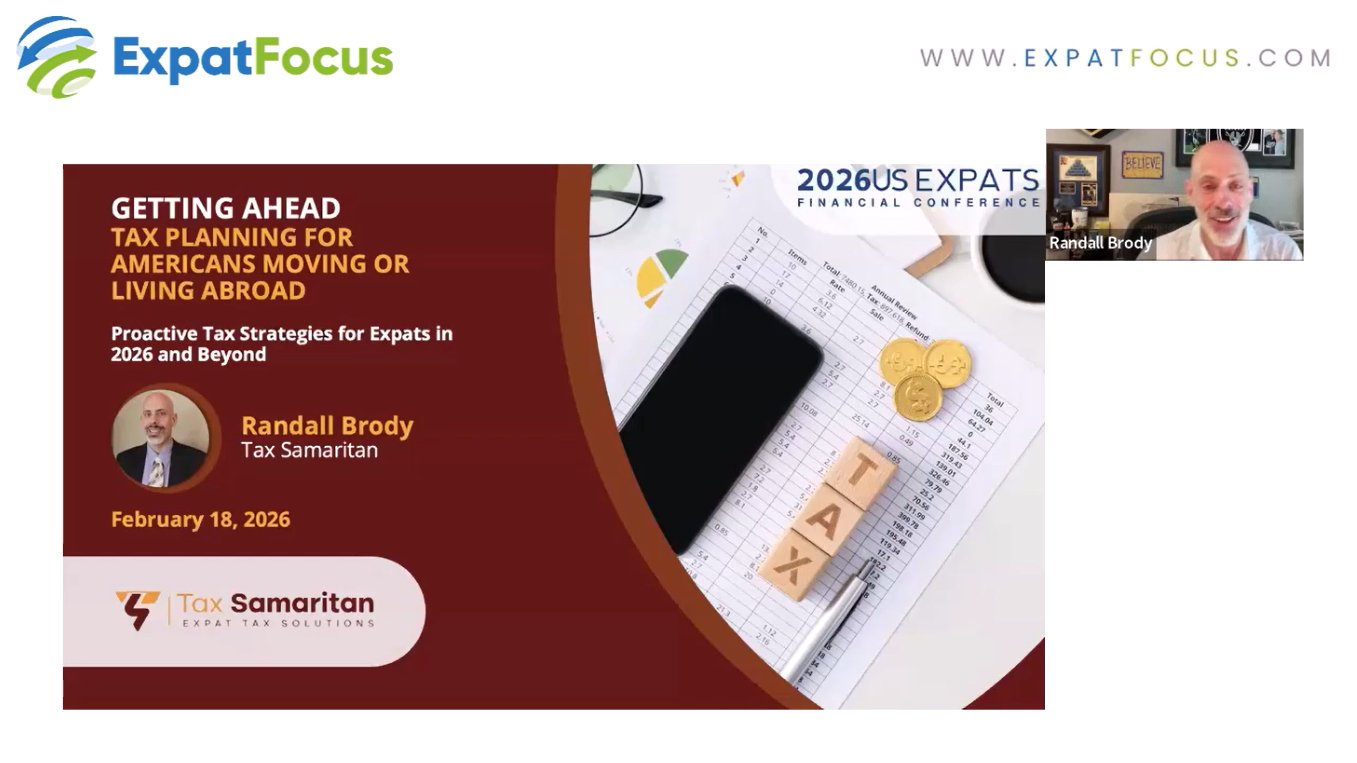
We have a fantastic schedule for you consisting of 17 sessions over four days, covering multiple aspects of financial information for Americans living abroad, with perspectives from some of the world’s leading experts in their fields. Today is the third day of the conference, and for this, our second session of the day, I’m delighted to be joined by Randall Brody, who’ll be discussing getting ahead: tax planning for Americans moving or living abroad.
Randall is an IRS Enrolled Agent and has an MBA from Cal State East Bay. He founded Tax Samaritan in 1997 to help American expats stay compliant and tax optimised. In that time, he has guided over 9,500 US taxpayers. Clients benefit from his passion for making complicated tax issues simple and for saving them the most money possible. His approach is characterised by integrity, personalised attention, and a commitment to delivering the best results for every client’s unique needs.
Before we start, please bear in mind the information presented is for general educational purposes only, and you should always seek your own personalised financial advice. Randall will be answering your questions after the presentation, so please add them as and when you think of them in the Q&A popup at the foot of your screen, and we’ll try to answer them all at the end, time permitting. So without further ado, over to you, Randall.
Randall: Thank you, Hugo. Greetings, everyone. As Hugo mentioned, I’m based in Las Vegas, Nevada. With over 30 years of tax and finance experience, I’ve helped over 9,500 taxpayers solve their expat tax problems and collectively eliminate more than $900 million in tax debt.
A little bit more about me. I’m passionate about travel, a proud father and grandfather, and I understand the unique challenges of expat life. When I’m not busy saving people money on their taxes, my wife and I enjoy rooting for the local Las Vegas Golden Knights hockey team and the Raiders football team, along with our giant dogs — a Labradoodle, a Great Dane named Scooby, of course, and a Saint Berdoodle. I also love to snow ski and try to get on the slopes at least once a week during the winter.
Today, we’re going to explore how we can transform the expat tax experience from mere compliance to empowerment. Over the next 35 minutes or so, we’ll discuss strategies to simplify your tax journey, empower your financial decisions, and align them with your broader life goals. Let’s dive in.
Randall: Let’s start by setting the stage. Living abroad is about more than changing your address. It’s about pursuing a new way of life. Whether you’re chasing financial freedom, seeking adventure, or building wealth, your tax strategy should support, not hinder, these aspirations. Today, we’ll focus on turning taxes into a tool for achieving your goals.
Let’s delve deeper into the importance of proactive tax planning for US expats by exploring three key areas. Number one: why US expats need more than compliance. While fulfilling tax filing obligations is essential, mere compliance often falls short for US citizens living abroad. The US uniquely imposes taxes on its citizens’ worldwide income, regardless of residency. This global taxation system can lead to complex financial situations, including the risk of double taxation — paying taxes both in the US and your country of residence.
Beyond the standard income tax return, expats must navigate additional reporting requirements such as the Foreign Bank Account Report, known by the acronym FBAR, and the Foreign Account Tax Compliance Act, known by the acronym FATCA. These regulations mandate the disclosure of foreign financial accounts and assets, adding layers of complexity to your tax compliance.
Relying solely on compliance without strategic planning can result in missed opportunities for tax optimisation. Proactive tax planning enables you to use available exclusions, credits, and deductions effectively, ensuring that your tax strategy aligns with your financial goals and minimises unnecessary liabilities.
Number two: the evolving landscape of expat taxation. The tax environment for US expats is continually changing, influenced by legislative reforms and international agreements. Recent discussions have focused on eliminating double taxation for Americans abroad. For instance, proposals have been introduced to allow expats to be taxed only on US source income, potentially alleviating the burden of double taxation. Will that happen? Who knows.
Additionally, changes in international tax treaties and adjustments to exclusions, like the foreign earned income exclusion, directly impact expats. Staying informed about these developments is crucial, as they can offer new opportunities for tax savings or require adjustments to existing strategies. The increasing complexity of global tax compliance, including heightened enforcement of FATCA regulations, underscores the need for expats to engage in proactive tax planning. By staying ahead of these changes, you can better manage your tax obligations and capitalise on new benefits.
Number three: today’s goal is to empower you to achieve financial freedom through transformative tax strategies. Our objective is to move beyond basic compliance and equip you with strategies that align with your life goals. By adopting a proactive rather than a reactive approach, you can minimise your tax liabilities, ensure compliance with evolving regulations, and focus on building wealth and achieving financial freedom.
We’ll explore how tailored tax planning can serve as a tool for empowerment, enabling you to make informed financial decisions that support your aspirations as an expat. Through strategic planning, you can turn the complexities of the US tax system into opportunities for growth and financial well-being. By understanding the necessity of proactive planning, staying informed about the evolving tax landscape, and implementing transformative strategies, you can navigate the complexities of expat taxation with confidence and achieve your financial objectives.
Randall: Why do people move abroad? Common reasons include financial freedom, adventure, personal growth, and reducing stress. But these aspirations can be complicated by the realities of taxes — for example, understanding the foreign earned income exclusion, tax treaties, or retirement account implications. Proactive planning ensures that your taxes align with these goals rather than creating obstacles.
Let’s see how this works in practice, and explore the aspirations that often motivate individuals to move abroad. First, pursuing financial freedom. Many Americans seek to relocate to countries with a lower cost of living, more affordable healthcare, and favourable tax environments to achieve financial independence. For instance, destinations like Portugal and Thailand offer expats the opportunity to enjoy a higher quality of life at a reduced cost.
Proactive tax planning plays a crucial role in this pursuit. By understanding and leveraging international tax treaties, foreign earned income exclusions, and other tax benefits, expats can minimise their tax liabilities, thereby enhancing their financial freedom.
Second, embracing adventure and lifestyle changes. The desire for new experiences and cultural immersion drives many to countries like Japan. Individuals have moved to rural Japan to engage deeply with local traditions and crafts, finding fulfilment in these unique experiences. However, such moves come with financial considerations, and proactive financial planning ensures that expats can manage currency exchanges, understand local tax obligations, and maintain financial stability while embracing new lifestyles.
Third, seeking growth and opportunities. Personal development and career opportunities are also significant motivators for moving abroad. Countries with strong economies and diverse cultures offer environments where individuals can grow personally and professionally. Strategic planning is essential here as well. By understanding the tax implications of foreign employment, investments, and business operations, expats can make informed decisions that support their personal and professional growth.
Fourth, building wealth and reducing stress. Relocating to countries with favourable economic conditions allows individuals to build wealth more effectively. Some Americans move abroad to benefit from lower taxes and improved economic opportunities. By effectively managing tax obligations and using available deductions and credits, expats can reduce financial stress and focus on wealth accumulation.
In summary, while the motivations for moving abroad are diverse, proactive tax and financial planning are fundamental in ensuring that these aspirations are realised. By aligning financial strategies with personal goals, expats can fully embrace the opportunities that living abroad presents.
Randall: Traditionally, taxes have been treated as a necessary evil — something you dealt with once a year and forgot about. But what if taxes were part of your transformational journey? What if you could move beyond transactional compliance to create strategies that deliver memorable outcomes, like increased savings, peace of mind, and confidence in your financial future? Imagine how your global lifestyle could be enhanced with a tax strategy tailored to your aspirations.
Let’s explore how tax services can evolve from traditional transactional compliance to becoming an integral part of your expat journey. The traditional approach is reactive, transactional compliance. Historically, tax services have been reactive, focusing on annual filing requirements and addressing issues as they arise. This transactional model emphasises completing necessary forms and ensuring compliance with tax laws, often without considering your broader financial goals or life circumstances. This can lead to missed opportunities for tax optimisation, and it may not support your unique aspirations.
In contrast, a modern approach to tax services involves proactive planning that aligns with your individual life goals. This strategy encompasses personalised tax planning — tailoring tax strategies to fit your specific financial objectives and circumstances, maintaining regular communication throughout the year to adjust plans as life events occur, and considering all aspects of your financial situation, including investments, retirement planning, and estate considerations. By adopting this proactive stance, tax services become a supportive partner in your journey, helping you navigate complex international tax landscapes and seize opportunities for financial growth.
Then there’s creating memorable outcomes. Applying the concept of memorable outcomes to tax services means transforming the expat experience from a routine transaction to a meaningful and transformative journey. This can be achieved by delivering value beyond compliance, offering insights and strategies that not only ensure compliance but also enhance your financial well-being. It means building trusting relationships, establishing a partnership where you feel understood, supported, and empowered in your financial decisions, and providing educational empowerment — equipping you with the knowledge and tools to make informed decisions, thereby reducing anxiety and fostering confidence.
By evolving tax services in this manner, we create memorable outcomes that resonate with your aspirations, leading to greater financial freedom and reduced stress. This transformation aligns tax planning with your broader goals, making it an integral and enriching part of your expat experience. In summary, moving from a traditional transactional model to a proactive, experience-focused approach in tax services not only ensures compliance, but also actively contributes to your overall life satisfaction, your goals, and your success.
Randall: One of the most significant global shifts has been the transition to a subscription economy, transforming industries worldwide. We also see this playing out in the tax and financial industry, in a transition to a more proactive and strategic approach to planning. As expats, this shift means continuous access to expert tax and financial guidance, not just during tax season, but as an integral part of your long-term financial well-being.
Imagine having a dedicated advisor who helps you plan for major life decisions, such as moving countries, purchasing property, managing foreign investments, or structuring your retirement in the most tax-efficient way possible — not just at tax time. This ongoing relationship provides you with financial clarity, strategic advantage, and greater empowerment over your wealth and financial future.
In today’s rapidly evolving global landscape, tax planning is no longer just about compliance, it’s about strategy. The traditional model of tax services centred around annual transactional engagements is giving way to a more dynamic, consultative, and relationship-focused approach. The shift from transactional interactions to a year-round approach with subscription-based tax advisory services prioritises long-term optimisation over simple compliance.
Instead of treating taxes as a once-a-year obligation, a year-round approach allows expats to minimise tax burdens proactively, and to anticipate changes in tax laws, residency rules, and treaty benefits to avoid costly mistakes and maximise savings. It aligns tax planning with life goals, whether it’s structuring international investments, selling foreign property, or planning for cross-border retirement. A proactive approach ensures financial choices are tax efficient and stay ahead of regulatory changes. As I mentioned earlier, international tax laws evolve constantly, and having an advisor who monitors these changes means avoiding surprises and maintaining compliance effortlessly.
Embracing a year-round tax advisory model offers several benefits for expats. Strategic growth: a forward-looking tax strategy ensures that expats make financially sound decisions that optimise tax efficiency and wealth accumulation. Financial clarity: by maintaining ongoing conversations with a tax advisor, expats have a clear understanding of their tax obligations and opportunities, avoiding the uncertainty of last-minute tax filings. And peace of mind: knowing that tax planning is taken care of throughout the year allows expats to focus on their careers, families, and global adventures without unnecessary financial stress.
This model fosters a truly proactive approach to tax planning, transforming the advisor-client relationship into a long-term financial partnership. Traditionally, the majority of taxpayers only think about their tax obligations when filing their return. But in a subscription-based advisory model, the proactive planning process is a systematic approach designed to ensure that every aspect of your financial life is thoroughly addressed, guiding you from initial assessment to implementation, and ensuring that your financial strategy is comprehensive, tailored, and actionable.
By shifting to an ongoing advisory relationship, tax professionals empower expats to proactively manage their wealth, optimise their tax outcomes, and make smarter financial decisions rather than simply reacting to tax filing deadlines. The true power of proactive tax planning lies in its ability to transform financial complexity into financial opportunity. Rather than viewing taxes as an annual obligation, expats who embrace ongoing advisory services gain an invaluable strategic advantage — one that allows them to minimise taxes, build wealth, and make well-informed financial decisions. This shift from compliance to strategy redefines what it means to be an empowered global citizen in today’s tax landscape.
Randall: Now let’s talk about the virtual family office model. A virtual family office, or VFO, brings all aspects of financial planning under one roof, integrating tax planning, wealth management, and estate planning. For expats, this holistic approach is transformative. Expats with complex financial portfolios can benefit from coordinated strategies that simplify compliance while achieving strategic growth. A VFO doesn’t just handle taxes, it supports your entire financial journey, ensuring that all aspects of your finances work together seamlessly.
Let’s break it down. Imagine a system where your tax strategies align seamlessly with your broader financial goals, whether it’s growing your investments or securing your legacy. Expats often face complexities in managing multi-country investments or planning for a cross-border inheritance. A VFO helps navigate these challenges, ensuring tax efficiency and long-term success.
A VFO simplifies the often overwhelming task of international tax compliance, minimising errors and stress. Beyond compliance, it identifies strategies for long-term financial growth, such as leveraging foreign tax credits or strategically using retirement accounts. And most importantly, it provides peace of mind, knowing that all financial decisions are interconnected and optimised.
A VFO doesn’t just react to financial issues, it anticipates them through proactive planning. Expats can mitigate risks, maximise deductions, and plan for future goals like early retirement or relocating to another country. By using a VFO’s guidance, expats can better manage currency fluctuations and their impact on long-term financial planning. In summary, a VFO turns complexity into clarity and challenges into opportunities, aligning every financial decision with your life goals.
Randall: Let’s dive into some of the key tax updates for 2026 for expats. First, there are some changes in filing deadlines and standard deductions. The foreign earned income exclusion threshold has increased, which is always great news for many expats. It’s essential to understand how these changes may apply to your tax situation, as they can significantly impact your tax obligations and financial strategies. Staying informed about these changes is essential, not just for compliance, but for identifying opportunities to optimise your financial outcomes.
Here’s what’s new. The standard filing deadline remains at April 15, 2026, with an automatic two-month extension for US citizens living abroad, making the deadline June 15, 2026. However, it’s important to keep in mind that taxes owed are still due by April 15 to avoid interest. If needed, you can request an extension to October 15 by filing Form 4868, and this flexibility provides additional time to plan and ensure compliance.
The IRS has also increased the standard deduction amounts for tax year 2026 to account for inflation. For single filers, it’s increased to $16,100; for those filing jointly, to $32,200; and if you’re filing head of household, to $24,150. These increases reduce your taxable income, which is a straightforward way to lower your overall tax burden.
There are also new foreign earned income exclusion thresholds. The foreign earned income exclusion amount has increased to $132,900 for tax year 2026, and if you qualify through the bona fide residence test or the physical presence test, this allows you to exclude a significant portion of your foreign earned income from US taxation. This is a major benefit for expats, and proper planning can ensure that you take full advantage of it.
Tax treaties between the US and various countries may further streamline compliance and reduce double taxation risks. These treaties clarify taxing rights, reduce withholding rates for certain income types, and help expats navigate complex cross-border tax obligations.
Another area I want to mention briefly is the passport revocation rule. By law, the IRS will certify taxpayers with seriously delinquent tax debts to the State Department for specific actions regarding their passports. Generally, the State Department will not issue passports to taxpayers after receiving their delinquent debt certification from the IRS. The State Department may also deny a taxpayer’s passport application or revoke their current passport. If taxpayers with certified tax debts are overseas, the State Department may issue a limited validity passport, allowing the taxpayer to return directly to the US.
Seriously delinquent tax debts are legally enforceable, unpaid federal tax debts, including assessed penalties and interest, totalling more than $66,000, which is adjusted yearly for inflation. These debts include your US individual income taxes, trust fund recovery penalties, and business taxes for which individual taxpayers are personally liable, as well as other civil penalties. To summarise, under the passport revocation rules, taxpayers with a seriously delinquent tax debt of $66,000 or more may have their passports denied, revoked, or otherwise limited.
These changes and others are more than just updates. They are opportunities to adjust your tax strategy, reduce liabilities, and align your financial plan with your life goals. So let’s turn these updates into actionable benefits.
Randall: Let’s look at some real-world examples. Scenario one: optimising the foreign earned income exclusion for a remote worker. Take Jane, a remote worker living in Portugal. By optimising her exclusion and leveraging housing exclusion deductions, she was able to reduce her tax liability to zero.
The next scenario is strategic planning for retirement. An American entrepreneur, Sarah, operates a successful consulting firm in Germany. Her business generates an annual net income of $1.2 million. Sarah is concerned about her tax obligations in both Germany and the US, as well as the complexities of managing retirement contributions across two countries.
The tax advisory and virtual family office team collaborates with German tax advisors to align Sarah’s tax strategies, ensuring compliance and maximising tax efficiency in both jurisdictions. Tax optimisation includes use of the US-Germany tax treaty to prevent and minimise double taxation on her income. Retirement planning includes the establishment of a retirement plan that complies with both US and German regulations, allowing for tax-deferred growth and regular contributions to a US-based IRA and a German pension scheme, balancing benefits from both systems.
Sarah achieves annual tax savings of approximately $50,000 through this optimised cross-border planning, and she builds a robust retirement portfolio benefiting from both the US and German tax systems. With ongoing support, Sarah feels secure in her financial decisions, knowing she is compliant and optimised in both countries.
In the last scenario, let’s look at leveraging foreign tax credits. John, a US citizen residing in Singapore, owns multiple rental properties across Asia, generating a net annual rental income of $300,000 after expenses. He faces challenges in navigating the tax implications of his international real estate investments and seeks to structure his holdings efficiently.
The strategies implemented include entity structuring — the creation of an international holding company to own the properties, simplifying management and providing potential tax advantages — and the use of local entities in each country to manage properties, adhering to regional regulations. Tax planning includes the application of foreign tax credits to offset US tax liabilities, reducing double taxation, and the strategic use of depreciation and other deductions to lower taxable income.
Apologies — my internet went out for a moment there. Let’s move on to the next slide.
Randall: Looking ahead, think of your tax strategy as a tool for empowerment. Proactive planning not only aligns with your aspirations, but also helps build a legacy, whether it’s securing your family’s financial future, supporting charitable causes, or growing your wealth. With ongoing advisory partnerships, you can turn taxes into an opportunity rather than an obligation. Remember: transform your taxes, transform your life.
Thank you for joining me today. You’re welcome to download our free guide, The Power of Proactive Planning: Securing Your Financial Future, by scanning the QR code with your phone or entering the URL on your screen. Let’s make 2026 your best year yet.
Now it’s your turn. We can dive into any questions that you have. Feel free to submit them in the Q&A screen, and we’ll tackle as many as we can over the next few minutes. I’m here to provide clarity and actionable insights. If you prefer, you can reach out to us directly via email or the phone number that you see on the screen as well.
Hugo: Well, Randall, thanks very much for the presentation, and I’m glad you were able to rejoin. I was just looking at the questions thinking there weren’t many I could answer without you, so let’s bring you back.
There are a couple of questions about foreign tax systems, but let me just try this one in case it’s something you’re familiar with. Someone says: “I may move to New Zealand. Do you know about the FIF tax rules relevant to IRA and Roth accounts held in the US that New Zealand may tax?” Does that mean anything to you? It’s the New Zealand tax system, and I did explain when you dropped out that you’re a US tax specialist, not a New Zealand one.
Randall: Unfortunately, that’s correct — my expertise is limited to US taxation. For the impact on the New Zealand side, that’s the value of this collaborative approach: coordinating with an expert in New Zealand taxes who can answer and plan for those outcomes.
Hugo: Thanks. This one is quite a good general question. It says: “Should you file your — in this case Portuguese — taxes first and then your US return, or should you file your US return first, then your foreign taxes?” I think this probably applies to a lot of countries.
Randall: In most situations, the foreign tax return is completed first. But again, that’s another possibility for tax planning, to determine what the best approach is for you. In most circumstances, expats file the non-US tax return first.
Hugo: Somebody asks: “Do you just provide tax planning and advisory services, or can you also file for expats?”
Randall: Oh, yes. We provide tax compliance and preparation as well.
Hugo: With the subscription model, do you have different tiers to meet complexity requirements?
Randall: Yes, we do. We have three different levels. One you could call a light model, where minimal tax planning and meeting on an annual basis is needed. We have what we call our core option for tax advisory, where we meet on a quarterly basis. Then we also have what we call our max option, which is a customised solution — whether you want to set up monthly meetings, weekly meetings, whatever the case may be, we’ll customise a solution based on your needs. If you reach out to us directly, we can certainly go into more details about proactive tax planning with you specifically.
Hugo: There’s a question about how to invest for college as an expat, and I’m not sure if that’s something you’d like to address. I believe you work with Tom Zachystal, who gave a presentation at the conference yesterday.
Randall: Absolutely. We work with a number of wealth and financial advisors, and college planning is certainly very important, whether it’s planning for US institutions or foreign institutions. Another perspective on the power of proactive planning is addressing those issues for your children.
Hugo: As you mentioned, and as we’ve mentioned in other sessions, the ideal scenario is to work with a team — a US tax advisor, a local tax advisor, and a financial planner who works with expats. That way you’ll cover the bases and make sure the investment advice doesn’t suggest something that has unwanted US or local tax implications. It’s just a good approach.
Don asks about Italian tax residency requirements, and again, I think that’s a different question — let’s keep the questions related to US taxes for expats. So, this one: “I’m wondering, if I opened a local Spanish mutual fund for my kids, how would they be taxed, and would this make sense?”
Randall: Investing in non-US based mutual funds unfortunately puts you into a very punitive tax regime for US taxation, known as PFIC, or Passive Foreign Investment Company. It triggers a number of different things. One is a significant increase in tax complexity and compliance. There are additional tax forms that need to be completed, known as Form 8621, for each individual mutual fund, filed on an annual basis. It’s an extremely complex form — each individual mutual fund is like a whole other separate tax return, due to the complexity of the calculations.
Beyond that, the tax treatment from the US is very punitive and egregious. By default, they’re taxed at whatever the highest tax bracket rate is for that particular calendar year. There’s also accrued interest that’s tacked on to any tax debt, retroactive to the date of the initial investment.
There are other opportunities to elect different tax treatment of those PFICs, if done so on a timely basis. But overall, whether you’re selecting one of those alternative tax treatment options or not, the tax treatment always ends up being very punitive, and the tax compliance is a headache. So generally, I say avoid investing in foreign mutual funds whenever possible. In most situations, between the cost of compliance and the tax treatment, it’s going to erode any investment gains.
Hugo: Thanks. This is an interesting one: can you leverage US foreign tax credits on wealth taxes paid in a foreign country?
Randall: Again, that’s a question specific to the local tax regime, where we’d want to coordinate with a local tax professional. Every country has different tax rules. Certainly many have tax systems similar to the US, in the sense that they offer a foreign tax credit of some sort. But that’s on a country-by-country basis.
Hugo: That’s interesting, because often if somebody’s filed foreign taxes first, they then claim the tax credit on the US side. But in this case, wealth taxes are a bit different because they’re not income taxes. I know Spain has a wealth tax, for example, and I think France may have a form of one. I wonder, can the US tax credit only be applied in relation to foreign income taxes, or not necessarily?
Randall: That’s correct. Specifically, the US foreign tax credit is applicable only on foreign income taxes. So if you have a wealth tax — anything other than an income tax — that’s not something you can utilise for the US foreign tax credit.
Hugo: That makes sense. I’d add, because I’ve come across this, that different countries have very different rules, as you were saying, Randall. The Netherlands, for example, has a tax that is based on assumed income on assets, and I wouldn’t like to speculate how that would work with tax credits. I don’t know if you’ve come across that, or maybe it’s a question for a Dutch tax professional.
Randall: Yeah.
Hugo: Here’s another: “I heard that in general, family offices tend to come with a hefty minimum. As a single party of one, what’s the minimum portfolio you typically work with for the family office?”
Randall: Generally, our minimum asset size is $500,000. Optimal is a million or more, making it more accessible to most taxpayers. Certainly the traditional family office was something that was only accessible or available to very, very wealthy individuals. But we have a new transformative model with the virtual family office that makes it more accessible to the public.
Hugo: Nice. And in general for tax planning, are there minimum income thresholds for the tax planning services?
Randall: No, there aren’t minimum thresholds. But from a tax planning perspective, for an engagement we’re looking at a situation where the cost of the tax planning provides at minimum a two-for-one return. For example, if the tax planning fees are $5,000, our objective is to see $10,000 or more in tax savings. If it’s below that, that’s an engagement where we’ll say tax planning may not be beneficial, because of that reason.
Hugo: Makes sense. Here’s a good question. Suresh asks: “When would you recommend an expat claims the foreign earned income exclusion versus the foreign tax credit?”
Randall: That depends. Certainly if you’re residing in a country that doesn’t have any income taxes, that’s a very easy decision — you’re only going to select the exclusion. If you’re in a higher tax regime like the UK — sorry, Hugo — that can potentially make the decision easier as well, in favour of the foreign tax credit, because your UK income taxes are going to be higher than US taxes, and there’s a higher potential to offset your US taxes.
Another consideration in taking the foreign tax credit versus the exclusion is that it may open you up to qualifying for other refundable tax credits that you may not be eligible for if you’re excluding all of your earned income using the foreign earned income exclusion. So it’s something that needs to be analysed to determine what’s best for you.
Hugo: There’s a question here about whether retirees need to have tax planning for both US and foreign taxes — I guess if you retire abroad. She says: “I will be living in my home in France to retire, writing books for a small self-publishing Amazon business.” Should she do tax planning for both US and foreign taxes?
Randall: It depends on the opportunity for tax savings and tax planning. Should you be considering what your compliance requirements are for both the US and France? Absolutely. Whether there’s an opportunity for tax savings just depends. There are a number of factors, including your level of income and the level of taxes being assessed. If you have a tax liability in both countries of zero, obviously it doesn’t make sense to do any tax planning, because you’re already optimised — unless that situation is forecast to change in future years.
Hugo: I can see that could be a chicken-and-egg situation, where you don’t know if you need to tax plan until you can work out how much tax you would pay. But I suppose most people have an idea of their income, and so of what their likely taxes will be.
Randall: As your income or assets increase, the likelihood of benefiting from proactive planning — whether it’s tax planning or financial planning — increases as those amounts increase.
Hugo: And returning to your point about the UK having higher taxes than the US, I think that’s applicable for a lot of countries in Europe, not just us.
Randall: Yeah, I was just picking on you. Sorry.
Hugo: Fair enough. I think we’ve answered more or less all the questions. So Randall, thank you very much for joining us, and for the excellent presentation. I’m so glad you could rejoin and dive into some of those questions.
Randall: My pleasure.
Hugo: Randall’s contact details are visible on screen. Somebody mentioned the QR code wasn’t working — I just tried it and it definitely works, so have a last go at downloading that guide if you’d like to. Or head over to taxsamaritan.com, and from there you can reach out to Randall directly.
Randall: You can also use the URL on the bottom of the screen instead of the QR code, if you’re having trouble taking a shot with your phone.
Hugo: Thanks. Our next session as part of the conference is in just half an hour: an expert Q&A session for Americans moving to or living in Portugal specifically. A few Portugal questions came up just now, so if you haven’t already, head over to usexpatconference.com and jump onto that session, and hopefully we can answer those about Portuguese tax as well.
Thank you everyone for joining us. Thank you again to Randall, and I hope you all have a great rest of your day.
Randall: Take care. Bye bye.