
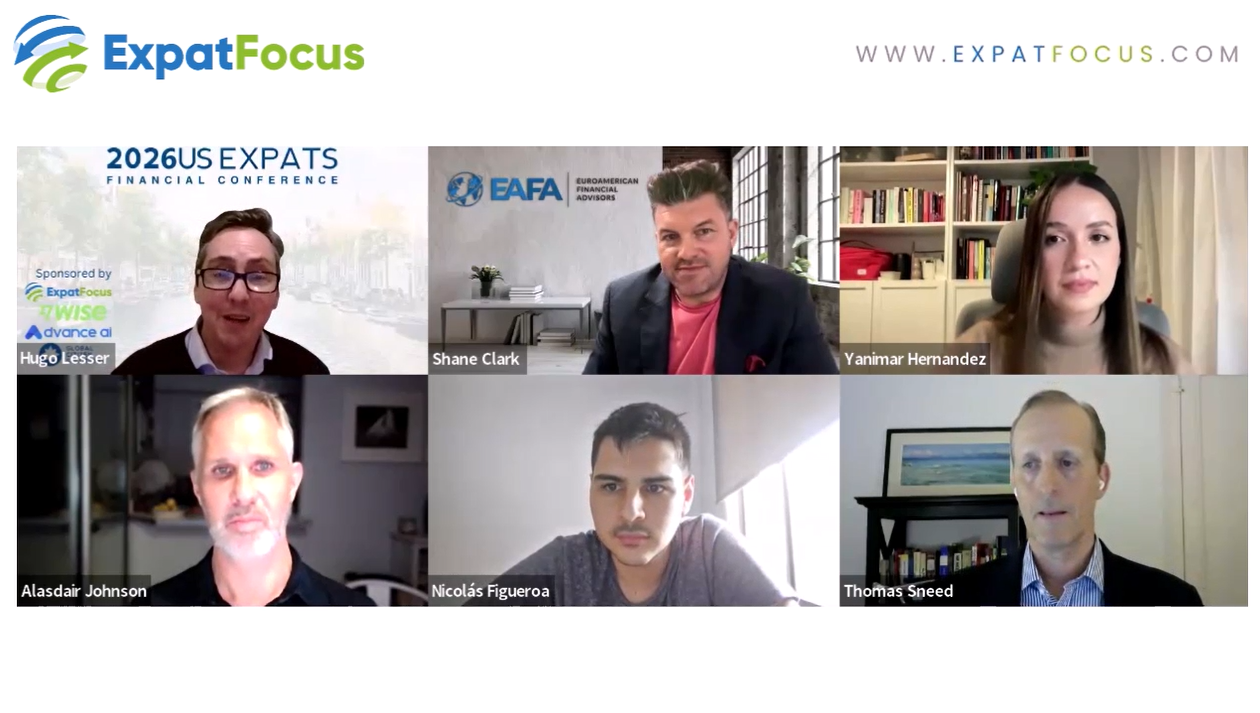
At the 2026 US Expats Financial Conference, a panel of cross-border experts — tax expert Nicolás Figueroa of Entre Trámites, immigration lawyer Yanimar Hernandez of Global Citizen Solutions, relocation specialist Alasdair Johnson of Moving to Spain, investment advisor Shane Clark of EuroAmerican Financial Advisors, and US expat tax specialist Thomas Sneed of Wicklow Tax Advisors — answered audience questions on moving to and living in Spain as an American. Together they covered Spanish and US taxes, visas and immigration, and cross-border financial planning, helping American expats structure their move to stay compliant on both sides of the Atlantic while avoiding costly surprises.
The following transcript was generated by AI and may contain inaccuracies.
Hugo: Hello and welcome to day two of the 2026 US Expats Financial Conference, sponsored by Expat Focus, Wise, Global Citizen Solutions, and Advanced AI Services. Today is the second day of the conference, and this is our final session of the day: a Q&A expert panel session for Americans moving to and living in Spain.
I’m delighted to be joined by Nicolás Figueroa from Entre Trámites, Alasdair Johnson from Moving to Spain, Yanimar Hernandez from Global Citizen Solutions, and Shane Clark from Euro American Financial Advisors. And if we’re lucky, Thomas Sneed will also join us from Wicklow Tax Advisors.
Before we start, please bear in mind that the information presented is for general educational purposes only, and you should always seek your own personalised financial advice. There are no presentations in this session — we’re simply going to field your questions, so please add them in the Q&A pop-up at the foot of your screen, whether they’re about Spanish tax, US tax, moving to Spain in general, financial planning, investing, or visas and immigration. We’ll try to answer them all, time permitting.
To begin with, let’s go around the panel so our audience knows what you each do. Shane, would you like to kick off?
Shane: Sure, I’ll jump in. My name’s Shane Clark, and I’m one of the founders and president of Euro American Financial Advisors. We’re a cross-border investment advisory firm for Americans moving anywhere in the EU, and we’re licensed with the Spanish investment authorities as an independent advisor. We also have a sister firm in the US called International Asset Management, which has been around 25 years, also working with US expats worldwide.
Hugo: Very nice. Yanimar, would you like to briefly introduce yourself?
Yanimar: Yes, thank you. I’m Yanimar Hernandez, a Spain lawyer at Global Citizen Solutions. We’re a firm that helps people invest, relocate, and reimagine their lives abroad. We work in Spain but also Portugal, Italy, and some other countries around the EU, as well as the Caribbean.
Hugo: Nicolás?
Nicolás: I’m here representing Entre Trámites. As Luis, our co-founder, has already mentioned, we help everyone who wants to come to Spain with their taxation and their immigration. I’m in the law firm, and I’m a tax expert.
Hugo: Alasdair?
Alasdair: We set up Moving to Spain as a result of moving here ourselves. We’re expats who’ve lived all over the world, and Moving to Spain was created to answer all the questions we had when we moved. We cover everything from the start of your plan to move to Spain, working with expert partners — including Entre Trámites — all the way through to finding a house and getting set up. So we cover the entire process.
Hugo: And Thomas — nice to see you, I’m glad you could join. This session was originally scheduled for yesterday. Would you like to briefly introduce yourself and your firm?
Thomas: My name is Thomas Sneed, and my firm is called Wicklow Tax Advisors. We handle US taxes for expats, and I have a lot of clients in Spain. I live between Miami and Barcelona, so I have some knowledge of Spanish taxes, but I focus on the US side.
Hugo: Fantastic, thank you. I see we’ve got some questions, so I’ll read them out and hopefully it’ll be clear who should field them. The first question is: how are US S corporations treated in Spain? I think that’s one for you, Nicolás, in terms of how they’re treated for Spanish taxes.
Nicolás: It depends — is it an S corp or a C corp?
Hugo: S corp, in this question.
Nicolás: Okay. So if you’re a tax resident in the United States and you want to come to Spain, the question here is more about the immigration matter than the taxation side. The first thing you need to understand is how you want to come to Spain. Then, when you file your taxes — and this also relates to a question I saw in the chat about someone living in France — where are you going to live in Spain? What city? Based on that, you’ll need to apply the specific autonomous community deductions. So always look at the immigration side first, then the tax side.
Hugo: So the tax treatment will be different depending where you are in Spain?
Nicolás: Exactly — depending on the autonomous community. It’s very similar to the states in the US; we call them autonomous communities here. That determines a specific tax bracket.
Hugo: Thanks. Alasdair, this might be one for you. Looking for a lower cost of living, is it worth looking at smaller cities in Spain? Maybe an overview of a few of the most popular regions and their cost of living?
Alasdair: Yeah. As Nicolás was saying, there are 17 autonomous communities in Spain. It’s about the size of Texas, so it’s a big country — hugely different from the green north down to the warm south and the Mediterranean coast. The cost of living varies enormously, and taxation plays a part in that, but so does the base cost of living. The biggest driver behind that is the cost of housing, whether rental or purchase.
Generally, where you find more people, you pay more money. The stretch down the Mediterranean coast has lots of tourists, expats, and people who want to live or retire there, so it costs more in general. If you go inland and away from the centres, you get a lower cost of living.
So the big three cities — Madrid, Barcelona, Valencia — generally have a higher cost of living than the parts around them. If you look inland, there’s an autonomous community called Extremadura where, for €150,000, you could get a six-bedroom mansion with a swimming pool. You certainly wouldn’t get that anywhere along the coast of Catalonia. It’s mainly driven by housing, so looking at housing prices is a really good place to start, along with taxation, because it can make a significant difference for a lot of people.
Hugo: Thank you.
Thomas: Hugo, just a quick comment on the S corp. If it’s an American asking, an S corp is a disregarded entity, so essentially in Spain you’re going to be taxed like an autónomo — it’s your personal income tax, not a corporate tax. And honestly, if you’re living in Spain, you don’t really need an S corp, because an S corp is a great way to pay less self-employment tax. But if you’re employed in Spain you have to pay autónomos, which is social security, and you don’t owe social security in the US. So that’s a little add-on: it’s a disregarded entity, taxed the same way — it’s transparent and passes through to your personal income. I think Nicolás would look at it the same way.
Nicolás: In Spain, unlike many other countries, you don’t have to set up a company in order to carry out your autónomo activity. You just make a single registration with social security and the tax agency, and you’re good to go as self-employed.
Thomas: Right — so it’s like being autónomo.
Hugo: Somebody asked: is there a chart or a way to look up the different tax rates of the different autonomous regions?
Nicolás: Yes, I can send it through the chat.
Hugo: Great. Should they contact you for it?
Alasdair: I can also help — we’ve got an article on our website that compares across all 17, and I’ll pop a link into the chat now. The good people at Entre Trámites, Luis and his team, actually double-checked it for me.
Nicolás: We must add a warning here. What we’re going to send is updated to last year. Since we’re going to file the income tax return this April, it may be updated, so always check the official sources — the tax agency webpage. They always update the guide for filing your taxes in Spain, and an updated version will be published.
Hugo: That’s great, thanks. There’s a question here that’s a financial-planning and tax crossover. It says: “I’m planning to move to Spain and use Social Security, savings, and my IRA for income on an NLV visa, so I cannot earn income. Should I use savings first, then Social Security, and last the IRA, to minimise my Spanish and US taxes? My understanding is that IRA withdrawals are taxed in Spain and the US as income. And how much do I need to be concerned about wealth tax?”
There are a few questions there. Shane, when you work through tax-optimised investments and a financial plan, would you comment on the best way to approach income to minimise taxes?
Shane: Sure. In this situation, depending on your level of wealth, we’d definitely want to bring in a local tax advisor — Nicolás can probably speak to that. But essentially, what you’d want to do is live off whatever has the lowest tax rate first. Income from the IRA is going to be taxed as ordinary income, so if your ordinary income is quite high, that’s going to be at a higher rate than the dividends and interest rate would be. That’s how we’d approach it, but we’d be executing the plan based on guidance from the tax advisor. Nicolás, do you want to speak to that?
Hugo: Nicolás, would you comment on the wealth tax and how it affects an American retiring in Spain with savings, an IRA, and Social Security income? Do the IRA and savings come under the wealth tax?
Nicolás: Same as we were discussing — it depends on the autonomous community. Some have an exempt amount before you pay wealth tax. In some it’s very low, in others very high, and depending on that you either pay wealth tax or not. There’s another very important thing in Spain that comes up a lot in practice — I don’t know if anyone has heard of Modelo 720. Modelo 720 is where you have to report every single asset, property, or bank account you hold outside the country. So be very careful with that.
Hugo: Thanks. Yanimar, in your experience, when Americans look to move to Spain, which regions are the most popular? And are taxes a consideration in people’s decision-making, or do you make recommendations based on the different taxes in different areas?
Yanimar: Usually they already know exactly where they’d like to move, and it depends on the type of visa they apply for. In our experience, digital nomads are often willing to move to Madrid, Barcelona, and in some cases the Basque Country. For non-lucrative visas, our clients are moving to Alicante, Valencia, and that area. So it depends on the type of visa and the profile of the client.
What we always advise is that they have a tax consultation before even applying for the visa, just to make sure they understand the implications of the place they’d like to live. That way they can prepare themselves and plan everything before they move.
Hugo: Thanks. There’s a question about properties and property taxes in Spain — and I think I can guess what Nicolás is going to say. The property taxes also vary by region?
Nicolás: Unfortunately, it goes the same way. There are also some taxes that are split between the state and the autonomous community — for example, the income tax return. The wealth tax, on the other hand, is charged only autonomously. So if you have a lot of wealth, always look first at the autonomous community.
Hugo: Thanks. The question actually asks how house prices and property taxes compare to Portugal — but since this panel is Spain-focused, I think that’s beyond our collective knowledge. So, Nicolás, what kinds of property taxes are there, both when you purchase and when you own property in Spain?
Nicolás: There are several. For example, if you purchase a property now and want to sell it within a year, there’s a tax on the increase in the property’s value. There’s another tax on the purchase of the property. There can also be regional taxes — for things like garbage collection and so on — and it always depends on how old the property is.
Hugo: Right. Thomas, this is probably relevant for a lot of people — what are the US tax implications of owning property in Spain for Americans?
Thomas: Unless you rent it out, there are none. You could claim the interest on a foreign property on Schedule A as an itemised deduction if it applied, but buying a property in Spain doesn’t really have any impact unless you’re renting it. If you do rent it, you have to declare it in the US — but Spain gets first crack at taxing that income, and you take a credit in the US for the tax you paid in Spain.
Hugo: And when you sell, there’s potentially capital gains — that would be the other side?
Thomas: Yes. Again, Spain gets first shot at taxing the property because it’s taxed where it lies. Americans would have to declare a capital gain on their US return, but would take a credit for the tax they paid in Spain.
Nicolás: Always focus on the source of the income.
Hugo: Thanks. Somebody says: “US tax law imposes a 30% withholding tax on interest paid by US borrowers to foreign lenders. Are there any restrictions or special rules for loans from Spanish individuals or companies?” Does that make sense?
Thomas: Not to me, no. I saw that one and I’m not sure where they’re going with it. If it’s an American borrowing money — maybe to buy a property in Spain — possibly, but I don’t know about any US withholding tax there, because I’m not sure where it would come into it. I think I’ll pass on that one unless they can clarify what they mean.
Hugo: Lisa says: “I’m moving to the Barcelona area in a few months and I’ve already set up a Wise account. Can I set up a Santander account while in the US, as I believe there’s a location in San Francisco?” Alasdair, can Americans set up a Spanish bank account before they move?
Alasdair: You can, but you can’t set up a resident bank account — you need to be resident in Spain, and there’s paperwork that follows from that. Generally, what we recommend is don’t bother unless you have a really specific need for it. Wise works great for a lot of things, but Wise isn’t actually a bank, so there are things it struggles to do. There are online banks like N26, Revolut, or ING where you can set up accounts that still let you pay into Spanish accounts.
But you do need a Spanish account number to pay things like tax, and some landlords will insist on a Spanish IBAN. So we generally advise not to bother until you get to Spain. Set up a resident account once you have your residency paperwork sorted out.
Hugo: And is it fairly quick and easy to set up a Spanish bank account once you’re there?
Alasdair: The online banks are fantastic now — Revolut, N26, ING. If you’ve got your documentation on you, you can set up an account in 10 minutes in a bar. It’s super simple. The bricks-and-mortar banks in Spain — Sabadell, CaixaBank, Santander, the big three — are a slightly more difficult process.
You’ve got to ask yourself why you want a Spanish bank account. All of those big banks do have simple online accounts, but they’re done better by the online banks. If you’re looking long-term — where you’ll want a mortgage and access to credit facilities — then a bricks-and-mortar Spanish bank account can be useful. In general, though, unless you have a very good reason for opening one, don’t bother. We have an account at Sabadell that we set up when we arrived 10 years ago, and they’re very good — they’ve improved dramatically. But I certainly wouldn’t worry about setting up a non-resident account before arriving in Spain; it’s more hassle than it’s worth.
Hugo: Thanks. I know Sabadell have special branches in main cities for international clients and expats, and they make it pretty quick to set up now with just a passport, so you don’t have to wait for your local tax number.
Alasdair: Within banks like Sabadell, they do have a wide range of accounts now. If you want to open a credit card or something with a line of credit, there’s a lot more paperwork than if you just want an effective online account that gives you a Spanish IBAN — where you can use Bizum, transfer back and forth, and withdraw cash. Sabadell has really focused on expats; their English-language support, for example, is fantastic, and they have welcome centres that make getting an account as a newcomer to Spain a bit smoother.
Hugo: Nicolás, this might be one for you. The Spanish government mentioned charging 100% tax on property purchases for foreigners. Is there any update on that, and are there any other penalties for foreigners buying property in Spain?
Nicolás: Yes, there was a discussion, and it’s still being discussed.
Hugo: So it hasn’t happened — and is it likely to, or was it just a headline?
Nicolás: Fortunately, not yet. They were trying to scare investors a little bit, because many foreigners came into the country, purchased a house, and just rented it out. So they were trying to scare the people who do that.
Hugo: Right, so it’s unlikely to happen. Are there any other penalties or obstacles for foreigners buying property in Spain?
Nicolás: The only one I can think of: if you want to purchase a house in Spain and you’re not a tax resident, you’ll need to pay something called imputed rent. If the property is going to remain empty — say you only come to Spain twice a year for holidays — you still need to pay income on that property.
Hugo: Is that income tax on the rental, or…?
Nicolás: No, it’s just because you own the property in Spain. If the property is empty and there’s nobody there, you pay imputed rent, which is a calculation based on approximately 1% of the value of the property. You pay a little bit of tax on that value.
Hugo: But if you rent it out when you’re not there, does that not apply?
Nicolás: Then you don’t pay the imputed rent — you pay the rental income as general income instead.
Hugo: Somebody else asks: “As a foreigner, can you qualify for a Spanish mortgage?”
Alasdair: I can take that one. Yes, you can. It’s harder — you don’t have a long-term credit rating — so if you arrive and apply for a mortgage, it certainly can be done, but there are a few more hoops to jump through. We work with a partner in Barcelona whose focus is 100% on helping expats purchase property in Spain. Once you’re a resident — especially if you’ve been here two to three years and you’re paying tax in Spain — that makes things simpler. But there’s no legislative restriction on getting a mortgage in Spain.
Hugo: Shane, moving to you. A question that came up earlier was whether property in Spain is good from an investment perspective. Clearly there’s an emotional element to buying property in Spain for Americans — often it’s either a vacation home or a home. But what about from an investment perspective?
Shane: Sure. We’d have to look at any property on an individual basis, depending on where it is. We’ve seen property prices rise significantly the past couple of years in Spain, particularly in Barcelona, Madrid, and Valencia. Whenever we look at a real estate property as an investment, we want to look at it like any other investment. If it’s a vacation property you fell in love with, you’re probably going to have a different lens than you would on your IBM stock. So we try to take the emotion out of it and evaluate it as an investment compared to whatever else is in the market.
Hugo: Thanks. To our audience — keep dropping questions in, and let us know whether you’re already in Spain or planning a move. Yanimar, I wanted to ask you: very briefly, what are the most common types of visas Americans moving to Spain apply for?
Yanimar: After the Golden Visa was shut down last April, the most common visas Americans apply for are the Non-Lucrative Visa and the Digital Nomad Visa. We don’t have the exact data from the government, but a few months ago I attended a conference where a senior representative of the authorities responsible for reviewing Digital Nomad Visa applications said the unit is receiving approximately 30,000 applications monthly for digital nomads. So it’s quite popular, and one of the nationalities that applies most for this type of visa is US citizens.
Hugo: That’s interesting. Another thing a lot of people moving to Spain are surprised by is the fact that they still have to file US taxes even if they’re not resident in the US. Thomas, could you briefly speak to that and why it’s the case?
Thomas: That’s a good question — the “why” is the hard part, and I’ll leave that to the powers that be. But as an American, you’re subject to US tax on your global income no matter where you live, so you always have to file US taxes. We’re talking about Spain, so there’s the US–Spain tax treaty. Someone earlier asked about Social Security — to give a quick overview of how the treaty works, some income is taxable first in Spain (assuming the person is resident in Spain) and some income is taxable first in the US, so you may have tax credits going in two directions.
Rental property is taxed where it sits, so if you move to Spain and still have a property in the US you’re renting out, you’ll declare it in both countries but pay tax to the US and the state where the property lies. Dividends are taxed at source, up to 15%, so if you have US dividend income, you’ll likely owe US tax. There’s a clause in the tax treaty that says US Social Security is taxable first in the US, so if you’re living in Spain you’ll probably pay some US tax on that — and anything you pay to the US will be credited in Spain as a deducción por doble imposición on your Spanish return. The general rate is higher in Spain, so you’ll probably end up paying a Spanish tax rate, but you will likely pay something to the US.
One other thing is pension income — 401(k)s and IRAs are taxable in Spain first, which maybe isn’t intuitive. Even though it comes from the US, Spain gets first crack at it. If you’re military or you worked for the US government and have a pension, that’s not taxable in Spain at all, so you’ll definitely owe US tax on it.
And one aside, Nicolás — on rental: if you’re not living in Spain and you’re renting a property out, I know there was a recent court case, but you pay a 24% flat tax on your rental income, and you pay it on the gross. You’re not allowed to deduct expenses. So if you’re an American who owns a property in Spain and rents it out, the taxes are pretty high because you can’t deduct expenses and you’re paying a flat tax on the gross income. But anyway — back to the US: you have to do your US taxes no matter where you are.
Hugo: That’s interesting, because with that rental income scenario you’re going to pay higher taxes to the US without those deductions, but on the Spanish side you’re avoiding—
Thomas: Sorry to interrupt — no, that higher tax is in Spain. You could have a rental property in Spain and on your US return you can depreciate the property and deduct all your expenses. But on your Spanish non-resident tax return you pay a flat 24%, and it’s only on the gross, so it’s a bit punitive in that sense. That’s a Spanish tax, not a US tax.
Hugo: Thank you, that’s great. Yanimar, there’s another one for you. Somebody says they’re applying for a Digital Nomad Visa and spoke with an attorney in September last year — have there been any changes since? And with so many people applying, how long is the process taking?
Yanimar: From the time we submit the application, the authorities take up to 20 business days to confirm whether it’s granted or whether they’re requesting additional documents. In that case, we should add an additional 10 business days. The good news is that even though they’re receiving this number of applications, they’re still taking around 20 business days, which is about a month. If we consider the total time for collecting documentation and applying, it could be around three months, as this person was informed by their attorney.
Since September 2025, there have been no changes. The only thing to consider is that the minimum wage will probably be updated soon, which will change the minimum amount this person needs to show the Spanish authorities to apply for the visa — but no big changes.
Hugo: Thanks. Nicolás, a question on the wealth tax: is there a nationwide minimum amount before wealth tax is charged, or does it again vary by region?
Nicolás: It varies, but right now it stands at €500,000.
Hugo: And does that include a property in Spain?
Nicolás: Exactly — and it will vary, going lower and higher. That’s why I mentioned, for example, that one autonomous community — I believe it’s Andalusia — has a deduction of around €2 million, so it can increase widely.
Hugo: I think I’ve heard that in Andalusia the wealth tax is very low. Is that the size of the deduction, or the percentage tax rate?
Nicolás: That’s the exempt amount, under which you don’t have to make any declaration. Then, if you do have to make the declaration, there are the percentages you apply. The ones that are very high or very low are the deductions and exemptions; once you surpass the exemption, you apply the brackets.
Hugo: Thank you. There’s a question for Thomas: the 24% flat tax for non-resident property owners — what’s the equivalent for resident property owners?
Thomas: That one’s better for Nicolás, because it’s different — it’s actually a good deal if you’re a resident.
Nicolás: Could you ask again, please?
Hugo: Thomas mentioned there’s a 24% flat tax on income from property rentals for non-resident property owners. Is that the same, or is there a different rate if you’re a resident property owner?
Nicolás: It changes a lot, because — remember I was talking about the state and the autonomous community taxes — when you become a taxpayer in Spain, you apply the brackets for both the state and the autonomous community. The brackets can go from around 13% up to approximately 23–27%, and tax in Spain is progressive, so it can be much higher or much lower.
Thomas: And, Nicolás, you also get a reduction, right? If you’re a resident in Spain and you rent out a property, I think 60% of the net income isn’t subject to tax — so they give you an incentive to rent out properties — and you can deduct your expenses.
Nicolás: Yes, there are a lot of deductions you can apply as a taxpayer. There’s a minimum personal threshold — just because you’re living in Spain, you can apply a deduction.
Hugo: That’s great, thank you. We’re just coming up to time, so I wanted to ask the panelists to very briefly share the best way to contact them, should anyone wish to follow up. Shane, would you mind going first?
Shane: I’ve just popped it in the chat. It’s [email protected], and our website is eurousafa.com.
Hugo: Thanks. Thomas?
Thomas: The best way is [email protected], or the website wicklowexpattax.com — I’ll type it in the chat.
Hugo: Wonderful. Alasdair, what about you?
Alasdair: You can come to our website, cunningly named movingtospain.com, or email us at [email protected]. I’ve put the details in the chat as well. Thanks very much for having us today.
Hugo: Nicolás?
Nicolás: I’ll drop my email and our webpage, entretramites.com, into the chat, in case you’d like to schedule a free consultation for any tax purposes. Feel free to get in touch.
Hugo: Thanks. And Yanimar?
Yanimar: Our website is globalcitizensolutions.com, and my email address is my name: [email protected].
Hugo: Fantastic. Thank you very much to our panelists, and thank you to all of you in our audience for joining us today. If you have any more questions, grab those details from the chat as quickly as you can.
As part of the conference tomorrow, we have five more sessions. Shane, I believe you’re starting tomorrow morning with a presentation on financial planning considerations for Americans living abroad in 2026. If you haven’t already, you can register for that session at usexpatconference.com. I hope everyone has a great rest of their evening, and thanks again to the panelists for taking the time.