
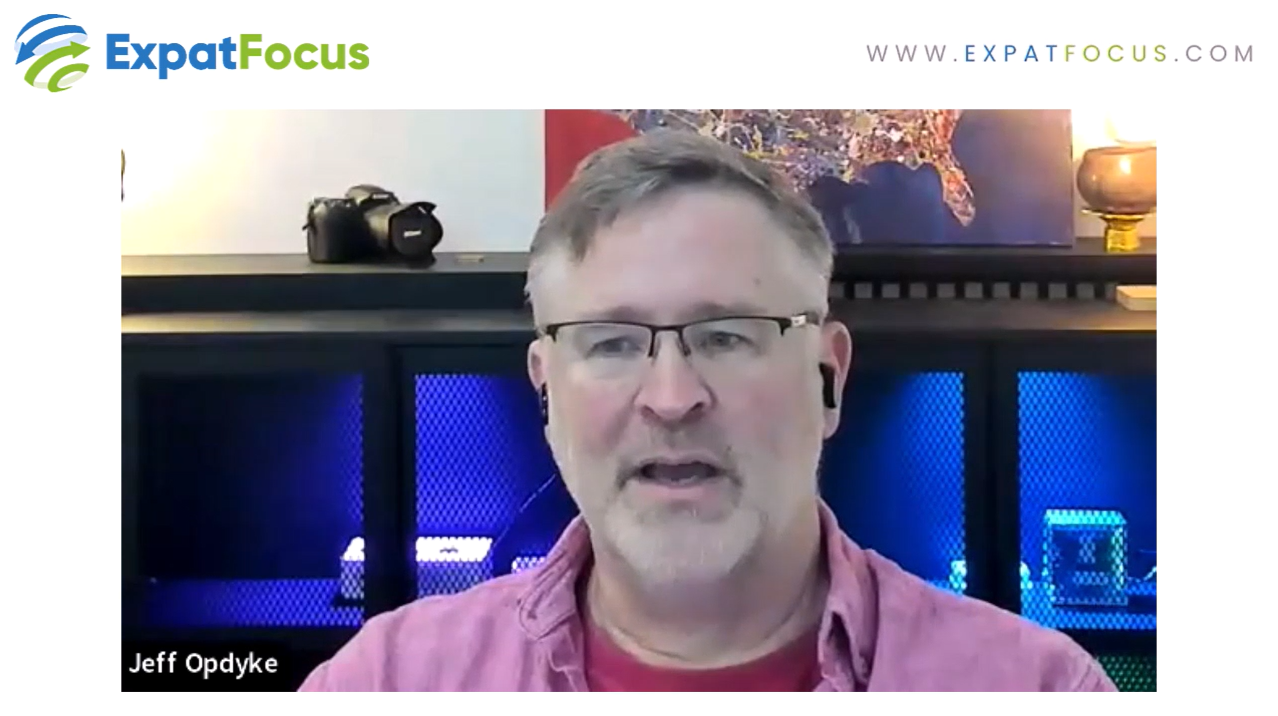
At the 2026 US Expats Financial Conference, Jeff Opdyke, editor of the Global Intelligence Letter, discusses what Americans living abroad need to know about crypto in 2026. A former Wall Street Journal personal finance writer who has been investing in crypto since 2017, Jeff writes the Global Intelligence Letter and the daily Field Notes e-letter for International Living, covering global investing, offshore strategies, and life overseas.
The following transcript was generated by AI and may contain inaccuracies.
Hugo: Hello, and welcome to day four of the 2026 US Expats Financial Conference, sponsored by Expat Focus, Wise, Global Citizen Solutions, and Advanced AI Services.
We have a fantastic schedule for you consisting of 17 sessions over four days, covering multiple aspects of financial information for Americans living abroad, with perspectives from some of the world’s leading experts in their fields. Today is the fourth day of the conference, and for this, our second session of the day, I’m delighted to be joined by Jeff Opdyke, who will be discussing what US expats need to know about crypto in 2026.
Jeff spent 17 years covering personal finance and investing for The Wall Street Journal, writing a weekly column that reached 10 million readers. He’s written 10 books on personal finance, investing, and working as a digital nomad. A keen traveller, Jeff has visited 77 countries so far, and invested around the world. After spending five years living in Prague in the Czech Republic from 2018, Jeff relocated to Portugal in 2023. He serves as editor of the Field Notes daily e-letter and the monthly Global Intelligence Letter, and is a regular contributor to International Living magazine.
Before we start, please bear in mind that any information presented is for general educational purposes only, and you should always seek your own personalised financial advice. Jeff will be answering your questions, so please add them in the Q&A pop-up at the foot of your screen and we’ll try to get through them all.
This session is going to be a little bit different, in that we’re going to do more of an interview than a presentation. I don’t know too much about crypto, so I’m delighted to learn some. Jeff, just to start with, what’s your background in crypto?
Jeff: I’m an old-timer in crypto, which is kind of weird because I’ve just turned 60 years old. I’m not the demographic that plays in crypto. Crypto is a young guy’s game, a young girl’s game. It tends to be teenagers, or people in their 20s and 30s, maybe into their 40s. When you start getting into the 50s and 60s, the demographic falls off really quickly. So I’m a unique animal in this world.
My background in it is that I started in 2017, and it was because my son wanted me to build a crypto mining rig with him. I was living in LA, he was living in Louisiana, and we were getting on the phone every night and building crypto rigs together. I was taking all kinds of spare computer parts, and he and I were building mining rigs that were mining Ethereum and something called Zcash. So I got into crypto literally hands-on, building stuff.
With 17 years at The Wall Street Journal, you learn to be a stock market guy, you learn to be a bond market guy. When my son originally came to me with the idea of crypto in the mid-2010s, I laughed at him. I said, “No, that’s not a real asset.” I wish I had listened to him, because you would be talking to me now from an island somewhere in Greece that I owned.
When I started digging into it in 2017, after I started building these mining rigs, I realised what the potential for crypto could be. I saw that we were going to have a fundamental change in the way money works. It was going to fundamentally change not just banking and investing, but education, entertainment, collectibles. It was going to change everything that all of us have grown up with since time immemorial. It is a completely new way of seeing money, and it’s a completely new way of doing what the internet has done over the last 25 or 30 years, and putting that on steroids. It is going to drastically reshape life as we live it.
Hugo: Can you tell us a little more about that? What is it, what is the impact going to be, and how is it going to change things? We all grew up in a traditional financial world. We have bank accounts, we invest. We know crypto exists, and it seems to exist slightly in its own universe, separate from the traditional financial world. But are the two colliding, and what sort of changes do you foresee?
Jeff: They absolutely are colliding. They’re merging. I’ve been writing since 2019 or 2020 that crypto’s going to change everything, and it’s because — well, let me back up.
To understand the blockchain, which is what crypto operates on, think about literally blocks. I have a block here, like the blocks you grew up with as a kid, with the A, the B, the C on it, or the cat or whatever. And on the front of this block, imagine there is the McDonald’s M symbol. On the back side of that block, it might be the Nike swoosh symbol, just to give people a visual. This block is created. It’s mined. Energy is expended to create this block. And inside this block is every single transaction that happens on that network in the moment that that block exists.
Then, after that block has been, quote, mined, the next block is created. That next block has the opposite of the McDonald’s symbol. So one is sort of interior and one is exterior — they match together, and they can never be pulled apart after that. They’re stuck together. That’s the blockchain. It just keeps building and building, and every single block is information about every transaction that has happened in that block, in that 10-minute span or that two-minute span, or however long it takes to create particular blocks on particular blockchains. Bitcoin is every 10 minutes or so. So every 10 minutes, a new Bitcoin block is created.
The way the blockchain works is that it makes everything more efficient. Think about when the internet came along. The internet didn’t become what it is today because you and I needed a faster way to share cat pictures or cat videos. The internet became what it is today because it gave all of these companies around the world a brand-new way to reach the consumer and a new way to reach new consumers. It allowed people to say, “I want to buy a book, but this book is for sale at some bookstore in Japan. Well, they can send it to me.” I can shop in Japan on the internet. I can shop around the world on the internet. I can go online and look at a hotel room, and wander through that hotel room and decide if that’s the hotel I want to stay at.
The internet has given us what we have today, which has completely changed our lives. We carry around the internet in our phone every day. The internet made businesses more efficient. It made businesses able to earn more money. It made them open up new products and services that never existed before. eBay was never around before. Amazon was never around before.
Think about back in 2000, when the internet crash happened, and people were running around saying, “That was just stupid. There’s no way anybody’s going to order a book and wait for it to come three or four days later when I can just go down to Barnes & Noble and buy the thing and come back home. Why do I care about ordering this book online?” Well, look at it now. Amazon is one of the world’s largest companies. We order everything off Amazon. We order everything off eBay. I go to amazon.es, which is the Spanish version of Amazon, probably three times a week, to order things I can’t find around here — useless things, maybe some particular product from the US that I can’t find in the supermarket here. I can find it on Amazon, and it’s here in Braga a day or two later.
So the internet made all these businesses more efficient, and it made them much more profitable, because it gave them new opportunities and new venues. The blockchain is exactly the same thing, except it is even more efficient.
Right now, if you wanted to send money around the world — and Wise is one of the supporters here, one of the advertisers — I can go to Wise, and I have a Wise account, and I use Wise every single month, because it’s how I get paid and how I move my money around. Let’s say I move 5,000 euros into America. It’s going to cost me X number of dollars, whatever that comes out to.
Now, a big bank like Citibank or JP Morgan is moving gazillions of dollars every single day, and they’re going through the Wise of their world, which is the SWIFT network. The SWIFT network takes them a couple of days to move money through, and they’ve got to pay service fees and all this stuff to move it. I don’t know what those fees are, but maybe they’ll move $100 million and it costs them a million dollars in fees. I’m completely making that number up, but you get the idea.
On the blockchain, I can convert that $100 million into tokens, into something called US dollar coin or US dollar token. These are digital representations, blockchain representations, of dollars, and they trade just like dollars. If you have $100 million worth of digital US dollar coin, you can send it to your bank and you have $100 million. They are synonymous. They are equal. So I can convert 100 million physical dollars into 100 million digital tokens, and I can say, “I need that money to go from JP Morgan to Credit Suisse in Switzerland, and I want it done on the blockchain.”
They’re going to move it on the blockchain, and it’s going to be there in seconds, not days, and it’s going to cost them fractions of a penny, not a million dollars. So now banks are much more efficient, and they’re saving so much money. Think about all the money that banks send around the world on an annual basis, and think about all the fees they’re paying on an annual basis. They’re wiping out those fees, and suddenly their cost structure is coming down dramatically.
That’s why blockchain is going to survive. That’s why crypto is going to be the future of everything that you and I do, because banks need it. Banks want it. Companies want it, because it’s giving them new products and new services that they can sell that have never existed before, and we can get into that in a minute.
For us, it’s going to lead to a world that looks very similar to what it is today, but it’s going to happen faster and more efficiently. You and I are going to go to the same gas station mini-mart, and we’re going to fill up our car, and we’re going to walk inside and buy a Red Bull or a Diet Coke and some potato chips. And we’re going to use our debit card just like we use today, and it’s going to happen in nanoseconds, and we’re going to walk away. It’s going to use the same kind of reader we use at a gas station. You hold your phone or your card, and it happens the same way.
But behind the scenes, it’s all happening on the blockchain. It’s not happening on these old banking infrastructure networks. Which means that instead of a merchant having to wait one to three days to get their cash from your purchase, it’s going to show up in their account instantaneously. Now they are more efficient, and the banks are more efficient, because they don’t have to worry about moving all this money around. So banks want this, and if banks want this, and if big business wants this, it’s going to happen. That’s why you want to be part of the cryptosphere going forward, because it is the world that we are moving into.
Hugo: Did you say the banks are already using it to transfer internationally?
Jeff: Absolutely. I have a list of talking points I was going to share with you, because I can tell you all these great things about crypto, and I can tell you I’ve been in it since 2017, and I can tell you I have six figures’ worth of crypto in various places, and why it is that I invest in Bitcoin and Solana every single week like clockwork through my Coinbase account. But I’m just a 60-year-old guy living in Portugal, nobody knows who I am, and who cares what I think? So it’s important to me that people understand what the important players think.
Those important players are like Citigroup. Citigroup announced this month that it was using the Solana blockchain to build out a proof of concept for tokenising promissory notes. They took promissory notes, which are physical documents, and they tokenised them, meaning they turned them into a digital asset, not a paper asset. They were able to issue these things on the Solana blockchain as digital promissory notes, they were able to distribute them across the blockchain as a digital asset, and they were able to settle them on the blockchain, meaning they were able to put these in people’s accounts and the money came back to Citigroup. The whole process was created and settled on the blockchain without a single physical asset existing.
It was a proof of concept to see if Citi could turn a real-world asset into a tokenised asset that could be traded efficiently on the blockchain, and it succeeded. They’re happy with it. Which means that if you expand that, we are now on the path to stocks, bonds, mutual funds, ETFs, commodities, currencies, real estate, collectibles. All of that is going to be a tokenised asset.
So when you go and buy shares of Apple, you’re no longer going to be just a record entry in a digital ledger somewhere, and you’re not going to be the owner of a physical piece of paper that says you own 74 and a half shares of Apple. You’re going to look in your crypto wallet, which is going to be inside your brokerage account, and you’re going to see that you own tokenised shares of Apple. You own Apple just like you own them in a traditional Fidelity account, but they’re all tokenised.
What that means is that now you don’t have to wait until the New York Stock Exchange is open, Monday to Friday from 9:30 to 4:00, whatever the timeframe is. You can trade these things 24/7, 365. If you decide on Christmas Day that Apple is horrible, you can sell it on Christmas Day. Or you can decide, “My kid loves this new gadget I bought him that was made by company XYZ, I’m going to go buy that.” It’s Christmas morning, and you’re going to go buy it because you see all these kids around the neighbourhood playing with the exact same toy. You’re taking the traditional world that has existed for decades and centuries, and you’re turning it completely around.
That is exactly what Citi is doing. They’re taking all of these real-world assets that we have bought for decades, and they’re putting them on the blockchain. And Citi is just one example. Visa has created a settlement system for stablecoins. I just told you about how you take $100 million of physical fiat money and turn it into 100 million digital tokens. Visa launched a pilot programme last year that is allowing US banks to settle transactions using US dollar coin, which is the number two dollar-based stablecoin.
They’re called stablecoins because they are designed to be stable. If you own Bitcoin or Ethereum, those things bounce around crazily, like a street rat that found a bag of cocaine. But stablecoins are literally designed to be stable, so they’re going to shadow the dollar. USDC will diverge from $1 by fractions of a penny. But if you put $1,000 into Coinbase, and you convert that thousand US fiat dollars into 1,000 USDC tokens, and then a week later you decide you need that money back, and you take that thousand and send it back to your bank as fiat, you’re going to get a thousand back. It’s not going to go anywhere. So these are stablecoins.
Visa has created this system so that banks can move US dollar stablecoins on the blockchain, on various blockchain networks, and this was a first-of-its-kind integration of stablecoins — a digital asset, a blockchain asset — into mainstream traditional banking infrastructure. They have created a new hybrid infrastructure that has never existed before. You’re going to see banks begin the process of cross-border and domestic settlements using this, and it’s going to happen in real time. Again, it’s not going to take days for this stuff to clear. It’s going to happen instantaneously. They’re going to be doing this across the domestic economy, they’re going to do it across borders, and it’s basically killing legacy systems like SWIFT, which is what the banks have used.
I could keep going. JP Morgan is doing things. Mastercard is doing things. BlackRock, the big asset manager, is doing things. Microsoft and Ernst & Young are working on a royalties platform for Microsoft’s Xbox ecosystem, which is a gaming ecosystem. It’s narrow, in that we’re talking just about the Microsoft Xbox system, but it speaks to a much more holistic effort that’s happening elsewhere in the world.
The companies that create games that run on the Xbox ecosystem are gaming publishing companies. There are artists who built the games. There are writers who wrote the script for the games. There are musicians who created the music for the ambiance. Those people all get paid royalties. In the past, those royalties have been paid in cash, and they’ve been sent through the mail or sent through some ACH system directly to somebody’s bank account, which takes days again. All of that is now happening on the blockchain.
So you can track who is eligible for royalties based on what is sold. You can say, “Okay, every week, every month, every quarter, whatever, they’re going to get paid.” And it all happens instantaneously, because the blockchain tracks this stuff. It knows exactly what was bought and who deserves money from that, and it automates the system so that now there’s nobody in the middle. There’s no middleman anywhere within Microsoft or its system who has to say, “Okay, Joe Bob McGillicuddy has earned $13,000 for this video game, now I’ve got to cut a cheque.” The blockchain knows instantly who gets paid. It takes the middleman completely out of the equation. Again, corporations become much more efficient. That’s where we’re going, and that’s why this is such an important area right now.
Hugo: That’s really interesting. Before we get on to different types of coin, I wanted to bring it back to Americans living abroad. How will I, as an expat, use it? Can I use it to make savings on international transfers? How would I invest, if I want to invest? I guess Coinbase — and as you say, you were talking about stablecoins, but investing in crypto in general seems like you’ve got to weather a lot of ups and downs. How would you recommend we start to incorporate these into our lives?
Jeff: There are ways you can incorporate it. I talked about stablecoins. The US dollar is the biggest stablecoin, but there are stablecoins for the euro, the yen, the Swiss franc, the British pound, and so on.
So if I’m an expat, and let’s say I’m concerned that the dollar is going to continue to weaken because that is the current administration’s desire — it wants a weaker dollar — and let’s say I believe the administration is going to achieve its desire of a weaker dollar. I’ve got all this money that’s sitting in dollars, and I have to either keep it in dollars and know that the value of my purchasing power relative to where I live in Europe is going to be going down, or I can protect myself.
I can take those dollars and, through a crypto exchange, convert them into euros. I can say, “I’m going to convert fiat dollars into digital euros, and I’m just going to hold them in my account.” And now I’m going to get paid interest on that. If I hold digital dollars at the moment, I’m going to get paid 4.5% or 5%, whatever the number is, in interest. I get paid interest just like you get paid at a bank. But I can instead say, “I want to hold it in euros. I want to hold it in digital gold. I want to hold it in digital silver.”
And let’s say I decide I want to move from Europe to Uruguay, to pick a random country. I now don’t have to worry about anything. I don’t have to worry about moving my bank account from Europe all the way down to Uruguay, or converting these digital euros and digital gold into fiat and taking it down to Uruguay. I can just leave it in my account, and when I get down to Uruguay, my account’s still there, and I’m operating the exact same account, holding the exact same assets, but from a different country. So it offers a level of freedom and convenience that doesn’t exist in the traditional financial world.
Plus, there are income opportunities. There are ways to enhance your income living overseas just by going through decentralised finance, as it’s called. I’m not going to dive into all of that, because it can be complex and convoluted. But there are ways through decentralised finance where right now I’m earning 12, 13, 14% annual income, and it’s fairly safe income. It’s not CDs, but it’s the next level up from CDs in terms of safety. I’m not too worried about it, and I’m getting a really nice yield just from owning stablecoins that are held in a decentralised finance account that is invested in a particular way. So there are opportunities for larger streams of income using crypto rather than traditional finance.
Hugo: Who is paying you that interest? Because they’re not being held by a bank.
Jeff: This gets inside baseball, and I don’t want to confuse people and make their eyes glaze over. Like I said, crypto’s a young person’s game, and young people tend to be crazy in their pursuit of wealth, particularly in the crypto world. Crypto bros are eager to turn $5 into $5 million by next Thursday. And crazily enough, some of that stuff does happen.
So in some of these DeFi places, what they’re doing is that some crypto bro will come along, and he wants to borrow crypto so that he can go and make a trade somewhere else. There are a lot of really convoluted trades where you can double and triple dip, where you’re earning income three ways off the same amount of crypto. So these guys will go up there and they want to borrow crypto from a particular decentralised finance site. I have deposited crypto there, and so they are effectively borrowing my crypto — my stablecoins that I’ve put there, USDC.
For that, the crypto exchange is extracting interest payments. But these are higher interest payments than a bank is going to pay. A lot of the stuff is collateralised, so there’s no real risk for me. The crypto guys are willing to pay 14% interest for what they’re trying to do, because they know they’re going to generate a 192% gain, so they’re willing to pay that interest. I get a big portion of that, so maybe the crypto exchange will keep 8% of it and I get the other 9 or 12%, whatever the numbers work out to be. Again, I’m just making up numbers. But that’s the way decentralised finance works.
There are a lot of opportunities in the decentralised finance world to do this. Decentralised finance has created a stream of products and services that have never before existed. I mentioned the Microsoft thing with royalties and the gaming — I can actually invest in royalties. I can invest in music royalties, and I can own income from a particular stream of music. I can own corporate factoring, what they do when they’re moving product around. I can invest in that.
I would never have had access to that before as an individual investor going through Fidelity or Charles Schwab, or even Merrill Lynch — or, I don’t know if Merrill exists today, Bank of America, whoever — unless I’m a big-dollar investor. As an average mom-and-pop investor, a Main Street investor, I never had access to some of these things. Now I have access to pretty much any kind of product you can imagine, because it has been tokenised somewhere and I can invest in it.
I’ll give you two examples that I think are really interesting. There’s a company in New York called Parcl Labs, P-A-R-C-L. A few years ago, these guys went out and created a whole new system. Before I tell you that, I want to tell you that the way you track real estate today is through the Case-Shiller indexes. Case-Shiller goes out and gives you, “Here’s what the index for metropolitan New York or Boston did over the last three months.”
So Parcl said, “There’s a better way to do this.” They went out and used these things called oracles. You can think of an oracle as a little spider that runs around the blockchain world pulling data, all this kind of data. Parcl created a service, a product, where every single day they can track the price change in a particular metropolitan statistical area, meaning they know every new listing that has happened, they know every price change that has happened, and they know every sale that has happened.
They can say, “Based on all this data from all these sales every single day in this particular metropolitan statistical area, we know that the price per square foot on real estate in New York is up 0.7% today,” or is down 0.2% today, or whatever the numbers are. They can track that stuff. It has never, ever existed in the history of man to be able to do that on a daily basis.
And now you’re having Wall Street create products around this. There are all kinds of investment products. People are able to trade real estate almost like they’re trading stocks. You can become a day trader in New York real estate now. You can become a day trader in Miami Beach real estate. Or you could be a long-term investor. You can say, “I really think that Austin real estate in Texas is going to go down, so I’m going to short Austin.” And I can do that through the blockchain, because of this daily pricing mechanism.
The other example I’ll give you is a company called BAXUS, B-A-X-U-S, at baxus.co. They’re on the Solana blockchain, and Parcl is on Solana as well. BAXUS has tokenised whiskey, which seems really weird — how can you tokenise a liquid? What they do is they have these bonded warehouses, and I think theirs is in Kentucky. They might have other ones now, but the one I know about was in Kentucky.
Let’s say there is a mom-and-pop liquor store based in DeKalb, Illinois. They have their traditional collection of basic liquors that people want to buy, the good stuff all the way down to the cheap stuff. But they also have a couple of really rare whiskeys — one of those rare bourbons, I can’t remember what it’s called now. Or they have some rare Macallans from decades ago. Those things don’t sell very often, because they are expensive, thousands of dollars.
So what can they do? They can go to BAXUS and have their whiskey authenticated. They’ll send it to the bonded warehouse, the warehouse will say, “Yep, this is an authentic Macallan whatever, and it’s worth $14,000,” and they’ll put that on the BAXUS website. Then investors will come along and say, “I’m going to loan this person $9,000 against this $14,000 bottle of whiskey, and I’m going to charge them 18%.” Mom and Pop are going to put that whiskey there, and they’re going to get their $9,000. And now with that $9,000 they can go and add product to their store — the stuff that does sell, not the stuff that sells once a year. So they can use these rare bottles of whiskey to finance their operations.
If they don’t repay that loan, then the whiskey goes to the lender, and the lender can do whatever he or she wants with it. They can take possession of it, so they’ve just bought a $14,000 bottle of whiskey for $9,000. Or they can turn around and sell it on the website. It’s worth 14,000, they might sell it for 12 or 13. Now they’ve taken a $9,000 investment and turned it into 12 or 13 thousand dollars. Or somebody comes along and says, “I want to buy that bottle of whiskey, I didn’t realise you guys had it.” So they buy it, and suddenly the loan is unwound, Mom and Pop get their $14,000, and the $9,000 is paid off.
BAXUS has created this opportunity for these rare whiskeys, and rare wines and whatnot, to be tokenised and put on the blockchain for anybody around the world to buy. Mom and Pop would never have had access to those people. But now it’s on the blockchain, and if it doesn’t sell, at least they can use it for access to cash that they can use to run their business. That’s what blockchain is doing.
Hugo: You mentioned having access to investment opportunities that you wouldn’t normally have as a retail investor. Is that through Coinbase?
Jeff: This is where it gets complex. The world of crypto can be very complex. You’re not going to get access through Coinbase. What you’re going to do is use Coinbase as a hub. I can own big crypto through Coinbase. I can own Ethereum, Solana, Bitcoin, and dozens of others, and they’ll just sit in my Coinbase account, just like if you bought Apple at Fidelity, it just sits in your Fidelity account.
But you can also use Coinbase as a jumping-off point into the real blockchain. On my computer here, I have crypto wallets. These are browser wallets. When I go into my Chrome browser, I can click on a little icon at the top and my Phantom wallet opens up, or my Leather wallet opens up, or my MetaMask wallet opens up, whichever one I want. These are all wallets that I control.
When I own crypto at Coinbase, that crypto is in a giant pool of crypto. It’s not in Jeff’s account. It is in Coinbase’s account, and Coinbase knows that in that giant pool, Jeff owns 419 of this. If something were to happen to Coinbase, if Coinbase were to go into liquidation for bankruptcy problems or something, all of that is locked up in liquidation as it goes through that whole legal process, and I may not have access to it for six months, 18 months, four years, whatever it is.
When I send it away from Coinbase to these individual wallets that I have — MetaMask, Solana, Jupiter, whatever — I own it. It is in my name. Nobody can touch it. If Coinbase were to die tomorrow, or Kraken were to die tomorrow, or Gemini or whoever, it doesn’t matter to me, because my crypto is in my name and I hold it, so nobody can get to it.
That’s where you would buy something like BAXUS, or where you would buy Parcl Labs. You would go into your own crypto wallet and connect to these decentralised exchanges. Coinbase is a centralised exchange, because it’s run by a centralised company. Decentralised exchanges are not run by a particular company. Anybody can list their crypto there and you can go and buy it. It’s like going to the supermarket and seeing that little pegboard where somebody’s giving guitar lessons or wants to sell a cat. It’s that kind of thing. It’s decentralised. So when you go through these decentralised exchanges, that’s where you’re going to be able to buy some of these kinds of tokens, like BAXUS or Parcl or some of the others.
Hugo: For expat retail investors, where do we get started? Where does one find these exchanges? I guess you just go onto the internet and search.
Jeff: Yes. Once you have a Coinbase account, or a Kraken or Gemini or whoever you’re using, you would just search for “top decentralised exchange for Solana” or “top decentralised exchange for Ethereum,” and you’ll see them pop up. All the blockchains have their own decentralised exchanges that operate on that particular blockchain.
What you’ve got to understand about blockchain is that Bitcoin, Ethereum, and Solana, even though they are crypto and they operate on the blockchain, there is no one blockchain. There are multiple blockchains. Bitcoin has its own network, Solana has its own network, Ethereum has its own network, and they shall never meet. If you try to send Bitcoin to a Solana wallet, it’ll never happen. In fact, in years past, you would have lost your crypto. It tends not to be the case these days, but in years past you would have simply lost it, because it goes to a dead account. You can’t gain access to Bitcoin on the Solana blockchain, so if you had sent it there, you had no way to gain access to it. It’s changing these days, but you just need to understand that different blockchains operate differently, so you have to go to different decentralised crypto exchanges to make the trades.
Hugo: And for those tokenised assets you were talking about, again, you’re looking for these decentralised exchanges. But it also begs the question: you can see the advantages of decentralisation, but then you have no regulation. Can that also be a disadvantage?
Jeff: Crypto remains the Wild West in many ways. But it has become less and less Wild West. I’ve been part of it now for almost 10 years, and it is clearly less and less Wild West. You’re getting a lot more traditional business people coming in and creating new products.
On the Solana blockchain, one of the big decentralised exchanges, the leading one, is called Jupiter, the Jupiter Network. Those guys are going to become the Fidelity and the RE/MAX and the Forex exchange of the Solana blockchain. You’re going to be able to, at some point, trade stocks there, you’re going to be able to trade real estate there, you’re going to be able to trade currencies there — not cryptocurrencies, but traditional currencies, commodities and whatnot. That’s their role. That’s their game plan. It’s not going to happen tomorrow. This is a longer-term kind of thing. But for that reason, I want to own the Jupiter token, because I see what their vision is.
It’s being run by people who are not just “live by night, let’s make a million dollars in crypto and then leave.” They’ve been around for several years now, and they’ve grown into one of the most important parts of the Solana blockchain, and they’re going to keep growing. If you could go back into the 1980s — I think that’s when Charles Schwab went public, sometime in the ’80s — and buy Charles Schwab’s IPO, and then sit on it all the way through the ’90s when online brokering really took off, that’s what something like Jupiter is. You’re buying it when it’s young, it’s volatile, it’s unstable, it’s going to bounce around. But if you see the vision of where they’re going, then it’s going to become the Charles Schwab of blockchain in the future, and I want to own exposure to that.
Hugo: We’ve got a few questions from our audience, so let me hit you up with some of these. Lisa says, “Curious if you think institutions will be using USDC as a stablecoin, or if they will be creating their own stablecoins, making a lot of different stablecoins throughout the system?”
Jeff: That’s actually happening already. PayPal has its own stablecoin, PYUSD I think it is. JP Morgan built its own stablecoin for internal use, and it’s already doing $10 million a day or a month — I can’t remember the numbers and the timeframe, but they’re doing a lot of volume on their own internal blockchain network, moving treasuries back and forth in the JP Morgan stablecoin. Trump built his own stablecoin, the Trump USD or World Financial USD, whatever it’s called. I can’t remember now.
So yes, there’s going to be a lot of competition in the stablecoin world. But it’s like saying there’s a lot of competition for buying gasoline. You can go to Shell or Exxon or whatever. There’s a lot of competition for supermarkets. You can go to Whole Foods or Kroger. There’s a whole lot of competition for burgers: McDonald’s, Burger King, Wendy’s. It’s the same thing. You’re going to have companies running their own stablecoins on their own networks, and it’s going to be a function of how big those networks are.
Where are people going to be going to trade? I truly think that one of the most important blockchains for daily living going forward is going to be the Solana blockchain. Everybody knows Bitcoin, but Bitcoin runs at about seven transactions per second, which is exceedingly slow. Everybody knows Ethereum. Ethereum runs at 15 to 17 transactions per second. To put that into perspective, Visa and Mastercard run the world on 1,700 transactions per second. All that credit card stuff that happens globally happens at about 1,700 transactions per second.
Solana is currently running at anywhere from 6,000 to sometimes as much as 100,000 transactions per second, and they’re on their way to one million transactions per second, and that’s not a guess. There’s a company in Chicago that has Firedancer. They have taken apart the entire Solana blockchain and rebuilt it. The blockchains run on what’s called metal, which is basically all the computer parts that run this stuff. They’ve taken apart everything and rebuilt it in a much more strategic and efficient fashion, and they’ve been able to run the blockchain at a million transactions per second — again, Visa is 1,700.
When you are able, as a company, as a bank, as a financial provider, as a gaming company, as an education company, as a mom-and-pop mini-mart in Des Moines, Iowa, to run your operations at a million transactions per second, you are clearly going to be moving onto the blockchain. Banks are going to be moving onto the blockchain, because it’s so fast and so efficient and so cheap. When you’re that fast, and transactions are costing fractions of a penny as opposed to dollars or 10, 20, 30 cents — even a penny is expensive relative to 0.0003 cents. The number of transactions you can do in the span of a single dollar is enormous. That’s where we’re going.
And yes, there are multiple stablecoins, but the ones that are going to win are going to be US dollar coin and US dollar token. PayPal might do something, but the big ones are always going to be US dollar coin and US dollar token. US dollar coin is run by a company out of New York called Circle, and they’re tight with the global financial system, so I see no problems there.
Hugo: Cheryl asks, what are the different properties that make a stablecoin or a Bitcoin? Is it the same underlying composition, and it just happens that a stablecoin is stable because it’s tied to a real asset, as it were?
Jeff: They’re built differently. A Bitcoin is mined, literally mined. These machines behind me, if you can see them — this one right here is actually mining Bitcoin. This one over here is actually the Bitcoin blockchain. The entire blockchain, going back to 2010, is right there. So I’m running the blockchain, I’m helping make sure the blockchain is stable.
This thing mines Bitcoin. I’ve set it up so that I’m not part of a network that is mining, like a thousand miners working together. This one’s mining on its own, so if it ever actually mines an entire block, I get the full block of Bitcoin, which would be roughly $300,000 at the moment. Bitcoin is mined, so it’s actually using electricity, using energy to go through all these algorithms. It’s trying to find the next hash, this big long string of alphanumeric data that determines, yes, this is a legitimate Bitcoin block.
Stablecoins are not done that way. Stablecoins are just created. If JP Morgan puts $10 million into USDC today, then $10 million worth of USDC is simply created out of thin air. And then when they pull it out into fiat, $10 million worth of stablecoins goes away. So they operate fundamentally differently. One is creating something that’s permanent. US dollar tokens ebb and flow in their numbers based upon how many physical dollars are flowing into or out of the US dollar stablecoin market.
Hugo: Thank you. Cheryl also says: how does one get started in this arena? What do you recommend for experienced investors in traditional assets but with no experience with coins?
Jeff: I would say open an account at a place like Coinbase or Kraken. I have accounts at both of them. Coinbase is probably easier for most people. You’re just going to open an account, and you’re going to connect your bank account to Coinbase. Every time I want to go and buy crypto at Coinbase — if I buy Solana or whatever — I go into my Coinbase account, I click that I want to buy $1,000 worth of Solana, and it automatically pulls that money directly out of my bank account, because I’ve connected the two. So I can buy instantly.
And if I want to sell — when I sell Bitcoin or Solana or Ethereum, I’m selling it into USDC. So now I have USDC in my account as a stablecoin, say 10,000 USDC. I can tell Coinbase, “I want to convert this into fiat that goes back to my bank.” They’re going to do it, and it’s going to be back in my bank in a day or two. So it’s really easy to get started, simply by connecting your bank account to Coinbase and saying, “I want to start with something like Bitcoin,” or “I want to start with something like Solana or Ethereum,” and then go from there.
If you’re really interested in crypto, there’s so much research you can do to find out what the real opportunities are that are emerging in real-world assets, and the DeFi companies that are, quote, public, where you can own their tokens. But for most people who don’t really want to spend all this time trying to figure out what the Charles Schwab of crypto is going to be, I would tell you the best thing you can possibly do is go into Coinbase or Kraken or whoever and set up a dollar cost averaging plan.
I have a dollar cost averaging plan through Coinbase where every single Monday I am buying more Bitcoin and more Solana. Every single Monday, the same amount of money every time, and I don’t care if the price is up, down, or sideways, I’m just buying it. And I’m going to wake up one morning and I’m going to have a gazillion and a half dollars’ worth of Bitcoin or Solana sitting in my account, simply because I accumulated it every single week along the way.
It is the easiest way to get involved in crypto if you don’t want to spend all the time that I have spent learning about crypto. I’ve been writing about crypto for seven or eight years. I know crypto teams all over the world. I’ve been to crypto conferences all over the world. I’ve spent an inordinate amount of time dealing with crypto, and if you don’t want to do that, then dollar cost average your way into Bitcoin and Solana and you’re going to be happy.
Hugo: Are there risks from the AI revolution to the security and future of blockchain and coins?
Jeff: AI and crypto are merging. They’re becoming one. Crypto and AI are going to work hand in hand going forward, and at some point, probably before the end of this decade, you’re going to see AI communicating and transacting with one another through the blockchain. They’re going to know, “Hey, this transaction that I need to do with you is going to cost me, this AI, 0.003 Solana, so I need Solana in my account.” So it’s going to go off to Coinbase and buy its own Solana. AI and crypto are going to be working together. There is no question about that. That’s already happening. Crypto is going to be the grease that keeps AI working together.
Now, the risk you’re talking about isn’t from AI. The risk is from quantum computing, because quantum computing theoretically could break a blockchain. The only way to break a block is if you control 51% of the network. It’s called the 51% attack. If I own 51% of the network, then I can say, “This block right here never existed, and I’m pulling it out.” Because the way these machines behind me work is that they agree. All the machines get together and they agree that this block is real. If I own 51% of the network, I can say, “That block isn’t real, and I’m going to get rid of that block,” or, “I’m going to redefine that block so that instead of that transaction happening over here, it actually happened in my account, and now I have 400,000 Bitcoin,” or whatever it is.
So the real risk is that quantum computing is able to break the blockchain. That has been known for a while, and you already have all the technical guys working to ensure that Bitcoin and whatnot are not going to be broken by quantum computing. But we’re not close enough to it yet for it to happen. To try and break the blockchain — I can’t remember the exact numbers, but you’ll get the idea — it would take longer than the Earth has existed to actually break the blockchain as it exists today. So that’s not going to happen anytime soon. Quantum computing could do it at some point, but there’s already a lot of effort under way to ensure that never happens.
Hugo: Amazing. We’re coming up to the hour, but just a couple of quick ones. There are concerns — is mining bad for the environment?
Jeff: That used to be a thing, but it’s not any more, because a lot of crypto mining now is taking place in places like Texas, where there’s just a vast amount of wind coming through. So they’re running off wind. A lot of them are beginning to run off nuclear. A lot of them have moved to the Nordic countries and they’re running off hydropower and geothermal power. The ones in the US and elsewhere are running off solar. So you’re beginning to see a lot of the crypto space moving towards renewable energy much faster.
I would say the global banking industry creates far more damage to the global climate, simply because you have everybody going to banks. You have all these banks that are running air conditioning. You have all these employees driving back and forth from banks. So I would say crypto is not nearly as destructive as the global banking industry.
Hugo: I love that. Well, thanks so much, Jeff. How can people contact you? I know you have newsletters — how can folks sign up to those?
Jeff: We have the Global Intelligence Letter. I think it’s globalintelligenceletter.com. That’s the best way to do it, because you can sign up there for my Field Notes, and Field Notes is free. I think Global Intelligence is $49 a year or something, but Field Notes is my daily e-letter, and that’s free and you can sign up for it there.
Hugo: Fantastic. And you also work with internationalliving.com. Any other websites of your own you’d like to mention while you’re here?
Jeff: No, don’t worry about mine. Just worry about Global Intelligence.
Hugo: Fantastic. Well, thank you to everyone for joining us today. I’m sorry we’ve run out of time. If you still have questions, head over to Global Intelligence to contact Jeff or sign up for the daily notes.
We have one more session remaining in this year’s conference, which is on visa types and plan B strategies for Americans moving abroad, and that starts in an hour’s time. So if you haven’t already, you can register for it at usexpatconference.com. But for now, thanks so much again, Jeff, and thank you to our audience, and see you again soon.
Jeff: Thanks for having me.