
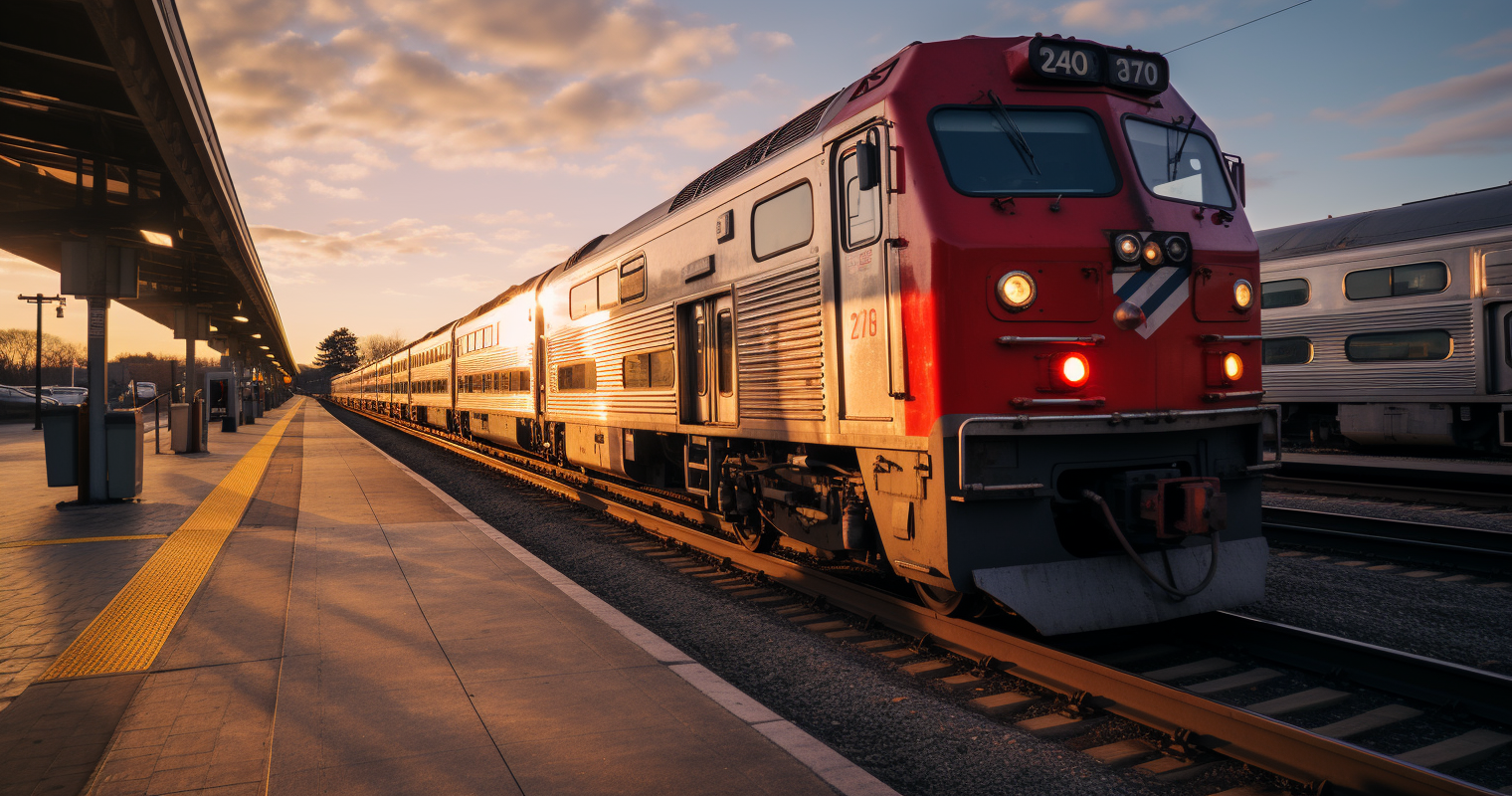
Slovakia’s rail network has a long and established history, with ZSSK (Železničná spoločnosť Slovensko) serving as the state-run carrier connecting cities, regional hubs, and alpine destinations across the country. Ticket prices rank among the cheapest in Central Europe, and far-reaching zero-fare entitlements benefit both students and older passengers. The system works well for commuters and city-to-city travellers alike, though services on more remote lines tend to be slower and less frequent.
| Item | Details |
|---|---|
| National rail operator | ZSSK (Železničná spoločnosť Slovensko) |
| Zero-fare eligibility (as of 2025) | Students under 26 and pensioners over 62 with Slovak citizenship or permanent residence; EU residents also covered under certain conditions |
| Season ticket saving (as of 2025) | 50% or more off the standard single fare for 2nd class commuters |
| Student/youth discount | 50% off regular fare; Student Season Tickets offer 60–70% off (as of 2025) |
| Digital ticket share (2025) | Over 56% of tickets sold via digital channels; mobile app accounts for over 40% of sales |
| Main booking app | IDeme vlakom (ZSSK official app) |
What is the overall standard of rail travel in Slovakia?
Rail services throughout Slovakia are delivered by the state operator ZSSK (Železničná spoločnosť Slovensko), which links the country’s principal cities, smaller regional towns, and mountain leisure destinations. Given Slovakia’s modest geographic footprint, the network achieves considerable coverage, making trains a genuinely practical choice for everything from daily commuting to longer trips between Bratislava, Žilina, Banská Bystrica, and Košice.
In terms of service quality, Slovak rail occupies a solid middle ground within Europe — broadly comparable to Poland or the Czech Republic rather than the high-speed, meticulously punctual systems found in Germany, Switzerland, or Japan. Main corridor express and intercity services tend to be reliable and reasonably comfortable, whereas some rural branch lines rely on ageing rolling stock and operate at reduced speeds. Punctuality on busy routes has seen genuine improvement in recent years, though more remote services remain somewhat less predictable.
In 2022, ZSSK carried an average of 67 million passengers, a figure that underlines the network’s role as a meaningful artery for everyday life rather than a niche attraction for tourists. The Bratislava–Žilina–Košice spine is the most important long-distance corridor, offering frequent express and fast train departures throughout the day and lending itself well to intercity commuting.
For newly arrived residents, the rail network is a worthwhile option for both regular commutes — especially within and around Bratislava and other regional cities — and for domestic travel across the country. People living in rural areas may find that bus services supplement or substitute trains on certain routes, so it pays to check local connectivity carefully when selecting a place to live.
What classes of rail travel are available in Slovakia, and what are the differences between them?
On the highest-category trains, the coach options include Business Class, First Class, and Second (Economy) Class, each offering a distinct level of service. That said, which classes are actually available on any given journey depends on the train category, since not every service runs all three.
On regular domestic ZSSK services, the practical choice comes down to First Class and Second Class. First Class coaches provide more generous seating space, a calmer atmosphere, and generally greater comfort over longer distances. Passengers who decide to upgrade to First Class after boarding may pay the relevant class surcharge directly on the train, so the decision does not have to be made before departure on most domestic routes.
Railjet Xpress trains — which connect Bratislava with Vienna and Zürich — use Viaggio Comfort coaches featuring both First and Second Class, including an onboard passenger portal. Seat reservations are compulsory on Railjet Xpress services.
For everyday domestic travel on ordinary (Os) and regional express (REX) trains, the difference between classes is comparatively minor, and the vast majority of passengers travel in Second Class without any meaningful reduction in comfort. On shorter commuter segments, First Class is technically available but the price uplift is rarely justified unless you regularly travel a long route and strongly value a quieter guaranteed seat. For international journeys, premium services such as the Pendolino (SuperCity) between Prague and Košice deliver enhanced comfort in exchange for a supplementary charge on top of the standard domestic fare.
Where can you find rail timetables and ticket prices in Slovakia?
The definitive official source for schedules, fares, and all booking-related information is the ZSSK website at www.zssk.sk/en. It covers domestic routes comprehensively and provides links through to international connections. Timetable information is accessible online and can also be obtained from ZSSK’s contact centre, customer service desks at stations, onboard train personnel, and station ticket offices.
Complete fare lists, the method by which prices are calculated, and the tariff conditions applying to ZSSK trains are all published in the ZSSK Terms of Service, accessible via the official website. Since fares and surcharges are updated from time to time, it is always best to consult the official price lists directly rather than depending on third-party summaries that may not reflect the current position.
For planning journeys involving multiple operators or crossing international borders, well-regarded aggregator platforms such as Rail.cc and Omio draw on timetable data and direct users to official booking channels. Private operators Leo Express (LE) and RegioJet (RJ) also run certain Slovak domestic routes; RegioJet tickets can be purchased at www.regiojet.com and Leo Express tickets at www.leoexpress.com, both online and at their respective station offices.
For journeys within the Bratislava Integrated Transport System (IDS BK) — which brings together ZSSK trains, city trams, buses, and trolleybuses across the Bratislava region under one ticketing umbrella — integrated timetable and fare zone details are available at www.idsbk.sk. As pricing can shift with the seasons, always verify the latest fares through these authoritative sources before travelling.
How do you buy rail tickets in Slovakia, and can you book in advance?
Tickets for Slovak trains can be purchased online or in person at a station. ZSSK provides a range of purchasing options to accommodate varying levels of familiarity with digital tools. For regular users, the most convenient route is the official ZSSK mobile app, IDeme vlakom, which lets you buy, store, and display tickets entirely on your phone.
Digital ticketing has grown rapidly in Slovakia in recent years. The proportion of tickets sold through digital channels rose from just under 5 percent in 2020 to more than 56 percent in 2025, with the mobile app alone responsible for over 40 percent of all sales. Purchasing via smartphone has effectively become the default approach for the majority of travellers on the network.
The following purchasing methods are available:
- ZSSK website: Buy tickets online at www.zssk.sk/en and receive an e-ticket by email or save to your account.
- IDeme vlakom app: The official ZSSK app for iOS and Android. ZSSK is launching an electronic version of its discount card via the IDeme vlakom app in September 2025, featuring a scannable QR code, though the traditional plastic card will remain valid.
- Station ticket offices: Available at larger stations with staff assistance. At all sales points of ZSSK across the territory of Slovakia, if boarding a ZSSK train where there is no sales point, you can approach train personnel proactively and purchase your ticket onboard with no extra surcharge.
- Ticket vending machines: Ticket vending machines are available in train stations and at bus stops of local transport.
- SMS ticketing: On certain self-service dispatch lines, tickets can be purchased via the IDeme vlakom app, by SMS, or at a station.
Advance reservations are possible on most mainline services and are a sensible precaution for long-distance travel, particularly on express and EuroCity trains where seat reservations are either strongly recommended or compulsory. On standard fast trains, reservations are an option but carry no obligation. Zero-fare passengers travelling on long-distance services classified as R, RR, Ex, EN, EC, or SC must obtain a reservation in advance for the specific train they intend to board — open-ended zero-fare travel is not permitted on these categories.
For assistance with online purchases, ZSSK operates a contact centre reachable through the official website. RegioJet and Leo Express each maintain their own booking systems, apps, and customer support channels, accessible through their respective websites.
What types of rail tickets are available in Slovakia, and are there discount schemes?
Domestic fares are calculated according to ZSSK’s published price list, based on the actual distance of the journey in kilometres. This distance-based structure keeps shorter trips highly affordable and ensures that passengers pay in proportion to how far they travel. The principal ticket categories are single (one-way) tickets, return tickets, season tickets for specific routes, and network passes.
Tickets covering distances up to 100 km remain valid on the date shown and until 4 a.m. the following day. Return tickets for journeys up to 100 km share the same validity window as singles. For distances exceeding 100 km, return tickets remain valid until the end of the 3rd day of their validity period. This extended window offers useful flexibility, particularly for longer trips.
Season tickets represent outstanding value for regular commuters. They offer a significant reduction compared to standard single fares — 50% off for 2nd Class and more than 50% off for 1st Class. By way of illustration (as of 2025): a single journey from Trnava to Bratislava on a season ticket costs €1.28; from Spišská Nová Ves to Košice it costs €2; and from Žilina to Bratislava it costs €4.65. Always confirm current season ticket pricing directly at the official ZSSK season tickets page, as these figures may change.
Slovakia operates one of the most far-reaching zero-fare schemes in Central Europe. Students under 26 and pensioners over 62 who hold Slovak citizenship or permanent Slovak residence are entitled to travel at no cost, as are students under 26 and pensioners under 62 who are citizens or permanent residents of any EU member state. Students enrolled at schools in Slovakia are additionally covered regardless of their nationality — this extends to students from countries outside the EU as well.
Passengers entitled to zero-fare transport must register at a ZSSK ticket desk. On registration, they receive a rail customer card enabling them to obtain zero-fare tickets for train travel. From August 2025, the process was simplified: passengers eligible for free travel no longer need to collect a zero-fare ticket before boarding regional trains, a change designed to reduce administrative burden and make public transport easier to use.
Student and youth discounts are available separately from the zero-fare scheme. The discounted rate is 50% off the standard fare in both 2nd and 1st Class coaches, with no restriction based on the passenger’s residential or school address. Student Season Tickets for selected routes offer a further reduction of 60–70% off the standard 2nd Class fare (as of 2025). For current thresholds, consult the ZSSK children and students page.
Holders of the MAXI KLASIK loyalty card benefit from up to a 50% discount on standard domestic trains for 2nd Class travel. Interrail passes are valid in Slovakia for international travellers or those wishing to explore the wider European network. The ZSSK discounts overview page provides a comprehensive and up-to-date list of all available concessions.
How accessible is the rail network in Slovakia for disabled passengers?
ZSSK offers dedicated support for passengers with reduced mobility, though the quality of provision varies noticeably across the network. Newer rolling stock deployed on main corridors — including modern electric multiple unit trains and refurbished intercity coaches — is generally well equipped, with step-free boarding arrangements, designated wheelchair spaces, and accessible toilet facilities. Older carriages still in use on rural branch lines can pose greater difficulties, and level-access platforms are not universal at smaller stations.
ZSSK maintains a dedicated accessible travel section on its website at www.zssk.sk/en/accessible-travel/, addressing the needs of passengers with reduced mobility, visual impairments, and hearing impairments. Passengers requiring platform or boarding assistance are encouraged to notify ZSSK ahead of travel so that the appropriate support can be arranged.
Within the Bratislava Integrated Transport System (IDS BK), holders of ŤZP and ŤZP-S disability recognition cards with permanent residence in the Bratislava region receive fully free travel within Bratislava city fare zones. The ŤZP card is Slovakia’s official disability status card, and possession of one unlocks a range of concessions across both rail and urban public transport.
Measured against the accessibility standards of countries such as the Netherlands or Sweden — where step-free access has become near-universal — Slovakia’s infrastructure is still catching up. Larger stations in Bratislava, Žilina, Košice, and other regional centres offer considerably better access than smaller rural halts and request stops. If barrier-free travel is a priority for your daily commute, it is well worth researching the specific stations and routes involved before choosing where to live.
For group travel or more complex journeys involving wheelchair users, getting in touch with ZSSK’s customer service centre through the official website well before departure is strongly advisable to confirm that the right support will be available throughout the journey.
Are there metro or urban rail systems in Slovakia’s cities?
No Slovak city has an underground metro system. Bratislava, the capital, is among the more notable European capitals to lack one entirely — a fact that sometimes comes as a surprise to newcomers who expect a city of its status to be served by a tube or subway. Urban mobility in Bratislava is instead built around a dense network of trams, trolleybuses, and buses run by Dopravný podnik Bratislava (DPB), complemented by suburban ZSSK rail services that fan out into the wider Bratislava region.
The Integrated Transport System of the Bratislava Region (IDS BK) is the essential framework for understanding how urban and suburban rail fits into daily life in Bratislava. IDS BK uses a zone-based fare structure in which ticket prices reflect both the number of zones crossed and the duration of travel. During a single journey, passengers may transfer between any integrated lines and operators as many times as needed, subject to the time shown on their ticket. This is conceptually similar to the zone-based Oyster card system in London or the T-ticket model in Barcelona, where one ticket covers multiple operators within a defined area.
Regional express (REX) and ordinary (Os) ZSSK trains form part of the integrated transport network in the Bratislava region, which means suburban rail services around the capital can be used with IDS BK tickets on relevant route segments. This arrangement lets residents of rail-served suburban communities commute into Bratislava on the same integrated ticket they would use for a city tram journey.
Short-stay visitors and tourists can take advantage of the Bratislava CARD, which provides free travel within IDS BK fare zones. For residents, a monthly or annual travelcard is typically the most economical solution. Full timetable, fare zone, and travelcard details are available at www.idsbk.sk. DPB’s own journey planner and app are also handy tools for getting around Bratislava’s tram and bus network.
In other Slovak cities — including Košice, Žilina, Banská Bystrica, and Prešov — urban transport is provided by municipal tram and bus operators. Košice, for instance, boasts one of the oldest and most extensive tram networks in the country. These city systems do not formally integrate with ZSSK rail ticketing in the same way as the Bratislava IDS BK, so a separate local transport ticket is generally required for the urban leg of a journey.
What should expats know about using the rail network day-to-day in Slovakia?
Day-to-day use of Slovak trains becomes straightforward once you grasp a few practical fundamentals. Station signage at major hubs is in Slovak, but departure boards at larger stations display destinations in a format that most travellers familiar with the Latin alphabet will find legible. Train category codes — Os, REX, R, EC, and so on — appear on departure boards and give you a quick indication of what kind of service you are boarding.
Onboard announcements are made in Slovak as standard. On international services and some intercity express trains, announcements may be repeated in German, Czech, or English. On local regional trains, however, Slovak is likely to be the only language used. Picking up a handful of key Slovak transport terms — such as nástupište (platform), odchod (departure), and príchod (arrival) — will make navigating stations noticeably easier from day one.
Passengers are permitted to travel with pet animals in 2nd Class carriages on ZSSK trains. ZSSK accommodates bicycle and e-bike transportation on almost all of its services. Smaller items of luggage can be kept with you in a compartment or open-plan coach free of charge, while larger pieces can be stowed in designated luggage areas or mobile storage on the train.
It is important to familiarise yourself with the expanding self-service dispatch system (SVS), which is being rolled out progressively across an increasing number of regional routes. Currently operating on 19 lines, the SVS model eliminates the need for onboard conductors, meaning passengers are required to hold a valid ticket before they board — you cannot buy one from train staff on these services. The approach mirrors systems already in use in Austria, Germany, the Czech Republic, and Switzerland. Passengers found travelling without a valid ticket face a penalty ranging from €40 (if settled immediately) to €70 (if paid subsequently), in addition to the cost of the relevant fare.
Seat reservations are not obligatory on the majority of domestic services, though they are available and sensible on heavily used long-distance routes. Where reservations are not required, boarding and finding an unoccupied seat is perfectly standard practice — as it is on most regional rail networks across Central Europe. On IC and Railjet Xpress trains, however, reservations are compulsory.
The culture of train travel in Slovakia is quiet and generally understated. Making phone calls in compartments is widely regarded as inconsiderate. Offering your seat to elderly passengers or those travelling with young children is expected as a matter of course. Smoking is banned throughout the entire network. The overall atmosphere on Slovak trains closely resembles that found on services in neighbouring Czech Republic or Austria — measured, orderly, and polite.
Frequently asked questions about rail travel in Slovakia
Does Slovakia have a national rail pass for unlimited travel?
ZSSK provides season tickets tied to specific routes rather than a single all-network unlimited pass. These are most suitable for commuters who travel the same route repeatedly. For wider exploration, Interrail passes are valid across Slovakia and permit travel on ZSSK trains as part of a multi-country itinerary. Visit the ZSSK discounts and offers page for the most current pass options.
Can I get free train travel in Slovakia as a student or pensioner?
Students under 26 years of age and pensioners over 62 years who hold Slovak citizenship or permanent residence in Slovakia qualify for zero-fare travel. EU residents within the same age brackets are also covered subject to certain conditions. Registration at a ZSSK ticket desk and receipt of a customer card are required before travelling free of charge. Full eligibility details are available on the ZSSK zero-fare page.
Is it safe to buy train tickets on the day rather than in advance?
On most regional and ordinary services in Slovakia, purchasing on the day is entirely standard practice. For busier express corridors — the Bratislava–Košice route in particular — booking ahead is advisable, especially at weekends and around public holidays. On routes operating under the self-service dispatch (SVS) model, tickets must be purchased prior to boarding; buying from a conductor is not an option on these lines.
Are there direct train connections from Slovakia to neighbouring countries?
A direct rail link connects Bratislava to Vienna, with frequent departures and a journey time of roughly one hour. Several direct connections also operate between Slovakia and the Czech Republic, including overnight trains. Services to Hungary, Poland, and Germany are available as well, with some itineraries requiring at least one change. Check ZSSK’s international ticketing section for current routes and timetables.
Can I take my bicycle on Slovak trains?
ZSSK carries bicycles and e-bikes on almost all of the trains it operates. A modest fee applies to bike carriage; consult the ZSSK website for the current charges and for any route-specific restrictions, as rules can differ between train types.
Does Bratislava have a metro system?
No. Bratislava has no underground metro. The city’s public transport comprises trams, trolleybuses, and buses operated by DPB, which are integrated with suburban ZSSK trains through the IDS BK zone ticketing system. The IDS BK website provides comprehensive information on the full integrated network for the Bratislava region.
How do I get help at a Slovak train station if I don’t speak Slovak?
Staff at principal stations — particularly those in Bratislava, Košice, and Žilina — frequently have a working knowledge of German or at least basic English. The ZSSK website is fully available in English at www.zssk.sk/en. The IDeme vlakom app further simplifies matters by enabling digital ticketing, which means that for most straightforward journeys, the language barrier at ticket windows can be sidestepped entirely.
What happens if my train is delayed or cancelled?
ZSSK’s terms of service set out passengers’ entitlements in the event of delays or cancellations, consistent with EU Regulation 1371/2007 on rail passengers’ rights. Compensation may be due for substantial delays on long-distance services. To submit a claim or complaint, follow the ZSSK customer claims procedure detailed at www.zssk.sk/en.