
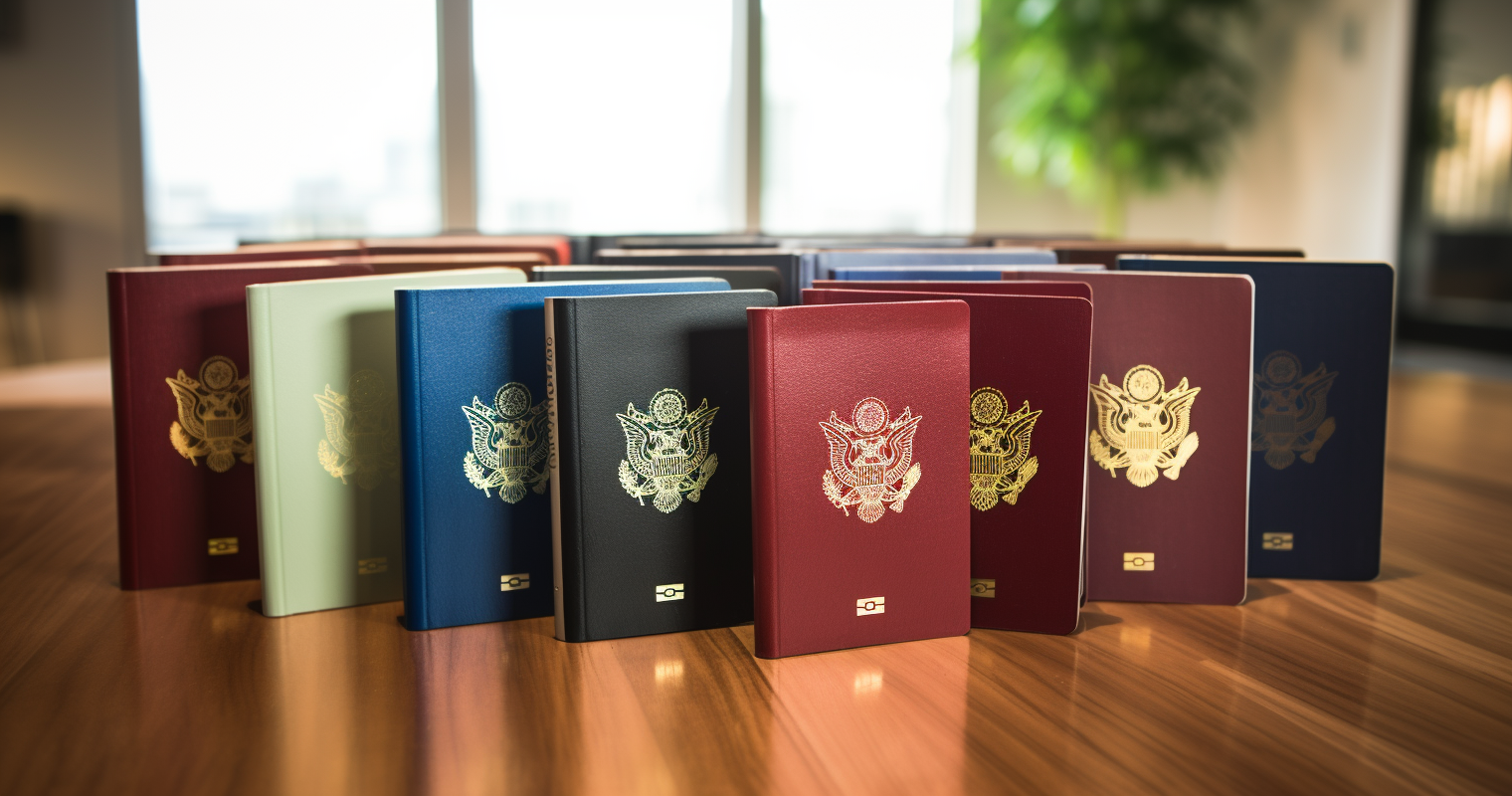
For most foreign nationals living in the United States, citizenship is achieved through naturalisation — a process that becomes available after holding a green card (lawful permanent resident status) for five years, or three years for those married to a US citizen. To qualify, applicants must satisfy residency, English language, and civics requirements, prove good moral character, and swear the Oath of Allegiance. Dual citizenship is currently permitted under US law, although a bill that would alter this is under legislative consideration as of early 2026.
| Item | Details |
|---|---|
| Standard residency requirement | 5 years as a lawful permanent resident (3 years if married to a US citizen), as of 2025 |
| Application form | Form N-400, Application for Naturalization |
| Filing fee (as of April 2024) | $710 online / $760 by paper (biometrics included) |
| Reduced fee option | $380 for qualifying lower-income applicants; full waiver available |
| Typical processing time | Median approx. 5–8 months (varies by field office; check USCIS for current figures) |
| Civics test version | 2025 Naturalization Civics Test (effective 20 October 2025 for new filings) |
| Dual citizenship | Currently permitted under US law; proposed legislation pending as of 2026 |
| Official body | US Citizenship and Immigration Services (USCIS), uscis.gov |
Who is eligible to apply for citizenship in the United States?
Several distinct pathways to US citizenship exist, each depending on your individual circumstances. While naturalisation is the most frequently used route for foreign nationals residing in the US, citizenship can also be acquired through birth on American soil, through a parent’s nationality, or via military service.
Naturalisation after residency
Naturalisation is the legal process through which a foreign national voluntarily becomes a US citizen. The most widely used pathway requires the applicant to have held lawful permanent resident (LPR) status — commonly referred to as a green card — for a minimum of five years. During that period, the applicant must have maintained continuous residence in the US and been physically present in the country for at least half of those five years.
Citizenship through marriage
If you are the spouse of a US citizen, the standard residency requirement is shortened: you need only have held lawful permanent resident status for three years before applying. The continuous residence and physical presence thresholds are similarly reduced to three years for this pathway. The marriage must be legitimate and must still be in effect at the time of application.
Citizenship by birth and descent
Any child born on US territory is automatically a US citizen under the 14th Amendment to the Constitution. Depending on the laws of the parents’ home country, that child may simultaneously hold dual citizenship. Children born outside the United States to US citizen parents may also acquire citizenship through the principle of jus sanguinis — the right of blood — provided specific legal conditions are satisfied. A Consular Report of Birth Abroad (CRBA), obtainable from the nearest US embassy or consulate, serves as the official documentation in such cases.
Military service route
Certain members of the US armed forces are not required to meet the standard continuous presence requirement when seeking naturalisation. USCIS publishes an eligibility chart outlining the circumstances under which military service members may apply. In some cases, eligible service members may apply after just one year of qualifying military service, rather than waiting the customary five years.
Age, language, and other requirements
Applicants must generally be at least 18 years of age to submit Form N-400 on their own behalf. They must also demonstrate English language ability and pass the civics test at their naturalisation interview. Certain age-based exemptions apply: applicants aged 50 or older who have held permanent residency for more than 20 years are excused from the English language requirement and may sit the civics test in their preferred language with an interpreter. The same language exemption is extended to those aged 55 or older with at least 15 years of permanent residency.
By way of comparison, the United Kingdom requires six years of lawful residence before naturalisation (five years general residence, plus one year holding Indefinite Leave to Remain), while Australia requires four years of permanent residency. The US five-year threshold is broadly consistent with international norms.
Good moral character
Under a revised USCIS standard introduced in 2025, the absence of a criminal record alone is no longer regarded as sufficient proof of good moral character. This updated policy reinstates a pre-1990 discretionary framework, empowering USCIS officers to assess applicants holistically. Officers may now take into account conduct that, while not criminal, is inconsistent with civic responsibility — such as repeated traffic infractions or patterns of harassment.
What steps are involved in applying for US citizenship?
The naturalisation process is initiated by filing USCIS Form N-400, Application for Naturalization, together with the applicable filing fee. US Citizenship and Immigration Services (USCIS) oversees every stage of the process. The steps from start to finish are outlined below.
- Verify your eligibility. If you were not born in the US and did not automatically acquire or derive citizenship through a parent, use the USCIS naturalisation eligibility tool to confirm whether you are eligible to apply.
- Assemble your supporting documents. Study the Form N-400 instructions carefully and gather the documents needed to substantiate your eligibility. These typically include your green card, passport-style photographs, and records that demonstrate continuous residence.
- Complete and submit Form N-400. You will need to create a USCIS online account to file electronically. Alternatively, you may submit a paper application by post. Applications may be filed up to 90 days before you reach the end of the required three- or five-year residency period.
- Pay the required filing fee. As of April 2024, the filing fee is $710 for online submissions and $760 for paper submissions, both of which cover biometric services. Consult the USCIS Fee Schedule before submitting your application, as fees are periodically revised.
- Attend your biometrics appointment. After USCIS formally acknowledges receipt of your application, you will be directed to attend a biometrics appointment at which your fingerprints, photograph, and signature will be recorded.
- Attend the naturalisation interview. Once preliminary processing of your case is complete, USCIS will schedule your interview. You must appear at the designated USCIS office at the time stated in your appointment notice and bring that notice with you. At the interview, an officer will review your application and administer both the English language and civics tests.
- Await the decision. USCIS will issue a written decision by post. If you filed online, an electronic copy will also appear in your account. Your application may be approved if all eligibility criteria are met; continued if additional evidence is needed or if you did not pass the tests on your first attempt; or denied if the evidence shows you do not meet the requirements.
- Swear the Oath of Allegiance. If your application is approved, you will be scheduled for an oath ceremony. Your Certificate of Naturalization will be presented to you at the ceremony — examine it carefully for errors and report any inaccuracies to USCIS before leaving the venue.
Fee waivers and reductions
The revised 2024 fee schedule introduced a 50% discount for certain lower-income applicants. Those whose household income falls between 150% and 400% of the Federal Poverty Guidelines are eligible to pay a reduced fee of $380. A complete fee waiver is available to applicants whose household income is at or below 150% of the Federal Poverty Guidelines, or who receive qualifying means-tested public benefits such as Medicaid, SNAP, or SSI. Because poverty guidelines are updated annually, always confirm current eligibility thresholds on the official USCIS website before applying.
What tests, interviews, or ceremonies are required?
The English language test
At the naturalisation interview, a USCIS officer will evaluate your ability to read, write, speak, and understand English. This assessment involves reading sentences aloud, writing sentences from dictation, and conversing with the officer throughout the interview. The 2025 civics test update does not alter the English language component, which continues to cover reading, writing, speaking, and comprehension.
The civics test
USCIS has introduced the 2025 naturalisation civics test, designed to evaluate an applicant’s knowledge of US history and government in accordance with statutory requirements. The 2025 test applies to applications filed on or after 20 October 2025. Topics covered include the organisation of government, citizens’ rights and responsibilities, and significant events in American history. Comprehensive study materials are provided free of charge at the USCIS Citizenship Resource Centre.
For context, the United Kingdom’s Life in the UK test covers British history, culture, and values in 24 questions, while Australia’s citizenship test is a 20-question computer-based examination focusing on the pledge, national values, and laws. The US civics test follows a broadly similar format but places particular emphasis on constitutional governance and historical milestones.
Exemptions from testing
Applicants aged 50 or older who have maintained permanent residency for more than 20 years are excused from the English test and may take the civics test in their native language with the assistance of an interpreter. Applicants who satisfy certain age or disability criteria may be exempt from both the civics and English language tests entirely. USCIS has signalled that it will apply more rigorous scrutiny to disability-based exemption requests, so applicants pursuing this route should ensure their supporting medical documentation is thorough, current, and provided by a qualified practitioner.
Background checks
USCIS will review your application and carry out the required background and security checks, which may involve submitting fingerprints. USCIS has also resumed neighbourhood investigations to verify that applicants satisfy all statutory requirements. Complex cases may experience longer processing times as a result of these checks.
The Oath of Allegiance ceremony
The final milestone in the naturalisation journey is the Oath of Allegiance, which may be administered at either a judicial or an administrative ceremony. At this event, you formally renounce allegiance to any other sovereign power and pledge your loyalty to the United States. Your Certificate of Naturalization is issued at the ceremony, and you should check it carefully for any errors before leaving the venue. The occasion is often a meaningful and celebratory one; family members are generally invited to attend.
What are the benefits of becoming a US citizen?
Obtaining US citizenship unlocks a wide array of rights and privileges that lawful permanent residents do not fully enjoy. These advantages span civic life, international travel, employment opportunities, and long-term legal security.
The right to vote
Citizens are entitled to vote in federal, state, and local elections — one of the most important rights that is exclusively reserved for citizens. Lawful permanent residents are not permitted to participate in any US government election. Citizens also have the right to hold a US passport and enjoy the full spectrum of constitutional protections.
US passport and travel access
As a US citizen you may apply for a US passport, which ranks among the world’s most powerful travel documents, granting visa-free or visa-on-arrival entry to the vast majority of countries globally. This is a significant practical benefit over holding a green card, which does not confer equivalent travel privileges.
Ability to sponsor family members
Citizens are able to petition for a wider range of family members to immigrate to the US than permanent residents can, and the queues for immediate relatives of citizens tend to move considerably faster. Spouses, children, and parents of US citizens qualify as “immediate relatives” and are not subject to the annual numerical limits that apply to other immigrant visa categories.
Access to federal employment and security clearances
A large number of federal government positions — particularly those requiring access to classified information — are open exclusively to US citizens. Anyone considering a career in federal law enforcement, the intelligence community, the military, or other government sectors will typically find that citizenship is a firm prerequisite.
Protection against deportation
Unlike permanent residents, US citizens cannot be deported. Even a green card holder who has lived in the US for many decades can, under certain circumstances, have their residency revoked and face removal proceedings. Citizenship offers permanent, effectively irrevocable protection from deportation, except in the narrow circumstances where it was obtained through fraudulent means.
Eligibility for federal benefits and scholarships
Certain federal financial assistance programmes, grants, and scholarships are restricted to US citizens. Some states likewise limit access to specific public benefits to citizens only. Citizenship grants access to the full range of entitlements available under federal law.
Does the United States allow dual citizenship, or will you have to renounce your existing nationality?
Yes — dual citizenship is fully lawful in the United States. The Exclusive Citizenship Act of 2025 has not been enacted and therefore does not alter existing law. US citizens may continue to hold more than one nationality, and there are currently no renunciation requirements or deadlines.
Under current US law, there is no ceiling on the number of citizenships a US citizen may hold simultaneously. The US government does not require you to formally declare or register your dual nationality status.
The proposed Exclusive Citizenship Act of 2025
In December 2025, Congress introduced the Exclusive Citizenship Act of 2025, a bill that, if passed, would prohibit US citizens and nationals from holding multiple nationalities. However, legislative probability models currently place the likelihood of enactment at approximately 3%, and there is no indication that Congress is prepared to advance this legislation at present. You should keep track of official developments but need not take any immediate action based solely on this proposal.
Your home country’s rules matter too
While the US currently permits dual nationality, your existing country of citizenship may impose its own restrictions. Not every country allows its citizens to hold dual nationality — China and India, for instance, treat the acquisition of a foreign citizenship as an automatic forfeiture of the original one. Other countries, such as Spain, permit dual nationality only with a selective group of partner countries. Before applying for US citizenship, always consult your home country’s official immigration or foreign affairs authority to understand how naturalisation elsewhere may affect your existing nationality.
Tax obligations
Holding dual citizenship can expose you to tax obligations in both countries. The United States taxes worldwide income, which means you must report all earnings to the IRS irrespective of where you reside. Your second country of citizenship may also impose its own tax requirements. This is an especially important consideration for those who do not plan to remain in the US permanently after naturalising. Seek qualified tax advice before proceeding with your application.
How long does the process of becoming a US citizen typically take?
The complete journey from arriving in the US to receiving citizenship involves two separate phases: accumulating the necessary residency as a permanent resident, and then navigating the naturalisation application process itself.
Phase 1: Qualifying residency
You must have held lawful permanent resident status for at least five years before applying — or three years if you are married to a US citizen. Most people will also have spent time in the US on a temporary visa before obtaining a green card, meaning the overall period from first entering the country to obtaining citizenship is often well in excess of five or six years.
Phase 2: Application processing
In the 2021 fiscal year, the median processing time for Form N-400 stood at 11.5 months. By January 2024, this figure had fallen to 5.2 months. The end-to-end process — from filing the application through completing all naturalisation steps and tests — can realistically take anywhere from eight months to two years. Processing times differ meaningfully from one USCIS field office to another, so always consult the USCIS Processing Times tool for current estimates at your specific office.
Realistic overall timeline
When the required residency period is combined with application processing time, most applicants should expect a realistic minimum of approximately five and a half to seven years from first receiving a green card to taking the Oath of Allegiance — less for those who qualify via the three-year spousal route. The USCIS website remains the only authoritative source for current processing data, as these figures are updated regularly.
What are the most common reasons a citizenship application is refused?
USCIS may deny a Form N-400 application on a variety of grounds. Familiarising yourself with the most frequently cited reasons for refusal can help you avoid preventable errors and present the strongest possible application.
- Criminal record or inability to demonstrate good moral character. Certain criminal convictions are permanent bars to establishing good moral character and automatically give rise to a ground of denial. Other convictions are treated as conditional bars, meaning an applicant may be able to overcome them by demonstrating genuine rehabilitation and presenting positive equities.
- Failure to meet residency or physical presence requirements. Not satisfying the five-year (or three-year) continuous residence requirement, or having spent an excessive amount of time outside the US during the qualifying period, is a frequent basis for denial. Applicants who were abroad for more than six months but fewer than twelve must persuade the USCIS officer that they never intended to abandon their permanent residence in the US.
- Failure to pass the English language or civics test. If an applicant does not pass the English and/or civics test at the first attempt, USCIS will typically continue the application and schedule a second attempt. Persistent failure, however, may lead to denial.
- Incomplete or inaccurate documentation. Missing paperwork, inconsistencies between documents and application answers, or failure to disclose required information are common causes of both delays and denials. Accuracy and completeness throughout the application process are essential.
- Failure to register for Selective Service. Male applicants between the ages of 26 and 31 who did not register with the Selective Service when required may face additional scrutiny, though USCIS may afford them an opportunity to demonstrate that registration was not required of them or that they were exempt.
- Questions regarding constitutional allegiance. Applicants must affirm their willingness to support and defend the US Constitution. Evidence of membership in organisations that oppose constitutional governance can disqualify an applicant.
Is there an appeals process?
Yes. If USCIS denies your Form N-400, you have the right to request a hearing before a USCIS officer to contest the decision. This is initiated by filing Form N-336, Request for a Hearing on a Decision in Naturalization Proceedings. Should the outcome of the hearing also be unfavourable, you may seek judicial review in a federal district court. If your application is denied, it is strongly recommended that you consult a qualified immigration attorney.
Where can you find reliable, up-to-date information about citizenship in the United States?
Given how frequently fees, processing times, and policy requirements change — particularly in the current regulatory climate — you should rely exclusively on official government sources when planning your application and making decisions.
- US Citizenship and Immigration Services (USCIS): uscis.gov/citizenship — the primary official resource for all naturalisation requirements, forms, fees, study materials, and processing times. This is your essential first reference for any naturalisation question.
- USAGov Naturalization Page: usa.gov/naturalization — a government-maintained plain-language guide to the naturalisation process, with links to official resources throughout.
- USCIS Fee Schedule: uscis.gov/g-1055 — always verify current filing fees here before submitting any application, as fees are subject to periodic revision.
- USCIS Processing Times Tool: egov.uscis.gov/processing-times — check up-to-date processing times by form type and field office.
- USCIS Citizenship Resource Centre: uscis.gov/citizenship/find-study-materials-and-resources — free civics test study resources, flash cards, and practice tests available in multiple languages.
- US Department of State — Travel and Passports: travel.state.gov — for information relating to US passports, Consular Reports of Birth Abroad, and formal renunciation of citizenship.
Blogs, online forums, and third-party websites can provide a useful general introduction, but should never be treated as authoritative sources for fees, deadlines, or eligibility criteria. The US immigration system changes frequently, and only the official sources listed above should be relied upon for definitive guidance.
Frequently asked questions
Do children born in the United States automatically become US citizens?
Yes. Any child born on US soil is automatically a US citizen by virtue of the 14th Amendment to the Constitution — a principle known as birthright citizenship, or jus soli. It should be noted that there is active legal and political debate regarding the application of birthright citizenship to children born to certain categories of visa holders. The Supreme Court is currently examining Executive Order 14160 on this matter, with a ruling anticipated around July 2026. Monitor official sources closely for any developments.
Can US citizenship be lost or revoked?
A US citizen may voluntarily relinquish citizenship through a formal act of renunciation conducted before a US consular officer abroad. Citizenship may also be revoked — a process known as denaturalisation — where it was obtained by means of fraud, misrepresentation, or deliberate concealment of material information during the application process. Under current law, holding a second citizenship does not in itself result in the automatic forfeiture of US citizenship.
What happens to my naturalisation application if I move abroad during the process?
Relocating outside the US after filing Form N-400 can seriously jeopardise your application, since you are required to demonstrate continuous residence in the country throughout the process. Applicants who spend more than six months but fewer than twelve months abroad must persuade the USCIS officer that they had no intention of abandoning their permanent residence in the US. Undertaking extended international travel after filing is a considerable risk and should be avoided where possible. Speak with an immigration attorney before making any overseas travel plans once your application has been submitted.
Can I apply for citizenship if I have a criminal record?
Some criminal convictions represent absolute bars to demonstrating good moral character and will result in automatic denial. Others are treated as conditional bars, meaning the applicant may be able to address them by showing credible evidence of rehabilitation and positive equities. The nature, gravity, and recency of any offence all play a significant role in the assessment. If you have any criminal history, always seek advice from a qualified immigration attorney before submitting an application.
Do I need to renounce my current citizenship to become a US citizen?
No. Dual citizenship is currently fully lawful in the United States. The Exclusive Citizenship Act of 2025 has not been enacted and has no effect on existing law. Americans may continue to hold more than one citizenship, and there are no renunciation deadlines or mandatory requirements at this time. Bear in mind, however, that your home country may require you to surrender its nationality upon naturalising elsewhere, so always check with the relevant authorities in your country of origin.
How many questions are on the civics test and how many do I need to answer correctly?
Under the 2025 naturalisation civics test — which applies to applications filed on or after 20 October 2025 — officers pose up to 20 questions drawn from a published list of 128, and applicants must answer at least 12 correctly in order to pass. Study materials and the complete question bank are freely available at the USCIS Citizenship Resource Centre. Always verify the current pass threshold at uscis.gov, as the test format may be subject to future revision.
Is there a language requirement if I have a disability?
Applicants who meet certain age or disability criteria may be exempt from both the English language and civics tests. USCIS has indicated that it will apply heightened scrutiny to disability-based exemption requests, so any medical documentation submitted in support of such a request must be thorough, current, and provided by a suitably qualified medical practitioner.
Can I apply for a US passport immediately after naturalisation?
Yes. Upon receiving your Certificate of Naturalization at the oath ceremony, you become immediately eligible to apply for a US passport. Applications may be submitted in person at a passport acceptance facility or, for future renewals, by mail. Your Certificate of Naturalization — or a certified copy — will be required as proof of citizenship when making your initial passport application. Be sure to factor in additional weeks for passport processing beyond the naturalisation timeline itself.
What is the cost of naturalisation and are there any exemptions?
As of April 2024, the filing fee for Form N-400 is $710 for online submissions and $760 for paper submissions, both of which include biometric services. A full fee waiver is available to applicants whose household income does not exceed 150% of the Federal Poverty Guidelines, or who receive qualifying means-tested public benefits such as Medicaid, SNAP, or SSI. Always consult the USCIS fee schedule at uscis.gov for the most current figures before filing, since fees are revised periodically.
Does the US tax its citizens living abroad?
Yes. The United States taxes on the basis of citizenship rather than residency, meaning all worldwide income must be reported to the IRS regardless of where you live. Your second country of citizenship may also levy its own tax obligations. This means that even if you depart the US permanently following naturalisation, you will generally still be required to file US tax returns each year. Obtaining professional tax and legal advice before and after naturalising is strongly recommended.