

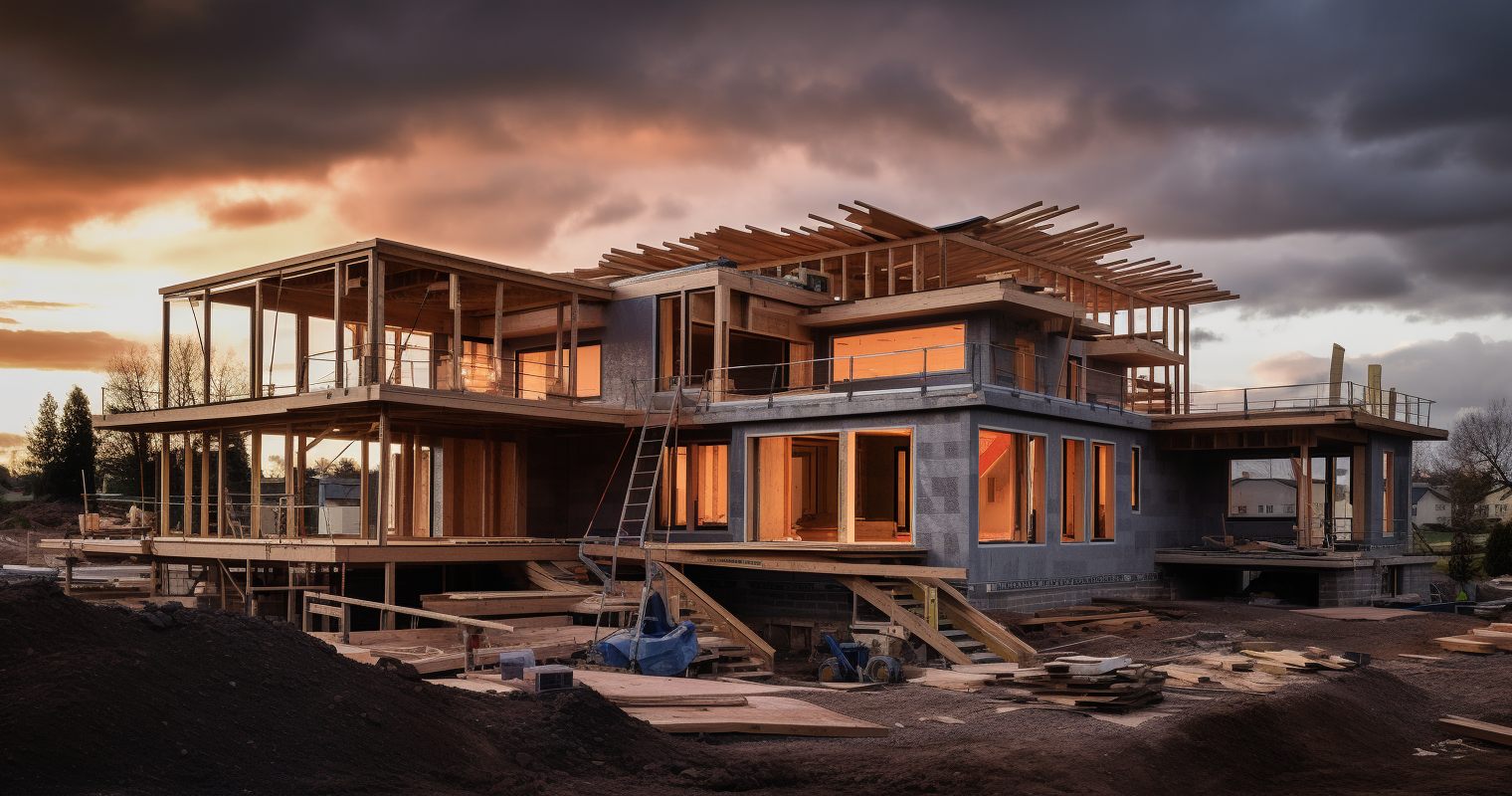
Foreign nationals can absolutely build or renovate property in Poland, but the process involves a layered framework of planning, zoning, and construction permit requirements that differs markedly from systems in many other countries. A building permit is generally mandatory before work begins, though homes of no more than 70 m² may proceed via a simplified notification route. The sector is formally regulated, heritage protections are rigorous, and buyers from outside the EU may require a special permit from the Ministry of Interior before they can acquire land.
| Item | Details |
|---|---|
| Building permit required? | Yes, for most construction; homes up to 70 m² can use a simplified notification process (as of 2025) |
| Building permit decision time | Up to 65 days from application submission (as of 2025) |
| WZ decision (building conditions) time | Typically 30–90 days (as of 2025) |
| Construction cost estimate | PLN 5,550–6,200 per m² for a standard house (as of 2025) |
| Property transfer tax | 2% PCC on resale property purchases (as of 2025) |
| Non-EU land purchase permit | Required from the Polish Ministry of Interior for most non-EU buyers |
Do you need planning permission to build or renovate a property in Poland?
The fundamental principle of Polish Construction Law is that a building permit must be secured before any construction work commences — yet the legislation contains numerous exceptions. The system operates along two main paths: a full building permit (pozwolenie na budowę) and a streamlined notification procedure (zgłoszenie budowy). Which route applies depends on the scope and character of the intended project.
Since 2022, a single-family dwelling of up to 70 m² may be constructed via notification alone, without the need for a full permit — a rule that remains in force in 2025. To be eligible, the property must have a built-up area not exceeding 70 m², consist of a single-storey detached structure (a mezzanine is permitted, but a full usable attic is not), be intended solely for the owner’s own residential use rather than commercial purposes, and must conform to either the Local Spatial Development Plan (MPZP) or a Decision on Development Conditions (WZ).
A full building permit is required where the built-up area surpasses 70 m², where the building extends to more than one storey, or where it is intended for commercial use. For any larger project, comprehensive plans prepared by a fully qualified and licensed architect or comparable professional are a prerequisite for obtaining the permit.
Poland’s planning framework has gone through substantial reform in recent years. Significant amendments to the Spatial Planning and Development Act of 27 March 2003 introduced new legal instruments, including general plans and a revised procedure for obtaining planning permissions. A significant tranche of these reforms took effect on 24 September 2023, with further provisions entering force on 1 January 2025 and 1 January 2026.
Where no local development plan (MPZP) applies to a given area, an individual decision establishing the terms of development must first be obtained. A local development plan has the status of a universally binding regulation under Polish law. This individual decision — known as the Decyzja o warunkach zabudowy (WZ) — sets out precisely how a particular plot may be developed.
Unlike planning regimes in countries such as the UK or Canada — where a single local planning authority handles both land-use policy and building consent — Poland keeps spatial planning and construction permitting as separate processes. Resolving zoning status may therefore be a necessary preliminary step before a building permit application can even be lodged. A WZ decision typically takes between 30 and 90 days to obtain (as of 2025).
Once zoning is settled, the building permit application process proceeds as follows:
- Establish zoning status by consulting the Local Spatial Development Plan (MPZP) at the relevant municipality (gmina) or, where no MPZP is in place, by applying for a WZ decision from the mayor (burmistrz or prezydent miasta).
- Engage a licensed architect to prepare architectural drawings and a complete construction design. As a rough indicator, architect’s fees for the full plans required for a building permit run approximately PLN 130–200 per m² (as of 2025).
- Lodge the building permit application with the architecture and construction department at the relevant local authority (starostwo powiatowe).
- Under Polish construction law, the authority is required to issue a decision within 65 days of receiving a complete application (as of 2025).
- Once the permit is granted and has become final, construction may begin. You must also inform the building supervision authority (nadzór budowlany) of the planned start date in advance.
- Upon completion, apply for an occupancy permit (pozwolenie na użytkowanie), or for smaller projects, submit a formal notification of completion.
Always verify current fees and timescales directly with your local authority (starostwo powiatowe or urząd miasta/gminy), as these can vary between municipalities and are subject to ongoing legislative change. The national administrative portal, www.gov.pl, provides up-to-date guidance in Polish.
What are the rules around listed buildings, conservation areas, and heritage protection in Poland?
Poland operates a formal and legally rigorous heritage protection system. The management of cultural heritage — encompassing protection, documentation, research, financing, and use — is grounded in the Polish Constitution and in the Act of 23 July 2003 on the Protection and Care of Monuments. Anyone acquiring or renovating an older building should verify its heritage status thoroughly before any commitment is made.
Under Polish law, a cultural monument (zabytek) is defined as an “immovable or movable item, their parts or complexes, which are human creations or their byproducts, serving as a testimony of a past epoch or event, and whose preservation is in the societal interest due to their historical, artistic or scientific value.”
A property may attract special protected status if it is designated as a Historic Monument (Pomnik historii), classified as a cultural park (Park kulturowy), or declared by local government as warranting protection. This is broadly analogous to listed building status in the UK or entry on the National Register of Historic Places in the United States, though Poland’s system has its own categories and administrative arrangements.
The Act introduces the concept of a historic building as any immovable property entered in the register of monuments or recorded in the official inventory of heritage assets. In practice, virtually every form of construction activity — from routine maintenance and renovation to energy upgrades or changes of use — falls under a special legal regime requiring prior authorisation from heritage protection authorities (Articles 36 and 37 of the Act).
State administrative bodies carry responsibility for monument protection, while owners and custodians of protected buildings are obliged to care for them — including conducting any necessary research, maintaining documentation, and keeping the monument and its surroundings in the best achievable condition.
The principal authority in this field is the National Heritage Board of Poland (Narodowy Instytut Dziedzictwa — NID), which is responsible for compiling and disseminating heritage information, setting conservation standards, and maintaining the National Register of Monuments. At the regional level, each of Poland’s 16 voivodeships has a voivodeship office for the protection of cultural property, headed by the voivodeship cultural property conservator (wojewódzki konserwator zabytków).
Before purchasing any property — particularly older buildings in historic city centres, rural manor houses, or former industrial sites — you should cross-check both the national register and the register held by the relevant voivodeship conservator. The National Heritage Board can be reached at: www.nid.pl. Violations of heritage protection rules can attract substantial administrative fines, enforcement notices requiring restoration of original features, and in serious cases, criminal sanctions. Always engage an architect or legal adviser with heritage experience when working on a listed property.
What permits and licences are required when building or renovating in Poland?
In addition to planning permission and the main building permit, a construction project in Poland may require a range of further approvals depending on the location, the nature of the works, and the surrounding environment. The specific permits that apply can only be determined on a project-by-project basis, as they depend on the character of the development — but may include environmental authorisations, public road access permits, and tree felling consents.
The most commonly encountered additional permits and approvals include:
- Environmental decision (decyzja środowiskowa): Necessary for larger developments or those with potential impacts on protected natural areas (Natura 2000 sites, national parks, water bodies). Issued by the regional directorate for environmental protection (Regionalna Dyrekcja Ochrony Środowiska — RDOŚ) or the local authority, depending on the scale of the project.
- Tree removal permit: Cutting down trees that obstruct a building site requires a permit, normally applied for at the local municipality (gmina).
- Road access permit: Where a development necessitates a new or modified access point onto a public road, a separate permit from the relevant roads authority is required.
- Utility connection agreements: Written connection agreements with the relevant distribution operators for electricity, gas, water, and sewerage should be secured before construction starts. These are entirely separate from the building permit process and can take considerable time to arrange.
- Heritage authority consent: As described in the previous section, where a property or site is listed or lies within a protected zone, written consent from the voivodeship conservator of monuments must be obtained before any works commence.
- Occupancy permit (pozwolenie na użytkowanie): When applying for an occupancy permit at the conclusion of a project, the investor must submit the technical design to the building supervision authority. This confirms that the finished building corresponds to the approved design and satisfies all safety requirements.
Since September 2020, the construction design submitted with permit applications must comprise three components: a land and land outline planning design, an architectural and building design, and a technical design. Make sure your architect is familiar with these requirements from the very start of the project.
For fire safety on larger or commercial developments, approval from the State Fire Service (Państwowa Straż Pożarna — PSP) may also be necessary. Fees and processing times for individual permits differ between municipalities and project types. Always confirm current requirements with the relevant local or regional authority, and consult www.gov.pl for official guidance.
How do you find a reliable, trustworthy builder in Poland?
Poland’s construction sector is regulated under the Construction Law Act, and individuals working as construction managers or site supervisors are required to hold appropriate professional qualifications. Nevertheless, identifying a dependable contractor — particularly for a foreign property owner who may not be fluent in Polish — demands careful and methodical due diligence.
The key professional credential for construction supervisors and site managers in Poland is the uprawnienia budowlane — a formal licence issued by regional chambers of engineers. The Polish Chamber of Civil Engineers (Polska Izba Inżynierów Budownictwa — PIIB) is the principal regulatory body for construction engineers and site managers. Contact details:
- Website: www.piib.org.pl
- Address: ul. Kujawska 1, 00-048 Warszawa, Poland
- Phone: +48 22 551 56 00
- Email: [email protected]
The PIIB’s online register allows you to confirm whether an individual holds a valid construction licence. Any site manager or construction supervisor on a permitted build must hold current PIIB membership, so requesting a prospective contractor’s membership number and checking it through the online register is a straightforward but essential step.
Practical steps for evaluating a builder in Poland include:
- Request references and inspect completed work — speak with former clients wherever possible, ideally those who commissioned comparable projects.
- Confirm PIIB registration of the construction manager or site supervisor using the online register at www.piib.org.pl.
- Insist on a detailed written contract in Polish, and have it independently translated and reviewed by a Polish lawyer. The contract should clearly set out the scope of works, materials to be used, a payment schedule, timescales, penalty provisions for delays, and a dispute resolution mechanism.
- Verify the builder’s NIP (tax identification number) and KRS (company registration number) in the official company register at www.rejestr.io or ems.ms.gov.pl — this confirms the firm is properly registered.
- Structure payments in stages tied to verified completion milestones, rather than transferring large sums in advance. Be wary of any contractor demanding a substantial deposit before any work has been done.
- Require proof of liability insurance — ask the contractor to demonstrate that they carry civil liability insurance (ubezpieczenie OC) covering construction activities.
Frequent problems experienced by foreign property owners include contractors who submit an attractively low initial quote and then present inflated invoices partway through the project, incomplete or verbal agreements that are hard to enforce, and cash transactions that leave no legally traceable record. Engaging local architects and construction firms with sound knowledge of Polish building regulations is strongly recommended, as requirements are often complex and can vary considerably between municipalities.
How do you find a qualified local architect in Poland?
In Poland, architects must be licensed to practise and are required to hold membership of the Chamber of Architects of the Republic of Poland (Izba Architektów Rzeczypospolitej Polskiej — IARP), the statutory regulatory body responsible for licensing and maintaining professional standards. Contact details:
- Website: www.izbaarchitektow.pl/en/
- Address: ul. Stawki 2A, 00-193 Warszawa, Poland
- Phone: +48 22 827 85 62
- Email: [email protected]
Only an architect holding current IARP membership — or recognised equivalent qualifications — may sign and submit plans for a building permit application in Poland. The construction design required for a permit is a formalised legal document, and the architect bears full legal responsibility for regulatory compliance upon signing it. Always verify that any architect you engage holds current IARP membership through the chamber’s online register.
For citizens of EU member states, the Swiss Confederation, and members of the European Free Trade Association (EFTA), recognition of architectural qualifications for professional practice in Poland may be either automatic or processed under the general system. Architects who qualified outside these groupings must undergo a separate recognition procedure. If you intend to use a foreign-qualified architect on a Polish project, establish their IARP registration status before entering into any contract.
While there are no fixed fee schedules, the IARP’s standards allow the scope of a contract to be defined with precision, so you have a clear understanding of what each fee covers. Architects in Poland may charge a fixed project fee, an hourly or daily rate, or a percentage of the total construction value, depending on the individual and the nature of the commission.
Expats who do not speak Polish should ask prospective architects whether they have worked with international clients and whether they are able to communicate in another language. There is no legal requirement for architects to work in any language other than Polish, but many practitioners in major cities such as Warsaw, Kraków, Wrocław, and Gdańsk regularly serve foreign clients. Asking for references from previous international clients is a sensible part of the selection process.
What are the common pitfalls when buying land to build on in Poland?
Acquiring land for construction in Poland requires thorough legal, technical, and administrative due diligence at every stage. Cutting corners at any point can result in purchasing land that proves impossible to develop, or that carries legal encumbrances or environmental constraints that are costly to address.
Confirm zoning status before anything else. Only land designated for construction purposes under the Local Spatial Development Plan (Miejscowy Plan Zagospodarowania Przestrzennego — MPZP) for the relevant area can lawfully be built on. Obtaining permission to develop undeveloped land — particularly where it is not already earmarked for building or is classified as agricultural — can be very difficult. Where no MPZP is in place, you will need to secure a WZ decision before you can be certain the plot is buildable.
Verify title and plot boundaries. The Land and Mortgage Register (Księga Wieczysta) is publicly accessible online and enables buyers to check ownership and any charges or encumbrances before signing anything. The register can be searched at ekw.ms.gov.pl. Also examine the cadastral map (mapa ewidencyjna) at the local Land Registry and Cadastral Office (Starostwo Powiatowe) to confirm that the plot boundaries correspond to what the seller is representing.
Be aware of agricultural land restrictions. Poland imposes extensive restrictions on agricultural land, making it generally very difficult to purchase or build on such plots. Reclassifying agricultural land to residential or mixed-use is a lengthy and unpredictable process, and many such applications do not succeed.
Investigate utility availability. Rural plots can present significant obstacles to development: the terrain may be unsuitable, and the land may lack connections to mains electricity, water, and sewerage. Access routes for construction vehicles may also be problematic. Before signing any purchase contract, obtain written confirmation from local utility operators as to whether connections exist or can be provided, and at what cost.
Conduct environmental and flood-risk checks. Establish whether the plot falls within a flood hazard zone or a Natura 2000 protected area. Flood hazard mapping is maintained by the Polish Waters authority (Wody Polskie) and accessible at www.isok.gov.pl. Environmental constraints on Natura 2000 land can severely restrict or entirely prevent construction activity.
Engage both a notary and a lawyer. All property transactions in Poland must be completed in the presence of a licensed notary (notariusz) — this is a statutory requirement, not a matter of preference. However, a notary’s function is to ensure the transaction is properly executed, not to advise you on risk. It is strongly advisable to also retain an independent Polish property lawyer to examine the title, identify any encumbrances, check planning status, and review the contract terms before you commit. Upon identifying a suitable plot, you will ordinarily sign a preliminary contract (umowa przedwstępna) accompanied by a deposit of 1–5% of the purchase price. Ensure your lawyer reviews this preliminary contract and that it incorporates appropriate protective conditions.
What are the rules around foreign ownership and financing for construction projects in Poland?
Poland’s regulations governing foreign property ownership vary considerably depending on whether the buyer is an EU/EEA national or a citizen from outside those groupings. The rules applicable to land acquisition differ from those governing apartment purchases, and it is important to understand both before making any commitment.
EU and EEA nationals generally enjoy the same rights as Polish citizens when purchasing land and property. No special permit is required for this group, and there are no restrictions on commissioning construction projects.
Non-EU and non-EEA nationals face additional requirements. As a non-EU citizen, you may need to apply for a permit from the Polish Ministry of Internal Affairs (Ministerstwo Spraw Wewnętrznych i Administracji — MSWiA) in order to purchase either a house or land for development, though purchasing an apartment does not typically require such a permit. Applications must be submitted to the MSWiA before any land or house purchase is completed. Check current requirements directly with the ministry at www.gov.pl/web/mswia.
Financing. Mortgage rates for foreign buyers in Poland in 2026 typically range from 6% to 8%, following the central bank’s December 2025 rate reduction to 4%. Foreign nationals can in principle access Polish mortgage products, though lenders may require Polish residency, a Polish income source, or an established local credit history. Construction loans (kredyt budowlany) are offered by Polish banks and are typically disbursed in tranches linked to verified stages of construction. Terms, eligibility criteria, and rates vary considerably between lenders, so consulting a Polish mortgage broker (doradca kredytowy) with experience serving international clients is advisable.
Property transfer tax. The 2% PCC property transfer tax on resale property transactions represents the largest single closing cost for buyers in Poland, frequently exceeding combined notary and registration fees (as of 2025). It applies to land purchases as well as property. New-build purchases from developers are generally subject to VAT rather than PCC.
Residency and ownership structures. Purchasing property in Poland creates no pathway to residency or citizenship, unlike golden visa schemes available in countries such as Portugal or Greece. Foreign investors considering larger-scale development projects sometimes hold land through a Polish registered company (spółka z o.o. — the equivalent of a limited liability company), which can simplify financing and ownership arrangements. Specialist legal advice on the most appropriate structure for your circumstances is strongly recommended.
What official sources should you consult when planning to build or renovate in Poland?
Poland’s regulatory environment for construction and property matters is distributed across multiple authorities at national, regional, and local levels. The following bodies and resources are the primary points of reference:
| Authority / Resource | Role | Website |
|---|---|---|
| gov.pl (central government portal) | Official guidance on permits, procedures, and public administration | www.gov.pl |
| Ministry of Development and Technology (Ministerstwo Rozwoju i Technologii) | Responsible for construction law, spatial planning, and housing policy | www.gov.pl/web/rozwoj-technologia |
| Main Office of Building Supervision (Główny Urząd Nadzoru Budowlanego — GUNB) | National regulator for building supervision; oversees construction compliance | www.gunb.gov.pl |
| Land and Mortgage Register (Księga Wieczysta) | Online property register — verify ownership, mortgage charges, and encumbrances | ekw.ms.gov.pl |
| National Heritage Board of Poland (Narodowy Instytut Dziedzictwa — NID) | National register of monuments; heritage policy and standards | www.nid.pl |
| Chamber of Architects of Poland (IARP) | Regulates and registers licensed architects | www.izbaarchitektow.pl/en/ |
| Polish Chamber of Civil Engineers (PIIB) | Regulates and registers construction engineers and site managers | www.piib.org.pl |
| Polish Waters (Wody Polskie) / ISOK | Flood hazard maps and environmental water data | www.isok.gov.pl |
| Ministry of Internal Affairs (MSWiA) | Non-EU land purchase permits | www.gov.pl/web/mswia |
| Local municipality (gmina / urząd miasta) | Local spatial development plan (MPZP), WZ decisions, building permits | Search via www.gov.pl |
Rules, fees, and procedures in Poland are subject to regular change — particularly given the wide-ranging spatial planning reforms being introduced in phases between 2023 and 2026. Always verify the current position with the relevant authority before committing to a purchase or initiating any construction activity. Where possible, engage a Polish property lawyer and a licensed architect as early in the process as you can.
Frequently asked questions
How much does it typically cost to build a house in Poland?
The cost of building a house in Poland in 2025 falls in the range of PLN 5,550–6,200 per m², which means that for a typical project of around 120 m² you should budget in excess of PLN 700,000, before adding the cost of the plot. Prices vary according to location, specification, and choice of materials. Construction in Warsaw and other major urban centres tends to cost more than in rural areas. Always obtain a minimum of three detailed written quotes from licensed contractors before making any commitment.
Do I need to speak Polish to manage a building project in Poland?
There is no legal requirement to speak Polish, but all official documentation — permits, contracts, and planning decisions — will be issued in Polish. Having all contracts and official correspondence rendered into your own language by a sworn translator (tłumacz przysięgły) is strongly advisable. Many architects and lawyers in larger cities are accustomed to working with international clients and can communicate in other languages; engaging bilingual professionals from the outset will substantially reduce the risk of costly misunderstandings.
Are UK or US architectural qualifications or building standards recognised in Poland?
For architects who are nationals of EU member states, the Swiss Confederation, or EFTA member states, recognition of qualifications may be either automatic or processed under the general system. Architects who qualified in non-EU countries such as the United States must apply for recognition through the IARP. Polish construction standards are based on EU technical regulations (Eurocodes) and Polish national standards (Polskie Normy — PN), which differ from US and other non-EU building codes. A locally registered architect must assume legal responsibility for ensuring any design submitted in Poland complies with the applicable Polish standards.
What happens if I breach planning rules or build without a permit in Poland?
Unauthorised construction is treated as a serious matter in Poland. The building supervision authority (nadzór budowlany) has powers to order a halt to works, require demolition of any unauthorised structures, and impose substantial financial penalties. In certain circumstances, it is possible to apply for retrospective legalisation of an unauthorised build (legalizacja samowoli budowlanej), but doing so involves penalties, fees, and full compliance with all technical requirements in retrospect — and there is no certainty of a successful outcome. Obtaining proper permissions in advance is always the correct and prudent course of action.
How long does a complete new build project typically take from land purchase to move-in?
Timescales can vary widely, but as a general guide: securing zoning confirmation or a WZ decision typically takes 30–90 days; receiving a building permit decision can take up to 65 days from the submission of a complete application; and the physical construction of a standard family home generally takes between 12 and 24 months depending on complexity and contractor availability. From land purchase through to moving in, it is prudent to allow a minimum of 2–3 years for a new build, factoring in time for permit processing delays, utility connections, and contractor scheduling.
Can I manage the construction myself, or do I need to appoint a professional site supervisor?
Polish construction law requires that every permitted construction project have a formally appointed construction manager (kierownik budowy) holding the relevant PIIB-licensed uprawnienia budowlane. This is a statutory obligation and cannot be dispensed with. Even if you wish to be closely involved in day-to-day progress, you are still legally required to appoint a licensed construction manager who assumes formal legal responsibility for the project. Confirm their current PIIB membership at www.piib.org.pl.
What should I do if I have a dispute with my builder?
Begin by attempting to resolve the matter in writing in accordance with the terms of your contract. If that proves unsuccessful, mediation may be sought through the regional chamber of commerce or the appropriate professional body. Polish courts do handle construction disputes, but proceedings tend to be slow and financially draining. For this reason, a carefully drafted contract — reviewed by a Polish construction lawyer before work begins — containing unambiguous dispute resolution provisions and financial penalty clauses, is the most valuable protection available to you. Never rely solely on verbal commitments or informal agreements.
Are there any restrictions on renovating a property I have already purchased?
Minor internal works — such as painting, replacing floor coverings, or carrying out routine maintenance — do not generally require any permit. However, structural alterations, extensions, changes of use, or any works affecting a listed building or a property within a conservation area will require either a full building permit or, at a minimum, a formal notification to the local authority. With the exception of a limited number of categories of development specified in the Building Law Act, planning permission is required before any operational development — which is defined to include construction, reconstruction, increasing a building’s height, renovation, and demolition. Always consult your local starostwo or urząd gminy before commencing any substantial renovation work.