


Key Points

If you’re an American over 65 moving to Canada, don’t assume Medicare will move with you. In most cases, Medicare does not pay for healthcare outside the United States, apart from a few narrow emergency exceptions. That means you will need a separate plan for healthcare in Canada, especially during the transition period before provincial coverage begins. Medicare’s official guidance explains the limited exceptions.

Canada’s public healthcare system can provide excellent core medical coverage once you are eligible, but it is not a complete replacement for everything American seniors may be used to receiving through Medicare Advantage, Medigap, employer retiree benefits, prescription plans, dental cover, or private US insurance.

For many older applicants, Cigna Global is a sensible first quote because its international plans do not impose the same upper-age restrictions seen elsewhere in the market. BlueCross BlueShield (BCBS), Allianz Care, IMG Global, and Bupa Global may also be worth comparing, depending on your age, medical history, budget, and whether you plan to visit the US regularly.
Best Starting Points By Situation
| If you are… | Start by comparing… | Why |
|---|---|---|
| Over 75 or close to it | Cigna Global, Bupa Global | Age limits narrow the market quickly |
| Planning frequent US visits | BCBS, Cigna Global | US-linked or US-inclusive coverage may matter |
| Looking for premium worldwide cover | Bupa Global, Cigna Global | Broader global networks and higher-end plan options |
| Trying to control premiums | IMG, Allianz Care | May offer more flexible deductibles and plan structures |
| Moving during a provincial waiting period | International plan or visitor-to-Canada policy | You need cover before provincial insurance begins |
| Managing pre-existing conditions | Cigna, Bupa, Allianz, broker-led comparisons | Underwriting outcomes vary significantly |
The right provider depends on your age, health history, destination province, budget, and whether regular trips back to the US are part of the plan. When comparing quotes, use the same assumptions each time: same deductible, same area of cover, same outpatient requirement, same prescription requirement, and the same full medical history.
Why Health Insurance Planning Is Different For American Seniors Moving To Canada
Canada’s healthcare system is often described as universal, but that can be misleading for newcomers. Healthcare is administered by provinces and territories, not by one single national insurance plan. Eligibility, waiting periods, drug benefits, and supplemental programmes vary depending on where you live.
For American seniors, that matters because healthcare needs often become more predictable with age. A retiree relocating to Canada may already be managing prescriptions, chronic conditions, follow-up appointments, specialist care, dental needs, eye care, mobility issues, or planned procedures.
That makes the details of the policy more important than the headline price. A basic emergency-only policy may be enough for a short trip, but it may not be suitable for someone moving permanently with ongoing healthcare needs.
Why Doesn’t Medicare Work In Canada?
Medicare almost never covers ordinary healthcare outside the United States. Medicare’s own guidance says coverage outside the US is limited and that, in most situations, it will not pay for healthcare or supplies received outside the country.
The exceptions are narrow. They can include specific emergency situations, such as being in the US when a foreign hospital is closer than a US hospital, or travelling through Canada between Alaska and another US state when a Canadian hospital is the closest appropriate facility. Those exceptions are not designed for someone living in Canada and using Canadian doctors, hospitals, or specialists on an ongoing basis.
Some retirees keep paying Medicare Part B premiums while living abroad as a hedge in case they later return to the United States. However, keeping Medicare does not mean you can use it as ordinary health insurance in Canada. It is better understood as a re-entry safeguard than Canadian medical cover.
What Canadian Public Healthcare Covers — And What It Doesn’t
Once you are eligible, Canadian provincial healthcare generally covers medically necessary hospital and physician services. That can provide an important foundation for serious illness, emergency treatment, consultations with doctors, surgery, and medically necessary in-hospital care.
However, provincial healthcare is not the same as a comprehensive private plan. It may not fully cover:
- Prescription drugs, depending on province, age, income, and programme eligibility
- Routine dental care
- Routine vision care, glasses, and contact lenses
- Hearing aids
- Ambulance fees
- Physiotherapy, chiropractic care, podiatry, and other paramedical services
- Private or semi-private hospital rooms
- Home care and long-term care beyond specific publicly funded programmes
- Medical evacuation or repatriation
- Healthcare received during visits back to the United States
Expat Focus’ Canada health insurance guide also notes that Canada does not impose one single national requirement for expats to hold health insurance, but that private cover can be essential in practice, especially for temporary residents who are not eligible for public healthcare.
This is where many American retirees encounter an expectations gap. Someone used to Medicare Advantage extras, Medigap protection, employer retiree benefits, or a private US plan may find that provincial healthcare covers the essentials but leaves meaningful day-to-day costs outside the public system.
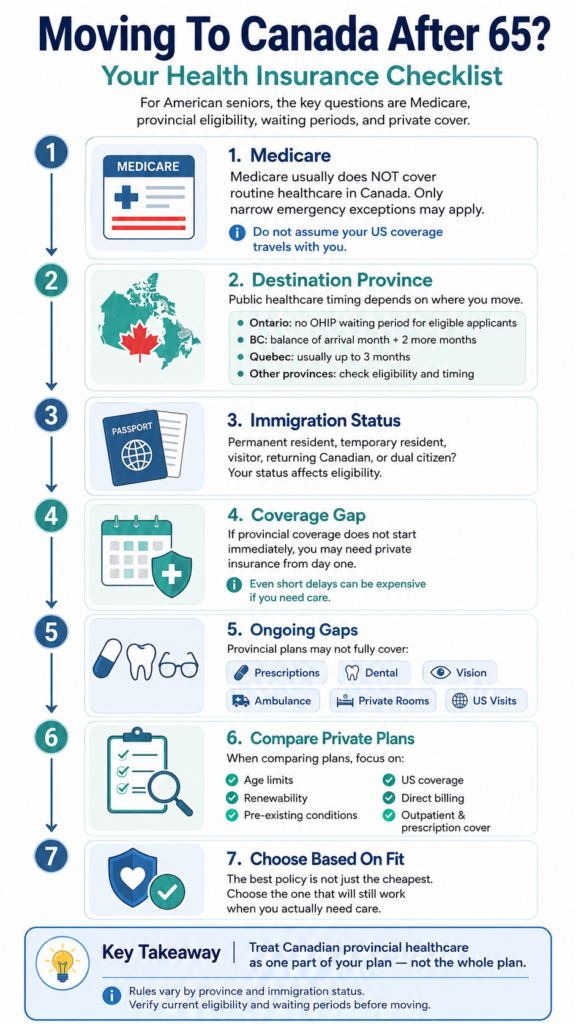
Provincial Waiting Periods: Why Your Destination Province Matters
The timing of public healthcare coverage depends on where you move, your immigration or residency status, and whether you meet the province’s eligibility rules. Canada’s federal immigration guidance warns that in some provinces, newcomers may wait up to three months for public health insurance to start, and recommends private health insurance during any waiting period.
| Province | What to check before arrival |
|---|---|
| Ontario | Ontario currently says there is no OHIP waiting period for eligible applicants, and that you can apply as soon as you arrive. Eligibility rules still apply. |
| British Columbia | In British Columbia, new and returning residents generally face a waiting period made up of the balance of the month in which residence is established, plus two additional months. |
| Quebec | RAMQ says coverage usually begins after a maximum waiting period of three months for people arriving from another country. |
| Alberta | Alberta says people moving, immigrating, or returning to Alberta from outside Canada may be eligible for coverage from the date they establish residency, provided they apply within three months and provide the required documents. |
| Manitoba | Manitoba’s rules depend on your status and where you are arriving from; returning Canadians may be able to apply for coverage from the date they arrive. |
| New Brunswick | New Brunswick states that a three-month waiting period is legislated under its Medical Services Payment Act. |
| Nova Scotia | Nova Scotia says there may be a waiting period before you become eligible when moving from another province, territory, or country. |
This is why private cover is important during the transition. Even a short administrative delay can become expensive if you need emergency treatment, hospital care, or specialist attention before provincial coverage is active.
Your Immigration Status Affects Your Health Coverage
Not every American “moving to Canada” is treated the same way for healthcare purposes. Provincial eligibility can differ depending on whether you are entering Canada as a permanent resident, temporary resident, work permit holder, spouse or partner of a Canadian citizen or permanent resident, returning Canadian citizen, dual citizen, or long-stay visitor.
This matters because some people use the phrase “moving to Canada” when they actually mean spending several months there each year. Others may be applying for permanent residence, joining family, relocating for work, or returning after decades in the US. Those are very different situations from a healthcare eligibility perspective.
Before buying insurance, clarify three things:
- whether you are legally eligible to live in Canada long-term
- whether your immigration status qualifies you for provincial healthcare
- when that provincial coverage actually begins
A retiree entering Canada as a visitor may need a different insurance strategy from someone approved for permanent residence. Likewise, a dual citizen returning to Canada may have a different route into the provincial system than an American applying to settle for the first time.
How The Main Providers Compare
Age limits are one of the biggest practical differentiators for American seniors. A plan that looks attractive at 68 may be irrelevant if it cannot be bought, renewed, or relied on later in retirement.
| Provider | Best for | Age issue | Strengths | Main limitation |
|---|---|---|---|---|
| Cigna Global | Older seniors and long-term expats | No upper age limit on its international health plans / senior international health insurance | Strong global insurer, modular plans, useful for older applicants | Premiums can be high, especially with outpatient cover |
| Blue Cross Blue Shield Global Solutions | Americans who want US-linked coverage | Living-abroad medical coverage is generally limited to applicants aged 74 or younger, subject to eligibility rules | Familiar Blue Cross Blue Shield connection, useful for US-linked coverage and US visits | Less suitable for the oldest applicants |
| Allianz Care | Seniors moving in their 60s or early 70s | Allianz says individuals can apply for its international health insurance if they are under 76 | Large global insurer, flexible deductibles and plan structures | Needs careful review of underwriting, pre-existing-condition treatment and benefits |
| IMG Global Medical | Cost-conscious expats | Global Medical is generally available/quoted up to 74, with senior-specific options for older ages | Often more budget-flexible and customisable | May involve more reimbursement paperwork; older applicants need plan-specific checks |
| Bupa Global | Higher-budget retirees seeking premium cover | Age limits vary by plan, jurisdiction and product; some Bupa Global products have no upper joining age | Large global private medical network and high-end benefits | Expensive compared with leaner plans |
Cigna states that its senior international health insurance has no upper age limit and includes guaranteed renewability, with future premiums not based on claims history. Blue Cross Blue Shield Global Solutions currently states that eligible applicants for its living-abroad medical coverage must generally be 74 or younger at the time of application, but readers should confirm current eligibility directly before applying. Allianz Care says individuals can apply for its international health insurance policy if they are under 76. Bupa Global describes its product range as premium international healthcare with flexible worldwide cover, but plan availability and age treatment should be checked directly before purchase.
The headline issue for older Americans is not simply price. It is whether the insurer will accept you, what it will do with your medical history, whether you can renew the policy later, and whether claims will be paid directly or reimbursed after the fact.
Provider Profiles
Cigna Global

Cigna Global is often a strong starting point for older Americans because it addresses one of the biggest problems in senior expat health insurance: age eligibility. Cigna states that its senior international health insurance welcomes applications at any age and offers guaranteed renewability.
That matters because a policy that looks affordable at 68 but cannot be renewed or replaced later may be a poor fit for someone making a long-term move. Cigna’s modular structure can also be useful, allowing retirees to choose a core plan and then add benefits such as outpatient, dental, vision, or other cover depending on budget and need.
The trade-off is price. Cigna is rarely the cheapest option, and premiums can climb sharply once outpatient care, lower deductibles, and broader geographic cover are added. Pre-existing conditions are also underwritten carefully, so applicants should expect detailed medical questions.
Best for: older seniors who want long-term cover, strong renewability, and a serious international insurer.
Watch out for: premium increases, underwriting exclusions, and the cost of add-ons.
Blue Cross Blue Shield Global Solutions
Blue Cross Blue Shield Global Solutions, formerly GeoBlue Xplorer, is attractive to Americans because of its connection to the Blue Cross Blue Shield ecosystem. For retirees who expect to travel back to the US regularly, or who want a plan that feels more familiar than a purely international insurer, it deserves a close look.
The main constraint is age. Official eligibility wording for Xplorer Premier says U.S. citizens and U.S. permanent residents living abroad, as well as legal U.S. residents applying under the stated rules, must be 74 or younger at the time of application. That makes timing important: someone applying at 69 may find it competitive, while someone applying at 76 is unlikely to be eligible.
The plan may be especially interesting for people who want continuity with US-style provider access. However, the exact treatment of pre-existing conditions, US benefits, eligibility and direct-billing arrangements should be confirmed in writing before purchase.
Best for: Americans who want US-linked coverage and expect frequent visits home.
Watch out for: application age limits, pre-existing-condition rules, and the difference between comprehensive US coverage and more limited US benefits.
Allianz Care
Allianz Care brings scale, global claims experience, and a well-known international brand. It is a strong contender for people moving in their 60s or early 70s who want broad global coverage and flexible plan design.
Allianz says individuals can apply for its international health insurance policy if they are under 76, but applicants should still check current eligibility, underwriting, and country-specific conditions before buying.
For seniors, the key question is whether the plan remains suitable after provincial coverage begins. Some retirees may only need robust inpatient and emergency cover. Others will want outpatient treatment, diagnostics, prescriptions, and dental benefits. Allianz can work well for both, but the price and underwriting outcome will depend heavily on plan design.
Best for: retirees who want a large global insurer and flexible deductibles.
Watch out for: eligibility age, plan jurisdiction, and pre-authorisation requirements.
IMG Global Medical
IMG skews toward expats and frequent travellers, with plans that can often be customised in detailed ways. It may appeal to seniors who want international major medical protection but are also trying to keep premiums under control.
The compromise is that the claims experience may be more reimbursement-led in some cases. For a healthy retiree who is comfortable paying upfront and filing claims, that may be acceptable. For someone with complex conditions, regular specialist needs, or limited tolerance for paperwork, direct billing becomes much more important.
Best for: cost-conscious seniors who still want international major medical protection.
Watch out for: direct-billing depth in Canada and exclusions for existing conditions.
Bupa Global
Bupa Global sits at the premium end of the market. Its strength is breadth: global provider access, high-end plan options, private care pathways, and a service model designed for internationally mobile customers with higher expectations. Bupa Global describes its products as premium international healthcare plans designed to support people at home and abroad.
For American seniors with significant assets, complex medical histories, or a desire for premium global access, Bupa may be worth quoting. But it is unlikely to be the cheapest route into Canadian healthcare coverage, and underwriting will still matter.
Best for: higher-budget retirees seeking comprehensive global cover.
Watch out for: price, plan-specific age limits, and underwriting outcomes.
What About Bridging The Provincial Waiting Period?
If you are landing in a province where coverage does not begin immediately, or where your eligibility is uncertain, you need a plan for the gap.
There are two broad options. The first is to use an international health insurance policy from day one, giving you one policy and one claims process throughout the transition. For seniors with ongoing medical needs, this can be the cleaner option.
The second is to buy a short-term visitor-to-Canada or newcomer policy from a Canadian insurer. This can be cheaper for a defined gap period, especially if you only need emergency protection until provincial coverage begins.
The trade-off is that short-term policies may be narrower. They often focus on emergency medical events rather than ongoing care. Pre-existing conditions may be excluded unless they have been stable for a defined period, and some policies become more restrictive at older ages.
For healthy seniors who only need to bridge a short waiting period, a temporary Canadian policy may be enough. For seniors with diabetes, heart disease, cancer history, recent surgery, multiple prescriptions, or other medical complexity, a full international plan may offer more predictable protection.
What Should You Check Before Buying?
A few details matter more than the marketing brochures suggest.
Pre-existing condition declarations
Be exhaustive. Declare diagnoses, medications, surgeries, tests, symptoms, and referrals. Insurers can deny claims later if they believe relevant medical information was withheld.
Renewability
Look for clear renewal terms, especially if this is part of a long-term relocation plan.
US coverage when you visit home
Some plans include the US; others exclude it or require you to pay more for a wider area of cover. If you expect to visit children, grandchildren, or doctors in the US, this point matters.
Direct billing in Canada
Having to pay upfront and claim back can become difficult when bills run into thousands of dollars. Ask whether the insurer has direct-billing arrangements with Canadian hospitals and clinics.
Prescription cover
Provincial prescription benefits vary, and not all international plans include outpatient prescriptions unless you add them.
Outpatient care
Doctor visits, diagnostics, scans, and specialist consultations can be central for older applicants. Do not assume these are included in a basic inpatient plan.
Deductibles and co-insurance
A high deductible can make the premium look attractive but may leave you paying a large amount before the insurer contributes.
Currency
Premiums may be in USD, while claims in Canada may be in CAD. Exchange rates can affect the real cost of cover.
Medical evacuation and repatriation
This may matter if you want the option to return to the US for care or be transported elsewhere in a major medical situation.
Related Reading
Before making a final decision, it is worth reading more widely around healthcare, immigration, and retirement planning in Canada.
- A Comprehensive Guide To Healthcare For Expats In Canada
- Canada Health Insurance Guide
- Navigating Health Insurance For Retirees Moving From The US To Canada
- Health Insurance In Canada: A Guide For American Expats
- How To Retire To Canada
- Navigating The Immigration Process In Canada
- 5 Reasons Expats Should Consider International Health Insurance
FAQ
Does Medicare cover me if I move to Canada?
Usually no. Medicare generally does not pay for healthcare outside the United States except in limited circumstances. It should not be treated as ordinary health insurance for someone living in Canada.
How long is the wait for provincial health insurance?
It depends on the province and your status. Ontario currently says there is no OHIP waiting period for eligible applicants, while British Columbia and Quebec describe waiting periods of up to roughly three months. New Brunswick also states that a three-month waiting period is legislated. Other provinces have their own rules, so check directly with the relevant provincial health authority before arrival.
Can I get insurance with pre-existing conditions over 65?
Often, yes, but expect medical underwriting. Some insurers exclude specific conditions, some charge more, and some may decline applications with complex medical histories. Full disclosure is essential.
Should I keep paying Medicare Part B while in Canada?
Many retirees keep Part B as a hedge in case they return to the United States. The downside is that you may be paying premiums for coverage you generally cannot use in Canada. The upside is that continuous enrolment may help avoid late-enrolment problems if you move back later. This is a personal financial decision and should be checked with Medicare or a qualified adviser before cancelling coverage.
Are dental and vision included in provincial plans?
Routine dental and vision care are generally not fully covered by provincial healthcare. Seniors should budget separately for dental treatment, glasses, eye exams, hearing care, and other supplemental services, or buy private insurance that includes them.
What is the best health insurance provider for American seniors moving to Canada?
For many older applicants, Cigna Global is a sensible first quote because of its no-upper-age-limit positioning and guaranteed renewability on its senior international health insurance offering. But “best” depends on your age, medical history, destination province, budget, US travel plans, and whether you need outpatient, prescription, dental, or vision cover.
Summary
For American seniors moving to Canada, the safest approach is to treat provincial healthcare as one part of the plan, not the whole plan. Medicare generally will not cover ordinary healthcare once you are living in Canada, and provincial coverage may not begin immediately or cover all the services you are used to receiving through US insurance.
Before moving, confirm your provincial eligibility, check whether a waiting period applies, decide whether keeping Medicare Part B makes sense, and compare private policies based on age limits, renewability, pre-existing conditions, US coverage, prescription benefits, and claims handling.
For older applicants, the right policy is not necessarily the cheapest one. It is the one that still works when you need it most: after a medical diagnosis, during a provincial waiting period, while visiting family in the US, or years into retirement when switching insurers may no longer be easy.