

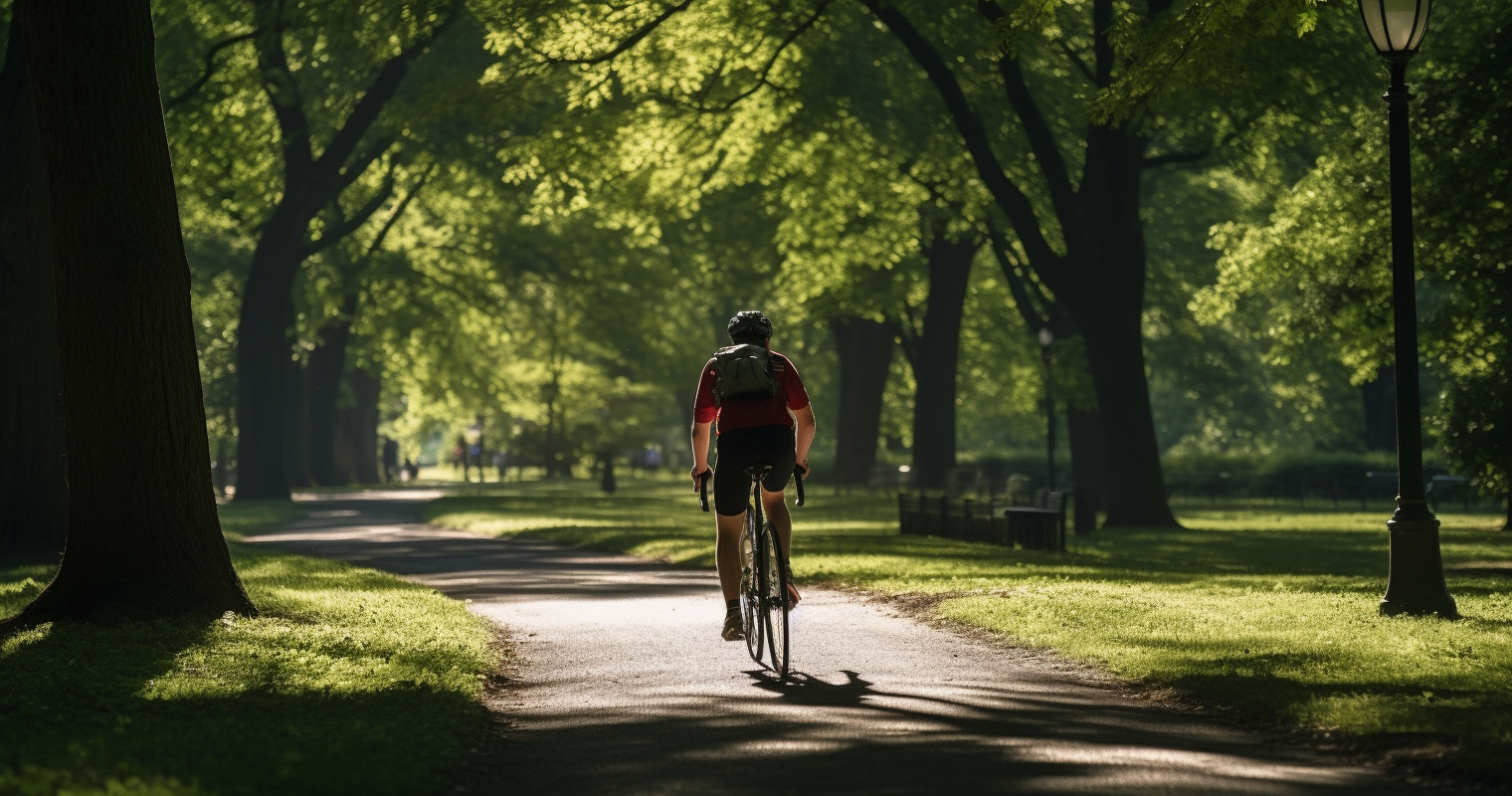
Denmark ranks among the world’s foremost cycling nations, with bike travel woven into the fabric of daily life as a genuine primary transport mode rather than a recreational pursuit. A comprehensive network of dedicated infrastructure, gently rolling terrain, and deeply rooted cultural attitudes toward cycling make it an eminently sensible option for getting to work, running daily errands, and taking children to school — for residents of every age and walk of life.
| Item | Details |
|---|---|
| Bike ownership rate | Over 70% of Danes own a bicycle (as of 2024) |
| Copenhagen commuter share | ~49% of trips to work or school made by bike (as of 2024) |
| Dedicated cycle paths | ~7,000 km nationwide; 11 National Cycle Routes covering 12,000+ km |
| Helmet law | Not mandatory for standard bicycles; strongly recommended |
| Lighting requirement | Front and rear lights legally required from dusk to dawn and in poor visibility |
| Bike VIN/frame code | All frames sold in Denmark must have an embedded VIN (required since 1948) |
| Cycling fines | DKK 500–1,500 for common offences (as of 2024) |
How popular is cycling in Denmark — is it a common way to get around?
Bicycling sits at the very heart of how people move through their lives in Denmark. This is not a romanticised notion — the data tells the same story. More than seven in every ten Danes aged six and over own a bicycle, and in Copenhagen that proportion climbs to nine out of ten. Cycling is genuinely how most people go about their day, far removed from being a weekend hobby.
When the breakdown of cycling trips is examined, 40% involve commuting to work or school, 33% are leisure journeys, 25% cover everyday errands, and 2% are business-related. This distribution confirms that cycling in Denmark operates as a fully-fledged mode of transport — playing a role comparable to that of the car, bus, or metro in other countries — rather than functioning primarily as a fitness or recreational outlet.
In Copenhagen, 49% of all trips to work or school are now made by bicycle, up from 35% just a decade earlier, driven by sustained municipal investment in cycling infrastructure. Denmark’s cycling culture is frequently compared to that of the Netherlands, and the two countries genuinely vie for the title of the world’s most bicycle-friendly nation. If you are arriving from a place where cycling infrastructure is fragmented or where cycling is associated mainly with sport — as in many North American or Southern European cities — the contrast will be immediately striking.
Danes cycle in every kind of weather and at every hour, using their bikes for pleasure, commuting, transporting goods, and family outings alike. Cycling is a deeply embedded part of Danish culture, and those who arrive without knowing how to ride are strongly encouraged to learn promptly. Danish children typically master the bicycle before starting school at age six — and often considerably earlier.
Despite Denmark’s reputation as a cycling nation, there are meaningful geographic differences in cycling rates within the country. People in rural areas cycle to work or school less frequently than their urban counterparts, even where commuting distances are broadly similar. If you are moving to a smaller town or out into the countryside, do not expect cycling culture to match the intensity you would encounter in Copenhagen or Aarhus — though the national infrastructure network does extend well beyond city boundaries.
What is the cycling infrastructure like in Denmark?
Dedicated cycling infrastructure is a defining feature of both Denmark’s cities and its countryside. Segregated bicycle paths and lanes are found throughout much of the country, and the 11 Danish National Cycle Routes together span more than 12,000 kilometres. This places Denmark firmly among the world’s best-equipped cycling nations — with urban infrastructure that rivals, and in many respects exceeds, even Germany’s respected cycling network.
There are an estimated 7,000 kilometres of segregated bicycle paths and lanes across Denmark. The four largest cities alone account for more than 1,350 kilometres of this network — 609 km in Aalborg, 510 km in Odense, 450 km in Aarhus, and 412 km in Copenhagen. These are not merely painted road markings: cycle paths are frequently raised above the carriageway and separated from it by a kerb.
The signature feature of Copenhagen’s cycle network is the kerb-separated cycle track, which creates a clear physical division between motor traffic and cyclists while also keeping cyclists apart from pedestrians on the pavement. The result is a logical, predictable streetscape that every road user can navigate with confidence. At junctions, the continuation of the cycle path is often emphasised by a broad blue strip across the tarmac to increase its visibility, and cyclists at busier intersections may have their own dedicated traffic signals.
Cycle superhighways represent a further evolution of the network: these are priority routes engineered with commuter needs in mind, providing a smooth, uninterrupted ride with fewer stops and enhanced safety. Their primary purpose is to connect residential areas with workplaces and educational institutions, making it more attractive to commute by bike than by car. Many superhighways run close to bus and rail stations, facilitating easy combinations of cycling with public transport.
Much of the funding for cycling projects in Denmark is provided by individual municipalities, but several co-financing mechanisms exist at the national level, including the Bicycle Subsidy Scheme (cykelpuljen), which was first established in 2009. Municipalities apply for project funding and can receive up to 50% co-financing from the state. The Danish Ministry of Transport oversees national cycling strategy, and the Danish Road Directorate (Vejdirektoratet) is responsible for national road and cycle route infrastructure. For current route maps and planned developments, the national cycling route planner at Cyklistforbundet (the Danish Cyclists’ Federation) is the best resource.
The quality of Denmark’s cycle paths is generally high — predominantly asphalt-surfaced and well maintained. In some areas, disused railway lines have been repurposed as cycle paths, adding to the network’s reach. Rural areas are served by signed regional routes, though infrastructure density and quality are naturally greatest in and around major urban centres. Both roads and cycle paths are clearly signed with place names and distances in kilometres.
Cycling is also well integrated into Denmark’s national, regional, and local rail services. Bicycles are permitted on trains to support mixed-mode commuting, most notably on Copenhagen’s S-train suburban rail network, where bikes can be carried in designated carriages at the front and rear of each train. This arrangement makes it straightforward to combine a longer train journey with a cycling leg at either end.
Is cycling safe in Denmark?
Cycling in Denmark is safe, in no small part because most motorists demonstrate a high level of awareness and consideration toward cyclists. The country’s entrenched cycling culture has cultivated a mutual respect between road users that results in markedly safer road-sharing than in many other countries. This driver attitude is noticeably different from places where cyclists are regarded as an inconvenience or a fringe presence on the road.
Nine in ten cyclists in Copenhagen report feeling safe when cycling in traffic — a remarkably high proportion that reflects both the quality of the infrastructure and the prevailing social norms around sharing the road. People of all ages cycle in Copenhagen not only because it is objectively safe, but because it feels safe. This subjective dimension is particularly important for new arrivals who may feel uncertain about cycling in an unfamiliar urban setting.
Figures reported as of January 2024 indicate a declining trend in cyclist fatalities, with an average of around 20 cyclists killed per year — a notably low rate by international standards. Denmark places a strong emphasis on prevention through educational campaigns and continuous improvements to infrastructure, seeking to address risks before accidents occur. For the most current safety statistics, consult SikkerTrafik.dk — Denmark’s road safety authority — and the Danish Road Directorate, which publishes annual road safety data.
The most significant hazard to be aware of is urban intersections, where the majority of serious cycling accidents occur. In 2024, the Danish Accident Investigation Board published a thematic report specifically examining bicycle accidents at city crossroads. When riding in urban areas, exercise particular caution at junctions, especially when large vehicles are making turns.
On the subject of helmets: there is no legal requirement to wear one. This often surprises people arriving from countries such as Australia or New Zealand, where adult helmet use is compulsory by law. Observational research tracking helmet use since 2004 shows that between 2004 and 2022, helmet use among all cyclists increased from 6% to 50%, and among school children from 33% to 79%. This growth is attributed to non-legislative means, including road safety education and behaviour change initiatives. Although a helmet is not compulsory, it is strongly recommended — particularly for children, faster commuters, and anyone riding off-road.
What are the rules of the road for cyclists in Denmark?
Denmark operates a clearly defined set of traffic rules for cyclists, and these are actively enforced — failing to comply can result in fines of between 500 and 1,500 kroner. The rules are set out in the Danish Road Traffic Act (Færdselsloven). For the full and current legal requirements, refer to the official guidance at SikkerTrafik.dk or Vejdirektoratet.dk.
The key rules for cyclists in Denmark are:
- Cycle paths: Where a cycle path is present, you are required to use it. Where none exists, you must ride on the carriageway. Cycling on the pavement is not permitted.
- Lighting: Danish law requires cyclists to ride with both front and rear lights from dusk to dawn, and also during the day in conditions of reduced visibility such as fog or heavy snowfall. The front light must be white or yellow, and the rear light must be red. Both must be visible from at least 300 metres. Riding without lights is a finable offence.
- Helmet: A cycle helmet is not legally required, but is recommended as it provides meaningful protection in the event of a collision.
- Hand signals: Signalling with your hand when turning is mandatory. Cyclists must also signal their intention to stop by raising the left arm with the hand held flat.
- Turning left: At intersections, cyclists wishing to turn left must not use the left-turn lanes designated for motor vehicles. Instead, they must cross the junction first and then turn. Where separate bike lanes are provided, cyclists must use these.
- Mobile phones: Holding a mobile phone while cycling is prohibited. Hands-free calls are permitted.
- Passengers: Carrying a passenger on a bicycle is not permitted. Adult cyclists may carry a maximum of two children under the age of eight in child seats. Two children of any age may be transported in a bicycle trailer.
- Alcohol: There is no fixed blood alcohol limit for cyclists, but you must not cycle if you are intoxicated to the point that it is dangerous to do so. A fine may be issued in such cases.
- Brakes and bells: Every bicycle must be fitted with properly functioning brakes and a working bell. Cyclists can receive a warning if their bell is found to be non-functional.
As of 28 March 2014, cyclists in Denmark can be fined for riding without lights, holding a mobile phone, having defective brakes or reflectors, running a red light, cycling against the flow of traffic, cycling across a pedestrian crossing, failing to signal, cycling with no hands on the handlebars, or riding on the pavement. The rules apply uniformly across the country, though local municipalities may impose additional restrictions in pedestrian zones — always pay attention to local signage.
For e-bikes, Denmark has a well-established regulatory framework. Standard pedelecs — defined as bicycles with a motor output not exceeding 250 watts and a maximum assisted speed of 25 km/h — are legally classified as bicycles and require no registration, insurance, or driving licence. Speed pedelecs, which are more powerful, are subject to stricter requirements including a mandatory helmet and minimum age rules.
Do I need to register my bike or have insurance to cycle in Denmark?
Denmark operates a distinctive and long-standing bicycle frame identification system. The Danish cycle VIN system was introduced in 1942, assigning every bicycle a unique code — a combination of letters and digits physically embedded in the frame, made up of a manufacturer code, serial number, and year of construction. Since 1948, it has been illegal to sell cycle frames in Denmark without this embedded VIN, and as a result, Danish insurance companies will not pay out on claims for stolen bicycles that lack a VIN. This stands in contrast to most other countries, where frame registration is voluntary rather than a legal requirement.
If you bring a bicycle from abroad that does not carry a Danish VIN, you may still ride it legally in Denmark — but be aware that it may not be covered by insurance in the event of theft. When purchasing a second-hand bicycle in Denmark, always verify that the VIN is present and matches any accompanying documentation. Bikes can be registered through the Danish police’s online cycle register, which aids recovery if the bike is stolen.
Standard bicycles require neither insurance nor a driving licence. However, taking out home or contents insurance that covers your bike against theft is widely recommended and common practice. The law also requires that your bike be locked when left unattended, and insurance providers generally stipulate that the lock used must be “Varefakta” approved. Your local bike shop can advise on approved models.
Bicycle theft is a genuine concern in Danish cities. Denmark may be a safe country overall, but that does not make your bike immune to theft. The more valuable the bicycle, the more attractive a target it becomes. For expensive or electric bikes, dedicated bicycle insurance policies are available from Danish insurers — current premiums vary considerably depending on the value of the bike, so contact insurers directly for up-to-date quotes.
Speed pedelecs are subject to different rules: liability insurance is compulsory, and you must carry the insurance certificate with you when riding. Consult the Danish Transport Authority (Trafikstyrelsen) for current requirements governing e-bike categories and insurance obligations.
Are there public bike-sharing or rental schemes in Denmark?
Renting a bicycle for city exploration or countryside touring is a well-established practice in Denmark, and most cities offer some form of bike-sharing arrangement. The specific schemes, pricing structures, and availability differ considerably from city to city, so always check the operator’s official website or the relevant local authority’s transport pages for up-to-date information.
Copenhagen’s original municipal bike-sharing system, Bycyklen, ceased operations at the end of 2022. The city’s bike-hire landscape has since evolved, with several private and dock-free operators now active in the capital. Services such as Donkey Republic offer dock-free bicycle hire across multiple Danish cities including Copenhagen, Aarhus, and Odense, with short-term rentals booked through a smartphone app. Check donkey.bike for current pricing and availability, as rates change regularly.
Both Aarhus and Odense operate municipal or subsidised bike-sharing schemes — check with the respective city municipality or local transport authority for current details and pricing. Many schemes function on a per-minute or per-hour charge basis through smartphone apps, and some require a refundable deposit. Since pricing structures are subject to change, always verify the current rates directly with the operator.
Bicycle rental shops are widespread, with a wide variety of bike types available for hire. Tourism-focused rental services are particularly well established in Copenhagen, and cycling tourism is a growing market. The Greater Copenhagen region is estimated to attract around 130,000 bicycle tourists annually, representing 7 to 8 percent of all visitors. For newcomers who need a bike quickly before arranging a purchase, rental shops offer a convenient interim solution.
Where can I buy or service a bike in Denmark?
Bicycle shops and repair services are plentiful throughout Denmark, though for specialist bike types or less common components you may need to seek out a dedicated retailer in a larger town. In cities such as Copenhagen, Aarhus, Odense, and Aalborg, there is a rich network of specialist bicycle retailers offering sales, servicing, custom fitting, and accessories. In smaller towns and rural locations, the local bike shop may be a more general retailer, but basic repairs and standard parts are almost always obtainable.
Denmark has a vibrant second-hand bicycle market, which is often the first port of call for new arrivals looking to get mobile quickly. Online platforms such as DBA.dk — Denmark’s main classifieds website, broadly comparable to Gumtree or Craigslist — list thousands of used bicycles across all price ranges. The classic Dutch-style utility bicycle, requiring minimal maintenance and well suited to carrying loads, is particularly popular in Denmark and easy to find on the second-hand market.
Two- and three-wheeled cargo bikes have also been gaining significant popularity, a trend that originated in Copenhagen and has spread to other parts of the country. It is estimated that around a quarter of Copenhagen families with two or more children own a cargo bike for transporting children, groceries, and other items. If you are relocating with a family, the cargo bike market is well developed, with a healthy range of both new and second-hand options available.
Consumer protection in Denmark follows EU standards, meaning new bicycles purchased from a registered retailer carry a standard two-year warranty against manufacturing defects — comparable to consumer protections across most EU countries. Retain your purchase receipt and any VIN documentation, as these are required for warranty claims and insurance purposes.
Can I bring my bike when I move to Denmark, and are there any import rules?
If you are relocating to Denmark from another EU member state, no customs duties or import taxes apply to your bicycle. The EU’s principle of free movement of goods means that personal belongings — including bicycles — can be brought into Denmark from other EU countries without restriction or duty.
If you are moving from outside the EU — for example, from the United States, the United Kingdom following Brexit, Canada, or Australia — your bicycle may qualify for a personal effects relief, sometimes referred to as a removal goods exemption. Under this arrangement, personal possessions that were owned and in use before your move may be imported duty-free, provided you satisfy the relevant residency and ownership criteria. You will typically be required to demonstrate that you are making a permanent move and that the items are intended for personal use rather than commercial sale.
The conditions and requirements for this exemption are set by the Danish Customs and Tax Administration (SKAT). Before shipping your bike, review SKAT’s current guidance on removal goods relief, as documentation requirements and thresholds can change. As of 2024, Denmark applies the standard EU customs tariff to bicycles imported from outside the EU that do not qualify for the personal effects exemption — check the official SKAT website for current duty rates, as these are subject to revision.
One important practical point for imported bikes: if your bicycle does not have a Danish VIN embedded in the frame, you may still ride it legally in Denmark, but as noted above, Danish insurers may not provide the same theft cover as they would for a VIN-bearing bicycle. There is no legal obligation to retrofit a Danish VIN to an imported bicycle, but it is worth discussing your cover options with a Danish insurer before depending on a bike brought from abroad for everyday use.
What are the best cycling routes or destinations in Denmark?
The 11 Danish National Cycle Routes form an interconnected network threading through the entire country. These routes serve as important arteries for cycling tourism, showcasing Denmark’s natural landscapes alongside its regional towns and villages. The national cycle route network spans 4,770 kilometres across the country, and the routes are well signposted and accessible to cyclists of all fitness levels — making them an ideal way for new residents to begin exploring Denmark by bike.
Among the most celebrated and well-travelled routes are:
- National Route 1 — The West Coast Route (Vestkystruten): Hugging Denmark’s dramatic North Sea coastline from Skagen in the far north all the way to the German border in the south, this is one of the most visually spectacular long-distance routes in the country. It also forms part of the EuroVelo 12 North Sea Cycle Route.
- National Route 5 — The East Coast Route (Østkystruten): Following the more sheltered eastern coast of Jutland, this route winds through historic market towns, stretches of woodland, and scenic fjords.
- The Island of Bornholm: Bornholm is widely regarded as one of Denmark’s finest cycling destinations, with a dense network of signed paths connecting beaches, forests, and the island’s distinctive round churches. It is particularly well suited to families with children.
- Copenhagen’s urban cycling network: For leisure riding and exploration within the city, Copenhagen’s own cycle infrastructure — including the Harbour Ring, the elevated Bicycle Snake (Cykelslangen), and green routes through the city’s parks — offers an unmatched urban cycling experience that doubles as a sightseeing activity.
- The Marguerite Route (Margueriteruten): A scenic 3,600-kilometre road route spanning the whole country, marked by a daisy symbol, linking many of Denmark’s most attractive landscapes and cultural destinations. While not exclusively a cycling route, much of it is readily suited to cyclists.
For comprehensive route planning, maps, and cycling tourism resources, the Danish Cyclists’ Federation (Cyklistforbundet) and VisitDenmark are the best official starting points. Both publish regularly updated route information, downloadable maps, and guidance on accommodation options along cycling routes.
How do I get set up with a bike after arriving in Denmark?
- Decide whether to buy new, buy second-hand, or hire initially. A second-hand utility bike from DBA.dk or a local shop is often the quickest and most affordable way to get moving. Hiring through a service like Donkey Republic can serve as a practical stopgap while you settle in.
- Check the bike’s VIN. If buying second-hand, confirm that the frame carries an embedded VIN code. Cross-check it against the Danish police’s online cycle register to ensure the bike has not been reported as stolen.
- Equip your bike legally. Ensure you have functioning front and rear lights (white or yellow at the front, red at the rear), reflectors, working brakes, and a bell — all of which are legal requirements. As lights are frequently stolen in cities, consider removable clip-on models.
- Buy an approved lock. Purchase a “Varefakta”-approved lock from a bike shop. Your home or contents insurer will almost certainly require this as a condition of any bicycle theft cover.
- Check your insurance cover. Review your home contents policy to establish whether it covers bicycle theft when the bike is stored outdoors. If not, look into a dedicated bicycle insurance policy, especially for higher-value bikes.
- Familiarise yourself with local cycling rules. Before heading into city traffic, get to grips with the key rules — particularly around lighting requirements, hand signals, and how to handle left turns at intersections. The SikkerTrafik.dk website provides guidance in multiple languages.
- Explore your local cycle network. Use the route maps at Cyklistforbundet.dk to identify the safest and most direct routes for your daily commute or regular journeys.
Frequently asked questions about cycling in Denmark
Do I need to wear a helmet when cycling in Denmark?
There is no legal requirement to wear a helmet when cycling in Denmark. That said, wearing one is well worth considering. Helmet use has risen considerably in recent years — from just 6% of all cyclists in 2004 to 50% by 2022, and among school children from 33% to 79% over the same period. If you are arriving from a country where helmet use is legally required for adults — such as Australia or New Zealand — the absence of legislation here may feel surprising, but wearing a helmet is widely accepted and increasingly the norm.
Can I take my bike on trains and buses in Denmark?
Yes. Bicycles are integrated into Denmark’s national, regional, and local rail services to support mixed-mode commuting. The arrangement is most developed on Copenhagen’s S-train network, where bikes can be carried in designated carriages at the front and rear of each train. Certain bus routes in Region Zealand also accommodate bicycles, though conditions apply. Check with DSB (trains) or Movia (buses) for current rules and any associated charges.
Is cycling in Danish cities difficult for beginners or people returning to cycling after a long break?
Not at all. The infrastructure has been designed with ordinary everyday users in mind, not just seasoned cyclists, and the country’s flat terrain makes cycling physically accessible to most people. Urban cycling quickly becomes second nature in Copenhagen. Allow yourself a few days to get comfortable with local hand signals and the rules around left turns at junctions, and you will likely find the experience far less daunting than cycling in cities with less developed infrastructure.
What happens if my bike is stolen in Denmark?
Bicycle theft is a common problem in Danish cities, particularly in Copenhagen. Danish insurance companies will not pay out on theft claims for bicycles that lack an embedded VIN. Always secure your bike with an approved lock, register it with the online police cycle register, and make sure your insurance policy covers theft when the bike is left outside. Keep a photograph of the VIN and frame as proof of ownership.
Are e-bikes widely used in Denmark, and do I need special insurance?
Roughly every eighth family in Denmark owns an electric bicycle, reflecting the strong and growing popularity of e-bikes. The regulatory framework is well established. Standard pedelecs — with a motor output of no more than 250 watts and a maximum assisted speed of 25 km/h — are classified as ordinary bicycles and require no registration, insurance, or driving licence. Higher-powered speed pedelecs are subject to stricter rules, including a mandatory helmet, liability insurance, and minimum age requirements — check Trafikstyrelsen.dk for the current regulations.
Is cycling practical year-round in Denmark, or is winter too harsh?
Cycling is a year-round activity in Denmark. On sunny days, in driving rain, through hail, and even in snow, you will encounter cyclists heading to work, the shops, or social occasions. The greater challenges come from wind and rain rather than extreme cold — Denmark rarely experiences heavy snowfall, and cycle paths are generally gritted and kept clear in winter. Good waterproof clothing, mudguards, and bright lights will go a long way toward making year-round cycling comfortable. April to October offers the most pleasant conditions for longer cycle touring, but everyday commuter cycling continues throughout the year.
Do cycling rules differ between Copenhagen and other Danish cities?
The traffic rules established under the Danish Road Traffic Act (Færdselsloven) apply uniformly across the whole country. Individual municipalities may, however, designate specific zones, shared-use paths, or local restrictions through signage. Always observe posted signs wherever you are cycling. For local cycling guidance in your area, consult your municipal council’s transport or mobility pages.
Where can I find official cycling maps and route information for Denmark?
The Danish Cyclists’ Federation (Cyklistforbundet) is the principal national body for cyclists, publishing route maps, safety guidance, and advocacy information. VisitDenmark offers extensive cycling tourism resources, including information on the national cycle route network. For urban route planning within Copenhagen, both the city’s official cycling portal and Google Maps include dedicated cycling directions that integrate with the local network.