
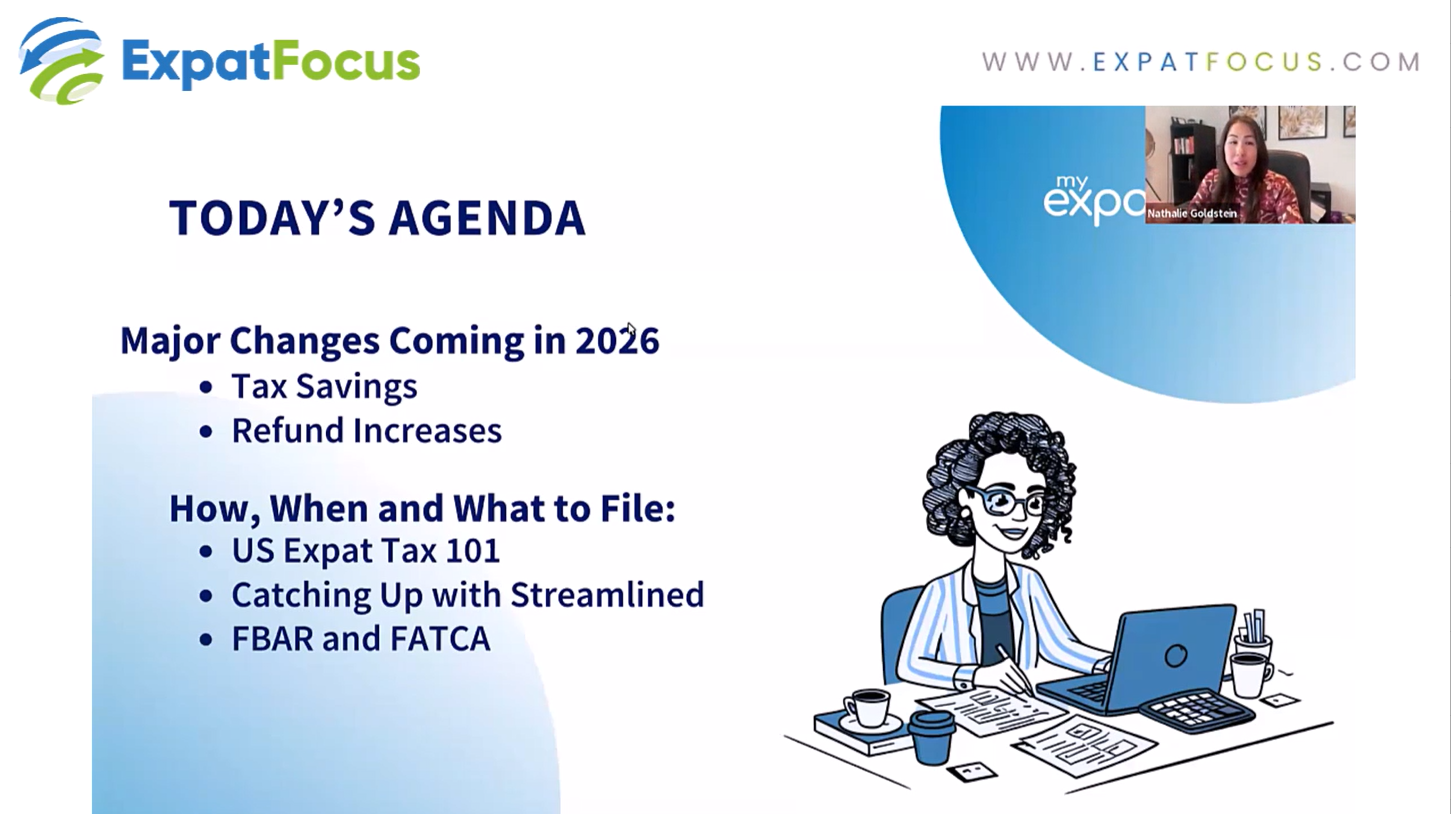
At the 2026 US Expats Financial Conference, Nathalie Goldstein, CEO of MyExpatTaxes, discusses US tax filing requirements for Americans living and working abroad in 2026. MyExpatTaxes is the leading tax software for US expats, guiding users step-by-step through the filing process to simplify IRS compliance and maximise refunds and benefits.
The following transcript was generated by AI and may contain inaccuracies.
Nathalie: So, 101 — the basics. If you haven’t filed before, what do you do if you haven’t filed? And of course, what about FBAR and FATCA requirements? I just want to preface this as we jump into the webinar. You’ll learn a lot of things. Some things might make you a little nervous. Just remember, if you’re not caught up on filing, or maybe you learn something new — you should have filed a certain form or something like that — please don’t stress out.
The IRS does have certain procedures that if you’re not caught up, you can go through that procedure to get caught up and become compliant. Definitely don’t feel nervous after this. Just feel informed and know there are steps you can take in case you learn something new. I like to start with that so people don’t get nervous as I talk about things.
In general, what are the filing deadlines for this year? Filing deadlines are normally on the 15th. This year is no different. Normally, if the 15th falls on a weekend or a holiday, it could shift a little bit, but this year that’s not the case.
The first deadline, as we all know, is April 15th. That deadline is for those either living in the US who have to file and pay their taxes, or for anybody that has to pay taxes. That’s the key word — if you think you still owe US taxes, then you should file and pay by April 15th.
If you are not sure whether you owe US taxes, I highly recommend you at least start your tax return to see if you might owe. You can already start on MyExpatTaxes.com. You can enter all your information and you would actually see, before you even pay or anything, an estimated refund or owed amount.
If you’re thinking, “I don’t know if I might owe or not” — generally the people that owe are people that still have US-sourced income, like US investment income, US interest that maybe you’re not taxing where you live locally. If you are self-employed in a country without a Totalization Treaty, that can also be a situation where you owe. Or if you’re a high earner, earning over about $125,000–$150,000 USD and you have interest income or other types of investment income, that could be a situation where you might owe as well.
It does happen, but generally most expats that file a US tax return don’t actually owe taxes. They just have to file their taxes, and we’ll get into that.
Now, if you know you don’t owe any US taxes, then you could actually wait an additional two months. If you’re an expat living abroad, you don’t have to file your tax return by April 15th — you can file it by June 15th. Just keep in mind that when you are filing your tax return, you should definitely use a service that’s catered to expats, because even though you don’t have to file any specific extension to file by June 15th, you do have to include a certain statement in your tax return.
That statement is not automatically included if you’re using any US-based tax software. If you use an expat-based tax software or an expat-based firm, they know to include that statement to say that you have the extra two months to file.
If you’re saying, “Well, I don’t even have my local tax return done yet, there’s no way I can file by June 15th,” that’s fine. What you do need to make sure you do is file for an extension. You can file an extension to October 15th, but you have to file for that extension by the due date of your return. So if you don’t need to file a return until June 15th, make sure you file that extension, which you can do with MyExpatTaxes for free.
You could also print out the form and mail it in, but I wouldn’t recommend that because it probably won’t even arrive at the IRS until after October 15th. You just have to file this extension and you’ll immediately know — if it’s filed electronically — whether it’s accepted or rejected. If it’s accepted, you have until October 15th.
And if you need more time, there is more time. The expat tax season is the entire year from April to December. If you needed more time — you’re abroad, for example you have a foreign corporation and you just don’t have all of that paperwork ready yet — you could actually request by October 15th an extension to December 15th.
But this extension is really annoying because you actually have to snail mail a letter. You have to say, “My name is X and I can’t file my tax return because of X, Y, Z. Please give me an extension until December 15th.” And then they don’t reply to you. They only reply if you don’t get the extension, but they don’t reply if you do get the extension.
If you can file before December 15th, we would highly recommend it. But those are the different filing deadlines. If you think, “Oh my gosh, I’m not going to make it by April 15th,” don’t worry — the season continues the whole entire year. But you do have to make sure you are organised and prepared so that you have your extensions ready.
If you’re with MyExpatTaxes, even if you’re not using us but you’re just on our newsletter, we’ll obviously send out reminders and help you file extensions as needed. And of course, if you owe back taxes, if you haven’t been filing, you should probably file sooner rather than later because in the event you do owe taxes, interest and penalties do accrue daily.
So, who actually needs to file a US tax return, and why do you have to file one? You don’t even live in the US. As the law states, if you are a US citizen or if you are a US green card holder, you have to file a US tax return if your worldwide income passes the filing thresholds.
Just keep in mind, for a US green card holder it can be a little bit tricky. Even if you left the US and you said, “Okay, I had a green card, it expired, I just left, I don’t care” — it’s not that easy. If you have a US green card, even if you just let it lapse or expire, if you did not formally abandon it with Form I-407, you could still be on the hook to file US taxes.
Because when you actually exit the US tax system — either as a US citizen giving up citizenship, or giving up your green card — you have to go through a formal process and then potentially file Form 8854 to exit the tax system. So just keep that in mind.
Now, if you’re a US citizen or a US green card holder, what is your worldwide income? Worldwide income is as it sounds — it’s income from all sources. It’s not just US income. It could be US rental income. It could be your pension in Germany. It could be your rental income from a property in the UK. Maybe you have a bank account in Spain — that interest income. All different types of income. If you get Social Security benefits or some type of pension benefits from any country, US or foreign, that’s counted.
All of your income together, before taxes, before deductions — if that is over the filing threshold for your filing status, then you have to file a US tax return.
Now, the filing thresholds are normally the same as the standard deduction, except for two cases. The first case is married filing separately. If you are married to a non-US citizen, you have to file as married — or head of household. But your spouse probably doesn’t want to be on your US tax return, because why would they want to share all of their financial information with the US government? Probably a hard sell.
That means you’ll probably file as married filing separately. Again, you could potentially file as head of household if you qualify, but most people that don’t have a qualifying child dependent and aren’t keeping up more than half the cost of the home — if you are married to a non-US citizen, you will generally be filing as married filing separately. And that filing threshold is as little as $5. Your bank interest could trigger the filing threshold. That has been the legal requirement since tax year 2018. They haven’t changed it. The US just really doesn’t like it when people are married and then don’t file together. That’s just the way it is.
The other one that is a little bit less obvious is if you’re self-employed. Even if self-employment is not your main role — if you have a side job, you’re freelancing, anything — if you have over $400 of self-employment net profit, you have to file a US tax return.
The reason for that is because over $400, the US might assess self-employment tax on your net profit, and that’s a Social Security tax. So those are the two exceptions to the filing threshold being the same as the standard deduction. They don’t generally change. Even if the standard deduction increases every year due to inflation, these filing thresholds for married filing separately and those that are self-employed generally remain the same.
No matter where you live, if you are a US citizen or US green card holder and your worldwide income surpasses those thresholds, you have to file a US tax return.
That was the bad news. The good news is, with inflation, we do see increases that benefit us. The standard deduction increases, which means the filing thresholds also increase. Even though most expats don’t end up paying US taxes, you do see the tax generally being a little lower each year because the tax brackets continue to increase, meaning you have more money taxed at a lower rate.
If you’re using the Foreign Earned Income Exclusion, which a lot of expats are, that does increase every year. Now it’s $130,000 US dollars, which you could exclude from US taxation as long as it’s earned income and it’s foreign-sourced.
If you have children under the age of 17 that have US Social Security numbers and you live in a high income tax country, then you probably are benefiting from the refundable child tax credit. As it sounds, you would get up to $1,700 per child as a refund from the US government. Even if you don’t pay any US tax or you haven’t given them a dime in the past few years, if you are eligible for this credit and you have children under the age of 17 with US Social Security numbers, the US really will pay you up to $1,700 per child every single year.
That sometimes increases. This year it didn’t necessarily increase, but it has increased from past years — it used to be $1,400. They keep increasing it slowly, but still increasing.
A couple of other things to remember. If you’re contributing to your US Individual Retirement Account, which you can do as an expat — and I hope you’re learning new things about what you can do. It’s really frustrating to have to file this US tax return even though you don’t live in the US, but there are also benefits that come with it. You might get a refund from the refundable child tax credit. Maybe you’re contributing to your US Individual Retirement Account, meaning you’ll have different pension and retirement systems set up for when you retire.
If you’re contributing to that, you can contribute up to $7,000 for this year. If you’re over 50, that is $8,000. If you do have an Individual Retirement Account and you’re on the other end of the spectrum where you’re pulling from that, just remember to take out your Required Minimum Distribution, because there is a tax — it’s lower than it used to be — but there is a 10% to 25% tax if you’re not taking out your Required Minimum Distribution.
If that’s you, make sure you do it in a timely manner.
As we discussed, obviously the IRS has this free file programme that they have been promoting. It’s kind of forgotten about us — unfortunately for this year, it’s still not available for Americans living abroad.
When I first moved abroad in 2015, nobody cared about us expats. That’s why I decided to create MyExpatTaxes, because if you lived abroad, all you could do was pay $500, $1,000, $2,000 to a US tax firm. That was your only option. Or you print out a piece of paper and try to figure it out yourself. Fortunately there are more online options such as MyExpatTaxes, and maybe eventually the IRS will remember us with the free file programme. But not yet for this year.
Something else that’s different — a very controversial title, but Trump Accounts. Not his social media accounts, but the actual investment accounts for children. There are new accounts that you could open. It’s a traditional IRA for children, but they don’t have to have earned income. You could actually open up investment accounts for your children that would benefit them later, under the age of 18, as long as they’re US citizens. That is something that’s new.
You could do that on MyExpatTaxes as well. But definitely, if you’re looking at setting up investment accounts for children or retirement planning, there are IRA options in the US for you and your children.
Let’s jump into what is double taxation, because I think that’s the biggest frustration. “Am I being double taxed? I live in the UK, I have to file a UK tax return, I pay UK taxes. Now I have to file a US tax return. I am being double taxed, and that’s not fair.”
That’s not necessarily the case. Double taxation means you’re paying tax on the same income twice. But there’s a lot of things in place to ensure that you are not double taxed. Even the US recognises that that is not fair. We have tax treaties, we have Totalization Treaties, saying certain items like your Social Security benefits can only be taxed in this country or the other country.
If there’s a Totalization Agreement, that would say if you’re self-employed in the UK, you pay self-employment taxes there, and then you don’t pay self-employment taxes in the US. And then on top of that, there are different expat tax benefits such as the Foreign Earned Income Exclusion and the Foreign Tax Credit, which says you can either exclude your income from US taxation — if it’s eligible, if it’s earned income and it’s earned abroad — or if you’re paying income taxes in the UK, in China, in Japan, you can actually use those income taxes as a credit directly on your US tax return.
Just keep in mind that if you’re living in a country with a lower income tax rate — say Singapore — and you pay Singapore the equivalent of $5,000 US tax, and the US would normally charge you $10,000 on that income amount, you would probably still owe the excess $5,000 to the US. You’d pay $5,000 to Singapore first, and then the US would say, “Well, you don’t pay enough foreign taxes based on the tax rate we have in the US.”
That difference you would have to pay to the US. That is not double taxation because you technically just didn’t pay as much as you would have living in the US. But I can understand the frustration. There’s a lot of things in place to try to prevent double taxation. It does happen, though.
There are situations where it can happen. If you don’t have a Totalization Treaty, you can end up paying self-employment tax and Social Security taxes in two different countries. If you don’t have a tax treaty with your country and then you work in the US, this gets a little bit tricky because the income you earned while working in the US is no longer eligible for Foreign Tax Credits.
If you’re a higher earner and you have investment income, there’s something in the US called Net Investment Income Tax, and that doesn’t allow Foreign Tax Credits to be used. There’s already a lot of fights over this Net Investment Income Tax because it is double taxation and it is seen as being unfair.
The IRS is still fighting this, because the court decisions have said you have to allow Foreign Tax Credits, but the IRS is still dragging their feet. So again, it’s rare, but it can happen that you are double taxed. But the majority of expats that file a US tax return do not pay income taxes. You do have to file a tax return, though — I’m sorry, that part still holds true.
As we mentioned, how do you prevent double taxation? There are tax treaties. Just keep in mind, if you’re using a tax treaty, they’re a little tricky because it’s written in legal language, so it’s already a little hard to understand. On top of that, every tax treaty has what’s called a savings clause.
The savings clause says that if you are a US citizen — some of them are even stricter, saying if you are a US citizen in the last 10 years, or you’re a US green card holder in the last 10 years — then you effectively cannot use 99% of this tax treaty. Tax treaties are very long, but as US citizens, as people that were part of the US tax system, it’s pretty much useless except for a few paragraphs. Normally those paragraphs are about Social Security benefits, which are exempt from the savings clause.
If you do claim tax treaty benefits, what you normally would do is file Form 8833, and you do have to file this form because if you don’t, there can potentially be a penalty for not filing it. You would report the income and then subtract it out as other income.
That is one way to prevent double taxation if you’re using a tax treaty. Otherwise, there are other tax benefits such as the Foreign Earned Income Exclusion, which is on Form 2555, or using Foreign Tax Credits.
This is the overall table — I believe this recording will be sent out, so you don’t have to take a screenshot. These are the three main tax benefits. The first one is the Foreign Earned Income Exclusion, Form 2555. It’s generally quite easy to use. The main caveat is it has to be foreign earned income.
You can’t use this on pension income because that’s not earned income. Earned income is salaried income, self-employment income, active partnership income — and it must be foreign, which means you must work abroad to earn this income. It doesn’t matter if you’re paid from a US employer. If you are working the entire time abroad, it can be excluded with the Foreign Earned Income Exclusion.
If you have a German employer and then you go to the US on a two-week business trip, the income earned on that two-week business trip is no longer foreign — that’s US-sourced. The daily income earned on that US business trip is no longer excludable, even though you have a foreign employer. It’s not about the employer, it’s not about the currency, it’s not about your bank account that gets the money. It’s about where you were physically on the day you earned this income.
That’s the Foreign Earned Income Exclusion. Keep in mind there are some cons. If you use the Foreign Earned Income Exclusion, which is generally the easiest expat tax benefit, you cannot claim the refundable child tax credit. Even if you’re eligible, you’re disqualified — you cannot get that refund.
If you’re trying to contribute to your Individual Retirement Account, it’s pretty hard because you don’t have any taxable compensation, since the exclusion eliminates your taxable compensation — unless of course you earn more than $130,000. And once you start this, you have to continue it, because if you start the Foreign Earned Income Exclusion and then stop it and switch to the Foreign Tax Credit, you can’t use the Foreign Earned Income Exclusion again for five years.
What we actually try at MyExpatTaxes is we’ll look at which approach is the best for you. But if we can get you to use the Foreign Tax Credit, we would prefer that because it’s a lot more flexible. You have carryovers that you can have for 10 years. If you don’t use up all the foreign taxes you paid on your current US tax return, you can carry it over for 10 years, which is very useful — especially if one year you pay less income taxes in your local country for any reason.
You can claim the additional child tax credit. You also have taxable compensation that helps you contribute to your IRA. Definitely, the Foreign Tax Credit is more recommended if it works for you. If you’re in a high income tax country, great. If you’re in a low income tax country, this is not going to work for you.
It’s just a little bit more difficult because there’s a lot of maths involved. There’s a lot of different versions of Form 1116 — general, passive, and resourced by treaty. I’m not going to get into it, but this is why you have to use a very specialised expat tax service, because there are so many little details to know. I think the average person has no reason to know whether their income should be in the general bucket or the resourced-by-treaty bucket.
I’ll quickly dive into self-employment, just because we do have a lot of self-employed expats. I think that’s the nature of being an expat — it’s not necessarily the easiest thing to get an employee job right away. We have a lot of people that go, “Hey, well, if you won’t hire me, I’m going to do it myself.” And I applaud all of you — I’m one of those as well.
If you are a digital nomad, just keep in mind that if you’re hopping around and you are not employed but self-employed, you’re probably going to pay self-employment tax, because you are probably not registered in any other country and paying Social Security taxes there.
Even if you’re using the Foreign Earned Income Exclusion and you pay zero income tax, you are still probably going to be on the hook for 15.3% of Social Security self-employment tax on your self-employment net profit. Something to plan for. It obviously helps you later because that contributes to your Social Security benefits account, which means you can pull Social Security benefits later on when you retire — assuming those funds exist at that point in time. Just a joke. They should.
Now, if you are self-employed as a freelancer, you live in a country and you’re registered as a self-employed person there, it gets a little bit easier. You can claim the Foreign Earned Income Exclusion. Maybe you claim the Foreign Tax Credit because you do pay income taxes there.
And if there’s a Totalization Treaty with that country — and there’s a Totalization Treaty with a lot of countries, mostly in the EU, in Asia it would be with Japan and Korea, in South America there are also a few — you can claim this Totalization Treaty and then you pay no self-employment tax. You pay no income tax probably because of the FEIE or FTC. You just file a tax return, but then you don’t really owe anything.
If you are a business owner and you have a foreign corporation with limited liability, you are probably filing a more complex tax return. You probably have Form 5471 in there, which is one of those high-penalty forms if you don’t file them — very high penalty — and something not to mess with. You would file that form. You could possibly be subject to GILTI taxation, but then there would be no self-employment tax because you’re not self-employed — you have a company and you’re normally an employee of that company.
In terms of GILTI taxation, that’s only for foreign companies that are more than 50% owned by US citizens, and there’s a lot of nuance around it. You can use the GILTI high-tax exclusion, Section 962 — I’ll get into it on the next slide. But no matter what type of self-employed person you are, there are different forms to file, and it’s normally fine to get to a good tax result in the end.
Again, at MyExpatTaxes we can handle these situations. Whether you are just an employee, or you’re self-employed, or you have a company, or you have really complex things — we’ve seen a lot of different situations and we’re always here to learn and optimise everyone’s tax returns.
I covered it already — self-employment tax. That’s 15.3% of your net profit. If you have a Totalization Treaty, you won’t be subject to it. You could pay it if you wanted to, in case you want to contribute to your US Social Security benefits, but you could also opt out of it. Most people will opt out because they don’t really want to pay it.
But if you pay it, you could get self-employment credits — maximum of four credits per year. If you have 40 credits, then you could potentially get Social Security benefits when you retire. Even if you have a Totalization Treaty but you just wanted to contribute to the US Social Security system, you can file as a self-employed person, opt to not use the Totalization Treaty, pay that self-employment tax every year until you have 40 credits, and then you would be eligible for US Social Security benefits.
Let’s jump to the refundable child tax credit. If you have children under the age of 17 — and even if you have other dependents — there is a credit for it. The first credit can lower your tax bill. It’s non-refundable and it’s larger at $2,200. If you don’t use up that entire non-refundable portion, the second part of it is refundable. It’s not actually an additional credit — it’s just the refundable portion of the child tax credit. As I mentioned, it’s $1,700.
You do have some requirements to be eligible. You have to have more than $2,500 of earned income. Earned income is any type of worldwide wages — it can be foreign wages, US wages. Self-employment is a lot trickier because if you are self-employed but you use a Totalization Treaty to not pay self-employment tax, it doesn’t count anymore. Unfortunately the rules were written that way. It’s not fair, but it’s the way the rules are written. Something to watch out for.
If you do have enough earned income — assuming your adjusted gross income is not higher than the phase-out threshold at the bottom, which is $400,000 for married filing jointly, or $200,000 for other statuses — then you can get up to 15% of your earned income minus $2,500, up to $1,700 per child, as a refund. Even if you pay no US tax, you could get that as a refund every single year.
Coming to my last slide — so Hugo will be happy — FBAR and FATCA. What does that all mean? Obviously, aside from your US tax return, you also have to report information about your financial assets abroad because the US likes to know as much information as they can about everyone.
That just means that when you’re opening up a bank account or any type of financial account abroad, you probably have to certify whether you’re a US citizen or not, and provide your Social Security number. You’ve probably tried to use some type of investment accounts abroad and they’ve said, “No, we don’t service US citizens.”
It’s because of FATCA. That’s why. Those institutions have to report your information back to the US Treasury, and then you also have to do the same every single year.
If you have over $10,000 of combined maximum balances in your financial accounts abroad, you have to file the FBAR. That form doesn’t go with your US tax return — it is electronically filed to FinCEN, the Financial Crimes Enforcement Network.
If you have over $200,000–$300,000 — or if you’re married filing jointly, that’s double — then you might have to file Form 8938. This goes in your US tax return. It’s $200,000 for the whole year, $300,000 from the last day of the year. But generally over $200,000, you have to file this form. It’s included in your tax return, and it’s the same as the FBAR, just with a couple of additional checkboxes.
That is everything to do with taxes and what you have to do every year. Obviously, if you haven’t been filing and you’re thinking, “I need to file now,” definitely make sure to file. You can use the Streamlined Filing Compliance Procedure. This means that even if you haven’t filed for 3, 10, 30 years, you can just file for three back years, file your current tax return, file for six back years of your FBARs and your current FBAR, and then you are all caught up.
If you had children that qualify for that additional child tax credit, you get those refunds. If you had federal withheld taxes that shouldn’t have been withheld, you get that back. And if we pay the IRS late, we owe them interest. But guess what — if you didn’t file your tax return and you didn’t get your refund, even though it’s technically your fault because you didn’t file, they will still pay you interest. Their interest rates are pretty good. If you get the interest, it’s good. If you have to pay it, it’s not that great.
Streamlined is an option. That’s what I mentioned — if you didn’t file and you’re stressed, they have a procedure for you. Just follow the procedure, we offer it, and then you are compliant. If you’ve been filing your taxes but you forgot your Form 5471s, if you forgot your FATCA forms, if you forgot your FBAR forms, you could also go through this procedure. You can amend prior tax returns under this procedure to be caught up and remove all late filing fees.
That is everything to cover in 35 minutes about US taxes, and I’m excited for your questions. I hope you were able to learn something new.
Hugo: Thank you very much. Excellent presentation. No problems at all going over half an hour — we’ll just get through as many questions as we can. Just to reiterate, if you’d like to ask Nathalie a question, drop it into the Q&A box at the foot of your screen. So let’s dive in.
Anna says, “We are in Spain and we’ll be filing as tax resident for 2025 for the first time. Do we need to file an extension with the IRS to avoid getting fined? It’s our understanding that we should file in Spain first and then with the US. In the past we’ve always filed in the US by April 15th.”
Nathalie: Yeah, so you are abroad on April 15th, so you actually don’t have to ask them for any extension if you file by June 15th. But if you want to wait until after June 15th to file your Spanish tax return first and then file your US one, then I definitely recommend you file an extension.
You could already file the extension right now. You could go to MyExpatTaxes.com, create an account, and file the extension today. It’s already open. You can just have that. You don’t need to, because you have until June 15th as an expat. But of course, it doesn’t hurt you either. You could file the extension and then file by April 15th and it would still be fine. There’s nothing wrong with getting an extension.
I think the other part of that question is which tax return do you file first. Most of the time people do file their local tax return first so that you can claim Foreign Tax Credits.
Of course, sometimes the local tax return takes forever. In this case, if you are nervous or if you want to make sure you pay any taxes due or get a refund in a timely manner, you could always file the US tax return first, submit it, and then amend it when you have your local one ready.
For those people that will not get their local tax return done until after October 15th, we normally recommend to just file the US one first, claim any taxes that were already withheld — you know the amount that was withheld — and then you can amend later when you really finish up that local tax return. Because some countries take two or three years to finish a tax return.
Hugo: Somebody else asks an interesting one. Have you noticed any changes at the IRS under the new Trump administration, such as related to audits for expats, chasing expats, use of technology? Anything that’s been apparent in particular?
Nathalie: The only thing I’ve really noticed is longer delays in calling them because not that many people are working sometimes. I haven’t really noticed anything different. What I did notice for this new tax year is a lot of last-minute changes and a lot of changes that haven’t been fully vetted.
For example, this new Trump Accounts form — they released it quite late. On top of that, you have the instructions to open up the Trump Account. There are almost no instructions on exactly how this counts as being a traditional IRA. It doesn’t really make sense because technically you put in post-tax contributions. I definitely notice some rushed elements.
But when I’m looking at the IRS stance in terms of audits or chasing expats or use of technology, I have not seen really an increase in that necessarily.
One thing I don’t like is, for example, if you had to file Form 3520, which is a form you need if you have a foreign trust or if you had really large gifts from a non-US citizen. People don’t realise they have to file, they file late, they file it outside of the Streamlined procedure, and then there are these automatic bills that come. The fine is really high — it’s $10,000 — so it’s not a joke. They will just automatically send those out.
I don’t think it’s to do with the Trump administration, but for a while now I have seen these automatic bills that come without any person reviewing them. Then it takes quite a while to try to dispute them. That’s why we really recommend that if you’re filing late or you forgot some type of form, make sure you go under Streamlined so that you can avoid getting those bills.
Hugo: Ross asks, “Can you clarify about our ability to contribute to our IRA while abroad? Somebody told me it’s not allowed for my Roth IRA.”
Nathalie: You can definitely still contribute to an IRA. Obviously, it depends on your financial institution. If your financial institution that houses your IRA does not allow you to contribute because you’re abroad, that’s a different situation. I can’t tell the financial institution to change their rules. But the US allows you to contribute.
You do have to have a couple of criteria met. The first part is you have to have enough taxable compensation. You have to have at least however much you want to contribute. If you want to contribute the full amount of $7,000, you have to have $7,000 of taxable compensation. Compensation is generally salary, self-employment income — income for your services. Now, that has to be taxable, which means you can’t exclude it with the Foreign Earned Income Exclusion.
If you have $50,000 of foreign wages and you use the Foreign Earned Income Exclusion to exclude the entire amount, well now you have zero taxable compensation. That’s why we say use the Foreign Tax Credit approach, because then you have $50,000 of wages, $50,000 of taxable compensation, and then after that taxable compensation calculation, you use the credit, so you owe zero tax. The net effect is the same as the Foreign Earned Income Exclusion — you owe zero tax — but with the Foreign Tax Credit, you have taxable compensation. That’s requirement number one.
If you’re doing a Roth IRA, there’s a second requirement that you have to be under the income thresholds. That one’s very tricky for those that are married filing separately, because the income threshold is basically $1 to $10,000. Obviously, if you have zero you can’t contribute because you have no taxable compensation. If you have over $10,000 in Modified Adjusted Gross Income, you can’t contribute either.
It’s pretty difficult for someone to contribute to a Roth IRA from abroad because you’ll probably hit the income thresholds on the other side. That’s why we would recommend you do a backdoor Roth IRA conversion. That’s a little tricky — it’s more in the financial planning realm.
What you do is contribute to your traditional IRA, which has none of these Modified Adjusted Gross Income limits. You contribute to your traditional IRA, you roll it over into your Roth IRA, and then when you file your tax return, you report your traditional IRA contribution as non-deductible. That effectively means you get no tax deduction because you’re making an after-tax contribution, and it ends up in your Roth IRA account.
Obviously, I would say reach out to us for the tax side of it. We have MyExpatPlanning, we have MyExpatInvest that has services to help you contribute to an IRA. Under MyExpatTaxes and MyExpatInvest, there are definitely ways to do that. A lot of it is going to be on your tax return — how you’re reporting that initial IRA contribution in the event you do this whole backdoor Roth IRA conversion. If there’s a will, there’s a way, is my answer to you.
Hugo: Thanks. That illustrates just why it’s worth seeking advice, because there’s often a way to do things and a better way to do things. So, onto the next question. Are RMD requirements different for expats relative to Americans in the US?
Nathalie: No. RMD — Required Minimum Distributions — are for those that have IRAs and are at what the IRS considers retirement age. There are different ages based on birthdays and things like that, so I’m not going to recite that from memory. But essentially, if you are retired, you have an IRA, or you’re within retirement age — over 65 — you do have to pull out a Required Minimum Distribution per year.
That is also a little bit of a complex calculation, but normally your financial institution should know that you need to pull it out. If you don’t pull it out, the IRS would then tax you on what you should have pulled out.
With that being said, it’s actually quite easy to get out of that tax because most people don’t realise they have to do it. The IRS literally has a way to handle this — there’s a checkbox that says, “I didn’t realise I had to do it.” You submit a statement to say, “I didn’t know I had to pull it out. Now I do know that I have to pull out this amount. I’ve done that already. I promise I will continue to pull out the minimum Required Distribution.” That will be enough reasonable cause to alleviate this tax.
If you’re in the situation where you forgot to take the minimum Required Distribution, just make sure you get in touch with us so we can help you with a reasonable cause statement to ensure you’re not being taxed 10%, 25%, or 50% — depending on the tax year — of your Required Minimum Distribution. But it’s not different. Whether you’re in the US or outside the US, it’s the same rules for us all.
Hugo: Here’s an interesting question. If you go blind or senile, do you get fined if you can’t file your 1040?
Nathalie: Not necessarily, unfortunately. There is an additional standard deduction if you’re blind. There’s not really one if you’re senile. There’s one if you’re disabled, but it’s basically that there’s a standard deduction — if you’re over 65 you get an additional boost, if you’re blind you get an additional boost, if you’re disabled you get an additional boost.
If you are earning over the filing threshold for your filing status, no matter the situation, you have to file a US tax return. Whether you’d be fined or not is a different question. If you don’t owe US taxes, being fined is going to be difficult because technically the fines are based on the tax owed. If you do owe US taxes, you’ll definitely be fined.
The other thing to think about is that even if you don’t owe US taxes, maybe you had to file some type of form. There are forms that carry penalties on their own. The FBAR carries a penalty if not filed. Form 8938 carries a penalty if not filed. Form 5471, Form 3520, Form 8865 — I’m literally just naming numbers, I’ll stop. But yes, you can potentially be fined. But of course, if that is the situation, then hopefully there’s someone that can help you with that US tax return to help get it filed. And again, there are some additional deductions available for you.
Hugo: Anissa then asked, “What happens when a dependent child reaches 17? Do they have to self-file, or can I claim them since they’re living at home?”
Nathalie: Nothing, really. You can still claim them. There’s the child tax credit, and then once it’s deemed that the dependent is no longer a child — so they’re over 17 — it goes into the other dependent credit. You can still claim them. You can claim children up to the age of 24 if they’re still students.
When it comes to children, the big question is, does age trigger a filing requirement? No. Again, it’s based on income. If your children, even if they’re 20, earn no income, they’re not filing a tax return. If they’re 18 and they have a job and they’re earning over the filing threshold for their status — over about $13,000–$15,000 as single — they need to file their own US tax return.
If they are earning investment income, this gets a little bit trickier. If your child has a mix of investment income — unearned income — plus earned income, they might need to file a tax return even earlier. Then that becomes this kiddie tax return where they have to use your tax rate on their return. I’m going down a path I will now pull myself out of.
But it’s not about age. It’s about how much money they earn. If they’re earning both investment income plus earned income, it definitely gets trickier. I would recommend reaching out to MyExpatTaxes at that point. But if they’re not earning income, they don’t have to file a tax return, period.
If they’re over 17, you can still claim them. You can claim them up to the age of 24 if they’re a full-time student. Just keep in mind that they should be fulfilling the requirements to be a dependent. One of them is living with you for more than half a year, but if they’re at school, they’re still considered to be living with you because it’s a temporary absence. Their address on file is still your home address.
Hugo: Julia says, “I overpaid taxes to the IRS and the balance credit was rolling for several years. I never got any interest from the IRS. Is it possible to claim interest?”
Nathalie: This only works if you are requesting to pull the money out. If you’re just having a rolling credit, they’re not a bank — they’re not going to pay you interest on the amount you have. What you would need to do is file your back tax return.
You can claim a refund up to three years past the due date of the original return. At this point, you could amend your 2022 tax return and ask for a refund. If you did that, you would get the refund plus some interest. But if you did it on your 2025 tax return this year and you said, “I want all of the credit out, I want to pull all the money out,” you would not get any interest because it’s not deemed a late refund. You would have to file a 2022, 2023, or 2024 tax return to pull that money out. Then the IRS would have said, “I should have paid this money” — and if it’s on a 2022 tax return — “by April 15th, 2023.” You would get interest from there.
I hope I’m explaining that in a way that makes sense. But just having money in the IRS account — it’s not a bank, so it’s not going to give you interest. But if they believe that they owed you a refund on a tax return that is late, then you would get interest on the amount that they refund you. They would tack on an additional interest amount.
Obviously, it’s probably not worth it unless you have a lot of money, because it’s probably not going to amount to too much. But you never know — it depends on how much money you have in there and whether it’s worth the effort to amend the back years. But if you want to pull money out, I would just say file the tax return to request the refund. The way you do that is you’d probably have a balance of estimated taxes paid. That’s the amount you would fill in — “I have estimated taxes paid of $10,000 and I now request a refund of that.” You do that on Form 1040.
Hugo: So somebody else asks, “How does it work if you are a state resident of an income tax state such as Colorado?” I guess for expats in general — state taxes.
Nathalie: Yeah, state taxes. I’m sure you all see the things online — “sticky states,” it’s very difficult. At the end of the day, every state has different rules, which makes it very complicated. They all have different tax rates, different tax forms. But it normally comes down to the principles of where you are domiciled. Domiciled means where you consider your permanent home.
If you are living in California — I’m from California, one of the hardest states to get out of — when I moved to Austria, I moved to Austria. It wasn’t that I worked at Cisco on a one-year contract and intended to return to California. I packed my things. I bought a one-way ticket. I set up residency in Austria. That’s the main difference.
If you are on a short-term assignment — you say, “Expedia hired me and I’m going to work there for two years and I’m going to return home” — you’re probably still domiciled in California because you probably still have a home there. You probably still get mail there. You still visit a lot. You still have a dentist. It really comes down to these nitty-gritty rules. If you read the residency books — do you still have a doctor in California? Do you still have a doctor in Colorado? Do you still have a dentist there? Do you still return to that state and consider that state your home? Or do you actually live somewhere else? Did you set up yourself somewhere else and you have doctors in your new place and dentists in your new place?
That’s the first part — the domicile part. If you’re domiciled in the state, even if you leave for more than a year, you could still be filing as a full-year tax resident and still paying full state taxes.
The other part is if you move out. In the year you move out, you’ll have to file a part-year tax return because you lived in the state for part of the year and then you didn’t. The part that you lived in the state, you have to file a tax return and pay taxes on the amount earned while you were a resident.
If you don’t live in the state, you’re not domiciled in the state, but you still have state-source income — say you have a rental property in Colorado or California — then you have to file a non-resident tax return and you pay income taxes on the state-sourced income only, not any of your other income.
If you are outside the state, you didn’t move in or out of the state during the year, you’re not domiciled there, you have no type of state-source income, you have nothing to do with that state anymore — you don’t have to file a state tax return. It’s pretty much like that.
What I recommend for people moving out, especially of sticky states — California, Colorado, New York — is: the year you move out, file a part-year tax return. Say, “I have moved out on this date.” Then the year after you moved out, file a non-resident tax return even if you don’t have any state sources — file a $0 non-resident tax return saying, “I don’t live here.” Then you have effectively created a paper trail of saying you have moved and left the state.
Most states have no way to deregister from that state. Especially if you still use a mailing address in the US — a family address, because you don’t want your mail to go to Mexico, say — if you use a California or Colorado mailing address on your 1040, even if you don’t live there, Colorado might send you a letter to say, “We think you live in Colorado. We need a state return from you.”
If that ever happens, it’s not a big deal. You just file a non-resident state return. We see that happen not very frequently, but sometimes. We’ve never really had anyone challenge a non-resident state return. But usually in that case, I’ve seen once or twice someone get a query because there was a W-2 involved. Then you just get a letter from your employer that says, “This person does not live in this state. I employed them from the company, but they live in Amsterdam, period.”
I think that answers the question. The main thing is just where do you see your move abroad — temporary or permanent? Where are you domiciled? If you are leaving the state, make sure you document that properly through the state tax returns. Part-year, then non-resident — and maybe you file non-resident for a few years.
Hugo: Somebody asked, “Do I need to file a change of address with the IRS when I move abroad? They wouldn’t otherwise know we’re overseas, would they?”
Nathalie: It depends on you. A lot of people keep their US mailing address — for example, you lived with your parents in the US, you left the US, and you still use your parents’ address on your US tax return even though you live abroad.
You don’t have to change it. The way the IRS would know you’re overseas is based on the income — what you’re reporting. You might have a US address on the 1040, but then you’re using the Foreign Earned Income Exclusion and on the Foreign Earned Income Exclusion you have to add your foreign address, so they would know you live abroad.
If you are filing at the June 15th deadline, you would have a statement to say that you were abroad on April 15th. The IRS doesn’t necessarily care that you moved abroad. They don’t care what mailing address you use. The forms themselves have specific questions.
You use the Foreign Earned Income Exclusion if you want to use that benefit. If you pay foreign income taxes, you would use the Foreign Tax Credit. You can use a foreign address, and if you do, you don’t have to tell the IRS — you would just file your tax return from abroad and have your foreign address on it. Every time you file a tax return, the IRS will then update their records.
If you filed a 2024 tax return with a US address and then a 2025 tax return with a Netherlands address, they would just update your address to be the new address on your 1040. There are forms that you can file to inform them. You can also call them and tell them you changed your address. But generally they just take it off your 1040.
Hugo: Isn’t it the case that foreign banks report your new foreign address as well to the US?
Nathalie: Generally they probably do. What they actually report, I don’t know. I know only that they obviously have to report the account numbers and the account balances, because that’s the FATCA requirement.
Hugo: So that’s another way they could find out you were overseas, I was thinking.
Nathalie: Yeah, I think the address or the income is what really tells it. Because if I look at the IRS statistics, they have statistics on where people are filing from and they do have a section for international filers — whether your 1040 address is international or not. However, they also have stats about how many people use the Foreign Earned Income Exclusion and how many use the Foreign Tax Credit. That’s how they would know.
But the IRS doesn’t really care if you’re an expat because they tax you the same anyway. It just depends on what benefits you use and if you’re eligible for those benefits.
Hugo: Let’s try and do one or two more quickly. “How do you get started working with your company online? Do you recommend talking with an advisor? Is the process mostly done online?”
Nathalie: It depends on you. You can go through MyExpatTaxes.com and choose our baseline option, which is €99. At that point, you would do everything online. You enter your name, you create an account, you enter your income in your local currency, any deductions you want to add, and we calculate the tax return for you. You review it and you submit it.
If you say, “No, it’s my first time, I want to work with someone,” you could immediately create an account and then upgrade. There’s a question that says which plan you want to use — you could use our premium plan. Once you pay for our premium plan, a tax advisor would reach out within one to two days and say, “Hey, nice to meet you. This is the information we need from you.” If you wanted a video call on top of that, you could add the video call and we’d give you a link to book one.
It’s a service for anyone and everyone that needs to file a US tax return. You could do it yourself through an online application. You could say, “No, I don’t want to do that, I want to talk to someone first,” or “I want to be in the premium plan.” Really depends on you. And if you ever have questions and you don’t want to start yet, you can always just email us at [email protected] — that was on the last slide of our presentation.
You can just say, “This is my situation. What do you recommend for me?” One of our support agents will reach out to you very quickly. Whatever you prefer, we’re always here for you. As tax season starts bumping up, don’t be surprised if you get emails from me and I’m your tax advisor. I’m on the front lines too once the April 15th deadline is around.
Hugo: Well, thank you very much, and really sorry to everyone who we haven’t been able to answer your questions. But as Nathalie just said, if you send an email to [email protected], the team will reply and hopefully be able to address those.
Finally, just thank you very much Nathalie, and thank you very much to everyone for attending this session. Our next session is starting in just about an hour — residence-based tax reform, the latest on the bill, ACA’s advocacy. If you haven’t already, register at usexpatconference.com, and we look forward to seeing you.
Nathalie: Thank you everyone. I just want to add one note — you can definitely e-file, because I saw that as a question. As an expat, you do not need to paper mail. MyExpatTaxes will help you e-file. I hope you enjoyed this, and I hope you enjoy all the other 16 webinars coming up. Thank you, Hugo, for organising everything.
Hugo: Pleasure. Bye.
Nathalie Goldstein is CEO and Co-Founder of MyExpatTaxes, where she helps make US tax filing simpler and more accessible for Americans living abroad. An IRS Enrolled Agent, she is passionate about helping expats navigate complex tax obligations with greater confidence and less stress.