
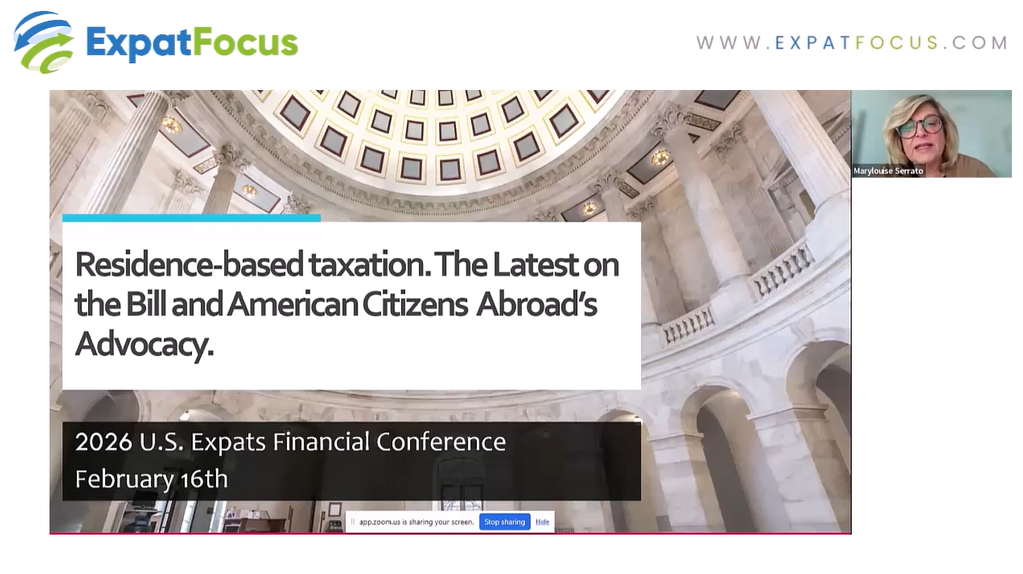
At the 2026 US Expats Financial Conference, Marylouise Serrato, Executive Director of American Citizens Abroad (ACA), provides an update on residence-based tax reform and ACA’s advocacy efforts. ACA is a nonpartisan non-profit that has spent nearly 50 years lobbying Congress and the administration on behalf of US citizens overseas, with a focus on taxation, compliance, voting rights, and representation.
The following transcript was generated by AI and may contain inaccuracies.
Hugo: Hello and welcome to day one of the 2026 US Expats Financial Conference, sponsored by Expat Focus, Wise, Global Systems Solutions, and Advanced AI Services. Today is the first day of the conference and this is our second session of the day, and I’m delighted to be joined by Marylouise Serrato. We’ll be discussing residence-based tax reform, the latest on the bill and ACA’s advocacy.
Marylouise is Executive Director of American Citizens Abroad. ACA supports Americans and campaigns to alleviate taxation and other legal burdens. Based in DC, Marylouise and ACA are at the forefront of US expat advocacy.
The talk will be followed by a Q&A session, so drop your questions into the Q&A popup at the bottom of your screen throughout. We’ll get to them as soon as possible and try to get through them by the end of the session. The sooner you drop your question, the more likely it is to be answered. Before we start, please bear in mind that the information presented is for general educational purposes only, and you should always seek your own personalised advice. So without further ado, over to you, Marylouise.
Marylouise: Thanks, Hugo, and thanks to the US Expats Financial Conference for inviting us here today. I know we’ve been joining you for the past few years and we always appreciate being invited. Thank you for letting us present to your audience. I’ll get right into it and share my screen.
So today, as Hugo mentioned, we’re going to talk about residence-based taxation and the latest on what’s going on with the bill that was introduced in Congress in 2024, and all of ACA’s advocacy on the bill.
To start off, I’ll give you a quick overview of ACA and ACA Global Foundation. We have been around nearly 50 years advocating and lobbying on behalf of US citizens overseas. Our focus is on the legislative and regulatory environment. Many of you know that Congress often passes regulations and legislation and is unaware, or not fully educated, on how this might affect US citizens living overseas.
We are a qualified lobbyist here in Washington, DC and we work on a number of issues. Today we’re going to talk about taxation, but we also advocate on voting rights, citizenship, and representation. You’ve probably also heard a lot about voting rights and some voting legislation that’s out there. I’ll touch just briefly on that and if you have any questions, feel free to ask.
We are nonpartisan. We just want good policy for our members. We are nonprofit. This really helps when we’re in congressional offices — offices in the administration know the structure of the organisation they’re working with.
We have two branches. We have ACA Inc, which is the advocacy and lobbying branch of the organisation. And then ACA Global Foundation, which is the research and educational part of the organisation. We fund research and studies, and we do events and webinars to educate the community and also to educate Congress and the administration.
We also have a political action committee and we are recognised in Washington, DC by the two major branches of government — Congress and the administration. A lot of that has to do with us having put our headquarters here in 2012. Before that, we did a lot of advocacy from a distance and through door knockers — which essentially means you come to Washington, DC for a week and meet with Congress. All very good and certainly helps with advocacy, but being in Washington, DC and having access to Congress and offices is really important.
Our focus as an organisation right now — the issues that are front and foremost, and why many of you are on this webinar — is taxation and compliance, be that filing taxes or having to deal with filing a FATCA form and an FBAR. The problems with investing — many of you probably know that you can run into some tax situations if you are invested in foreign mutual funds and have pensions. The GILTI and transition tax are also big issues for small businesses.
We do keep tabs on and advocate on Social Security and Medicare, and also, as I said before, on voting, citizenship, and representation.
Today we’re going to talk about taxation. Some of you may look at this list and say, I know this list, I’m familiar with it. Many of you have probably run into some of the problems listed here because you’re US citizens and we are taxed based on our citizenship, not based on where the income is actually earned.
That system of taxation — what ACA and Congress call residence-based taxation — would essentially tax based on where your income is earned. And if it’s not earned in the United States, it would not be subject to US taxation. So you can see there are issues of double taxation. We have phantom gains because of currency fluctuations and Americans having to use the US dollar as their base. The Net Investment Income Tax (NIIT), which doesn’t have an offset with foreign tax credits. And the pitfalls of Passive Foreign Investment Companies, or PFICs, which a lot of foreign mutual funds fall under.
So, residence-based taxation. The Residence-Based Taxation for Americans Abroad Act — or the LaHood legislation, as some of you have probably heard it called. The act, which was introduced in 2024, is HR 10468. Essentially, this piece of legislation outlined residence-based taxation and how it would function: it would exclude foreign-sourced income from US taxation. It would continue to tax US-earned income, but it would no longer tax foreign-earned income.
A lot of the LaHood legislation worked off the already existing regulations for non-resident aliens. It had certain parameters — citizens who had lived overseas at least three of the last five years since the age of 25 would automatically opt in. There would be a threshold on high net worth, and a lot of that has to do with making sure it was tight against abuse.
What’s happened since? HR 10468 will be reintroduced with new legislative language and will probably have a new bill number. Congressman LaHood introduced it at the end of 2024 in the last Congress, and since introduction he has come back and requested suggestions from the community and from other organisations like ACA on the legislative language.
The original legislation did include a lot of elements that ACA has in their RBT modelling. For those who aren’t familiar, back in 2014, ACA went out with a model that showed the current tax regime and how you would carve into that to achieve an RBT model. Some of Congressman LaHood’s legislation included elements that we had in our modelling.
We provided some additional suggestions and comments that were not in the LaHood legislation. Not all of our suggestions were taken on, and the same goes for other organisations. Congressman LaHood and his staff are considering those suggestions. They are meeting with the Joint Committee on Taxation and have been doing this for some time now. They’re developing a score — a cost — for the new residence-based taxation legislative language.
Our modelling shows that you can write the legislation to be low or no cost to the US Treasury. We believe that is the best way to get passage — to have a really good score on the legislation. At the same time, in the past month, Senator Young is also interested in drafting language for a companion bill that would be introduced in the Senate. No guarantees, but we’re hoping for reintroduction sometime in the first half of this year.
Many of you might be asking, well, why the delay? Why is it taking so long? The goal is to get the legislative language right, and I know that sometimes it’s very frustrating. People feel it should be quite easy — it should address these issues, you put a number on it and we’re done. It’s not that easy. It is a process and it does take time.
The first step really is that Congressman LaHood wanted input from the community and from organisations, to understand if the legislation really covered all the issues the community has out there. They can’t make it perfect for everyone, but they want to make sure it tackles the problem at hand. They also don’t want the legislation to open the door to abuse. So they want to make sure that in writing the language, there’s nothing that leaves a loophole.
Then getting a score — this is no simple task. The process for scoring involves going back and forth with discussions between the Joint Committee on Taxation, legislative counsel, and congressional staff. So it does take time. The important thing is that this is ongoing. We know it’s been ongoing and we know there’s been a back and forth, which means it’s getting full attention by the tax committees and congressional staff. It is a priority. A lot of people think that because it’s not moving fast, it isn’t a priority. That’s not the case.
Moving on — what is the congressional appetite for tax legislation? What is ACA going to do, and how are our resources going to help?
Tax legislation in 2026: many of you were familiar with the One Big Beautiful Bill that was signed into law last year in July of 2025. In the One Big Beautiful Bill, it addressed many tax issues, but there was no provision or inclusion for residence-based taxation. People are wondering why. As I mentioned before, Congressman LaHood, when he first introduced it, wanted to go back, get the community’s input on the legislative language, and get a score. This is really essential for passage.
There are still opportunities for tax legislation in 2026, even though the One Big Beautiful Bill was passed. There is still taxation of digital assets. There’s the Taiwan tax. There are also tax extenders, and there are representatives that still have tax priorities that weren’t addressed in the OBBB, including this one.
So there are still tax bills that may be coming along in 2026, and these could be an opportunity for RBT.
What is ACA going to do? We are a registered lobbyist, but we are also working with the BGR Group. They are a DC-based lobbying firm and they help you get through some of the tougher doors. That’s been a very good relationship. We worked with them throughout 2025 and it has really been very helpful in getting our messaging up to Congress and the administration.
We are out socialising the bill even though there is no new bill language. We are knocking on doors to get congressional offices familiar with residence-based taxation, and you’d be surprised that it actually is quite well known in a lot of the offices we’ve been in. That has a lot to do with the advocacy that ACA and other groups have been doing. But we have a long history up on Capitol Hill, and you’d be surprised how people move around. Someone that maybe you met with in one congressional office might now be sitting on a tax committee, or they might now be working for another tax advocacy group based in Washington, DC. This all helps. So we’re still knocking on doors and getting Congress and the administration familiar with the bill and the need for RBT.
Direct meetings are really important. It’s great to have a lobbyist and it’s great to do things from a distance, but it’s really important to do it face-to-face, in person, with the real advocates — meeting the people who are representing the community or the people who are faced with the actual problem.
We’re going to be doing more on our research and updating our 2016 and 2022 research. This was work that we did to cost out our modelling of RBT. It’s very welcomed in congressional offices and with the committees, and even though they do their own scoring, they’re always looking to learn more. It’s really helpful to have data on the community and on the actual residence-based taxation legislation and modelling.
We’re also engaging with the Commerce Department and highlighting how residence-based taxation is important to US trade and national security. We have a piece on our website — I can send it to Hugo later on. You should take a look at the website and read through that, to see how RBT can really be important to trade and national security, which we know are top priorities for Congress and the administration.
We’re also looking at other legislative opportunities that are highlighting this problem. Some of you may have seen Senator Hurd’s legislation that would exempt the current American Pope from US taxation. We’ve really capitalised on that. What’s good enough for the Pope is good enough for the five to six million Americans living overseas.
Another opportunity is the new visa programmes. You’ve probably heard talk about Gold Card and Platinum Card. Some of these visas — in particular the Platinum Card — will offer an exemption to foreign citizens who purchase them. They will be exempt from US taxation on their foreign-earned income, with certain caveats. Again, it highlights to Congress that there is a problem with the current system of taxation, and if you’re looking for solutions for the Pope and for visa programmes, you should really look for a solution for how it’s affecting Americans living and working overseas.
We continue to develop bipartisan partnerships with like-minded organisations. Last year, we worked together with Americans for Tax Reform on this issue, and we’re continuing to build that out and adding more organisations this year.
Webinars, conferences, round-table events — all of these help educate the community and offices up on Capitol Hill. And media — getting our op-eds out in the general media, getting ourselves quoted in media articles. We’ve been in some really important journals, Tax Notes in particular. That might not mean anything to a lot of people listening in, but it certainly is the bible for congressional offices working on tax and the tax writing committees. So it’s really important to be featured and our work noted there.
Also working with the Taxpayer Advocate. Some of you might have seen that she just put out her annual report to Congress and dedicated quite an extensive write-up on her most serious problems list to the problems for Americans living and working overseas. That is definitely something Congress has to respond to. It really does help to get that kind of support from her offices and that kind of focus on the problems.
Our research — why is that important? If the Joint Committee on Taxation and other offices in Congress are doing this work, how is ACA’s research going to help? Surprisingly, the IRS and Treasury don’t have a complete tax picture on US citizens living overseas. One of the first things we did when we did our research was define the size of the community. For many years it was unknown exactly how large the community was. A lot of numbers were being thrown around, and those don’t help anyone. If you’re starting from a wrong population number, it’s really hard to extrapolate out. So getting tight on those numbers was really important, and ACA Global Foundation was able to do that.
Offices and committees want this information because they don’t have a full picture. We’ll be updating that — the last time we did research was back in 2022 and it was an update of our modelling of RBT, which showed that legislation can be adopted with a low to no cost. So we’re going to go back in, re-look at those numbers, and those will be really helpful when the new legislation is introduced, when we go into offices, because we’ll be able to pinpoint and answer specific questions for committees and legislators.
So with all that, why should you support ACA? We have a long history of doing this. A lot of people say, well, if you’ve had such a long history, you should have gotten to residence-based taxation a lot sooner. Tax legislation is a big lift. It does take a lot of work. You can see just by what’s been going on with the LaHood legislation. We’re here in DC and we can help because we’re available to offices around the clock. We’re a registered lobbyist and we’re also working with our lobbying firm, so we get double impact.
We have a professional team of in-house staff here in Washington, DC — tax experts, individuals who have actually worked in Congress. We also have historic relationships with other like-minded organisations working on tax in Washington, DC, and with congressional committees. ACA knows them. They know us. And there’s this revolving door where someone you met with in one office is now in another — that helps because they can bring their knowledge across and educate.
Major media always comes to ACA for comment on this issue and other issues that affect US citizens overseas.
We’ve also had legislative success that we can point to. Some of you might be familiar with the Social Security Fairness Act. This was a piece of legislation that repealed the Windfall Elimination Provision, or WEP. We worked alongside many other organisations that were pushing for this. What WEP did originally was it applied to individuals who were getting a foreign pension alongside their Social Security, and it would reduce your Social Security by a certain percentage, which we felt was unfair.
Being in those offices advocating on this subject helped us introduce them to the other problems that Americans are facing overseas. A lot of those offices — we’re back in there now, saying we were able to pass the Social Security Fairness Act and repeal WEP, and that really solved problems for our community. Now we want you to get motivated and interested in taxation.
This is just a quick rundown of the important committees and offices and partners that are out there. ACA knows them all and has relationships with all of them, and that’s a really important tool in our toolbox.
How can you support ACA? Join. Become a member of ACA. You can contribute as a member. You can contribute to the ACA Political Action Committee. As an ACA member, you can also apply for a State Department Federal Credit Union bank account.
Some of you may have run into the problem where you can no longer maintain a US-based banking relationship. Some people say it’s really not that important — until the day they realise it is. You may need to deposit a US cheque. You may need to pay your taxes or receive a refund. All of this is really facilitated when you have a US-based bank account.
SDFCU can work with US citizens living overseas. They can work with foreign addresses and they have quite a lot of other products, not just bank accounts and savings accounts. In fact, we’ll probably be doing a webinar with SDFCU announcing all their latest and greatest offerings. I always say it’s like an insurance policy. If you’re thinking of moving overseas, if you’re overseas, just get one — it doesn’t cost you anything, and you will always have US banking services. You never know when you might need them.
You can also support our advocacy by donating to ACA or making donations to ACA Global Foundation. Those donations are tax deductible.
Lastly, we have our advocacy campaigns. These really help. We’ll be doing more of this in 2026. We have a write-in campaign. You go to our website — you don’t even need to be a member. There are several campaigns, about 15 of them on various topics. There is one on residence-based taxation. You go in, put your address — your voting address in the United States, or the last address you lived at in the US. It’ll bring up your representatives, because those are your representatives in Congress. You can put in your messaging. Sometimes the campaign has a little intro to let offices know, but you can add your own thoughts.
These really do work. We do see in the back end when there’s a groundswell in any particular office, we will follow up in that office. This really does pave the way. A lot of times when we walk through the door, they’ll say they’re happy to talk to us, and they had a handful of constituents get in touch and they understand this is a problem. So use the writing campaigns. They really do work. Visit our website and you’ll learn a lot about all our other activities and advocacy.
We’re working a lot now on the voting issues. Many of you have seen with the SAVE Act that there are some voter ID changes that may come into effect. We’re really working to educate Congress on how those are going to affect US citizens overseas and making sure that if anything changes, the tools are in place to guarantee that US citizens overseas continue to be able to vote easily via mail-in ballot.
So again, let your representative know. There’s also a campaign on voting on the website. Be sure to check those out. And with that, I think that’s all I have.
Hugo: Thank you very much for that excellent presentation. We’ve got quite a few questions, so if that’s okay, I’ll start reading them.
Marylouise: Great.
Hugo: First question from Gabriel. This is one that came up earlier as well. Gabriel refers to the University of Washington’s Federal Tax Clinic’s 2024 grant year report, which documents the first ever successful resolution of an IRS fraud file for an expat using the LITC. Have you ever heard of this?
Marylouise: No. I’ve heard that there’s some report, but it’s not publicly available. If anyone has a report that could be useful, we’re happy to take a look at it.
Hugo: Gabriel says that there are concerns the IRS is actively concealing the report. I think the best thing is for Gabriel to reach out to some of the panellists and they’ll be able to comment on that.
Next question. David says many American expats wind up returning to the US and suffer unfair taxation of foreign-source income such as pension income. Does ACA also address those issues?
Marylouise: No, our remit is really US citizens who are living overseas and are affected by citizenship-based taxation. We haven’t really touched upon the reverse problem.
Hugo: Julia asks a nice question — is Congressman LaHood up for re-election, and would that have any impact on the bill’s future?
Marylouise: There’s a lot of support for RBT. Congressman LaHood is definitely committed, and so is Senator Young. This is something that they’re doing because they really support residence-based taxation, and we expect that they’ll be around to see this through.
Hugo: Someone said: you mentioned the residence-based tax bill would be close to revenue neutral. Since it must reduce taxes for some individuals who earn income outside the US, how does it become revenue neutral? Would it increase taxes on others?
Marylouise: No, that’s one of the things we definitely don’t want to see happen, because that would work against passage. There’s not enough time on this webinar to talk about how you get to revenue neutrality. You can see from the presentation that this is a back-and-forth discussion with the tax writing committees, with the Joint Committee on Taxation that runs the numbers.
But there are certainly ways you can change the levers within the legislative language to make that happen. You saw some of the suggestions that we provided to Congressman LaHood in terms of where the threshold for high-wealth individuals is. Those individuals above that threshold may have a pay-to-play element. There may be a compliancy component.
We really don’t want this to be anything that someone stateside — a domestic taxpayer — is going to have to foot the bill for. There are ways to do it, but it’s definitely a science, and that’s why we hired a consultancy to run our numbers, because I certainly couldn’t do it.
Hugo: Somebody else says the tax compliance burden for current and former expats is increased by a lack of clarity in many tax provisions. Is ACA working to help provide more clarity? Which I guess is about information accessibility.
Marylouise: We continue to advocate strongly. What we really want — the gold standard — is residence-based taxation. But we continue to advocate on making compliance easier. For as long as we’re going to have the current system, it needs to be straightforward and less complex.
You’ll see a lot of what we are advocating for and suggesting reflected in the National Taxpayer Advocate’s report to Congress. She does a great job of highlighting just how difficult it is to comply from overseas. It’s not easy, as many of you know. We continue to advocate for that. It should be easier and simpler and more straightforward.
The big thing I think a lot of people come to us with is: I’m not sure what to put on a FATCA form, what to put on an FBAR form. Why are there two forms that are essentially asking me for the same thing? The IRS and Treasury have to be clear about what they’re getting at and how that compliance should be done.
Hugo: Someone else asks, could you explain the purpose and benefits of the Social Security Fairness Act and what it set out to accomplish?
Marylouise: I’d have to go back and take a look at the whole bill. Our focus was really the WEP — the Windfall Elimination Provision — which was a big part of that. It was so that Americans overseas who were drawing on a foreign pension and also drawing on their US Social Security would not lose those Social Security benefits, which they had fully paid into, and had also fully paid into a foreign pension.
Hugo: Someone asks, is the SDFCU bank account only available to US citizens living abroad, or anybody? Does one need a US Social Security number to open?
Marylouise: You have to be a US citizen to open a State Department Federal Credit Union account. If you are married to a foreign national, they can be a co-owner of the account. But to open one up, yes, you do need to be a US citizen.
Hugo: Garla says — not a question, just want to say thank you for your advocacy and taking the time to educate us on the impactful work you’re doing. Just to pass that on.
Marylouise: Thank you.
Hugo: Another question from Claude. What arguments against reform have you heard, and which ones might be barriers?
Marylouise: You’d be surprised that over time — and ACA’s been doing this, we’ve been around for 50 years, I haven’t been there for 50 years — but in the early days of door knocking and being up in Congress trying to sell this, you would get a lot of pushback.
You’d be surprised that there’s really not too much pushback once people understand how Americans are taxed when they’re overseas and what the effect of that is — from the business standpoint as well as the individual standpoint. The big concerns are that they want to make sure this doesn’t become legislation that is easy to abuse and opens up loopholes for bad actors. And that’s not even so much a pushback — it’s more their concern. If you can address that and tie it up, they see it makes sense. Once it’s explained, it’s really hard to get huge pushback.
Hugo: Someone said, what does Polymarket suggest the odds of it passing are? What do you think somewhat? But overall, how realistic is this of happening sometime in the next few years?
Marylouise: ACA wouldn’t be putting the time, effort, and investment — we have a lobbyist, that costs, we’re doing research, that all costs — we wouldn’t be putting the investment of our time and people behind this if we didn’t think it had a good chance of passage.
What we have seen as an organisation is that over time, this has become much more accepted in the offices that we’re in. A lot of that has to do with our advocacy and the advocacy of other organisations meeting on Capitol Hill. But there’s also a new generation, even in Congress and in staff. You have a lot of staffers or even representatives that have themselves lived overseas. Some still have families overseas. So this understanding and real-world impact — because they actually lived it — is really helpful, and we’re seeing more and more of that in the offices we go into.
Hugo: Really interesting. And is there bipartisan support for it?
Marylouise: There is bipartisan support. We go into offices talking to Republicans, Democrats, independents. You might not be aware, but Congressman Beyer in the past, in two or three congresses, has introduced legislation — the Tax Simplification for Americans Abroad Act. That was not RBT, but it was legislation to simplify filing for certain Americans living overseas under a certain threshold.
Congresswoman Titus has introduced the Commission for Americans Abroad Act, which calls for a commission that would investigate all these issues. She also has legislation called — I’m probably going to use the wrong name — the Americans Abroad Financial Access Act. And that would be a safe harbour for FATCA filing. So if you’re living overseas and your bank accounts are overseas, you would not be filing them. Those are not offshore accounts for you. They’re in-country. I live in Germany — these are my bank accounts in German banks.
So they understand the problem and are very supportive of trying to find solutions. When we go into offices, we hear good support on both sides. The one issue that does come up is making sure that it’s tied against abuse, which we know they can do.
Hugo: Last question, I think, unless anyone else has more — if you do, drop them into the Q&A window. This question says the president in his campaign said he was going to do something about this. Is he involved? Are the Republicans essentially open to it because of that campaign promise? And is there a way to get him to focus on it, to fulfil that promise?
Marylouise: That was a big announcement way back in 2024. I think right now the important next step is to get the revised bill and the new legislative language. I think once that has been introduced, that will kick off a lot, both in Congress and with the administration.
Hugo: Is there a timeline for that, do you think?
Marylouise: We’re hoping — fingers crossed — that in the first six months of this year we’ll see something. No guarantees. It’s hard to tell. Many of you, if you’re following the news, know that we’re in a partial shutdown because of the latest funding bill. You never quite know what’s going to happen in Congress — it could be a snowstorm that slows things down.
But we know from our meetings and from what we’re hearing that it’s a priority for Congressman LaHood and Senator Young. It’s definitely a priority in the tax writing committees. It’s something they’re actively working on, so it’s not something that isn’t moving. But time-wise, I don’t know.
Hugo: Well, Marylouise, thank you so much once again for the fantastic presentation. Thanks to everyone for joining us today. If you have more questions, reach out directly to American Citizens Abroad at americansabroad.org. Our next session as part of the conference is starting in just over an hour’s time, and we’ll be on insurance solutions for international systems and US expats in 2026. If you haven’t already, you can register at usexpatconference.com. For now though, thank you once again and we hope to see you very soon.
Marylouise: Thanks, Hugo. Thanks to the US Expat Financial Conference for the invite, and thanks everyone for joining. Bye-bye.