











The following transcript was generated by AI and may contain inaccuracies.
Carlie: Hey there, it’s Carlie with the Expat Focus Podcast. Is there a topic that you’d love to know more about? Or maybe there’s a particular person you really want me to have on the show? You can let us know by telling us on social media — simply search for Expat Focus. You can also leave a comment under a video on our YouTube channel.
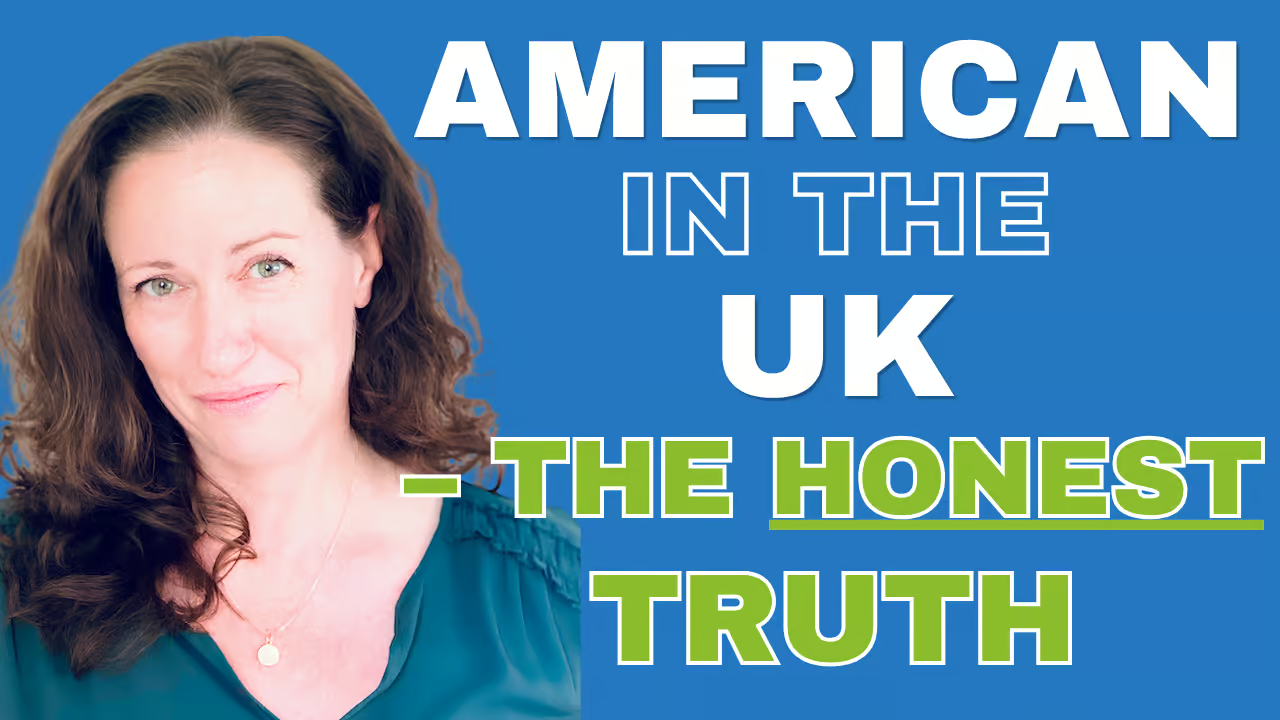
Making a move abroad over 40 is very different to doing it in your 20s. Victoria Pearce knows this because she has moved from the USA to the UK twice now, the second time changing careers and needing to integrate an 11-year-old into a new schooling system. We explore the pros and cons of moving after 40, navigating life as a trailing spouse, and supporting your child through the change.
Victoria, this is your second stint living abroad, so I’m curious to start with what led you to move overseas the first time, and what’s led to you doing it all over again?
Victoria: It’s definitely a habit I haven’t been able to kick. I’ve actually lived in the UK twice, so it’s both the US to the UK, back to the US, back to the UK. I moved here the first time for grad school. I was a practicing lawyer, wanted to do more employment-side, HR-type strategy work, and wanted to get a master’s degree for that.
I started looking at that in the US, saw the price tag, and decided maybe I should be more creative. Ultimately I found a one-year master’s program in the UK that really appealed to me, and that’s why I moved the first time. I really loved living here. Both times I’ve lived in the UK, it’s been kind of London-ish — not in London, but near.
When I got to the end of my program, I realised that the visa opportunities for me as a newish graduate, not having a lot of UK-based experience, just weren’t looking very good. I couldn’t find a skilled work visa or a way to stay, so ultimately I decided to move back to the US. I settled in California and lived there for about seven years.
My husband and I both got jobs with companies that were a dream for us to work for. Then COVID hit and we both just frankly burned right out. We were both working in careers that required us to be very much still on all through the shutdowns. Our daughter was at home schooling from home, and we were both ready for a change.
We started talking about how much we had missed living abroad and thought maybe it might be time to explore that some more. His work is in IT, which is a lot more transferable than my own, so we started looking for skilled work positions for him. He got an offer in Germany, and we were close to moving to Germany, but it just wasn’t the right fit for him career-wise. We ultimately turned it down, thinking, “Oh no, was that our one shot at doing this again?”
But a few months after that, he got an offer to come back to the UK, and we said, “Okay, great. We already know what we’re in for, and we really love it there.” So we decided to move back again. That’s the back and forth of my life. We’ve settled back in the UK for almost five years now, and we really love it here.
Carlie: So your husband had come with you the first time?
Victoria: Yeah. We’ve been married — I’m in my 40s — we got married when I was 21. He was 21. We were babies and idiots. I don’t recommend that for anyone listening for marriage advice, but we’ve managed to make it work. We’ve been through a lot of journeys together.
Carlie: And I believe you were over 40 that second time you moved. Is that correct?
Victoria: Yeah, that’s right.
Carlie: I find it really interesting because I moved abroad at 28. I just turned 40 this year, and I’m still abroad. In your 20s, moving abroad when you don’t have much tying you down — there’s a lot of experiences stretching out in front of you that you haven’t had yet, and it feels like the free and easy time to move.
When I think about making a move now as a 40-year-old, we have a mortgage, we have ties to the place we are. It would take a lot more work just to uproot ourselves and our stuff and move somewhere else now. Was that a consideration for you when you started discussing moving over 40?
Victoria: It absolutely was. There’s this expectation that moving abroad is something for students or people in their 20s — a time to move and make mistakes in your life at a time that makes sense for that. In your 40s, there’s an expectation of being much more settled.
You can call it a midlife crisis for me, but it didn’t slow me down. There were definitely some cons. I’ll start with cons and then move into pros so I can be more positive. It absolutely is unsettling to move at a point in your life when your friends are very settled, and when your family expects you to be settled.
We owned a house in California. We sold it as part of moving abroad, and I’ve been a renter since then, which has been a bit more of an adjustment. Not because it’s bad, but because it just wasn’t my life for a while there. We sold much of our belongings when we moved and didn’t bring a lot of furnishings from the US. We had a very settled 40-year-old kind of life, and we’ve moved back into a stage where we’ve been gradually rebuilding things, definitely not feeling as settled in that material regard.
It’s also just been harder to make friends. When we moved the first time, my daughter was very young — she was just starting school. She was in reception, which for Americans listening is the equivalent of US kindergarten. You made friends at the school gate because it was easy to constantly get thrown in with other people in similar life stages.
Whereas the second time we moved, my daughter was 11. She doesn’t need me to stand at the school gate and wait for her, so there aren’t so many opportunities to chat with people. A lot of people in their 40s have already got quite established friend groups.
Carlie: The school parents that have been together since the kids were little.
Victoria: Exactly. So it’s been a little more slow going, and I tend to be fairly introverted. It still takes me a while to remind myself I need to get out there and make a real effort to get involved in community things — other ways to human with other people here.
On the other side of things, for people who might be worried about moving over 40, I think this can be reassuring: for my husband, his career skills meant it was easier for him to find opportunities abroad because he was already at a place in his career where he had more skills than an entry-level person.
Even though I’m not working in the same career path I had in the US, I’ve accumulated a lot of career skills that have enabled me to be more flexible and able to pivot with what I want to do, while building on skills I’ve had in the past. There’s a bit more personal confidence because I’m not a baby at working — I’m familiar with the work environment in general, and that has been helpful as well.
Carlie: I often think if I could go back to those jobs I had in my 20s with the hindsight I have as a 40-year-old, I would smash it. I would do so well. I would not be walked over by managers. I wouldn’t be underpaid because I would know my worth.
Victoria: Absolutely. Very true. I couldn’t have in my 20s handled myself the way I handle myself in my 40s. There’s a lot of freedom in being at a point in my life where I do know what I bring to the table and am more able to advocate for myself.
Carlie: As someone currently dealing with the accumulation of stuff, was there freedom in packing up your life and just stripping physical objects down to what you really wanted in your life when you decided to do that move a second time?
Victoria: Yes. There really was. This might be a little personality-driven — my husband had a much harder time with it. For me, I’m constantly threatening to burn the house down because I don’t want to clean everything. So it was really freeing.
Carlie: I think I’m your husband in that relationship. But desperately trying to do better.
Victoria: It’s definitely an ongoing process. We’re even moving again this year within the UK, to be closer to the school my daughter wants to go to. Even that shorter move is a little bit like, “Oh gosh, we’ve got to go through stuff. We need to box things up again.” So it’s definitely not the easiest.
Carlie: I feel like I take after my parents on this point — having stuff. However, they have never moved in 40 years, and I realise there’s a benefit to needing to pack up your life every few years: that automatic culling process that happens.
Victoria: Yeah. We had a bit of a test for things when we were moving here, because we knew it would take a while for most things coming from the US — it’s such a long distance, it’s easier to send things by boat. The test was: do I not need this item for six months, but still want to have it in six months? Something that’s both impractical enough to not need for six months of your life, but also nostalgic enough that you must keep it. It gets pretty small once you put things into that box.
Carlie: I actually have that process every two years. I go back to Australia and cull one more box in my childhood bedroom. It’s amazing when you’re away from that stuff how the sentimentality fades. You can look at it and think, “Is this worth the extra kilogram in my suitcase going back to France? Or do I part with it now?”
Victoria: Right. Exactly.
Carlie: You mentioned your daughter changing schools, and I’m curious — there’s a lot of debate online about the optimal age to move a child abroad. How did you find moving her at the equivalent of what we call primary school in Australia? She was not quite at high school level yet.
Victoria: She was 11 when we moved, and I read a lot of stuff before we moved about this. I was very worried about what this was going to do for her, and what the impact would be on her life, both in settling into a different school system and just moving at this point in her life.
Partly she was excited to move, so I didn’t have a child kicking and screaming to stay, which helped with the reassurance to a certain extent. When we got here she arrived at a point when the school system in the UK was shifting from primary to secondary schools, so she actually started in secondary school — which the equivalent in the US would be middle school.
The reason I think that was beneficial was because she started at a point when all the local kids were shifting schools, so no one’s friend group was entirely intact from where they had been a year before.
Carlie: Even playing ground.
Victoria: Yeah. Anytime you move abroad, if there’s a point in schooling where there’s going to be a shuffling of children around, I think that’s helpful, because she was able to make friends a little more easily — people were more willing to meet new people at that point.
Carlie: And it’s amazing to hear that she was excited about the move too. I can imagine it would’ve been a much harder decision to make if she was devastated at the thought of leaving her school and her community.
Victoria: Absolutely. Part of that’s just my kid — she’s very adventurous in spirit in general. But I think it also helped that it was a place she knew, that she had been before. She didn’t have much memory of having lived in the UK the first time because she was so young. I do have a really adorable video of her calling me “Mummy” when she was four years old.
Carlie: Did she have a British accent and then lose a British accent?
Victoria: She did, and she lost it. Now that she’s back, she doesn’t — she sounds American. She sounds like me. But she can slip into a British accent, which is kind of a unique skill.
Carlie: I love that. I would want that skill. She’s cultivating the right skills.
Victoria: Yeah.
Carlie: How do you find having gone through a US school system yourself, then supporting her with the UK curriculum? My husband and I have decided not to have children, but something I thought about before we reached that decision was that raising children in France in a French school system, with a language I’m not fluent in and a system I have no idea about, would be so daunting. So how have you found it, US to UK schooling?
Victoria: It is very different. I do have the benefit of not having a language barrier, which has been good. I do have to reach out for help occasionally. The thing I’ve found most useful as a parent is just embracing the fact that I do not know what is normal here, and being very upfront about that. So whether I’m speaking to a teacher or to another parent, I’m very much, “GCSEs, what are they? I have no idea.”
I do know now, unfortunately, because my daughter’s about to take them. A year ago, or two years ago especially, I would’ve had barely any idea what was coming. It’s definitely a much more formal system here than it is in the US. The UK has a reputation, well earned, for being a quite formal schooling system, which is challenging.
I think it’s more challenging for me than it is for her, because there are things that seem kind of draconian to me. She got a negative mark — it wasn’t even a detention, but a little negative mark because she didn’t have the right colour pen with her one day. I just rolled my eyes.
Carlie: This is giving me flashbacks to not wearing the right colour socks, or not having my skirt down to my knees in high school in Australia.
Victoria: Exactly. Very similar ideas. For her, the biggest struggle has probably been that we moved at that tween-to-teen age. Coming in at 11 and going through those 11 to 13 years, when I feel like kids are just really testing out cruelty and boundaries.
I really found that she went from being something bright and shiny because she was American and different, to “Oh, if I need to punch down against this person, it’s going to be making comments to her about Americans being fat and stupid,” and things like that.
Carlie: Yeah, that sucks.
Victoria: Which is lame. But if it wasn’t that, it would be something else, is kind of what I tell myself, because I don’t think it’s easy to be a 12-year-old anywhere in the world. Being different — you’re going to be different from other people in some way, and this was her way of being different.
Carlie: I’m still scarred from being 12 years old and going to one of those “learn about your body” classes at school where they separate the boys on one side of the room with their dads and the girls on the other side of the room with their mums, and they talk about the body and how girls get periods. My mum couldn’t come, so I had to sit there with all the mums and daughters with my dad — with my dad saying, “Oh, you should probably go and get some of those free sanitary pads and keep them in your backpack from now on.” This was just in Australia. I wasn’t even in another culture, and that was awkward.
Victoria: I’m sure.
Carlie: I want to go back to you. You left your career to be a trailing spouse this time around. How have you navigated that career upheaval and that change in professional identity, I suppose?
Victoria: It has been a bit of an up and down for me. I was a practising attorney in the US, and very much was lawyer-focused. Even when I shifted into more HR work, once people realise that you’re good at having a tough conversation, it’s hard to get out of that kind of role. I did employee relations and things like that, which still can be heavy.
When we first moved, I do have the ability to work as a dependent here, which is nice — and certainly not something the US gives in reverse, so I’m appreciative of the opportunity I have here to be able to work. I originally took a similar role in HR that I was able to find, because of the skills that I had. Since I didn’t require a separate work visa for myself, I was able to get a job without taking too long to get it.
But I realised within about six months that I was just going to be doing the same thing I’d been doing, and I was actually looking for a bit more upheaval in my career. As we already talked about, I’d looked for a way to transition from strictly legal practice into something else, and was still pushing against that a little bit.
I had originally started taking up resume writing as a side gig — something I was helping people with — and realised I liked it. I liked writing. I’ve always loved writing. That was the slippery slope that led me to law school in the first place. So I’ve really transitioned away from legal practice to now running my own business. I’m a content writer. I work for law firms and legal tech companies, and some publications.
When I moved, I started a blog, because everyone who moves abroad starts a blog.
Carlie: Yes, we’ve all been there.
Victoria: I’ve built it up over time, and I’m pretty proud of it. It’s based on UK travel, and I’m also trying to help people who are interested in moving abroad to Europe as well.
Carlie: And this is alifeaway.com.
Victoria: Yes, that’s right. So that’s a lot of what I’m doing now. Because I work for myself, I spend a lot more time working from home, with the dog that likes to come help me. I love it. It’s been very helpful because I really like the balance of being able to work, but given that my daughter has had to adjust to a new place as well, and is going through GCSEs — which is just a horrendous thing that the UK school system requires — it’s been nice to have the flexibility to be there for her in a way I don’t think I would’ve had if we’d stayed in the US.
Carlie: I want to get political, Victoria. I was just in Paris the other week with a US colleague who was blown away by how much interest our French office seemed to have in American politics, so I apologise. But we are speaking at a time when there’s quite a lot of geopolitical turbulence. Number one, how does that affect your expat life? And is it a factor as you consider your longevity in the UK?
Victoria: Absolutely. For one, the second anyone here finds out that I’m from America, they have questions.
Carlie: We can’t help ourselves.
Victoria: Which is fair, and I don’t mind. It is funny to me — Hollywood does a good job of putting America front and centre of culture in a lot of places, but wow, have we earned the negative commentary that’s coming our way sometimes now. So it is hard to just be American outside of America. I think it’s hard to be American in America right now.
It’s hard in the sense that there’s this disconnect between what I value and what I grew up believing my country stood for, and where it is right now. I don’t think that’s an uncommon sentiment, both from other people in other parts of the world, and also Americans who are not sure whether they connect with their own country, whether they’re in America or not. I’ve had a lot of conversations with people about that.
In terms of what that impacts for me, I’m both grateful to have the opportunity to live outside of America, and then have these weird feelings of guilt for not being in America and trying to help my communities that I still have there and still care very much about. So it’s a weird disconnect to be homesick for a place that I also don’t want to be.
In terms of our long-term plans, right now we’re quite happy to be in the UK and don’t really have plans to return to the US. At the same time, being in my 40s when I moved over here, my parents are getting older, my husband’s parents are getting older, so there is the potential pull back in that direction. For the sake of that, as well as for the sake of the world in general, I’m hoping my country can get it together a little more than it is right now.
Carlie: The parents point is an interesting one, and it’s one I’ve been considering increasingly as well. I do have siblings in Australia who have reassured me I’m not expected to come back home. But it’s also that you realise the longer you spend abroad that you never get that time back with your family, and that is a really difficult one to confront. And how you decide to rectify that, or not, is also difficult to confront.
Victoria: Absolutely. It’s been very top of mind for me. You’re raising a point — whether you move abroad at 20 or at 45, you’re going to get to a point eventually in your life where you’re looking back at your family and friends, and that could be a year after you move, it could be many years after you move, and saying, “Is the life I’m building here still worth being away from the people I love there?”
One of the best things about living abroad is that I have friends and chosen family in many parts of the world, which I wouldn’t have had that opportunity if we didn’t live abroad. But at the same time, you don’t have the same depth of connection that you could have with someone you’ve known your entire life.
Carlie: The depth of connection — it’s difficult. You’re absolutely right. That is something sometimes that I really crave. We had our wedding in Australia last year because I had way more people to invite than my husband. So it made sense on the numbers to do it down under.
It was so enriching to have so many people I cared about in that room. But fast-forward one year and we’re preparing to do a celebration in France, and that depth of friendship is really on display, because suddenly the invite list is weighted towards my husband. I’m like, “Who do I know here enough that…?” And the invites I am sending to friends, they’re like, “Wow, I’m so honoured to be invited.” And I’m like, “Wow, does that mean I consider you more of my friend than you did to invite you to a wedding party?” Are we as friends as I think we are?
Victoria: Of course.
Carlie: It’s an interesting dynamic for sure. Are you going to become British citizens, or are you British citizens?
Victoria: We are not currently. We aren’t even permanent residents just yet. We hit our five-year mark later this year — which, as things currently stand and who knows because the UK immigration system changes pretty regularly, but assuming things stay the same, we would become permanent residents or be eligible for that later this year. Then a year after that we could become British citizens.
Assuming we retain the right to be dual citizens with the US, we probably will pursue that, especially for my daughter’s sake — just giving her more flexibility as she becomes an adult herself, to have options in her life.
Carlie: It is such a gift as well, to have multiple passports and multiple places to call home.
Victoria: Exactly.
Carlie: Victoria, I have a very serious question.
Victoria: Oh no.
Carlie: If you could change one thing about England, what would it be?
Victoria: Probably the views on immigration, actually. I thought it was going to be the weather. That’s the nice sweet answer. As someone who’s used to more sun, I’m sure you can also appreciate it’s the dark that just kills you. Now that we’ve had the clocks change, I’m back to being a happy sunny person again.
Carlie: But that 4pm in winter, and it’s pitch dark outside and you’re still at work.
Victoria: It’s hard. Really hard. But truly, in all seriousness, the UK immigration views — they’re not as bad and horrific as they are in the US currently, but they are. There are elements of similarity that give me pause and definitely give me concern, not just because I’m an immigrant, but just in terms of: is this a country I want to be part of and continue to build community in?
On the day-to-day, the people I know don’t share any sentiments that scare me, but seeing some of the rhetoric in politics, and seeing how it started in the US and how it seems to be ramping up here — it is scary. So I’m hoping for a shift.
Carlie: Seeing a similar trajectory in Australia, so I can relate. But ending on a more positive note —
Victoria: Yes, please.
Carlie: What is it that you love about life in the UK?
Victoria: I love a lot of things about living here. I really enjoy having a more car-free existence, or at least a car-optional existence. I lived in Texas and then in Southern California — those are very car-centric places. You don’t get around without a car. I’ve always kind of hated driving. So while I do have a UK driver’s licence, driving here is more optional. We only have one car. We don’t use it all the time, and I love that. It’s such a great part of my life to be able to say, “I’m going to go out and do something, and I don’t need to get in the car to do it.”
I really love the walking culture here. I love that on a Sunday people are out on what an American would call a hike, but it’s just a walk. And often into the pub, which is even better. My dog quite enjoys living here, because he gets to go out on walks with me, and we get to explore.
Carlie: I had this incredible experience just before I left the UK. A flatmate was like, “Would you like to go wild river swimming?” And I’m like, “Okay.” So we caught a train somewhere into nature outside of London, and we just started walking along this path with berries on it, and we ended up following a river with people on quaint little boats. It was gorgeous.
Then we came to this spot where we just stripped off and went wild river swimming. It was more like a pond, and the only thing I didn’t like about it, being an Australian who likes the beach, is the water isn’t salty — doesn’t feel as clean, and there’s a lot of bird poop around. But otherwise it was gorgeous. This is just a really quaint, beautiful day out in the summer, wandering along these little berry paths to the water.
Victoria: Absolutely. England in the summertime is probably one of my favourite experiences anywhere. In the wintertime it’s not always the same sentiment, but —
Carlie: When it’s Christmas lights time in London, that’s pretty cool too.
Victoria: Christmas is good. Yeah, Christmas is good.
Carlie: It has been an absolute pleasure to speak with you, Victoria. Thank you so much for coming on the Expat Focus Podcast. Remind our listeners again — if they would like to follow your journey and learn more about what you’re doing as an American in the UK, where can they find you?
Victoria: The best place to find me is on my blog, which is alifeaway.com.
Carlie: That’s it for today. Get international news and insights in your inbox every month by signing up to our newsletter. Just head to expatfocus.com/newsletter, and I’ll catch you in the next one.