
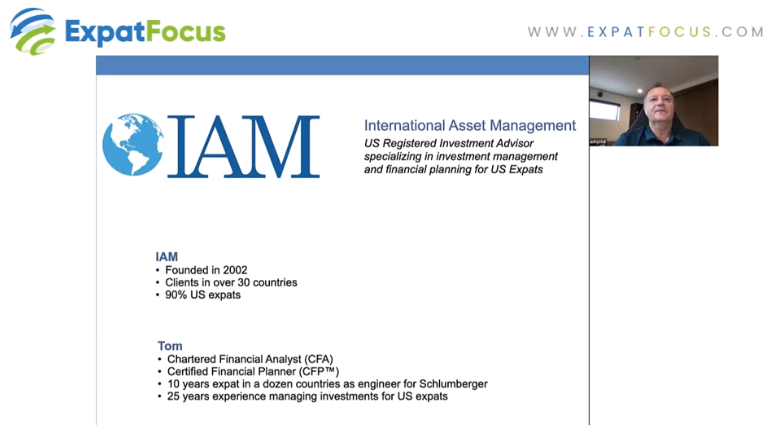
At the 2026 US Expats Financial Conference, Tom Zachystal, President and Chief Investment Officer at International Asset Management (IAM Advisors), discusses investment environments and themes for US expats in 2026. International Asset Management is a US Registered Investment Advisor specializing in cross-border investment management and financial planning for Americans living abroad, helping clients in more than 30 countries build globally diversified portfolios while navigating the tax and regulatory complexities unique to US expats.
The following transcript was generated by AI and may contain inaccuracies.
Hugo: Welcome, everyone. We’ll wait a couple of minutes to give people time to join before we get started. I’m here with Tom Zachystal from IAM Advisors. Tom, you’re in San Francisco, I believe.
Tom: Yeah, I’m in the Bay Area on what we call the Peninsula, which is south of San Francisco, and the office is in San Mateo. I don’t know if you can see it, but we’re in the middle of a storm — thunder and lightning. It started just a few minutes ago, so hopefully there won’t be a power cut.
Hugo: Hopefully not. We just need it to hold off for another hour.
Tom: Exactly.
Hugo: So you’re broadcasting from home today?
Tom: I’m at home today, yeah. I didn’t really want to go out in this to the office, so I have some company here — my dog. But it’s like you were saying, Hugo: we’re in the heart of Silicon Valley here. You’d think the internet would be okay.
Hugo: Yeah. They had a panelist earlier who was in North Carolina and said they’d had a foot of snow, which was uncharacteristic, but it seems to have passed.
Tom: It’s crazy. We have new terms now. Recently this term “atmospheric river” came into the vocabulary here, which is basically a deluge of biblical proportions, you could say — animals walking around by twos.
Hugo: I’ve not heard that one.
Tom: When it’s raining here, it’s snowing in the mountains, so I’m looking forward to doing some skiing at some point.
Hugo: Excellent. “Atmospheric river” is a good one. There seems to be a team of people in the UK government whose job is to make up new terms for rain to make it a good story. It rains a lot here, so they have to think up new ways to put it and different types of rain. But I haven’t heard “atmospheric river” before — it’s a good one. I think we get quite a lot of that.
Tom: Yeah.
Hugo: The number of people joining is leveling off now, so I’ll just read an intro and then hand over.
Tom: Sure.
Introduction
Hugo: Hello and welcome to day two of the 2026 US Expats Financial Conference, sponsored by Expat Focus, Wise, Global Citizen Solutions, and Advanced AI Services. We have a fantastic schedule for you consisting of 17 sessions over four days, covering multiple aspects of financial information for Americans living abroad, with perspectives from some of the world’s leading experts in their fields.
Today is the second day of the conference, and this is our fourth session of the day. I’m delighted to be joined by Tom Zachystal, who’ll be discussing investment environments and themes for US expats in 2026. Tom is President and Chief Investment Officer at International Asset Management. He has a proven track record of managing globally diversified investment portfolios and has helped Americans living abroad grow their wealth for over 20 years.
Tom holds Chartered Financial Analyst (CFA) and Certified Financial Planner (CFP) credentials, as well as an MBA in Global Management from Thunderbird University in Glendale, Arizona. Before we start, please bear in mind that the information presented is for general educational purposes only, and you should always seek your own personalized financial advice.
Tom will be answering your questions at the end, so please add them in the Q&A popup at the foot of your screen as and when you think of them, and we’ll try to answer them all, time permitting. So without further ado, over to you, Tom.
Presentation
Tom: All right. Let me get the screen share going and start the slideshow. So far, modern technology is looking good. Here’s a little intro slide — themes for this year, our email address, and website.
A little background: Hugo already gave you some on the firm. We actually have two firms. International Asset Management, which I started almost 25 years ago, caters to Americans living abroad. Ninety percent of our clients are US expats; the rest are probably people who aren’t Americans but worked in the US and have US retirement accounts. We offer investment management and financial planning services to this group. We have clients in over 30 countries, about $170 million under management, and five advisors.
Why did I start this company? I was originally an expat myself. I worked as an engineer in the oil business — I was born in Prague, grew up in Canada, and worked for a company called Schlumberger for about ten years internationally, in a lot of interesting places like Nigeria and the Middle East. Like a lot of people, I went through a career transition, ended up with Merrill Lynch and another company in California, and started this business in 2002.
That makes us kind of special, because there aren’t too many firms in the US that want to deal with non-US residents anymore. We partner with Charles Schwab and Interactive Brokers to hold our client accounts, and they’ve been good partners — they’re pretty good at dealing with international clients as well. That’s a niche that very few firms have in the US.
About three years ago, we started a separate business in Spain, which holds our European license — we also have a MiFID EU license. We’re one of the few US firms that has that as well. So it’s really set up for expats: investment management and financial planning.
Keeping things in perspective
Let’s talk about what we’re going to cover. The first thing we should talk about is keeping things in perspective, because there’s always a lot of concern about something. It’s been an especially volatile time in terms of US politics, global politics, tariffs, the AI bubble, and a lot of things that people are concerned about — especially Americans living or moving abroad. They’re worried about the US dollar, treasury bonds, and keeping their money in the US.
So we can start by getting perspective on some of these policies, then move through where we’ve been over the last year in investment markets and what the future might hold. Then we’ll move on to a few more specifically expat-related issues and talk a bit about financial planning as well.
The yield curve
Let’s start with the yield curve. This shows US Treasury bonds and how much they’re yielding at various maturities. On the left are the short-dated bonds, and on the right are the 30-year, long-dated bonds.
About two years ago, in 2024, we had what we called an inverted yield curve. The short-dated bonds were paying about 5.5%, and the long-dated ones less than that — about 4.5%. This was a topic of concern because many people think an inverted yield curve means a recession is coming, maybe six months to a year down the road. And yet here we are in 2026, and there hasn’t been a recession, despite tariffs and everything else going on.
Actually, 2024 and 2025 were pretty good years for investment markets — stock markets in general, the US market, and international markets. So we haven’t seen a recession, certainly not in the US.
Now look what’s happened. This is today’s yield curve, and it has normalized itself a little. This is what we expect to see — a smoother transition, with a bump in the middle at the two-year point, which is unusual. But essentially the yield curve has become more normal, because interest rates have gone down. The Federal Reserve has started lowering interest rates, which has driven short-term yields down. The long part of the curve hasn’t moved much — it’s moved up a bit — but the short part has come down from 5.5% to under 4% now. So now, all of a sudden, it isn’t pointing toward a recession.
The Federal Reserve
The reason this has moved around is the Federal Reserve, and there’s been a lot of talk about the Fed politically — the Powell and Trump conflicts and so on. But the Federal Reserve has done a pretty good job, in my view.
Looking back to 2008, when we had the financial crisis, the Fed lowered interest rates to stimulate the economy and to create more liquidity in the treasury bond market. Interest rates were very low until 2016. Then they thought they could normalize, with a little inflation coming in.
The Federal Reserve has two mandates: controlling inflation — keeping it around 2%, maybe a little more — and full employment. Those are hard to balance, frankly, but they’ve done a great job. In 2020, they dropped interest rates because of COVID; everybody thought the pandemic would be horrible for investment markets, but as it turned out, it wasn’t such an event, at least not for the stock market. Then in 2022 they raised rates — 2022 was a really bad year in stock markets, mostly because the Magnificent Seven technology stocks, some of them, were down 50% that year, amid angst over inflation, interest rates, and the Russia–Ukraine situation.
Now they’ve started lowering rates again, because we seem to have a pretty good balance, at least in the US, between inflation and employment. We can afford to lower rates a little. But at this point, the Fed has probably paused, because employment is decent and inflation, while up a little, is fairly well contained. Generally these are not bad times despite everything in the press, and that’s important to keep in perspective.
When you look at the Fed funds rate over the longer term — this goes back to about 1975, so 50 years — we’re not at an unusual level. We’re probably at about an average level. Back in the ’80s, during the OPEC oil crisis, inflation was really high because the price of oil and gas suddenly went up. But generally we’re at a decent level for the Fed funds rate — not too hot, not too cold.
Currencies and the US dollar
Interest rates also affect currencies. Generally, when you have lower interest rates, or when you’re lowering them, that tends to be negative for the currency, because investment dollars rush to higher-paying currencies and the currency weakens.
I also think the Trump policies have been toward a weak dollar — Trump would like a weak dollar to make things more competitive. What he may not realize is that this would stoke inflation, but nevertheless he’s had a weak-dollar policy. And I think people are getting a little disenchanted with the situation in the US, and you can see investment dollars flowing to other countries since the beginning of 2025.
We’ve positioned our portfolios to be more non-US based. We tend to be about 50/50. Over the last ten years we’ve been more in the US, but since the start of 2025, we’ve been more outside the US — also because almost all of our clients live outside the US.
Looking at the weakening trend over 2025: even against the Mexican peso (the bottom orange line), the US dollar was down about 14%. The Swiss franc is next. Pretty much the only major currency the dollar strengthened against was the Indian rupee (the green line). So a weakening dollar was one of the major themes of 2025. Year to date, that trend is continuing — the chart is almost identical to last year’s. Over the last few weeks it’s been a little more stable, but generally the dollar has weakened since the beginning of the year.
When you look at a longer period, keep in mind that currencies — especially major ones — are not like the stock market. They don’t go in one direction, because they’re mean-reverting, though sometimes over a longer period. On a 20-year chart, looking at the USD versus the euro (the blue line), we’re really about where we were 20 years ago. There have been ups and downs, but certainly not one direction.
Against emerging-market currencies, that isn’t necessarily the case. The Indian rupee has been weakening versus the dollar at a fairly steady pace over the last 20 years. The peso has been strengthening lately, but over 20 years the dollar has strengthened almost 65% versus the Mexican peso. And with some emerging markets there’s the threat of devaluation — we’ve seen a couple in Mexico, and Argentina as well.
The Swiss franc has been steadily strengthening versus just about every currency over a number of years. So we’re not at an unusual exchange rate at the moment. Versus the euro over the last 50 years, you can see dramatic ups and downs — like in 1985, where the euro strengthened quite a bit — but generally we’re in the middle of that range. We shouldn’t think we’re in an unusual exchange rate environment; it could really go in either direction, although for the moment the trend does seem at least slightly toward a weakening US dollar.
Stock markets
So what about stock markets? With all this anxiety about trade tariffs and fluid US policies — Greenland, kidnappings of presidents, and so on — and yet despite all that, stock markets have done very well. Even economically, the US seems to be doing okay. Other places aren’t doing as well: China’s been in a 2008-style property bust for a number of years, and Europe is barely ticking along in terms of economic growth.
At the beginning of April last year was Liberation Day, where Trump announced all the tariffs, but that was really only a three-week event for the markets. The other thing you can see is that the US market has not done as well as other markets. The US market — the S&P 500, the light blue bottom line — was up 13% last year. All those other markets (Brazil, Canada, Mexico) did much better. Interestingly, the top one is the South African market. It’s not as if they don’t have problems, yet that market did very well, probably because it has a disproportionate amount of mining companies in its index, and commodities like gold have done very well. The next two down are Brazil and Mexico. So especially the emerging markets have done pretty well.
Year to date, the trend continues. The US market is about flat so far this year, but the other markets — especially emerging markets — are doing well. The Brazilian market’s up 20% year to date. Next is Mexico, then Japan: they recently had elections, which seem positive for the Japanese investment market, and the yen has started strengthening a bit. Despite the low price of oil, the UAE — a small market — has been doing well, up 15%.
There seems to be a general transition by global investors away from the US and toward non-US markets, partly because many non-US markets are cheaper. The US market has been driven by technology companies — it’s 35% technology, just because of big companies like Apple, Meta, and Google. They’ve done well for many years, but now there’s concern about how much they’re investing in AI and whether the stock prices have gotten ahead of themselves. So there’s a rotation to other markets, which are much less tech-heavy. The European market has very little technology in it, and the UK index has practically zero. There are places like South Korea — which is mostly Samsung — where tech is represented, but by and large most non-US markets are much less tech-oriented than the US.
Commodities and crypto
The other story has been alternatives — specifically commodities, gold, and silver. Gold is the blue line; silver, from an investment perspective, is kind of like gold but more volatile — gold on steroids. Over the last year, gold is up 73% and silver is up 140%, but you can see that dramatic drop at the end of January where silver fell a lot very suddenly. Gold is less volatile, so we invest in gold, not silver — it’s just too volatile for us. We’ve had about 10% of the portfolios in gold for a number of years, and that’s done pretty well.
Gold mining stocks also did very well last year. It took a while for them to catch up — the price of gold had been rising for a few years, but the mining stocks weren’t necessarily rising in conjunction. Then about a year, year and a half ago, they started doing very well, and last year was a really good year for them.
On Bitcoin: we don’t invest in crypto, mostly because of the volatility and because I’ve never understood it myself. But people do invest in it, it offers some diversification benefits, and certainly a lot of people have made a lot of money over many years. However, there’s been a dramatic downturn in crypto since October of last year. The purple line is Bitcoin, and there’s Solana, another crypto. Solana is to Bitcoin what silver is to gold — much more volatile. Solana is down about 50% over the last year, and Bitcoin’s down about 30%, but most of that has come since October. Solana is down about 70% since the beginning of October. So be aware that if you’re investing in those markets, they’re very volatile — though they do offer some diversification benefits.
Forecasts and economic indicators
What does all this mean for the future? Here are some forecasts — other people’s opinions. It’s pretty hard to gauge what the future holds, certainly now with policies being so fluid in the US. Outside the US, the political climate seems much more oriented toward self-sufficiency these days — the Europeans and Canadians are doing trade deals, not so much with the US but with other countries — and there’s been a lot of movement of investment dollars outside the US.
The forecasts are generally positive. They’re usually positive anyway. They were positive at the beginning of 2025, and they were right. Wall Street analysts are generally predicting about a 10% increase in the US stock market, which would be an average increase — the US market longer term goes up about 10% a year. The thing I don’t agree with is their view that equities outside the US will also rise, but less strongly than US markets. They base that on the relative strength of the economy — and it does seem the US economy is doing better than, say, Europe’s. But I think there’s more than the economy at play here: money movements, a lack of faith in the US political environment, and the relative value of these markets. US price-to-earnings ratios are pretty high, especially among technology companies. So I think it’s a good time to have money outside the US.
What are the economists saying? They have leading economic indicators and coincident economic indicators, which we track as well. The stock market is itself one of the leading indicators, but there are about a dozen of them, having to do with things like unemployment. The leading economic indicator (LEI) is supposed to give us about a six-month window into what the economy might do — when a recession might come. The LEI is the blue line, and it’s been going down quite strongly since around the beginning of 2022. But the black line is the coincident indicator, which reflects what the economy is doing right now — things like industrial production — and it has continued to rise, though lately it’s flattened out a little.
This is worth watching, because if you look at past recessions (the gray areas), the leading indicator goes down, and then the recession starts when the coincident one goes down. I think we’re in a fragile time — maybe the tariffs haven’t fully hit yet, and who knows what they’ll ultimately be; there’s always a back-off from the tariffs at some point. So far we haven’t seen a big effect, but it could still be out there. There could still be a recession, but for the moment I don’t think it’s necessary to change our investment philosophy because of it — except maybe to have some more money outside the US. The European economic indicators tell a similar story; the LEI is more volatile in Europe, but essentially the same.
Bringing it together
Bringing it all together, here’s what we see. The analyst consensus is generally positive. Nobody really knows what Trump will do or what US policy will be, but so far it’s been contained. There are certainly concerns about US technology companies — how much they’re investing in AI and what the payback will be. But this is fundamentally different from the dot-com bust in 2000. I was advising people then, too — that’s when I started my career — and these technology companies have a lot of money to invest. They’re not little dot-coms that went bust in 2000; we’re talking about the Googles and Apples of the world. So I think AI will be a real thing. How much money will be made or saved from it remains to be seen, but for the moment it seems manageable.
The rest of the world outside the US may not be doing great economically in most places, but it’s not a recession either. It’s kind of stable, with more trade deals being done. So who knows — things are changing, but there’s no reason to be overly negative.
Nevertheless, we should keep our eye on company earnings. Every quarter I listen to maybe 50 earnings calls from companies in the US and abroad to get a sense of what’s going on, and so far things have been pretty positive. What we see in the US is what they call a K-shaped economy, where the rich get richer and the poor get poorer, unfortunately. People in lower income brackets are suffering because we’ve seen big inflation in things like beef and the cost of living in general. It’s stabilized a little, but that doesn’t mean inflation is going backward — it’s just not increasing as fast — and these people have taken a big hit. But they’re mostly not invested in the stock market. At the other end of the spectrum, you see people spending money on cruises and travel; high-end hotels are doing very well globally right now. A lot of that is the baby boomer generation — they’ve been saving, they’re now retiring, and they’re spending some of that money.
So we should keep an eye out for negative changes in earnings, but we haven’t seen too much of that yet. This might also be an interesting time for income-type investments, and generally for diversification — particularly non-US diversification.
Income-type investments
Briefly on income-type investments: everybody’s familiar with bonds and bond funds, but there are a lot of dividend-paying investments out there too — preferred shares and real estate investment trusts (REITs). We haven’t had much money in real estate; I don’t think it’s necessarily a good time to be in it. But there are things structured as REITs, which are basically pass-through entities that get cash flow from something and translate it into dividends for investors. Iron Mountain, for example, does data storage and has a cash flow that translates into a juicy dividend.
There are also BDCs — business development companies — which are like publicly traded private equity. You can get 6% to 10% dividends from many of these types of investments, and especially for people in more conservative portfolios, it’s nice to have that. They also provide diversification from bonds, because if you just have bonds and stocks, there isn’t much diversification — and maybe a little gold, but there’s no dividend from gold. These investments pay good dividends, and we have a number of them in our portfolios. Because the dividends are paid every quarter, it’s like an uncorrelated cash flow relative to everything else, so you get some diversification there as well.
Expat issues
Now, talking about expat issues in general — briefly, because it’s probably another seminar in itself.
One thing we’ve seen is people moving overseas being asked to use a US address on their investment accounts, because their advisor doesn’t want to give up the account and wants to fool his compliance department into thinking those people still live in the States. That’s obviously not ideal. With Charles Schwab, Interactive Brokers, and the companies we deal with, we don’t need a US address on those accounts. So bear in mind there are companies that will deal with expats.
On withholding rules — for example, on IRA distributions — some companies you have to educate. If you’re a non-US person taking distributions from a US retirement account, they might want to withhold 30% or something. Some brokerage firms have to be educated on the withholding rules.
There are also various regulatory challenges. PRIIPs is an EU regulation: if you live in the EU and open a retail account directly with Schwab yourself, you won’t be able to buy US mutual funds or ETFs. But we can use US exchange-traded funds for our clients, because we’re US advisors managing portfolios on a discretionary basis. That’s the PRIIPs regulation.
PFIC means that if you’re a US taxpayer, you don’t want to be investing in non-US mutual funds or ETFs, because those create a US tax reporting issue. If you Google the term “PFIC,” the law will come up.
On currency conversion: don’t go between the banks. Use a company like Wise, or Interactive Brokers, which has good currency conversion rates — and so does Schwab, actually. We can wire money out in euros or whatever out of a Schwab account.
On investing in non-US currency: what we generally tell people is to keep your US investment dollars in the US. But if you want some money in local currency invested in something, use things that aren’t PFICs — term deposits, savings, high-yield savings accounts, a CD-type equivalent if you can get one, or individual stocks and shares. Those aren’t PFICs either, but they’re harder to buy if you’re a US citizen abroad, and more expensive than trading in the US. So generally, use cash products for investments outside the US, and keep your US investment money in the US. That doesn’t mean it has to be invested in US dollars — we can invest on non-US exchanges even in a US account, or buy ETFs invested outside the US. So it doesn’t have to be in US dollars, even in a US account.
Another thing to bear in mind: a lot of people come to us saying, “I want to get my money out of the US and move it to a bank in Uruguay,” or something like that. Bear in mind we have SIPC insurance in the US — $500,000 on investment accounts. Outside the US, that’s sometimes nonexistent or very low. In Ireland, the equivalent is €20,000. In much of Europe it’s €100,000 or less, and in the US it’s $500,000.
Finally, a word about muni bonds. They’re nice if you’re in a high tax bracket in the US, because of the tax breaks. They’re not useful outside the US, because you’ll probably end up paying tax on the interest locally, depending on the tax treaty. So muni bonds are much less useful for US expats.
Financial planning
A word about financial planning, which is the second service we offer. What’s nice about doing a financial plan is that a risk profile only tells us how much risk you might want to take in the portfolio. A financial plan tells us what rate of return you might need on your investments to realize your goals — such as not outliving your retirement savings.
We can also use a financial plan to optimize an income strategy in retirement. A rule of thumb is that you take 4% of your savings out a year and don’t outlive your savings — a rule of thumb based on 30-year time spans over history. These days a lot of research has been done, and there’s a way to optimize that to take maybe 5% or even 6%. Some of these strategies are pretty simple: you take more money out when you’ve had a good year, like last year, and less in a bad year, and that helps as well. A plan looks at all your income streams — not just investments, but pensions, Social Security, annuities.
At its core, a financial plan is like a personal income statement, balance sheet, and cash flow projected into the future, incorporating whatever goals you may have. But for expats there are also the expat issues — estate planning, taxation. If I’m an American living abroad, I’m subject to two tax regimes. There’s inheritance tax in other places, and wealth tax in places like Spain — things we’re not used to in the US. So dealing with these expat issues is a very important part of the financial planning we do.
Because most of our clients live abroad, we have a more global perspective on investment markets, and that’s important. Even if you invest across the US, European, and other stock markets, they tend to go up and down at more or less the same time. There’s a bit of diversification from currency, but not a ton. Having other asset classes — gold, bonds, dividend-paying investments, a bigger international component — really helps on diversification.
So I’ll end on the importance of financial planning as well. That’s us. We’re going to open it up for Q&A. I’m based in the San Francisco area; my colleague Shane Clark is based in Spain, so we have people in various places and time zones. If you have any questions, feel free to reach out. I’m going to stop sharing now, and Hugo, maybe we can take some questions.
Q&A
Hugo: Thanks very much, Tom — great presentation. To our audience, if you have questions for Tom, please drop them into the Q&A window at the foot of your screen. We’ve got some questions already.
This one actually came up in the last webinar, but Tom might be better placed to answer it. Someone says: “At the moment we’re getting much better interest rates on high-yield savings accounts in the US than we would for similar accounts in Europe. But at what point is a potential drop in the dollar such a risk that we should pull the trigger and get more of our savings into Europe?”
Tom: That’s a great question, and I’m not sure anybody can really foretell the future on it. But what I’d say is that if the Fed drops interest rates, that would be negative for the dollar. At this point they don’t want to drop rates, although Trump would like them to, so we’ll see how that battle works out. It’s like a Goldilocks situation: employment is pretty good, inflation is not out of control, but they’re a little more worried about inflation. So I think the dollar is probably not going to go down substantially against the euro — it may go down a bit. Looking at the long-term trend from that slide, we’re kind of in the middle of that exchange rate.
So what do you do? I don’t know that I have a perfect answer, but generally, if you’re living in Europe, maybe you want to keep three months — or even a year’s worth — of spending in euros in a high-yield savings account, and then you don’t have to worry about it so much. You keep the investment dollars in the US, and when the dollar strengthens, as it inevitably will — maybe not this year, but maybe a couple of years from now — you take out some more money and move it to Spain, or wherever.
And don’t forget, you can have non-US investments in your US account. We can buy ETFs based on European exchanges, and we can buy ADRs — European companies that trade on US exchanges. So it’s easy to get money out of the dollar with investments; it doesn’t have to be moved to Europe necessarily.
Hugo: Thank you. This is quite a theme at the moment, but for different reasons. Lots of people are asking how to get money out of the US, or what the best ways are to do that. It’s not something we’ve talked about.
Tom: Yeah, exactly. I’m reading the Q&A, and someone asks: “Is having money invested in non-US funds — such as the STOXX Europe 600 index ETF — through a US brokerage and in dollars enough to diversify internationally?” I’d say yes. As long as a fund like the STOXX Europe 600 isn’t hedged back to the US dollar. Some are hedged back to the dollar — people want exposure to the markets but not to the euro, so it’s a hedged fund. But if it’s not hedged, you’re getting the currency exposure.
Think about it: if the ETF trades for, say, $100 a share, and it’s a Europe ETF, the underlying companies are European and their cash flows are mostly in euros. If the share price doesn’t move but the euro strengthens versus the dollar, you’ll see the value of that investment go up as translated into US dollars, just from the currency movement. So yes, from an investment perspective, it is enough.
Now, you might be worried about other things. Some people say, “I’m worried about politics or confiscation, and I want the actual account out of the US.” That’s much harder to do, especially for US citizens, and in my opinion it’s not really a concern. I don’t think anybody’s going to have their money confiscated in the US. Don’t forget that a big part of the world wants to keep their money in the US, because it’s a very private and very stable place at the end of the day, despite what might be going on politically.
Hugo: Thank you. I think we jumped over one question: “Is crypto really an investment where there is no underlying asset?”
Tom: Yeah, from Raymond — thank you for the question. I’ve asked myself the same thing for many years. It’s always seemed like a house of cards to me, but what can I say? A lot of people have made a lot of money off it. I was just at a crypto conference, which was a real cultural experience — it was in Roatán, in a place called Próspera, a very interesting libertarian community. I hung out with some Bitcoiners there. They’re smart people, and some have made a lot of money mining Bitcoin; they tend to be computer programmers and engineers.
But is it an asset? You could ask the same thing about the US dollar. What’s the dollar worth? It’s worth whatever we’re willing to pay for it, just like any currency at the end of the day. The thing about Bitcoin and these cryptos is that eventually you can’t really buy that much with them. You can increasingly buy things with Bitcoin, maybe, but generally you have to convert it to dollars, and whenever you think of Bitcoin, it’s always quoted in so many dollars.
So for me, it isn’t something I’ve ever invested in — I do think it’s a house of cards. But like I said, a lot of people have made a lot of money off it, there’s some support behind it, and there are valid aspects, like the speed of international payments and remittances being a lot cheaper. The whole blockchain thing is valid. So there’s something to it, but it’s not for the faint of heart, that’s for sure.
Hugo: A question from Lakin: “For someone looking to get started in investing, how much money would you recommend to have to make it worthwhile?”
Tom: It’s not so much how much money you have, but the kind of support you can get. For us, we have a minimum account size of $400,000 for our investment management services. In a cross-border sense especially, you’ll be hard-pressed to find investment management services for a smaller amount than that. What you can do is sometimes go to the brokerage firms directly — Charles Schwab, for example, has some limited in-house services for smaller accounts.
Generally, if you have a smaller account, it’s not worth paying the investment management fees. You’re better off buying a mutual fund, or — if you can’t buy a mutual fund because you’re an expat — a broad-based ETF, and just contributing even very small amounts until you build up a bigger stack. I’d say investment management services from a private company like ours probably don’t make sense until you’re up in that half-million-dollar range. But there’s a range of advice out there: you can go to robo-advisor companies like Betterment, which offer a diversified, plug-and-play portfolio. So there are other ways of investing smaller amounts.
Hugo: Is that available to expats?
Tom: That’s a whole different kettle of fish, because a lot of this isn’t available to expats. Even through companies like Charles Schwab, they’re probably limited in the advice they can give. But you can certainly buy a broad-based ETF in an account — even if you need to use a US address on that account, if you have a restriction like you do in Europe. You can buy a broad-based ETF to get started and put money into it.
Hugo: Rose has asked: “What are the pros and cons for Americans buying residential real estate abroad, as an investment or as a primary residence?”
Tom: Real estate in general — especially owning real estate, as compared to a real estate fund — is a great way to diversify a portfolio if you have enough money. Obviously it’s more expensive to buy a house or rental property. The nice thing is the tax perspective: if it’s just a residence you’re not renting, there’s very little tax reporting you have to do. You don’t have to file an FBAR form on it — the FBAR is for financial accounts over $10,000. There’s also Form 8938, the FATCA form, and real estate doesn’t go on that form either, unless it’s rental real estate. So it’s a great way to diversify, and you don’t really have to report it until you sell it and have a capital gain. So it’s nice from a tax reporting perspective.
Rental income is also a nice diversifier. There’s more tax reporting, obviously — it’s like a business now — but you get some tax write-offs too. You can go visit that rental property, for example, and it could be a tax write-off. It’s a little more work if you manage it yourself, and a manager will take a cut, plus there’s maintenance. But it’s a great diversifier if it’s something you can afford and are willing to look after.
Hugo: There haven’t been too many more questions. If anyone has any others, drop them in quickly. Otherwise, we’ll wrap things up.
Tom: On the real estate as well — it’s another way to diversify your currency. If you’re buying that real estate in Europe or somewhere, you’ve got exposure to the euro ultimately. So it’s another way to diversify from a currency perspective.
Hugo: Thanks so much, Tom, for the fantastic presentation, and thank you to our audience for joining us. If you have more questions for Tom, or you’d like to find out more about International Asset Management, you can reach out via iamadvisors.com.
Our next session is coming up — actually, we have two sessions very shortly. One for Americans moving to or living in France in just a few minutes, and another for Americans moving to or living in Spain in about an hour’s time. If you haven’t signed up for those and you’re interested, you can do so at usexpatconference.com.
Thank you very much for joining us. We hope to see you at other sessions as part of the conference. And once again, thank you, Tom.
Tom: All right. Thank you, Hugo.