
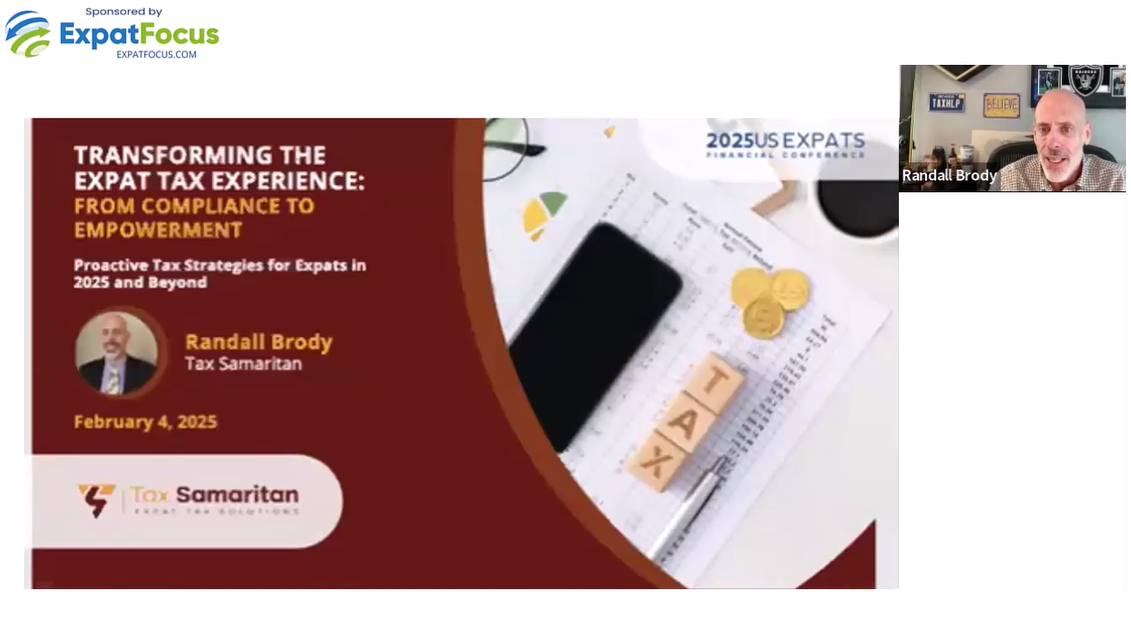
Randall Brody, founder of Tax Samaritan, joined the 2025 US Expats Financial Conference to explore 2025 tax updates, proactive planning, and the innovative Virtual Family Office model to empower expats.
The following transcript was generated by AI and may contain inaccuracies.
Hugo: Good morning, afternoon, evening everyone, depending where you are. We’ll just wait a couple of minutes to give everyone time to join before we get started. Randall, whereabouts are you today?
Randall: I am in Las Vegas, Nevada.
Hugo: Okay. How is it there? Is it winter or warm all year round?
Randall: Winter, but it’s currently unseasonably warm for Las Vegas this week. It is currently 64 degrees, or 18 degrees Celsius, which is very nice compared to your current weather.
Hugo: Yeah, definitely. That does sound nice. Is it sunny as well?
Randall: It is sunny, which is not unusual for Las Vegas. We have not had any rain in well over 200 days.
Hugo: Wow. Is there a time of year when it’s more likely to rain or not particularly?
Randall: This is the time of year.
Hugo: Is that an issue when it doesn’t rain for a long time, or not really? Does it come from somewhere else?
Randall: Not really. We’re a desert, so we get our rainwater from elsewhere. But yeah, it’s been unseasonably dry for our normal season.
Hugo: Yeah, it sounds very nice. In the UK here, I was out this afternoon. Took my dog for a walk and it was a combination of cold, windy, rainy. It was really unpleasant. I think you’re in the right place.
Okay, I think we’ve got lots of people joining. I think it’s slowing down a bit, so let’s just give it a little bit, then we’ll get started. Thanks for taking time to do this. I appreciate it’s tax season and I’m sure things are busy.
Randall: My pleasure. Happy to be here.
Hugo: Okay, let’s get started. I’m sure there are going to be plenty of questions, so the sooner we start, the more time we’ll have after the presentation.
Randall: Absolutely.
Hugo: Alright. Hello everyone and welcome to day one of the 2025 US Expats Financial Conference, sponsored by Expat Focus, the web’s favorite destination for anyone moving or living abroad, and Wise, a leading provider of fast, low-cost international money transfer services and multicurrency accounts for individuals and businesses.
We have a fantastic schedule for you consisting of nine sessions over three days, covering multiple aspects of financial information for Americans living abroad with perspectives from some of the world’s leading experts in their fields.
Today is the first day of the conference, and for this, our third session of the day, I’m delighted to be joined by Randall Brody from Tax Samaritan. We’ll be discussing transforming the expat tax experience from compliance to empowerment. Thank you for joining us, Randall.
Before we start though, please bear in mind that the information presented is for educational purposes only, and you should always seek your own personalized financial advice.
Note also that while the conference is free to attend, if you’d like to leave a tip for the organizers, you can do so using the PayPal link that I’ll drop into the chat window at the foot of the screen.
Randall will be answering your questions at the end, so please add them in the Q and A popup at the foot of your screen throughout. Whenever you think of them, we’ll try to answer them all, time permitting. So without further ado, over to you, Randall.
Randall: Thank you. Greetings everyone. My name is Randall Brody, founder of Tax Samaritan. As I mentioned earlier, I’m based in Las Vegas, Nevada.
With over 30 years of tax and finance experience, I’ve helped over 9,500 taxpayers solve their expat tax problems and collectively eliminate more than $800 million in tax debt.
I’m passionate about travel and a proud father and grandfather who understands the unique challenges of expat life. When I’m not busy saving people money on taxes, my wife and I enjoy rooting for the local Vegas Golden Knights hockey team and Raiders football team, along with our giant dogs: a labradoodle, a Great Dane named Scooby, of course, and a St. Bernard poodle mix.
I also love to snow ski and try to get on the slopes at least once a week during the winter. Although it’s been a horrible winter ski season here in Nevada, today we’re going to explore how we can transform the expat tax experience from compliance to empowerment.
Over the next 35 minutes or so, we’ll discuss strategies to simplify your tax journey, empower your financial decisions, and align them with your broader life goals. So let’s dive in.
Let’s start by setting the stage. Living abroad is about more than changing your address. It’s about pursuing a new way of life.
Whether you’re chasing financial freedom, seeking adventure, or building wealth, your tax strategy should support, not hinder, these aspirations. Today, we’ll focus on turning taxes into a tool for achieving your goals.
So let’s delve deeper into the importance of proactive tax planning for US expats by exploring three key areas. Number one: why US expats need more than compliance.
While fulfilling tax filing obligations is essential, compliance often falls short for US citizens living abroad. The US uniquely imposes taxes on its citizens’ worldwide income regardless of residency.
This global taxation system can lead to complex financial situations, including the risk of double taxation—paying taxes both in the US and in your country of residence.
Beyond the standard income tax return, expats must navigate additional reporting requirements such as the Foreign Bank Account Report, also known as FBAR, and the Foreign Account Tax Compliance Act, also known by the acronym FATCA.
These regulations mandate the disclosure of foreign financial accounts and assets, adding layers of complexity to tax compliance. Relying on compliance without strategic planning can result in missed opportunities for tax optimization.
Proactive tax planning enables you to utilize available exclusions, credits, and deductions effectively, ensuring that your tax strategy aligns with your financial goals and minimizes unnecessary liabilities.
Number two: the evolving landscape of expat taxation. The tax environment for US expats is continually changing, influenced by legislative reforms and international agreements.
Recent discussions have focused on eliminating double taxation for Americans abroad. For instance, proposals have been introduced to allow expats to be taxed only on US source income, potentially alleviating the burden of double taxation. Will that happen? Who knows.
Additionally, changes in international tax treaties and adjustments to exclusions like the foreign earned income exclusion directly impact expats. Staying informed about these developments is crucial as they can offer new opportunities for tax savings or require adjustments to existing strategies.
The increasing complexity of global tax compliance, including heightened enforcement of FATCA regulations, underscores the need for expats to engage in proactive tax planning.
By staying ahead of these changes, you can better manage your tax obligations and capitalize on new benefits. Today’s goal is to empower you to achieve financial freedom through transformative tax strategies.
Our objective today is to move beyond basic compliance and equip you with transformative tax strategies that align with your life goals. By adopting a proactive approach, you can minimize tax liabilities, ensure compliance with evolving regulations, and focus on building wealth and achieving financial freedom.
We’ll explore how tax planning can serve as a tool for empowerment, enabling you to make informed financial decisions that support your aspirations as an expat.
Through strategic planning, you can turn the complexities of the US tax system into opportunities for growth and financial wellbeing. By understanding the necessity of proactive planning, staying informed about the evolving tax landscape, and implementing transformative strategies, you can navigate the complexities of expat taxation with confidence and achieve your financial objectives.
So why do people move abroad? Common reasons include financial freedom, adventure, personal growth, and reducing stress. But these aspirations can be complicated, of course, by the realities of taxes.
For example, understanding foreign earned income exclusions, the foreign tax credit, FBAR, tax treaties, or retirement account implications and more. Proactive planning ensures that your taxes align with these goals rather than creating obstacles. Let’s see how this works in practice and explore the aspirations that often motivate individuals to move abroad and explore how proactive tax and financial planning can support your goals.
Many Americans seek to relocate to countries with lower cost of living, more affordable healthcare and favorable tax environments to achieve financial independence. For instance, destinations like Portugal and Thailand offer expats the opportunity to enjoy a higher quality of life at a reduced cost.
Proactive tax planning plays a crucial role in this pursuit by understanding and leveraging international tax treaties, foreign earned income exclusions and other tax benefits. Expats can minimize their tax liabilities, thereby enhancing their financial freedom.
Number two, embracing adventure and lifestyle changes. The desire for new experiences and cultural immersion drives many to countries like Japan, for example. Individuals have moved to rural Japan to engage deeply with local traditions and crafts, finding fulfillment in these unique experiences.
However, such moves come with financial considerations. Proactive financial planning ensures that expats can manage currency fluctuations, understand local tax obligations, and maintain financial stability while embracing new lifestyles.
Number three, seeking personal growth and opportunities. Personal development and career opportunities are significant motivators for moving abroad. Countries with strong economies and diverse cultures offer environments where individuals can grow personally and professionally.
Strategic tax planning is essential here by understanding the tax implications of foreign employment investments and business operations. Expats can make informed decisions that support their personal and professional growth.
And number four, building wealth and reducing stress, relocating to countries with favorable economic conditions allows individuals to build wealth more effectively. For example, some Americans move abroad to benefit from lower taxes and improved economic opportunities.
Proactive tax planning is vital in this context. By effectively managing tax obligations and utilizing available deductions and credits, expats can reduce financial stress and focus on wealth accumulation.
In summary, while the motivations for moving abroad are diverse, proactive tax and financial planning are fundamental in ensuring that these aspirations are realized. By aligning financial strategies with personal goals, expats can fully embrace the opportunities that living abroad presents.
Traditionally, taxes have been treated as a necessary evil, something you deal with once a year and forget. But what if taxes were part of your transformational journey? What if you could move beyond transactional compliance to create strategies that deliver memorable outcomes like increased savings, peace of mind, and confidence in your financial future?
Imagine how your global lifestyle could be enhanced with a tax strategy tailored to your aspirations. Let’s explore how tax services can evolve from traditional transactional compliance to becoming an integral part of the expat journey.
Historically, tax services have been reactive, focusing on annual tax filing requirements and addressing issues as they arise. This transactional model emphasizes completing necessary forms and ensuring compliance with tax laws, often without considering your broader financial goals or life circumstances, this traditional approach can lead to missed opportunities for tax optimization and may not support your unique aspirations.
In contrast a modern approach to tax services involves proactive planning that aligns with an individual’s life goals. This strategy encompasses personalized tax planning, tailoring tax strategies to fit your specific financial objectives and circumstances.
Continuous engagement, maintaining regular communication throughout the year to adjust plans as life events occur. Holistic financial integration considering all aspects of your financial situation, including investments, retirement planning and estate considerations.
By adopting this proactive stance, tax services become a supportive partner in your journey, helping to navigate complex international tax landscapes and seize opportunities for financial growth.
However, applying the concept of memorable outcomes to tax services means transforming the expat experience from a routine transaction to a meaningful and transformative journey for you as an expat. This can be achieved by delivering value beyond compliance, offering insights and strategies that not only ensure compliance but also enhance your financial wellbeing.
Building trusting relationships, establishing a partnership where you feel understood, supported, and empowered in your financial decisions. Providing educational empowerment, equipping you with the knowledge and tools to make informed decisions, thereby reducing anxiety and fostering confidence.
By evolving tax services in this manner, we create memorable outcomes that resonate with your aspirations leading to greater financial freedom and reduced stress. This transformation aligns tax planning with the broader goals of the individual, making it an integral and enriching part of the expat experience.
In summary, moving from a traditional transactional model to a proactive experience-focused approach in tax services not only ensures compliance, but also actively contributes to you as an expat’s overall life satisfaction, goals and success.
One of the most significant global shifts has been this transition to a subscription economy, transforming industries worldwide. We see this playing out in the tax and financial industry in a transition to a more proactive and strategic approach to planning for expats.
This shift means continuous access to expert tax and financial guidance, not just during tax season, but as an integral part of your long-term financial wellbeing. Imagine having a dedicated advisor who helps you plan for major life decisions, such as moving countries, purchasing property, managing foreign investments, or structuring your retirement in the most tax efficient way possible, not just during tax time.
This ongoing relationship provides financial clarity, strategic advantage, and greater empowerment over your wealth and financial future.
In today’s rapidly evolving global landscape, tax planning is no longer just about compliance, it’s about strategy. The traditional model of tax services created around annual transactional engagements is giving way to a more dynamic, consultative and relationship-focused approach.
So let’s explore how transitioning to a tax advisory model focused on continuous engagement could benefit expats. The shift from transactional interactions to a year-round approach with subscription-based tax advisory services prioritizes long-term tax optimization over simple compliance.
Instead of treating taxes as a once a year obligation, a year-round approach allows expats to minimize tax burdens, proactively anticipate changes in tax laws, residency rules, and treaty benefits to avoid costly mistakes and maximize savings.
Align tax planning with life goals. Whether it’s structuring international investments, selling foreign property, or planning for cross border retirement, a proactive approach ensures financial choices are tax efficient and stay ahead of regulatory changes.
International tax laws evolve constantly. Having an advisor who monitors these changes means avoiding surprises and maintaining compliance effortlessly.
Embracing a year-round tax advisory model offers several benefits for expats. Number one, strategic growth. A forward-looking tax strategy ensures that expats make financially sound decisions, optimize tax efficiency and wealth accumulation.
Number two, financial clarity. By maintaining ongoing conversations with a tax advisor, expats have a clear understanding of their tax obligations and opportunities, avoiding the uncertainty of last-minute tax surprises.
And number three, peace of mind. Knowing that tax planning is taken care of throughout the year allows expats to focus on their careers, families, and global adventures without unnecessary financial stress. This model fosters a truly proactive approach to tax planning, transforming the advisor-client relationship into a long-term financial partnership.
Traditionally, the majority of taxpayers only think about their tax obligations when filing their return, but in a subscription-based advisory model, the proactive planning process is a systematic approach designed to ensure that every aspect of your financial life is thoroughly addressed, guiding you from initial assessment to implementation, ensuring that your financial strategy is comprehensive, tailored, and actionable.
By shifting to an ongoing advisory relationship, tax professionals empower expats to proactively manage their wealth, optimize their tax outcomes, and make smarter financial decisions. Rather than simply reacting to tax filing deadlines, the true power of proactive tax planning lies in its ability to transform financial complexity into financial opportunity.
Rather than viewing taxes as an annual obligation, expats who embrace ongoing advisory services gain an invaluable strategic advantage, one that allows them to minimize taxes, build wealth, and make well-informed financial decisions. This shift from compliance to strategy redefines what it means to be an empowered global citizen in today’s tax landscape.
Now let’s talk a bit about the virtual family office model. This holistic approach combines tax planning with wealth management, estate planning and more. For instance, expats with complex financial portfolios can benefit from coordinated strategies that simplify compliance while achieving strategic growth.
A VFO doesn’t just handle taxes. It supports your entire financial journey, ensuring that all aspects of your finances work together seamlessly.
A virtual family office or VFO brings all aspects of financial planning under one roof, integrating tax planning, wealth management, estate planning, and more. And for expats, this holistic approach is transformative. By coordinating these services, we ensure simplified compliance and uncover opportunities for strategic growth, all while giving you peace of mind.
Let’s break it down. Imagine a system where your tax strategies align seamlessly with your broader financial goals, whether it’s growing your investments or securing your legacy. For example, expats often face complexities in managing multi-country investments or planning for cross border inheritance. A VFO helps navigate these challenges ensuring tax efficiency and long-term success.
A VFO simplifies the often overwhelming task of international tax compliance, minimizing errors and stress. Beyond compliance, it identifies strategies for long-term financial growth, such as leveraging foreign tax credits or strategically using retirement accounts, and most importantly, it provides peace of mind knowing that all financial decisions are interconnected and optimized.
A VFO doesn’t just react to financial issues, it anticipates them. Through proactive planning, expats can mitigate risks, maximize deductions and plan for future goals like early retirement or relocating to another country, for example. By using a VFO’s guidance, expats can better manage currency fluctuations and their impact on long-term financial planning.
In summary, a VFO turns complexity into clarity and challenges into opportunities, aligning every financial decision with your life goals.
Let’s dive into some of the key tax updates for 2025 for expats. First, there are some changes in filing deadlines and standard deductions. The foreign earned income exclusion threshold has increased, which is great news for expats. It’s essential to understand how these changes apply to your situation as they can significantly impact your tax obligations and financial strategies.
Let’s dive into some of the tax updates for 2025 that are particularly relevant for expats. Staying informed about these changes is essential not just for compliance, but also for identifying opportunities to optimize your financial outcomes. Here’s just a little taste of what’s new.
The standard filing deadline remains April 15th, 2025, with an automatic two month extension for US Citizens living abroad, making the deadline June 16th. However, keep in mind that taxes owed are still due by April 15th to avoid interest. If needed, you can request an extension to October 15th by filing form 4868. This flexibility provides additional time to plan and ensure compliance.
The IRS has increased the standard deduction amounts to account for inflation. For single filers, the deduction has increased to $14,600. For married filing jointly filers, it has increased to $29,200, and if your filing status is head of household, it has increased to $21,900. These increases reduce taxable income, which is a straightforward way to lower your overall tax burden.
There are new foreign earned income exclusion thresholds, and the exclusion amount has increased to $126,500 for the tax year 2024. If you qualify through the bonafide residence test or the physical presence test, this allows you to exclude a significant portion of your foreign earned income from US taxation. Obviously this is a key benefit for expats and proper planning can ensure that you take full advantage of it.
As far as the impact of international tax treaties, tax treaties between the US and various countries may further streamline compliance and reduce double taxation risks. These treaties clarify taxing rights, reduce withholding rates for certain income types, and help expats navigate complex cross-border tax obligations.
Another area I want to mention just briefly is the passport revocation rule. By law, the IRS will certify taxpayers with seriously delinquent tax debts to the State Department for specific actions regarding their passports.
Generally, the State Department will not issue passports to taxpayers after receiving their delinquent debt certification from the IRS. The State Department may also deny a taxpayer’s passport application or revoke their current passport. If taxpayers with certified tax debt are overseas, the State Department may issue a limited validity passport, allowing the taxpayer to return directly to the US.
So seriously delinquent tax debts are legally enforceable, unpaid federal tax debt, including assessable penalties and interest that currently total more than $64,000. These are adjusted annually for inflation, and these debts include US individual income tax debts, trust fund recovery penalties, business taxes for which taxpayers are personally liable for, and other civil penalties.
To summarize, under the passport revocation rules, taxpayers with a seriously delinquent tax debt of $64,000 or more, which is adjusted annually for inflation, may have their passports denied, revoked, or otherwise limited.
These changes and others are more than just updates. They’re opportunities to adjust your tax strategy, reduce liabilities, and align your financial plan with your life goals. So let’s turn these updates into actionable benefits.
Let’s look at some real world examples. Let’s look at scenario one. Take Jane, a remote worker living in Portugal. By optimizing her foreign earned income exclusion and leveraging foreign housing deductions to ensure that she qualifies to take the exclusion, she was able to reduce her tax liability completely to zero.
Let’s look at a second scenario, an American entrepreneur, Sarah, who operates a successful consulting firm in Germany. Her business generates an annual net income of $1.2 million. Sarah is concerned about her tax obligations in both Germany and the US, as well as the complexity of managing retirement contributions across two countries.
The tax advisory and virtual family office team collaborates with her German tax advisors to align Sarah’s tax strategies, ensuring compliance and maximizing tax efficiency in both jurisdictions. Tax optimization includes utilization of the US Germany tax Treaty to prevent and minimize double taxation of her income.
Retirement planning includes the establishment of a retirement plan that complies with both US and German regulations, allowing for tax-deferred growth and regular contributions to a US-based IRA and a German pension scheme, balancing benefits from both systems.
Sarah achieves annual tax savings of approximately $50,000 through optimized cross-border tax planning. She builds a robust retirement portfolio benefiting from both US and German systems with ongoing support. Sarah feels secure in her financial decisions knowing she is compliant and optimized in both countries.
In our last scenario, John is a US citizen residing in Singapore. He owns multiple rental properties across Asia, generating a net annual rental income of $300,000 after expenses. He faces challenges in navigating the tax implications of his international real estate investments and seeks to structure his holdings efficiently.
The strategies implemented include entity structure, structuring the creation of an international holding company to own the properties, simplifying management and providing potential tax advantages, the utilization of local entities in each country to manage properties, adhering to regional regulations.
Tax planning includes the application of foreign tax credits to offset US tax liabilities, reducing double taxation, and the strategic use of depreciation and other deductions to lower taxable income. In addition, the development of an estate plan that addresses the complexity of passing international assets to heirs, minimizing potential estate taxes.
As far as results, John reduces his effective tax rate by 15%, saving approximately $45,000 in taxes annually. The new structure streamlines property management and reporting across multiple jurisdictions, and John’s estate plan ensures a smooth transition of assets to his heirs with minimized tax implications.
Looking ahead, think of your tax strategy as a tool for empowerment. Proactive planning not only aligns with your aspirations, but also builds a legacy, whether it’s securing your family’s future, supporting charitable causes, or growing wealth with ongoing advisory partnerships. You could turn taxes into an opportunity rather than an obligation.
Remember, transform your taxes, transform your life.
Thank you for joining me today. As you could see on your screen, download our free guide, the Power of Proactive Planning, secure your financial future by scanning the QR code with your phone or entering the URL that you see on your screen. Let’s make 2025 your best year yet. Now it’s your turn.
Let’s dive into your questions. Feel free to submit them in the Q and A and we’ll tackle as many questions we can over the next few minutes. I’m here to provide clarity and actionable insights for you.
Q&A Session
Hugo: Thank you very much, Randall. That was fantastic. Yeah, let’s just leave that QR code on there for a while. I just tried it. It works well. So I love it when things work. Always good.
So yes to our audience, please do drop any questions you have for Randall. Tax questions, ideally not complex personal questions about your situation. For those, if you have those kind of questions, reach out to Randall directly at [email protected].
But yes, general questions and let’s—I can see some questions already coming in, so let’s dive in. So question about the virtual financial office plan. How would a VFO plan ahead on currency fluctuations?
Randall: That is a very specific question. So I am not a currency planning expert. So we have currency exchange experts that you would be aligned with and you would be connected with and they would handle planning in that type of situation.
Hugo: Yeah. Okay. So somebody says, please explain the exemption of filing an FBAR for retirement funds invested outside the US.
Randall: Exemption. I am not sure what specific exemption.
Hugo: That doesn’t sound right. I was going to say yeah if it’s an individual investment account, whether it’s a retirement account or not, it’s going to be reportable, I think.
Randall: Yeah. There’s not—the only exemption would be regarding IRAs.
Hugo: Which are in the US. Yeah.
Randall: Yeah. If you can clarify your question more specifically, I can perhaps provide you a more clarified answer.
Hugo: Cool. Okay. Here’s a nice one. In your experience, what is the biggest tax mistake that expats make, brackets, other than not using your services?
Randall: Not filing a tax return is the biggest mistake. The US is unique in that it’s a citizenship-based form of taxation. So as a result, many taxpayers feel that if you’re not resident in the country, a US tax return is not required to be filed. So they don’t file a tax return. So that’s a very common misconception and a return is not filed as a result. So that’s what I—that’s what comes to mind as a biggest tax mistake.
Hugo: And I think that’s quite common, isn’t it? Yeah, it’s quite common. Question from Mary. Hey, hi Mary. Mary, we were asking some questions earlier from London, if I remember rightly. Mary says, what’s your take on the potential of the upcoming legislation regarding taxation of Americans abroad?
And actually that’s what we had a session covering some aspects of that earlier. So Randall and I think you mentioned this before, before we were just, before we started the webinar a bit earlier, we touched upon it. So what’s your take on that?
Randall: It’s a very low likelihood of that ever coming to fruition. That any change would come about. It’s very difficult for Congress to agree to anything let alone something that, you know, there’s not a lot of—unfortunately this is not a hot topic or one that’s of a lot of legislative interest.
Hugo: Yeah, it’s tricky, isn’t it? It’s a huge interest to the expat community, but for yeah, for the majority of I guess the politicians, it’s something they may not be fully aware of. Trump obviously made that promise when he was campaigning. Yeah. Whether he’ll, whether it’s possible, whether he’ll be able to follow through, whether it was a—
But yeah, obviously there, there are groups like ACA who we had on earlier who are trying to seize the moment. But I think as you say it’s a tough one.
Randall: It’s been a topic of conversation as long as I’ve been in the tax industry. But yeah.
Hugo: Okay. So somebody asks, how do you report the Kiwi Saver? It’s a New Zealand retirement account to the IRS. That’s quite specific.
Randall: A Kiwi Saver account is declared on the FBAR. Unfortunately, it’s also considered a foreign trust as well, reportable on Form 3520.
Hugo: Okay. So a couple of reporting requirements there. Sorry, some of these are quite convoluted. Let me just double check.
Did you have dual citizen small business clients you advised to plan ahead by keeping their retirement savings in the corporation as retained earnings, who then lost a percentage of those savings in the—yeah, I suppose this was the 2017 tax changes.
Have you—I think this is somebody who has been affected by that and asking if you have other clients in that situation. This person says they’re still paying it off.
Randall: There’s a huge variety of scenarios of clients affected by all kinds of situations.
Hugo: Yeah. Okay. How could a strategy support or help to maintain US state domicile? That’s not clear to me. Is that clear to you?
Randall: Could our strategy support or help to maintain—I’m not sure what the question is.
Hugo: I think that, Robert, that needs a little clarification.
Randall: Definitely. You know what I could say: as far as moving overseas, planning as far as maintaining or changing your state domicile is a critical component of your pre-move planning.
That’s something that should be an important part of your strategy, particularly if you’re moving from a high tax, very restrictive or aggressive state such as California, New York, or Virginia that’s going to be very aggressive and continue to tax you as a resident for a period of years post your move overseas.
Hugo: So the person about the state domicile has clarified. How could the virtual family office strategy help maintain US state domicile? But again, I’m not sure why you’d want to maintain state domicile potentially.
Randall: Yeah. The VFO really doesn’t have anything to do with the tax planning. That’s really your tax advisor directly versus the virtual family office planning.
Hugo: Okay. So there are a few people commenting that they’re having issues with the QR code and the link. Is there something we could paste into the chat? The link? Just seeing if I can grab it.
Randall: It’s qr.co.
Hugo: Ah, it’s QRCO.
Randall: And I will post it into the link as well.
Hugo: Somebody says the URL is case sensitive. Yeah, let’s get that working. Okay. Have we got some more? There are lots of questions about the link.
Have we got some more tax questions? Does foreign pension income count as passive or general income for the foreign tax credit for Form 1116?
Randall: Foreign pension income is generally general income unless there’s a treaty exception. And I’ve pasted the direct link for the guide in the webinar chat.
Hugo: Fantastic. Just to note, Randall’s posted that link. That’s great. Chat is disabled. That doesn’t sound right. Let me just double check.
Randall: I’ll also type it in as an answer.
Hugo: Sorry guys, keep those questions coming. How’s that? Hopefully the link’s showing up in the chat now.
Okay. State pension accounts such as the French Social Security System, are those reported on an FBAR? It sounds like foreign social security. They gave the example of paying into the French Social Security system.
Randall: No. Government pension accounts are not reported on the FBAR unless they’re private pension accounts.
Hugo: Okay. Somebody has a quite specific question, but I think probably it’s a situation that’s quite common. There’s a freelancer residing in Croatia and a tax resident in Croatia, but earning US sourced income only, sent to a US checking account.
They said, “I understand I do not qualify for the foreign earned income exclusion, so I’d have to pay income taxes both in Croatia and the US.” Does that sound right, or should they be able, as a resident in Croatia, to claim the foreign earned income exclusion?
Randall: If you’re physically performing the work in Croatia, it’s still considered foreign earned income, so long as you meet the other qualification criteria for the foreign earned income exclusion.
It doesn’t matter that you’re being paid by a US employer or it’s being paid into a US checking account. All that matters is that you’re physically performing the work within a foreign country.
So as long as you qualify under the physical presence test or the qualified residence test, you would qualify for the foreign earned income exclusion. Likewise, you would also potentially qualify for the foreign tax credit if you’re paying taxes to Croatia on that income.
Hugo: Fantastic. Thank you.
Randall: Oh you perform your work only in the US? So then you wouldn’t—if you’re performing that work only in the US, then yeah, certainly you would not qualify to claim the exclusion or the foreign tax credit on that income.
Hugo: But it also said fully residing in Croatia. So even if the company and the work is in the US, if you are in Croatia, is it right to say you can still claim it?
You said, “I’m fully residing in Croatia, but I perform my work in the US.” So I’m not sure there’s a bit of a contradiction there, but it depends where the person is, doesn’t it?
Randall: Yeah. It depends on where you’re physically performing the work.
Hugo: Got it. Randall, thank you very much for the presentation and for taking the time mid tax season to join us. In terms of the conference, that’s it for today.
Tomorrow we have three more sessions on financial planning, investing, and another tax seminar. So please do join us for those if you haven’t already registered at usexpatconference.com.
If you have questions for Randall about your situation, email him at [email protected]. The download link for the guide is taxsamaritan.com/proactiveplanning.
So I’ll just say that again: it’s taxsamaritan.com/proactiveplanning. And with that, it just remains to say thank you to Randall and thank you to everyone for joining us. Have a good rest of your day.