
by Nathalie Goldstein, EA, CEO and co-founder of MyExpatTaxes
Living abroad doesn’t pause your US tax obligations. Even if your only bank accounts and salary are overseas, the IRS still considers your income taxable. Each year brings changes to thresholds, reporting rules, and planning opportunities, and 2026 is no exception. Staying on top of the rules requires proactive awareness.
The good news is that with the right information and the right tools, staying compliant doesn’t have to be overwhelming.
In this article, we highlight the most important US tax considerations for Americans living abroad in 2026, covering income taxes, reporting requirements, credits, and planning pitfalls that often catch expats by surprise.
The US Tax System Remains Citizenship-Based
Unlike most countries, the US taxes based on citizenship rather than residency. If you hold US citizenship or a green card, filing a tax return is mandatory wherever you live if your income exceeds filing thresholds. These thresholds rise slightly each year with inflation, but your obligations never disappear entirely.
Expats must report their worldwide income every year, including foreign salaries, self-employment income, pensions, and investment earnings. This is one of the most common areas where Americans abroad get caught off guard. Even if you pay taxes abroad, filing comes first, with credits and exclusions calculated afterward. Ignoring this can lead to IRS penalties, even if you technically owe no US tax.
For 2025 tax returns (filed in 2026), the standard deduction (the minimum income amount before you need to file) is $15,750 for single filers, $31,500 for married filing jointly, and $23,625 for heads of household. However, you also have to file if you have just $400 of self-employment income, or if you’re married filing separately (e.g., to a non-US taxpayer), if you have just $50 of any income.
It’s important to remember, living abroad doesn’t automatically remove your filing obligations. Missing deadlines or filings can snowball into penalties that grow over time.
The Foreign Earned Income Exclusion increases annually. The Foreign Earned Income Exclusion allows qualifying expats to exclude a portion of earned income from US taxation, reducing their overall liability. For the 2025 tax year (returns filed in 2026), the exclusion limit is $130,000 per qualifying taxpayer.
To qualify, you must meet one of two tests:
- Physical presence test – spend 330 full days outside the US within a 12-month period.
- Bona fide residence test – establish residency in a foreign country for a full tax year.
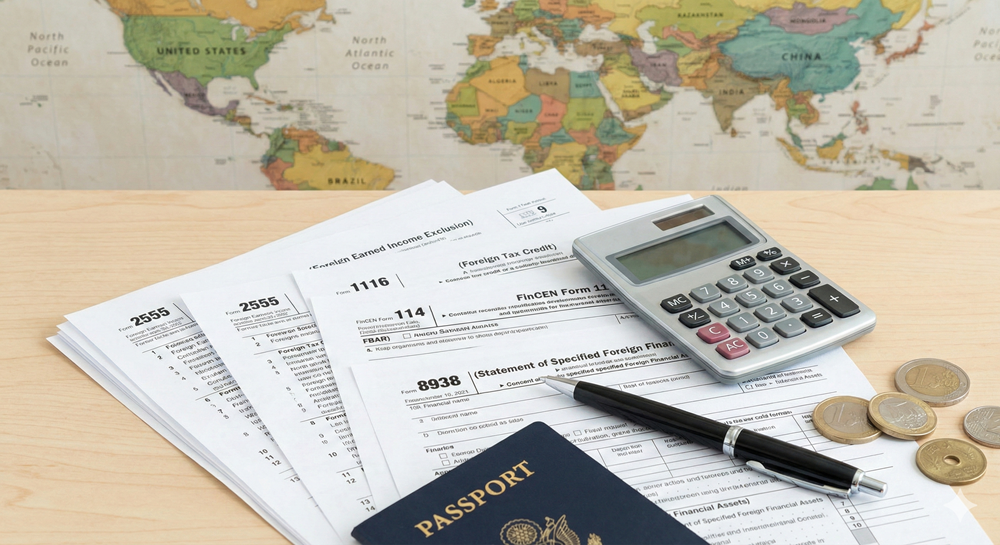
You claim this exclusion using IRS Form 2555, which you should file with your federal tax return.
The Foreign Earned Income Exclusion applies only to earned income, not investment or rental income. Housing exclusions are still available, though limits vary by city. Self-employed Americans remain responsible for US self-employment tax on excluded income, however they can alleviate this tax burden with an applicable Totalization Treaty, if eligible.
Many expats rely heavily on the Foreign Earned Income Exclusion without considering foreign tax credits, which can sometimes provide better long-term results. Deciding which strategy to use depends on income level, the host country’s tax rates, and your overall financial plans.
Foreign Tax Credits: A Key Strategy for Higher Earners and Families Abroad
For Americans who pay high taxes overseas, foreign tax credits can often outweigh the benefits of the Foreign Earned Income Exclusion. These credits allow you to reduce US tax using income taxes already paid abroad.
Countries with high tax rates, such as the UK, Germany, Canada, and Australia, make this approach particularly valuable. Credits not used within one year can be carried forward for up to ten years, providing greater flexibility. By choosing the Foreign Tax Credit instead of excluding income under the Foreign Earned Income Exclusion, your foreign earnings remain included on your US tax return. This means you are still treated as having taxable compensation, which helps preserve eligibility for Roth IRA contributions and avoids complications that can arise when income is excluded for purposes of US tax calculations, including those related to Social Security benefits.
Applying these credits correctly requires careful categorization. Passive income, general income, and treaty-sourced income each follow separate rules, and mistakes often lead to avoidable US tax. Families should also note that if you claim the Foreign Tax Credit rather than the Foreign Earned Income Exclusion, you can also claim the refundable Child Tax Credit. Choosing the right strategy here can make a meaningful difference in your overall US tax outcome, resulting in a potential refund.
FBAR and FATCA Reporting Risks Increase Each Year
Financial reporting remains the area where most Americans abroad face penalties. The rules themselves haven’t changed, but enforcement pressure continues to increase.
You must report any foreign accounts if balances exceed certain thresholds. FinCEN Form 114, known as the Foreign Bank Account Report (FBAR), is filed separately with the Treasury Department when your combined foreign accounts exceed $10,000 at any point during the year.
Some account types that often trigger reporting include:
- Bank accounts, savings, and checking accounts.
- Foreign investment accounts, pensions, and retirement accounts.
- Certain insurance products or managed investment platforms.
Separately, you’ll also have to file IRS Form 8938, Statement of Specified Foreign Financial Assets, if your foreign assets surpass the applicable reporting threshold. The Form 8938 filing requirement doesn’t replace your FBAR duty, but it often applies alongside it.
Penalties apply even if your income is fully taxed abroad. Many expats are surprised to learn that “small” accounts still count, especially when multiple accounts push them over reporting thresholds without them realizing it.
Self-Employment and Digital Nomads Have Unique Tax Considerations
Remote work and freelancing continue to grow among Americans abroad, but the tax rules remain strict. Self-employment tax applies even for expats unless a Totalization Agreement with their host country provides relief.
Totalization Agreements can help prevent double Social Security taxation, but they aren’t universal. Digital nomads should carefully track both their income and travel days to minimize surprises when filing.
Operating a business overseas doesn’t remove US filing obligations. The risk of a permanent establishment increases the longer you stay in one country. Owning a foreign corporation or partnership introduces complex reporting requirements, and this is one of the fastest ways expats can accidentally trigger large penalties when forms like Form 5471 or Form 8865 are missed.
How US Expats Should Think About Retirement Accounts and Pensions
Retirement planning for expats remains one of the trickiest areas. US-based accounts, such as 401(k)s and IRAs, are generally taxed only when distributed, and required minimum distributions still apply at the standard ages. Roth accounts maintain US tax-free treatment, though foreign rules may differ.
Foreign pensions can be more complicated. Tax treatment depends on treaty language, contributions may not qualify for deductions, and growth might remain taxable in the US annually. This is an area where many expats are often surprised later on, especially when foreign pension rules don’t align with US tax treatment. Planning ahead avoids unwelcome surprises near retirement.
Investment Income and Foreign Funds: Common Pitfalls for US Expats
Foreign investment products often trigger significant US tax obligations. Passive foreign investment companies (PFICs), including certain mutual funds, ETFs, and insurance-based investment products, remain among the most challenging investments for expats.
PFIC rules can eliminate capital gains advantages and introduce complex reporting requirements. Many expats find maintaining US-based investments simpler and less costly. Capital gains planning is critical, as selling assets abroad may still trigger US tax even when foreign rules do not. This is an area where choosing the right investment strategy early can help US expats avoid unnecessary complexity and unexpected US tax exposure.
Many Expats Overlook State Taxes
Leaving the US doesn’t automatically end state tax residency, a costly misconception that catches many expats years after they move abroad.
States such as California, New York, Virginia, and South Carolina often aggressively pursue former residents.
Residency rules consider more than where you live. Voter registration, driver’s licenses, property ownership, and family ties can all trigger audits. Passive assumptions about leaving a state can leave you exposed to unexpected tax bills.
Breaking state residency requires deliberate action and clear documentation. Although you are not required to give up your voter registration or driver’s license, it is generally advisable to file state tax returns when you leave the state, as well as a few years after to help document your change in residency. Keep in mind that even if you no longer live in the state, you may still be required to file a state return if you have state-sourced income, such as rental income or income earned during a business trip to that state.
Options for Expats Who Need to Get Back on Track
Many Americans only realize they have US filing obligations after several years of living abroad, often due to a misunderstanding of the rules rather than intentional non-compliance. The IRS offers programs like the Streamlined Filing Compliance Procedures to help eligible expats catch up and get back on track without being penalized.
Under this program, qualifying expats can catch up by filing three years of tax returns and six years of FBARs, along with a certification that their prior non-compliance was non-willful. For many Americans living abroad, streamlined filing provides a practical way to resolve past issues and move forward with confidence. Taking action sooner rather than later is crucial, as eligibility may be lost if the IRS contacts you first. Addressing this issue early can also help reduce stress, as international information sharing continues to expand.
Planning Ahead Reduces Stress and US Tax Exposure
Expat tax planning is most effective when done proactively. Tracking travel days, reviewing account balances, and coordinating foreign and US filings throughout the year reduces mistakes and stress.
Practical steps for 2026 include:
- Track travel days carefully to document qualification for the Foreign Earned Income Exclusion.
- Monitor foreign account balances monthly to avoid FBAR and FATCA issues.
- Coordinate foreign and US filings strategically, especially when foreign tax credits may apply.
Managing US taxes while living abroad starts with planning ahead and staying organized. For Americans living overseas, understanding the rules early helps avoid surprises and keeps compliance manageable. Even with complex regulations, the right approach can turn US tax filing into a routine, stress-free process.
Nathalie Goldstein, EA is CEO and co-founder MyExpatTaxes, helping Americans abroad stay compliant and optimized with user-friendly US expat tax software.